Wood carving with a rotary tool is one of those jobs where a few millimeters of control can separate a clean groove from a gouge you spend the next twenty minutes trying to hide.
The motor matters, but so do the shape of the tool, the speed range, the way bits are held, and how much vibration reaches your fingertips. A powerful tool that feels clumsy can be less useful for carving than a slightly less aggressive one that lets you guide a burr exactly where you want it.
That is why I would not choose the best Dremel tool for wood carving by accessory count alone. A box with a hundred pieces can look generous, yet many of those pieces may never touch wood. For carving, I care more about controllable speed, a secure collet or chuck, comfortable handling, access to useful carving burrs, and whether the tool can stay steady through longer shaping sessions.
The ten tools below range from familiar Dremel kits to cordless, flex-shaft, precision, and budget-friendly rotary systems. They do not all suit the same kind of carving.
Some make sense for relief work and hobby projects, some are better for fine detail, and one is built much more like a dedicated power-carving station than a handheld rotary tool. The right choice depends on how you carve, what wood you use, and how much control you want at the bit.
What Makes a Rotary Tool Work Well for Wood Carving
A rotary tool removes material by spinning a cutter, burr, sanding drum, abrasive point, or similar accessory at high speed. That sounds simple, but wood reacts differently depending on grain direction, density, bit shape, pressure, and rotational speed. A coarse burr can remove material quickly in basswood, while the same approach can chatter, burn, or tear fibers if you push it carelessly into harder wood.
For that reason, carving is less about running the tool at its highest setting and more about balancing speed with control. A broad shaping burr needs enough speed to cut cleanly, but tiny detail work often benefits from slowing down so you can see what the bit is doing. If you feel as though the tool is pulling your hand instead of following it, the setup is too aggressive for that stage of the carving.
Variable speed gives you room to change technique
A wide speed range is useful because carving rarely stays at one level of aggression. Rough shaping may call for a faster setting and a larger cutter. Fine channels, lettering, small contours, and sanding around delicate edges usually need a gentler approach.
The Dremel 4300 and 4000 both run from 5,000 to 35,000 RPM, while the Dremel 3000 also offers six settings across that same published range. Milwaukee’s M12 rotary tool runs from 5,000 to 32,000 RPM. WEN reaches 35,000 RPM but starts at 8,000 RPM, and the Proxxon IBS/E tops out at 20,000 RPM. Those numbers do not automatically rank one tool above another. They simply tell you how much room you have to tune the tool to the bit and the wood.
I know it is tempting to assume that the highest RPM number equals the strongest carving tool. It does not. Foredom’s K.5240, for example, runs its SR motor up to 18,000 RPM, yet it is designed around a flexible shaft, foot control, substantial motor, and a handpiece that accepts larger shank accessories. Its character is very different from a tiny high-speed craft tool.
The grip matters more after the first ten minutes
A rotary tool can feel comfortable when you pick it up in a store and tiring once you start cutting a recessed background around a carving. Body diameter, balance, surface texture, and where the power cord or battery sits all influence control.
For close detail, many carvers prefer a pencil-like grip or a flex shaft because it moves motor weight away from the hand. Dremel tools can accept optional flex-shaft attachments, WEN includes one with the 23190 kit, GOXAWEE and PHALANX bundle flex shafts, and Foredom is built around a flexible-shaft system from the start.
A flex shaft does not automatically make your work better. It needs to be routed without tight bends, and the handpiece still has to suit the burr you want to use. Still, if your main goal is detailed relief carving rather than occasional sanding and cutting, reducing the mass in your hand can be a meaningful advantage.
Bit holding affects both convenience and accuracy
Rotary tools generally use collets, chucks, or a combination of the two. A collet grips a specific range of shank sizes and can provide a simple, concentric hold when matched correctly. A keyless chuck is more convenient when you change between different shank sizes frequently.
The Dremel 4300 stands out because its included keyless chuck accepts Dremel accessory shank sizes without requiring a collet swap. GOXAWEE also uses a three-jaw keyless chuck in its 140-piece kit.
By contrast, the Proxxon IBS/E leans deliberately toward precision collets and includes six sizes. Foredom’s H.44T handpiece includes 3/32-inch, 1/8-inch, and 1/4-inch collets, which opens the door to larger woodcarving accessories than a typical small rotary tool can accept.
The detail I would pay closest attention to is not simply whether a chuck is “universal.” Check the actual shank diameter of the burrs you plan to use. A tool can be excellent and still be the wrong fit if your preferred carving cutters do not match its collet or chuck system.
Accessory count and carving usefulness are not the same thing
Large kits often mix cutting wheels, polishing pads, sanding bands, drill bits, wire brushes, grinding stones, and a small number of carving cutters. That is useful if you want one tool for many DIY jobs, but a wood carver should look at the actual carving and sanding pieces rather than the headline count.
The Dremel 4300-5/40 includes 40 accessories and five attachments. The WEN 23190 includes 190 pieces. GOXAWEE lists 140 pieces, PHALANX 139, and HARDELL 69. Those totals make the kits flexible, but they do not mean the 190-piece kit gives you more serious carving capability than Foredom’s smaller purpose-built assortment.
A good approach is to treat included accessories as a starting point. Once you know whether you prefer fine engraving cutters, carbide burrs, small sanding drums, or larger shaping tools, buy better versions of the accessories you actually use.
Wood hardness changes what feels powerful enough
Basswood, butternut, pine, and similar woods can be forgiving with modest rotary tools. Dense hardwoods ask more from the motor and from the operator. If you press too hard because the cutter is removing material slowly, the bit can heat, the wood can burn, and the tool can wander.
For frequent hardwood shaping, sustained power and good accessory support matter more than having a miniature cordless body. For tiny craft details, resin pieces, model work, or light engraving, a small cordless tool can be pleasant because it is easy to control and has no cord pulling at the back of your hand.
That is the central trade-off in this list. There is no single body size, motor type, or speed range that is automatically right for every carving style.
| Product Image | Product Name | Features | Price |
|---|---|---|---|
 |
Dremel 4300-5/40 High Performance Rotary Tool | 40 Dremel accessories. 5,000 – 35,000 RPM. Universal 3-JAW chuck. High quality accessories. |
Check Price |
 |
Dremel 4000-2/32 Variable Speed Rotary Tool | High performance motor. 360-degree grip zone. Create wooden bowls, trays, and other DIY crafts. |
Check Price |
 |
Dremel 3000-2/28 Variable Speed Rotary Tool | Lightweight. 1.2 AMP motor. 5,000 – 35,000 RPM. Adjustable settings from slow to fast. |
Check Price |
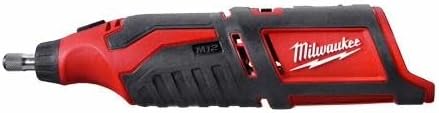 |
Milwaukee 2460-20 M12 ROTARY TOOL ONLY | High-quality tool. Easy to use. Bigger M12 battery. |
Check Price |
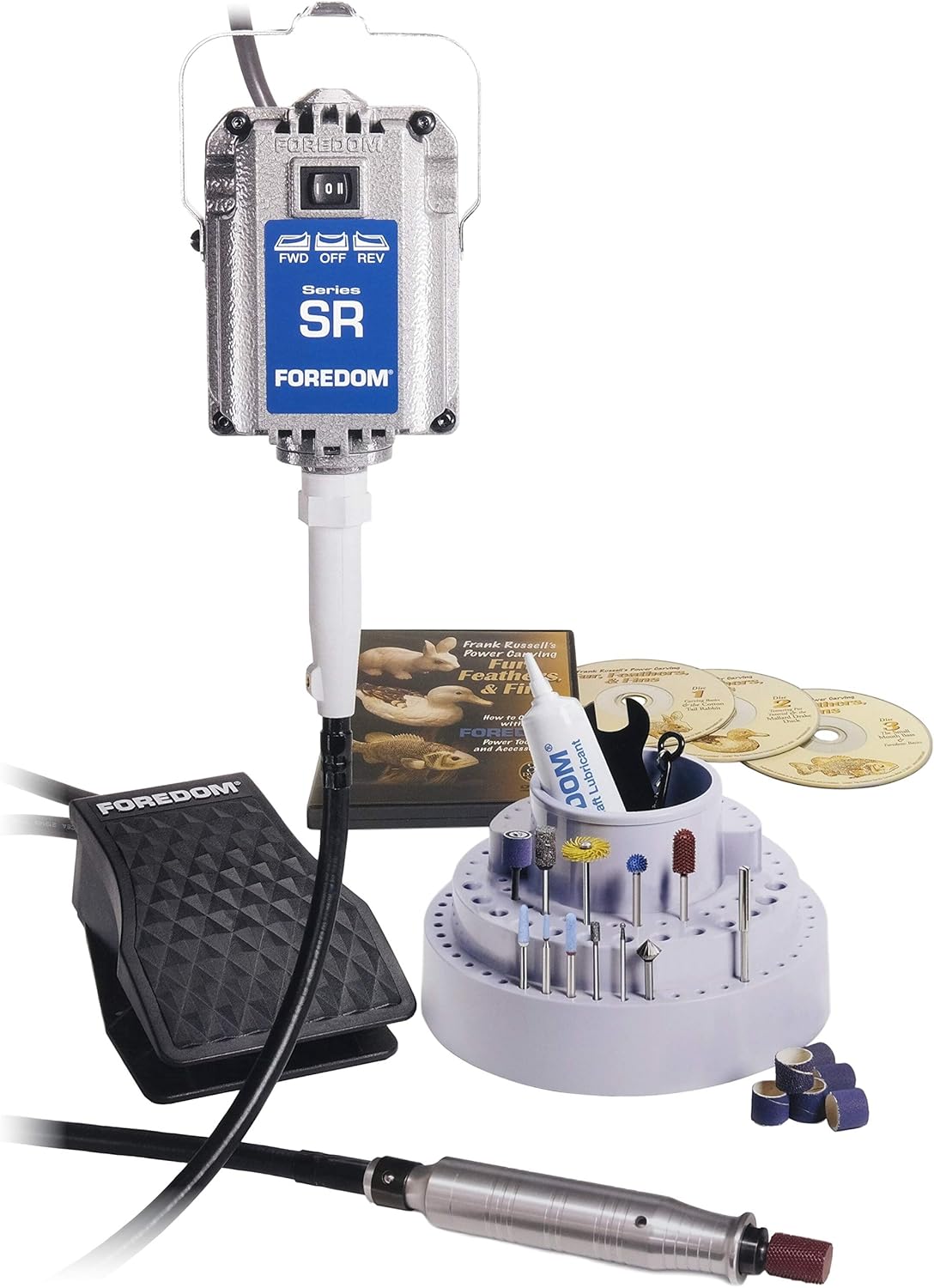 |
Foredom K.5240 Woodcarving Kit, 115v | Speed control. Handpiece and accessories. C.FCT speed control. |
Check Price |
 |
PROXXON Professional Rotary Tool IBS/E, 38481 |
Aluminum die-cast head. Ground steel spindle. 34 industrial quality bits. 5,000 to 20,000 RPM |
Check Price |
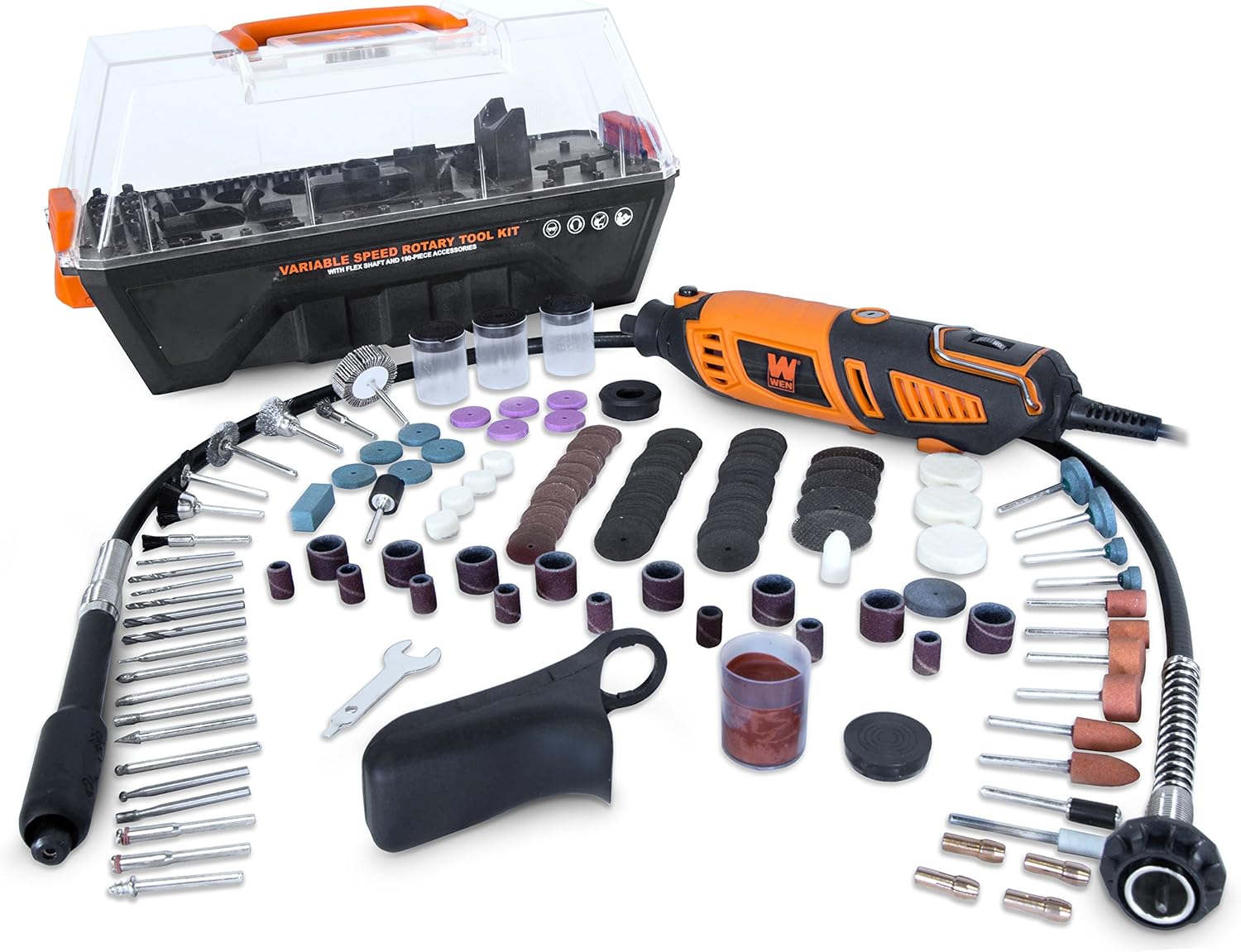 |
WEN 23190 1.3-Amp Rotary Tool | 190 accessories. 1.3AMP Speed motor. 8,000 to 35,000 RPM. Lightweight. Steady-grip handle. |
Check Price |
 |
GOXAWEE Rotary Tool | 140pcs Accessories. 8,000 to 30,000 RPM. Diamond cutting wheel. Carbon brush, |
Check Price |
 |
180W Rotary Tool Kit | 8000-32000 RPM. 6 Speed adjustments. Easy to use. 139pcs Accessories. |
Check Price |
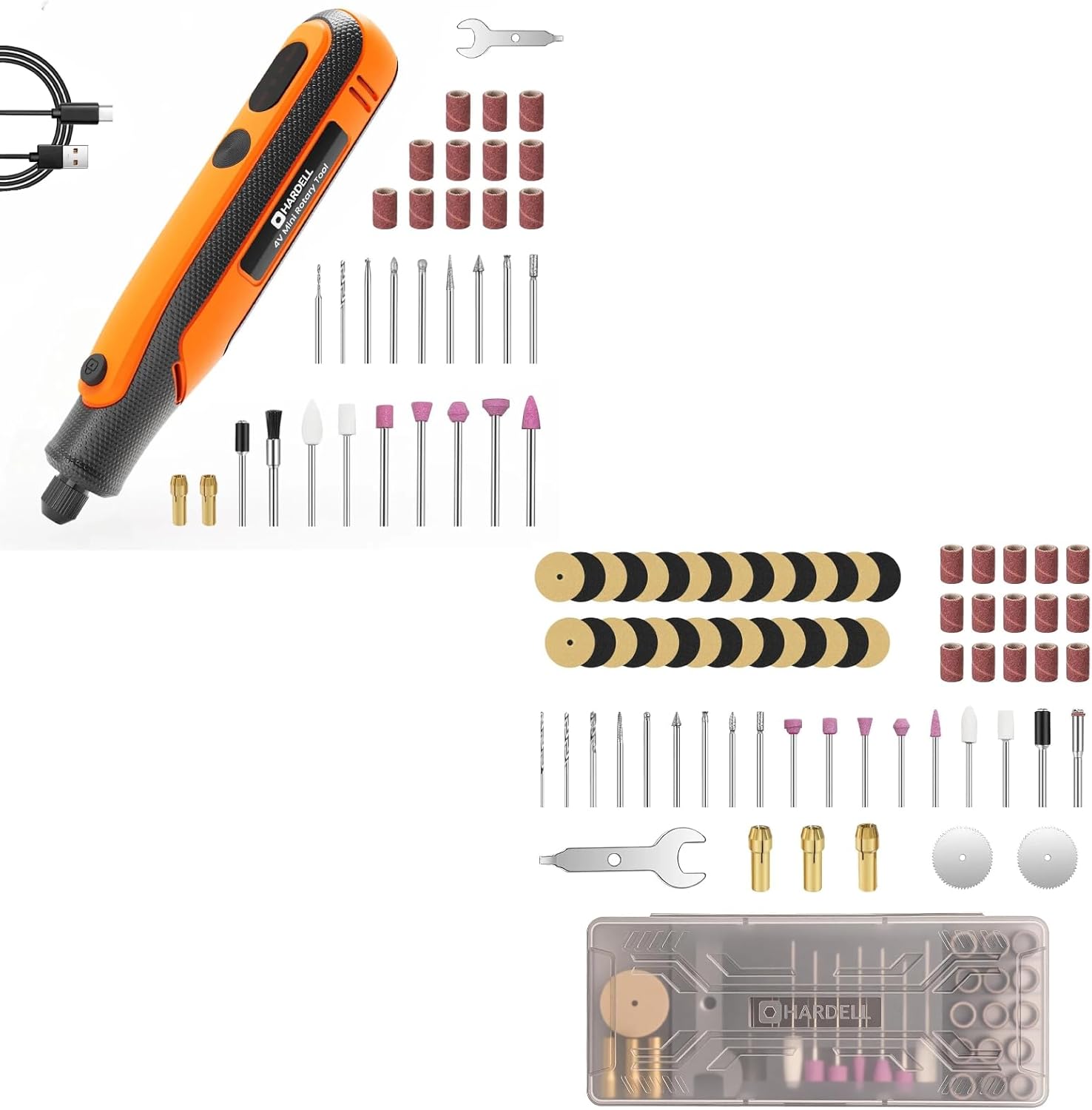 |
HARDELL Mini Cordless Rotary Tool | 69pcs Accessories. Type-C charging. High-quality materials. Waterproof design |
Check Price |
What to Check Before You Choose Your Rotary Tool
The easiest buying mistake is to compare tools by one headline number. A better decision comes from looking at the complete carving setup: motor, speed control, hand feel, bit compatibility, runtime, attachments, and the kind of material removal you expect.
Decide whether you need a handheld motor or a remote motor
Most tools here place the motor in the body you hold. That keeps the setup simple and portable. Foredom is different: the motor hangs separately and drives the handpiece through a flexible shaft. That arrangement takes more workspace, but it removes most of the motor mass from your hand and gives you foot-controlled speed.
If your projects are occasional signs, ornaments, spoon details, or small furniture accents, a conventional rotary tool is easier to store and set up. If you spend long sessions power carving and want larger burr options, the Foredom layout deserves serious consideration.
Think about power source before you think about portability
Corded tools give you uninterrupted operation as long as you have an outlet. They also avoid the weight, cost, and runtime limits of a battery. Dremel 4300, 4000, and 3000, Foredom, Proxxon, WEN, GOXAWEE, and PHALANX are all built around corded operation in the versions discussed here.
Milwaukee 2460-20 and the HARDELL mini tool are cordless. Milwaukee makes the most sense if you already own M12 batteries because the 2460-20 is sold as a bare tool. HARDELL is much smaller and aimed at fine craft work rather than sustained heavy carving.
Cordless freedom is useful when you move around a large piece, work outside, or do quick touch-ups away from a bench. For a long carving session at one table, a cord is often less inconvenient than stopping because the battery is empty.
Match the lowest usable speed to your detail work
Lower speed helps when you want to control heat, work near fragile edges, or use accessories that have their own RPM limits. Dremel 4300 and 4000, Milwaukee 2460-20, and Proxxon IBS/E all start at 5,000 RPM. WEN starts at 8,000 RPM, GOXAWEE at about 8,000 RPM, and PHALANX also starts at 8,000 RPM.
HARDELL’s current 69-piece mini model offers five steps beginning at 5,000 RPM and ending at 18,000 RPM. That is a useful spread for light detail work, but the manufacturer explicitly positions it away from heavy-duty projects.
Do not ignore cooling and dust
Wood carving creates fine dust, and high-speed cutters can generate heat. Keep the tool’s ventilation openings clear and do not cover them with your hand. Let the bit cut rather than forcing it. If the body becomes unusually hot, stop and check whether the vents are clogged or the accessory is being overloaded.
Dust control matters too. A shop vacuum positioned close to the cut, combined with respiratory protection appropriate to the wood and dust level, makes the work cleaner and easier to see. Some exotic woods can be particularly irritating, so the material itself should influence your protection choices.
Plan for the bits you will buy later
Starter accessories eventually wear out. Before choosing a tool, check whether you can easily buy compatible collets, sanding drums, mandrels, carving cutters, burrs, and replacement accessories. Dremel has a broad attachment ecosystem. Milwaukee uses common rotary accessory shank sizes. WEN supports a range from 1/32 inch to 1/8 inch through its collets. Proxxon includes six precision collets. Foredom’s H.44T reaches up to 1/4-inch shanks.
If you already own carving burrs, measure their shanks before buying anything. That one check can save you from purchasing a tool that looks ideal on paper but cannot hold the accessories you actually want to use.
Dremel 4300-5/40 High Performance Rotary Tool – Strong All-Round Control for Serious Hobby Carving
The Dremel 4300-5/40 is the most fully equipped Dremel kit in this group. Dremel specifies a 1.8-amp corded motor, variable speed from 5,000 to 35,000 RPM, electronic feedback, a pivoting LED work light, and a keyless chuck. The kit includes five attachments and 40 accessories.
For wood carving, the useful part is the combination of power and control. A 35,000-RPM ceiling gives you plenty of speed for small cutters and sanding drums, while the 5,000-RPM lower end gives you more restraint for careful detail work. Electronic feedback is designed to help the tool maintain performance under load, which is useful when the cutter moves from a light pass into denser grain.
The keyless chuck is another practical advantage. Instead of changing collets every time a different Dremel accessory shank appears, you can change accessories more quickly. That matters during a carving where you may rough out with one cutter, move to a smaller engraving bit, then finish with a sanding accessory.
Features that matter in actual carving
The pivot light can sound like a minor extra, but shadows become annoying when you are cutting inside a recess or following a penciled pattern. Being able to aim light toward the working area can make it easier to judge depth and edge quality.
The 360-degree grip zone also helps because you do not hold a rotary tool the same way for every cut. Rough shaping often feels natural with a fuller palm grip, while fine detailing may push your fingers closer to the nose. The 4300’s shape gives you more freedom to reposition your hand without landing on an awkward hard edge.
Dremel says the 4300 is compatible with its rotary attachments. That gives it room to grow if you later add a flex shaft, detailer’s grip, routing attachment, or other supported accessory. For someone building one flexible DIY station rather than buying a carving-only machine, that ecosystem is valuable.
- The 1.8-amp motor and 5,000-35,000 RPM range give it enough headroom for both fine work and stronger material removal.
- The keyless chuck makes frequent bit changes much less fussy during multi-stage carving.
- The pivoting LED helps illuminate recesses and small details that are easy to lose in shadow.
- Its broad Dremel attachment compatibility gives the tool more long-term flexibility than a basic fixed-format rotary kit.
- The full-size corded body is still heavier in the hand than a flex-shaft handpiece or mini cordless tool.
- The kit is versatile, but serious carvers may still want dedicated carbide burrs or a flex shaft beyond the included pieces.
Who It’s Best For
This is a strong fit for hobby woodworkers who want one premium corded rotary tool for carving plus sanding, grinding, cutting, and other workshop jobs. It also makes sense if you expect to add Dremel attachments as your projects become more detailed.
Not Ideal For
It is less attractive if you mainly carve for hours at a bench and want the lightest possible handpiece. In that situation, a dedicated flex-shaft system such as the Foredom layout may feel more natural.
Dremel 4000-2/32 Variable Speed Rotary Tool – A Balanced Corded Choice for Frequent DIY Carving
The Dremel 4000-2/32 sits slightly below the 4300 in motor output but keeps many of the features that matter for carving. Dremel lists a 1.6-amp motor, 5,000 to 35,000 RPM variable speed, electronic feedback, a 360-degree grip zone, and compatibility with Dremel rotary attachments. The current 2/32 kit includes 32 accessories plus the A576 sanding/grinding guide and 565 multipurpose cutting guide.
For many woodworkers, that is enough. You still get the same broad published speed range as the 4300, and electronic feedback helps the tool remain consistent as load changes. The difference is that you do not get the 4300’s built-in pivot light or included keyless-chuck emphasis in the same way.
Features that matter in actual carving
The 4000’s separate on/off switch and variable-speed control are useful because you can stop the tool without losing your chosen speed setting. That is a small workflow detail, but it becomes convenient when you repeatedly pause to inspect a carving, brush away dust, or change your hand position.
Its 360-degree soft grip gives you several comfortable holding angles. For carving a shallow relief or rounding an edge, you may hold the body farther back. For fine work, you can move closer to the front while still having a grippy surface.
The EZ Twist nose cap stores a wrench function in the tool’s nose cap, simplifying conventional collet accessory changes. It is not as effortless as a true keyless chuck, but it removes one small loose tool from the bench.
- The 1.6-amp motor provides substantial corded power without making the tool a specialized carving-only purchase.
- Its 5,000-35,000 RPM range covers delicate control, general carving, sanding, and faster shaping work.
- Electronic feedback helps the motor respond more consistently as the cutter meets resistance.
- The Dremel attachment system gives you a clear upgrade path for a flex shaft or other precision-oriented attachments.
- It lacks the integrated pivot light that makes the 4300 convenient in shadowed detail areas.
- Frequent accessory changes are a little more involved than on the 4300’s keyless-chuck setup.
Who It’s Best For
The 4000-2/32 suits woodworkers who want a capable, durable corded rotary tool and do not need every premium feature of the 4300. It is especially sensible for mixed DIY use where carving is important but not the only job the tool will do.
Not Ideal For
It is not the best match if cordless freedom is essential or if you want a purpose-built handpiece for long power-carving sessions. Those needs point more toward Milwaukee or Foredom respectively.
Dremel 3000-2/28 Variable Speed Rotary Tool – A Friendlier Starting Point for Light Carving
The Dremel 3000-2/28 is the lighter-duty Dremel option in this list. Dremel specifies a 1.2-amp motor, six variable-speed settings from 5,000 to 35,000 RPM, 28 accessories, and two attachments: the A576 sanding/grinding guide and 565 multipurpose cutting guide.
That combination is appealing for beginners because the tool can cover carving, sanding, polishing, sharpening, and light cutting without requiring an expensive first purchase. It has enough speed range to teach you how different bits behave, yet the motor is less ambitious than the 4000 or 4300.
Features that matter in actual carving
The 3000 includes Dremel’s EZ Twist nose cap, which makes accessory changes simpler than working with a separate wrench every time. It also uses a ventilated body designed to reduce heat buildup during operation.
The six-speed approach is straightforward for a new user. Instead of chasing tiny dial changes, you can move between clearly separated settings and learn what works on basswood, pine, hardwood edges, sanding drums, and small engraving cutters.
I would treat the included accessory kit as practice material rather than the final word on carving bits. Once you know which shapes you use most, adding a few good carving cutters will improve the experience more than collecting another large general-purpose accessory box.
- The 5,000-35,000 RPM range gives beginners plenty of room to learn speed control without locking them into one pace.
- Its 1.2-amp motor is adequate for light and moderate hobby carving while keeping the tool approachable.
- The kit includes useful guides and enough accessories to start experimenting immediately.
- The EZ Twist nose cap simplifies routine accessory changes at the bench.
- It has less motor reserve than the Dremel 4000 and 4300 for frequent aggressive carving in dense wood.
- The full-size tool body can still feel bulky for very fine detail compared with a flex-shaft handpiece.
Who It’s Best For
This is a sensible starting tool for hobbyists carving ornaments, signs, small decorative panels, craft pieces, and softwood projects. It also suits someone who wants a recognizable accessory system without paying for the strongest Dremel model immediately.
Not Ideal For
It is less suitable for a carver who expects to remove a lot of hardwood quickly or run demanding burrs for long periods. A more powerful Dremel or a Foredom system gives you more headroom for that style of work.
Milwaukee 2460-20 M12 Rotary Tool – Cordless Freedom for Carvers Already Using M12
Milwaukee’s 2460-20 is a 12-volt cordless rotary tool built around the M12 battery system. Current product information lists a variable-speed range of 5,000 to 32,000 RPM, an included 1/8-inch collet, compatibility with standard rotary accessory shanks from 1/32 inch to 1/8 inch when the appropriate collet is used, and a compact body around 1.3 pounds. This tool-only version does not include a battery or charger.
For carving, the main appeal is freedom from a power cord. That can be genuinely useful on larger pieces where you move around the work instead of sitting in one position. It also makes quick outdoor carving, cleanup, and touch-up work easier.
Features that matter in actual carving
The variable-speed dial gives you a broad range similar to the corded Dremel tools, though the upper limit is 32,000 RPM rather than 35,000. Milwaukee also uses grinder-style exhaust ports and front-bearing protection as durability features.
The 1/8-inch collet works with a huge number of common rotary accessories, and optional smaller collets extend the range. If you already own standard 1/8-inch carving burrs, sanding drums, and mandrels, compatibility is straightforward.
Battery ownership changes the value equation. If your workshop already runs on M12, this tool can slide into the system without another charger taking up space. If you own no M12 batteries, the bare-tool price is only part of the real setup cost.
- Cordless operation removes cord drag and makes it easier to move around large carvings or work away from a bench.
- The 5,000-32,000 RPM range gives useful control for both detail work and faster shaping.
- Its compact in-line design is easy to reposition and works with common small-shank rotary accessories.
- Existing M12 users can share batteries and chargers across compatible Milwaukee tools.
- The 2460-20 is sold tool-only, so new M12 users need a battery and charger separately.
- Long carving sessions are limited by battery runtime in a way corded and flex-shaft systems are not.
Who It’s Best For
Choose it if you already use Milwaukee M12 tools, want cordless mobility, and carve in places where a power cord gets in the way. It is also useful as a second rotary tool for portable work even if your main carving station is corded.
Not Ideal For
It is less compelling for a first-time buyer with no M12 batteries who plans to carve at one fixed bench for hours. A corded Dremel or dedicated Foredom setup is simpler for uninterrupted stationary use.
Foredom K.5240 Woodcarving Kit – A Dedicated Flex-Shaft System for Longer Power-Carving Sessions
The Foredom K.5240 is the outlier in this list because it is not a conventional handheld motor. It combines Foredom’s M.SR hang-up motor, C.FCT foot speed control, H.44T handpiece, flexible shaft, and a current 27-piece woodcarving accessory kit. Foredom specifies the SR motor at 1/6 horsepower, forward and reverse operation, and speeds up to 18,000 RPM.
For serious power carving, that architecture changes the experience. The heavy motor stays above or behind the bench while your hand carries the much smaller H.44T handpiece. Speed is controlled with your foot, so your hands can remain focused on the workpiece and handpiece.
Features that matter in actual carving
The H.44T uses collets for 3/32-inch, 1/8-inch, and 1/4-inch shanks. That 1/4-inch capacity is important because it lets the system use larger carving burrs that typical hobby rotary tools cannot hold. If your projects involve removing more wood before refining details, larger accessories can save a great deal of time.
The motor is reversible, which can be useful for changing cutting direction and accommodating different working positions. Foredom does caution that reverse operation needs care with screw-top mandrels because rotation can loosen them.
Foot control feels different from a rotary-tool dial. You can slow down as you approach a delicate edge and increase speed as you move into open material without taking your hand away from the handpiece. That is one of the strongest reasons experienced power carvers are drawn to this style of machine.
- The remote 1/6-horsepower motor keeps most of the weight out of your hand during long carving sessions.
- The H.44T handpiece accepts up to 1/4-inch shanks, giving access to larger carving accessories.
- Foot-operated variable speed lets you adjust cutting pace while both hands remain focused on control.
- Forward and reverse operation plus the flexible-shaft format make the system adaptable to varied carving angles.
- It needs more bench space and setup than a self-contained handheld rotary tool.
- The system is more specialized than the budget rotary kits and may be unnecessary for occasional light craft carving.
Who It’s Best For
This is the strongest fit for dedicated power carvers, frequent hardwood work, sculptural shaping, relief carving, and anyone who values a light handpiece over maximum portability. It is also the most natural step up if a standard handheld rotary tool starts to feel limiting.
Not Ideal For
It is not ideal for someone who wants a small tool that lives in one case and comes out for occasional household tasks. Its motor, shaft, handpiece, and foot control are better suited to a permanent or semi-permanent workspace.
PROXXON Professional Rotary Tool IBS/E 38481 – Precision-Focused Control With a Collet System
The Proxxon IBS/E is built around precision rather than the largest possible speed number. Current specifications list a 100-watt motor, electronic variable speed from 5,000 to 20,000 RPM, an aluminum die-cast head, a ground steel spindle supported by ball bearings, six high-concentricity collets, and 34 industrial-quality bits and cutters.
That design makes sense for detail carvers who care about bit stability. A cutter that runs with less visible wobble is easier to place accurately along a line, especially when you are engraving lettering, defining a relief edge, or refining a small decorative element.
Features that matter in actual carving
The six included collets cover sizes from 1/32 inch through 1/8 inch. Changing collets takes longer than using a three-jaw chuck, but the system is deliberately focused on a secure, concentric hold.
The 5,000-20,000 RPM range is narrower than Dremel’s 35,000-RPM tools. That is not necessarily a disadvantage for wood carving. Many carving and sanding tasks live comfortably below maximum rotary-tool speed, and lower-speed precision can be more useful than a very high ceiling if your work is detailed.
The die-cast head and supported spindle also make the IBS/E feel more machine-like than many plastic-bodied hobby tools. I would consider that a benefit for a bench worker who values smoothness and repeatability over a huge box of accessories.
- The precision collet system and supported spindle are well suited to detailed engraving and controlled carving.
- Its 5,000-20,000 RPM electronic speed range covers a useful spread for wood, sanding, and fine abrasive work.
- The aluminum die-cast head gives the front of the tool a stable, durable structure.
- Six collets and 34 included bits provide a practical precision-oriented starting set.
- The 20,000-RPM ceiling is lower than most of the general-purpose rotary tools in this list.
- Collet changes are slower than swapping accessories in a keyless three-jaw chuck.
Who It’s Best For
The IBS/E suits detail carvers, model makers, decorative woodworkers, and people who care about smooth spindle behavior and a precise accessory hold. It is particularly appealing for small controlled cuts rather than aggressive stock removal.
Not Ideal For
It is less suitable if you want maximum material removal speed, cordless use, or the ability to run large 1/4-inch carving burrs. Those needs are better served by other tools in this group.
WEN 23190 1.3-Amp Rotary Tool – A Large Starter Kit With Flex-Shaft Control
WEN’s 23190 is a corded 1.3-amp rotary tool with variable speed from 8,000 to 35,000 RPM. The kit includes a flex shaft, removable steady-grip handle, carrying case, and 190 accessories. WEN specifies collet support for bits from 1/32 inch to 1/8 inch.
The large accessory count makes this one of the easiest kits for a beginner who wants to experiment without immediately buying a separate box of sanding, polishing, grinding, and cutting pieces. For wood carving specifically, the included flex shaft and steady-grip handle matter more to me than the raw number 190.
Features that matter in actual carving
The removable steady-grip handle redistributes the tool’s weight over the hand and can help when you prefer holding the motor directly. For finer detail, the flex shaft removes the bulk of the body from your grip and gives you a smaller working end.
An 8,000-RPM minimum is higher than the 5,000-RPM lower end of Dremel, Milwaukee, and Proxxon. That means you have slightly less low-speed finesse for heat-sensitive work or delicate edges. Still, 8,000 RPM is workable for a wide range of carving and sanding tasks when the bit and pressure are appropriate.
The collet range is broad enough for many hobby accessories. As with any large kit, though, the quality and usefulness of individual pieces vary by task. I would use the included accessories to learn what you like, then replace the most-used carving bits with better dedicated cutters.
- The included flex shaft gives beginners a practical way to try lighter handpiece-style carving without buying another attachment.
- A 1.3-amp motor and 8,000-35,000 RPM range cover most hobby rotary-tool tasks comfortably.
- The removable steady-grip handle provides another holding option for controlled work.
- The 190-piece kit and carrying case make it easy to start experimenting with different accessory types.
- The 8,000-RPM minimum gives less low-speed control than tools that start at 5,000 RPM.
- A very large general-purpose accessory set includes pieces a dedicated wood carver may rarely use.
Who It’s Best For
The WEN 23190 makes sense for beginners and occasional woodworkers who want a complete corded starter setup with a flex shaft already included. It is also useful for someone who wants one inexpensive rotary kit for carving plus many household detail jobs.
Not Ideal For
It is less suitable for someone who already owns high-quality carving burrs and wants a more refined, purpose-built power system. In that case, the large accessory bundle adds less value.
GOXAWEE Rotary Tool – Flexible Hobby Kit With a Keyless Chuck
The GOXAWEE model featured here is a 140-piece corded mini rotary-tool kit with a flex shaft and keyless chuck. Current retailer information for this version lists a 130-watt motor, five adjustable speed steps from 8,000 to 30,000 RPM, and a three-jaw keyless chuck that accepts accessory shanks from roughly 1/64 inch to 1/8 inch.
For a hobby carver, the keyless chuck is the defining feature. If you switch frequently between a small engraving cutter, sanding drum, drill, and polishing mandrel, not having to change collets each time saves effort. The flex shaft also gives you a more pen-like working grip for small details.
Features that matter in actual carving
Five speed steps are simpler than a fully continuous dial. That can be friendly for beginners because you learn a handful of predictable settings, but it is less flexible if you like fine control between speeds.
The 30,000-RPM upper end is plenty for most small rotary accessories used in wood carving. The 8,000-RPM lower limit is more important to understand: for tiny details or heat-sensitive work, you need to use a sharp cutter and a light touch rather than relying on very low speed.
The 140-piece bundle is broad rather than wood-specific. The useful strategy is to treat the kit as a general-purpose base and add carving burrs that match the wood and relief work you actually do.
- The keyless three-jaw chuck makes it easy to change between common small accessory shank sizes.
- An included flex shaft gives you a lighter handpiece for detail carving and engraving.
- The 8,000-30,000 RPM range covers most hobby shaping, sanding, and engraving jobs.
- The 140-piece bundle gives a new user plenty of accessories for learning different rotary techniques.
- Five stepped speeds provide less fine adjustment than a continuously variable control.
- The broad accessory bundle is not a substitute for a focused set of high-quality woodcarving burrs.
Who It’s Best For
This kit fits beginners, crafters, and occasional woodworkers who want a flexible corded set with a keyless chuck and flex shaft. It is particularly convenient for mixed projects where you change accessory types often.
Not Ideal For
It is not the first choice for long professional carving sessions or aggressive hardwood removal. A stronger Dremel or Foredom system gives you a more robust long-term platform for demanding work.
PHALANX 180W Rotary Tool Kit – Higher-Power Budget Kit With Six Speeds
The PHALANX P02 is sold with a 1.5-amp, 180-watt motor, six speed settings from 8,000 to 32,000 RPM, a flex shaft, and 139 accessories.
Those specifications put it in an interesting middle ground. It has more stated motor power than many low-cost craft kits, yet it is still sold as a general-purpose accessory bundle rather than a dedicated carving machine.
Features that matter in actual carving
Six speed settings give you predictable stages for moving from detail work to faster shaping. The 32,000-RPM upper end is enough for small cutters and sanding drums, while the included flex shaft can improve control when you are following fine outlines.
The 139-piece accessory set lowers the barrier to starting, but the same advice applies here as with WEN and GOXAWEE: do not judge carving quality by the number of pieces. A few sharp, well-shaped burrs that suit your wood are more important than dozens of polishing and cutting accessories you may never use.
A flex shaft also needs sensible handling. Keep its curves broad, avoid kinking it, and let the inner shaft run smoothly. If the shaft starts feeling hot or rough, stop rather than forcing it through a long session.
- The 180-watt, 1.5-amp motor gives this budget kit useful power for general hobby carving and sanding.
- Six speed settings from 8,000 to 32,000 RPM provide a broad working range.
- The included flex shaft makes detailed hand positioning easier than holding the full motor body.
- The 139-piece kit provides a wide starter assortment for mixed DIY work.
- The 8,000-RPM minimum is not as gentle as the 5,000-RPM starting point on several premium tools.
- The large bundled accessory count says more about variety than about the quality of the carving cutters themselves.
Who It’s Best For
The PHALANX kit suits budget-conscious hobbyists who want a corded motor with a flex shaft, broad speed range, and a large starter assortment. It is a practical bridge between tiny craft tools and more expensive premium rotary systems.
Not Ideal For
It is less appropriate for a carver who values long-term accessory-system support, very fine speed adjustment, or professional bench use above initial kit value.
HARDELL Mini Cordless Rotary Tool – Light, Portable Control for Small Details
HARDELL’s current 69-piece mini cordless rotary tool is designed for fine DIY work rather than heavy stock removal. The current 4V version uses five speed settings at 5,000, 8,000, 11,000, 14,000, and 18,000 RPM, Type-C charging, three chuck sizes, and a compact body around 6.5 inches long and 0.35 pounds. HARDELL explicitly notes that the mini tool is not intended for heavy-duty projects.
That limitation is also what makes it pleasant for tiny work. A tool this light can feel much more like a pen than a conventional full-size rotary motor. For engraving names, cleaning small recesses, sanding miniature details, or carving softwood accents, that lightness can improve control.
Features that matter in actual carving
The five-speed range starts at 5,000 RPM, which is helpful for careful detail work. The 18,000-RPM maximum is far below the 30,000-plus ceiling of the larger tools, so this is not the model I would choose for aggressive shaping.
Type-C charging is convenient because you are not tied to a proprietary wall charger. The 69-piece accessory set gives you several ways to experiment, while the three chuck sizes support common small accessories.
Its small battery and motor make it a specialist for detail and portability rather than a replacement for a full corded carving tool. I would use it for finishing touches, tiny craft pieces, and short sessions, not for carving a deep relief from a block of hardwood.
- The very light, compact body gives excellent hand control for fine engraving and small decorative work.
- Five speeds beginning at 5,000 RPM make it easy to slow down for delicate edges.
- Type-C charging keeps the cordless setup simple and travel-friendly.
- The 69-piece kit gives beginners enough accessories to explore light sanding, engraving, drilling, and polishing.
- The 18,000-RPM ceiling and small cordless motor limit aggressive shaping and sustained hardwood carving.
- It is designed for fine DIY work, so it should not be treated as the main tool for heavy material removal.
Who It’s Best For
Choose HARDELL for small crafts, light engraving, miniature details, softwood accents, and portable touch-up work. It also makes sense as a second tool that handles fine finishing after a larger rotary tool has done the rough shaping.
Not Ideal For
It is not suitable as the only power carver for deep relief, dense hardwood, or long sessions that demand sustained motor output.
How the Ten Tools Compare in Practice
The three Dremel kits are the easiest group to compare because they share the same basic tool format and accessory ecosystem. The 4300-5/40 is the strongest and most feature-rich of the three, with its 1.8-amp motor, keyless chuck, pivot light, and electronic feedback.
The 4000-2/32 keeps the broad 5,000-35,000 RPM range and electronic feedback while trimming some premium conveniences. The 3000-2/28 is the more approachable starter, with a 1.2-amp motor and six-speed control.
Milwaukee changes the decision by adding cordless mobility. Its 5,000-32,000 RPM range is broad enough for serious hobby work, but the tool-only format makes the most financial sense for people already invested in M12 batteries.
Foredom is the choice that changes how you work rather than simply changing the motor specification. The separate 1/6-horsepower motor, foot control, flex shaft, and H.44T handpiece create a true power-carving station. It is less portable but more comfortable for long, deliberate bench sessions and supports larger shank accessories.
Proxxon also favors precision, but in a compact one-piece corded tool. Its 5,000-20,000 RPM range, precision collets, supported spindle, and aluminum head are attractive for detailed carving and engraving where smooth accessory rotation matters more than the highest possible speed.
WEN, GOXAWEE, and PHALANX are value-oriented corded kits. WEN stands out for its 190-piece bundle, steady-grip handle, and included flex shaft. GOXAWEE is appealing if the keyless three-jaw chuck is a priority. PHALANX offers a 180-watt motor, six speeds, flex shaft, and 139-piece bundle.
HARDELL sits at the opposite end of the scale from Foredom. It is a tiny cordless detail tool, not a heavy carver. That makes it easy to control on miniatures and light craft work but unsuitable for deep, sustained material removal.
If I were choosing by carving style rather than brand, I would think in four lanes. For a versatile premium handheld setup, start with the Dremel 4300 or 4000. For a dedicated bench carving system, look at Foredom. For precision-oriented detail work, Proxxon deserves attention. For budget experimentation, WEN, GOXAWEE, PHALANX, and HARDELL each make sense at different power and portability levels.
Setting Up a Rotary Tool for Cleaner Wood Carving
A good tool can still leave ugly cuts if the setup is rushed. Clean carving starts before the motor turns on, especially if you are working near a finished edge or trying to follow a pattern accurately.
1. Secure the work before choosing a bit
Clamp the carving blank so it cannot slide, rotate, or tip under pressure. Protect finished surfaces with padded jaws or scrap wood. A workpiece that moves encourages you to grip the rotary tool too tightly and makes controlled lines harder.
If the piece is small, a bench vise, carving clamp, or non-slip mat can help. Keep your supporting hand out of the projected path of the cutter. Think about where the tool would go if it suddenly slipped before you start the motor.
2. Pick the cutter for the amount of wood you actually need to remove
Use larger or more aggressive burrs for rough shaping and smaller cutters for detail. Trying to rough out a large recess with a tiny engraving cutter wastes time and encourages excessive pressure. Using an aggressive cutter for a final outline creates the opposite problem: one twitch removes too much material.
Check the accessory’s shank size and maximum safe speed. Make sure it matches the tool’s chuck or collet and that the accessory is rated for the RPM you plan to use.
3. Seat the accessory correctly
Insert the shank far enough for a secure grip, but do not bottom it hard against the internal end of the chuck or collet. Tighten the accessory according to the tool’s instructions. A loose bit can wobble, produce chatter, and become dangerous.
On keyless chucks, verify that the jaws close evenly around the shank. On collet systems, use the correct collet rather than trying to force a mismatched diameter.
4. Start slower than you think you need
Begin at a moderate or low setting and make a test pass on scrap from the same wood. Watch the cut, listen to the motor, and check whether the wood is burning or tearing. Then increase speed only if the cutter benefits from it.
This is especially useful with unfamiliar hardwood. Dense grain can respond very differently from the soft practice block you used last week.
5. Let the bit cut instead of pushing it
A sharp burr should remove material with light, controlled pressure. Forcing the tool can bend small accessories, heat the wood, load the motor, and make the cutter jump when it crosses grain.
Use multiple shallow passes for grooves and recessed backgrounds. The first pass establishes the line. Later passes deepen it. That is slower than trying to reach final depth in one movement, but it is also far easier to control.
6. Work with grain whenever the shape allows it
Rotary cutters are less grain-dependent than hand chisels, but grain direction still affects tearing. If the edge starts fuzzing or splintering, change the direction of your pass, reduce pressure, or switch to a finer cutter.
On figured grain, you may need to approach the same contour from different directions. Do not insist on one sweeping motion if the wood is telling you it dislikes it.
7. Use a flex shaft correctly if your setup has one
Hang or position the motor so the shaft forms a gentle curve. Tight bends increase friction and can make the shaft heat. Keep the handpiece aligned naturally with the cut rather than twisting the shaft to reach an awkward angle.
For Foredom, keep the motor properly supported. For Dremel, WEN, GOXAWEE, and PHALANX flex-shaft use, follow the maker’s attachment instructions and do not run an accessory above its rated speed.
8. Move to sanding only after the shape is right
Sanding drums are good at smoothing, but they can also round crisp carving edges quickly. Finish your geometry with cutters first. Then use progressively finer abrasives only where you want softened transitions.
I don’t use sanding as a rescue plan for every uneven cut. If an edge is supposed to stay sharp, a controlled fine cutter or hand tool may preserve it better than a spinning sanding drum.
9. Clear dust so you can see the surface
Stop regularly and brush or vacuum dust from recesses. Dust hides tool marks and can make a clean valley look rougher or smoother than it really is.
A vacuum nozzle placed close to the work can help, but position it so the hose does not interfere with your hand or pull fine chips toward your face.
10. Finish with a slow inspection before removing the clamps
Turn the tool off, wait for the accessory to stop completely, and inspect the work under side lighting. Low-angle light reveals ridges, scratches, and uneven depths much better than flat overhead light.
Then make only the corrections you can clearly identify. The last stage of carving is where people often remove too much because they keep “improving” an area that was already finished.
Keeping Your Rotary Tool and Carving Bits Working Well
Fine wood dust is hard on rotary tools. It settles around vents, collets, chucks, and accessory surfaces. After a carving session, unplug the tool or remove the battery, then brush dust away from the exterior and ventilation openings without pushing debris deeper into the motor.
Wipe the nose area and inspect the chuck or collet for packed dust. If an accessory begins to slip despite proper tightening, clean the shank and gripping surfaces before assuming the tool is worn out.
Carving burrs should be stored so their cutting edges do not knock against one another. A simple indexed bit holder is better than a loose tin. Resin and wood residue can clog some cutter profiles; clean them with a method appropriate to the accessory material and manufacturer guidance rather than attacking every burr with the same solvent or wire brush.
Flex shafts deserve their own attention. Avoid storing them sharply bent. If the manufacturer specifies lubrication or service intervals, follow those instructions. A shaft that suddenly becomes noisy, hot, or rough should be inspected before the next long session.
Cordless tools need battery care too. Do not leave a small battery on charge indefinitely unless the manufacturer says the charger is designed for that behavior. Store batteries in a dry place away from heat, and inspect packs for damage before use.
Small Habits That Lead to Rougher Carving
Pressing harder when the cutter slows
This usually happens because the operator assumes pressure equals power. In reality, extra force can make a small burr chatter, heat the wood, and overload the tool.
Use a sharper or more appropriate cutter, increase speed within safe limits if the accessory allows it, or make shallower passes. If a tool genuinely lacks the output for the job, pressure will not turn it into a larger carving machine.
Choosing a bit by shape but ignoring shank size
A burr may look perfect for a project and still be incompatible with the tool. This is especially relevant when moving between standard 1/8-inch hobby accessories and larger Foredom cutters.
Check both shank diameter and the tool’s actual collet or chuck range. If an adapter or different collet is required, obtain the correct part rather than improvising a loose fit.
Running every accessory at maximum speed
High RPM can be useful, but it can also burn wood, overheat some accessories, and make fine control harder. Every cutter has a safe operating range, and the wood itself may prefer a slower pass.
Start lower, test, then increase only as needed. The goal is a clean cut, not a large number on the dial.
Holding a flex shaft in a tight loop
A flex shaft is meant to bend, but tight bends create extra friction. Users sometimes wrap the shaft around their wrist or force it into a sharp curve to reach behind a workpiece.
Reposition the motor, workpiece, or your chair instead. A gentle shaft path improves both comfort and service life.
Carving unsupported edges
Thin edges, fragile points, and narrow raised details can break if you attack them from the wrong direction. The tool may be under perfect control and the wood can still split along grain.
Support fragile sections whenever possible and remove material toward stronger areas. Leave delicate points slightly oversized until the surrounding shape is established.
Treating sanding drums as precision cutters
Sanding drums are excellent for blending and smoothing, but they remove edges quickly. If you keep correcting a detail with a coarse drum, crisp geometry slowly turns soft and indistinct.
Use a cutter to define the line first, then sand only the surfaces that actually need blending. Smaller abrasive points are often better than a broad drum near fine detail.
Forgetting that included accessories are consumables
Starter kits can create the impression that every included bit should last for years. Sanding bands wear, cutoff wheels shrink, brushes fatigue, and inexpensive cutters may dull.
Replace worn accessories rather than compensating with more pressure. A fresh, suitable bit often makes an average rotary tool feel much better.
Safety Notes for Rotary Wood Carving
Rotary carving sends fine dust and small particles away from the cutter at high speed. Wear eye protection every time. For dusty carving and sanding, use respiratory protection appropriate to the dust and work in a well-ventilated area or with local extraction.
Secure loose hair, sleeves, jewelry, and cords. A spinning mandrel or burr can grab loose material instantly. Keep the tool’s cord and any vacuum hose behind the direction of travel so you do not cut into them or snag them with the accessory.
Inspect burrs, mandrels, sanding drums, and cutting wheels before use. Do not run cracked, bent, or damaged accessories. Make sure the accessory is seated and tightened properly, then bring the tool to speed before contacting the wood unless the manufacturer instructs otherwise.
Do not exceed the accessory’s rated RPM. The tool’s maximum speed may be higher than the safe speed of a particular wheel, brush, or cutter. The accessory limit is the one that matters.
Use clamps whenever practical. A hand holding the workpiece should never sit in the likely path of a slipping rotary cutter. For small carvings, a proper clamp is cheaper than the repair work and injury that follow a sudden grab.
Finally, allow the tool and accessory to stop fully before setting the tool down. A rotary cutter can keep spinning for several seconds after power is released.
Frequently Asked Questions About the Best Dremel Tool for Wood Carving
Which of these tools gives the best balance for general hobby wood carving?
The Dremel 4300-5/40 gives the broadest combination of power, 5,000-35,000 RPM control, keyless chuck convenience, lighting, and attachment support. The Dremel 4000-2/32 is a strong alternative if you do not need the 4300’s pivot light and keyless-chuck setup.
Is the Dremel 3000 powerful enough for wood carving?
Yes, for light and moderate hobby carving. Its 1.2-amp motor and 5,000-35,000 RPM range are suitable for softwood details, signs, small reliefs, sanding, and engraving. Frequent aggressive hardwood removal is where the stronger 4000, 4300, or a Foredom system becomes more attractive.
Is a flex shaft worth using for wood carving?
It can be. A flex shaft moves most of the motor weight away from your hand and gives you a smaller handpiece, which often improves control during detailed work. It also adds setup and needs a smooth, gentle bend to work properly.
Why would someone choose the Foredom K.5240 instead of a Dremel?
Foredom is designed more like a dedicated power-carving station. Its remote 1/6-horsepower motor, foot control, flex shaft, and H.44T handpiece reduce hand weight and support accessories with shanks up to 1/4 inch. It makes more sense for frequent, longer carving sessions than for occasional portable DIY jobs.
Is cordless better for carving?
Cordless is better for movement, not automatically for cutting quality. Milwaukee’s M12 tool is useful if you move around large workpieces or already own M12 batteries. A corded tool is often simpler for long bench sessions because runtime is effectively unlimited.
Can the HARDELL mini tool carve hardwood?
It can make light cuts and details, but HARDELL positions the mini rotary tool for fine DIY work rather than heavy-duty projects. Its small motor and 18,000-RPM maximum make it better for softwood, miniatures, engraving, sanding, and finishing touches than deep hardwood shaping.
Do I need expensive carving burrs immediately?
No. Start with the included accessories long enough to learn which shapes you actually use. Once you know whether you prefer ball, flame, cylinder, tapered, or other profiles, buying a few better-quality burrs in those shapes is more useful than buying another huge general accessory bundle.
What speed should I use for carving wood?
There is no single correct RPM because cutter shape, diameter, wood density, and the desired finish all matter. Start on the lower side of the accessory’s safe range, make a test pass, and increase speed if the cut is clean and controlled. If the wood burns or the cutter chatters, change technique rather than automatically adding more speed.
Choosing the Best Dremel Tool for Wood Carving Without Buying More Than You Need
The best Dremel tool for wood carving is the one that matches the way your hand, your bits, and your projects actually work together. If you want a powerful, flexible handheld tool with a deep accessory system, the Dremel 4300-5/40 is the strongest all-rounder here. The 4000-2/32 keeps most of the important performance features at a simpler level, while the 3000-2/28 remains a practical starter for lighter carving.
Milwaukee makes sense when cordless M12 convenience matters. Foredom is the more serious bench-carving direction, especially if you want a light handpiece, foot control, and larger burr capability.
Proxxon rewards precision, while WEN, GOXAWEE, and PHALANX give budget-minded users broad corded kits to learn with. HARDELL is the small-detail specialist rather than a heavy material-removal tool.
Before you decide, look at the wood you carve most often and the bits you want to use. Check the shank sizes, decide whether you need a flex shaft, and think about how long a normal carving session lasts.
Then compare the ten tools above against those needs rather than the size of the accessory box. That approach usually leads to a tool you will keep reaching for instead of one that spends most of its life zipped inside its case.