A palette knife can leave a ridge of oil paint standing cleanly on the canvas, skim a transparent layer across raised texture, or turn two separate pigments into mud in a few careless passes. The tool looks simple, but the blade shape, spring, edge, neck angle, and handle all change how paint moves. That is why two knives that look nearly identical in a product photo can feel very different once they are loaded with a dense oil color.
For oil painting, I would not choose a knife by the number of pieces in the box alone. A five-knife assortment can be more useful than a nine-piece set if the blades have shapes you actually reach for, while one well-made straight-edged knife can be the right tool for a specific painting method. Mixing on a palette, building impasto, dragging broken color, scraping back a passage, and cutting a narrow highlight all ask for different kinds of control.
The products here range from inexpensive multi-shape sets to single professional knives. The practical goal is to match blade behavior to the marks you want to make, not to collect the largest assortment. Once that is clear, details such as stainless-steel construction, handle comfort, blade rebound, and cleaning become much easier to judge.
Why Palette Knives Behave Differently From Brushes
A brush carries paint inside and between flexible filaments. A palette knife carries paint on a relatively smooth blade, so the paint is transferred more by pressure, angle, and contact area than by bristle movement. That difference is what gives knife painting its crisp ridges, broken edges, flattened deposits, and occasional gaps where the blade skims across the surface without filling every low point.
Blade shape controls the footprint of the stroke
A long narrow blade can draw a line with its edge, spread a small ribbon of paint with its flat face, or reach into a detailed area without covering too much surrounding surface. A broader diamond, trowel, or spatula form carries more paint and makes larger deposits. Pointed tips are useful for small accents, while broad ends are better for flattening, mixing, and laying down fields of color.
The shape also changes how you load the tool. A narrow pointed knife can pick up a small bead of light paint for a highlight. A wider knife can lift a thicker roll from the palette and place it with less repeated scooping. If you constantly reload a tiny knife to cover a large passage, the problem may be blade size rather than technique.
Flexibility changes pressure and edge quality
A flexible blade bends as pressure increases. That spring can help the knife glide over surface texture and release paint smoothly, but too much flex makes it harder to push thick material or scrape decisively. A stiffer blade feels more direct. It can be easier to use for firm mixing, lifting paint, or producing a defined edge, though it may feel less forgiving when you want soft, floating contact.
There is no single ideal stiffness for every painter. Heavy impasto, soft dragging, fine edge work, and palette mixing can benefit from different amounts of spring. Sets are useful partly because you can discover which blade response suits your hand instead of trying to force one tool into every job.
The offset neck keeps your hand away from wet paint
Many painting knives have an angled or offset neck between the handle and blade. That small bend creates clearance, allowing the blade to lie flatter against the palette or canvas while your fingers stay above the surface. It also makes it easier to approach thick paint from a shallow angle without dragging your knuckles through a wet passage.
A strong blade-to-neck connection matters because this area takes repeated bending and twisting loads. The goal is not a rigid pry bar; it is a controlled spring that returns reliably after normal painting pressure. If a neck starts twisting permanently, precise edge placement becomes much harder.
A painting knife should not be treated like a cutting knife
Art palette and painting knives are designed to move paint, not to cut canvas or other materials. Several makers explicitly describe their blades as having no cutting edge. Even where a blade feels thin or sharp at the edge, use it as a painting tool. Pushing aggressively into stretched canvas can score a ground layer, dent the support, or in extreme cases damage the fabric.
That is especially important during scraping. Scraping is useful for removing wet paint or revealing lower layers, but the safest approach is to change the angle and pressure gradually. Let the blade skim and lift paint rather than trying to dig through the painting surface.
| Product Image | Product Name | Features | Price |
|---|---|---|---|
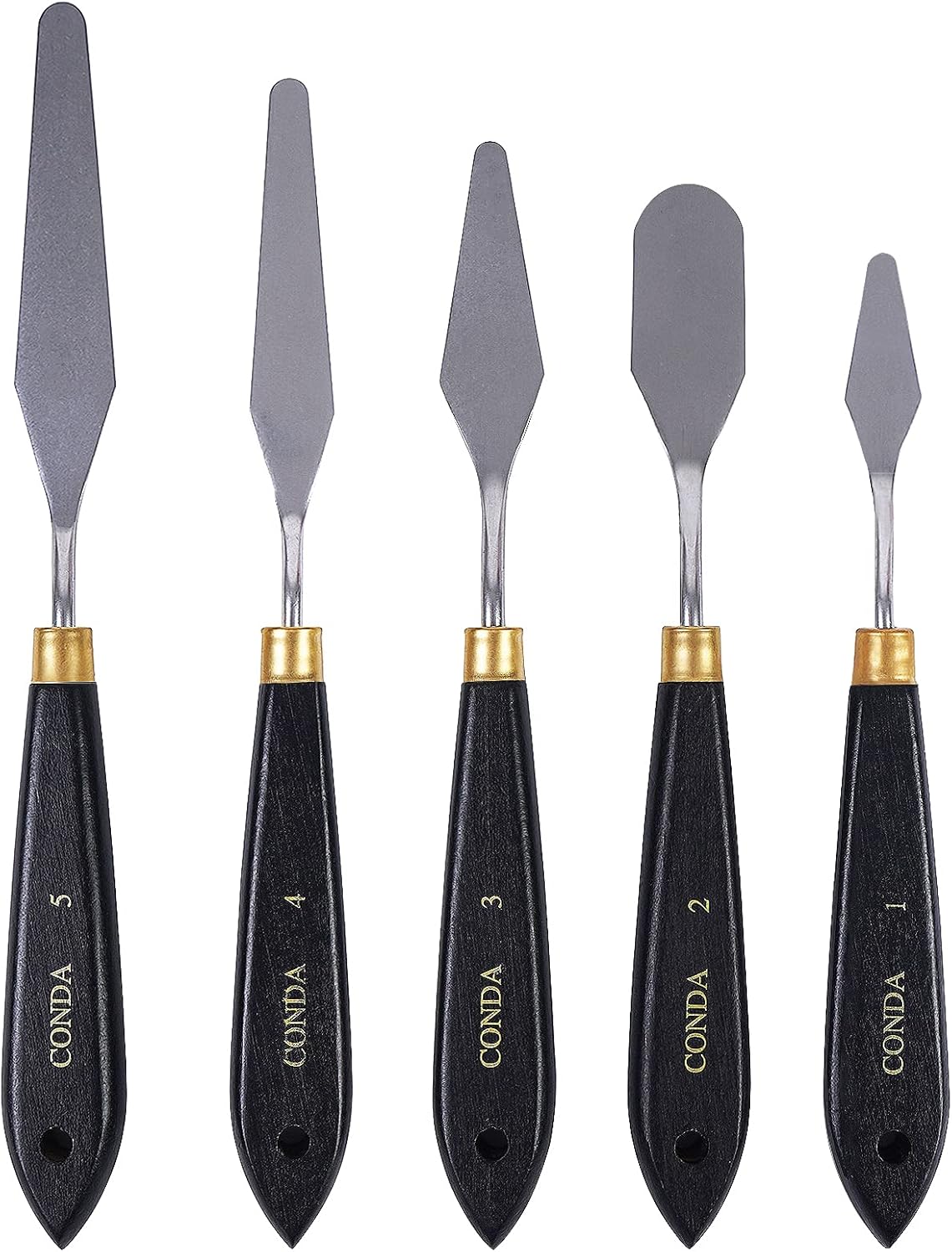 |
conda Palette Knife Painting Stainless Steel | Set includes 5 unique palette knives for versatile texture creation. High-quality matte stainless steel blades resist wear and corrosion. Tempered and hand-ground blades for consistent flexibility and precision. Perfect for oil and acrylic painting. |
Check Price |
 |
Liquitex Professional Freestyle Small Painting Knife | Enables textural effects and expressive mark-making. Designed for use with thick-bodied and gel-based materials. Crafted for durability and flexibility. Blade shape optimized for precision and control. |
Check Price |
 |
Mont Marte Studio Palette Knife | Includes 5 palette knives in different sizes and style. Flexible stainless steel blades for smooth paint handling. Ideal for mixing, spreading, and layering paint. Resistant to corrosion and wear. |
Check Price |
 |
Martin/ F. Weber Bob Ross Number10 Standard Painting Knife | Made of stainless steel for durability and corrosion resistance. Precision edge ideal for mixing, spreading, and sculpting paint. Delivers optimum results with professional painting techniques. Solid construction suitable for heavy use. |
Check Price |
 |
HTS 316V8 8.5″ Tapered Wood Handle Stainless Steel Palette Knife | Flexible stainless steel blade for smooth mixing and spreading. Wooden handle for comfortable grip and classic aesthetic. Great for oil and acrylic paint preparation. Smooth edges prevent tearing or gouging canvas. |
Check Price |
 |
9 Pcs Paint Palette Knives for Painting, | Includes 9 palette knives in assorted shapes and sizes. Designed for color adjustment, thick coating, and large-area coloring. Suitable for oil, acrylic, and canvas painting. Durable stainless steel blades resist corrosion and rust. Wooden handles offer a comfortable grip for long painting sessions |
Check Price |
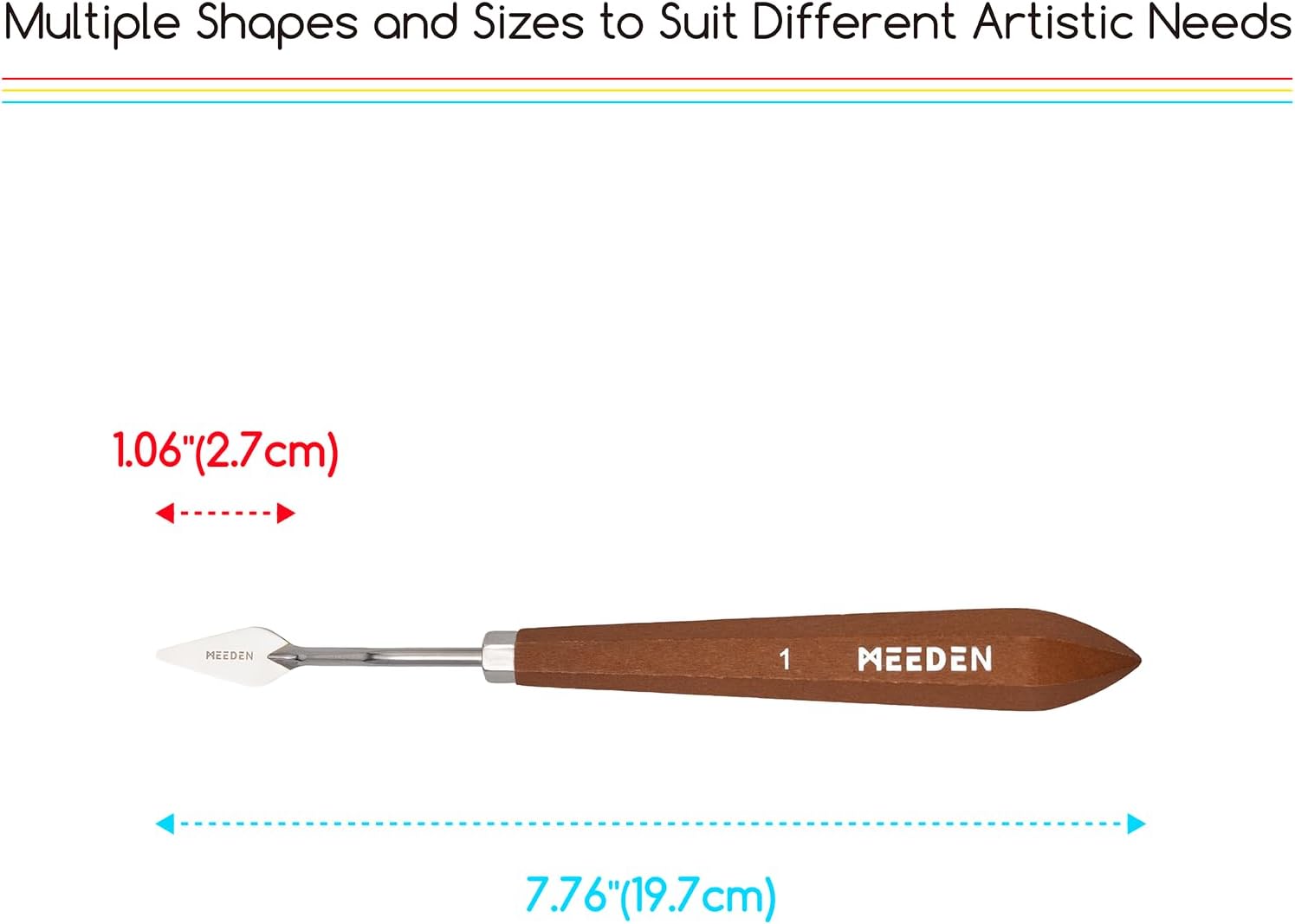 |
MEEDEN Artist Palette Painting Knife | Made from superior stainless steel for durability and corrosion resistance. Quick rebound to original shape after use. Curved neck design for easy paint pickup and improved handling. Premium beech wood handle for a smooth, comfortable grip. Enhances pressure and angle control for detailed work |
Check Price |
What to Check Before Choosing a Palette Knife
Start with the marks you want to make
If most of your work involves mixing paint and occasional texture, a simple five-piece assortment gives you enough shapes to compare without filling a drawer. If knife painting is central to your style, a single higher-quality knife in the shape you use most may be more valuable. Broad impasto painters often want a larger blade with predictable spring; detail painters may care more about a fine point and a narrow shoulder.
I know it is tempting to buy the set with the greatest number of knives because it looks more versatile. Count is only useful when the shapes are meaningfully different. Several near-duplicate blades can add clutter without adding new marks.
Stainless steel is practical, but construction still matters
Stainless steel is common because it resists corrosion, cleans easily, and can be made thin enough to flex. That does not make every stainless blade identical. Thickness, temper, grinding, neck design, welding or riveting, and overall shape affect how the knife behaves under pressure.
For routine studio work, look for a blade that returns to its normal alignment after ordinary flexing and a connection that does not wobble in the handle. A knife that stays bent after gentle use becomes unpredictable, especially when you are trying to place a clean straight ridge.
Handle shape matters during long mixing and painting sessions
A wooden handle can feel warm and substantial, while molded or coated handles can offer a more consistent non-slip surface. The more important question is whether the handle lets you control the blade without clenching. A handle that is too thin for your hand may encourage a tight grip, while an overly bulky handle can make delicate angle changes awkward.
The neck should also line up comfortably with the way you hold the knife. Painters who work from the shoulder with large sweeping strokes may prefer a different balance from someone making small controlled accents at a tabletop easel.
Sets are most useful when the shapes genuinely differ
A good starter set usually combines a few distinct profiles: a small pointed knife, a medium versatile shape, and a broader blade for larger deposits or mixing. Additional specialty forms become useful as you learn what effects you repeat. A nine-piece set can be excellent for experimentation, but only if the blades remain stable enough to teach you what each shape is doing.
For a new painter, I would rather see five clearly different knives than nine versions of the same narrow leaf shape. The set should help you discover technique, not just make the product box look full.
Think about cleaning before dried paint becomes part of the tool
Fresh oil paint is much easier to remove than cured paint. Wipe excess color from the blade promptly and follow the cleaning guidance for the paint and solvent system you use. Do not leave a thick ridge of oil paint around the neck joint, because hardened residue can make a flexible blade feel stiff and can hide corrosion or looseness.
If you use artist solvents, follow the solvent maker’s ventilation, storage, and skin-contact guidance. Do not treat a jar of solvent as an open-ended studio accessory. Cleaning habits should protect both the tool and the person using it.
CONDA 5-Piece Stainless-Steel Palette Knife Set – A Broad Starter Assortment
The CONDA set in the source article is the red-handled five-piece stainless-steel assortment commonly sold as model A16201G or a closely related listing. Current retail descriptions identify five traditional painting-knife shapes with stainless-steel blades and wood handles. The set is intended for mixing, spreading, scumbling, scratching, applying paint, and working with materials such as acrylic color, oil color, gesso, modeling paste, and texture gels.
Its strongest advantage is range without excess. Five different shapes are enough to compare narrow and broad contact, pointed and rounded areas, and small versus larger paint loads. That is useful if you are still figuring out whether you enjoy flat spreading, edge lines, heavy ridges, or palette mixing most.
Features That Matter in Practice
The stainless-steel blades are the core feature. They give the knives a resilient working surface that can be wiped clean and used with wet paint without the maintenance concerns of untreated steel. Retail descriptions also emphasize flexible spring, which matters when you are dragging a knife across raised impasto rather than forcing the blade through it.
The five shapes create meaningful differences in contact area. A smaller knife can handle localized accents and color placement, while a longer or broader blade can spread more paint in one pass. This reduces the temptation to make every mark with the same tool simply because it is already in your hand.
The wood handles provide a familiar traditional grip. They also give the set more substance than disposable plastic knives. The trade-off is that wood should not be soaked unnecessarily during cleaning; wipe the blade and joint promptly rather than leaving the whole knife submerged.
- Five distinct knife shapes give a beginner useful technique range without overwhelming the workspace. The set can cover mixing, spreading, texture, scraping, and smaller edge work.
- Stainless-steel blades are practical for oil-paint cleanup and routine studio use. They resist corrosion better than untreated carbon steel when cared for normally.
- The blades provide enough spring for expressive dragging and impasto work. That makes the set more instructive than rigid craft spatulas that do not respond to pressure.
- Wood handles give each tool a stable, traditional grip. They are easy to index in the hand when changing from the flat face to the blade edge.
- The set is useful beyond a single paint consistency. The shapes can move normal oil color, thicker impasto mixtures, acrylics, gesso, and texture media within sensible studio use.
- The set is designed as an assortment rather than one highly specialized professional knife. A painter who already knows a favorite blade profile may prefer to buy that shape individually.
- Wood handles need sensible cleaning habits. Leaving them soaked in solvent or water is unnecessary and can age the handle faster than prompt wiping.
Who It’s Best For
This CONDA set suits a beginner or occasional knife painter who wants several real stainless-steel shapes to experiment with before investing in individual professional knives. It is especially useful if the same tools will be used for both palette mixing and direct paint application.
Not Ideal For
It is less compelling for an experienced painter who already knows the exact blade shape, spring, and balance they prefer. In that case, a single purpose-chosen knife can provide a more consistent feel than an assortment.
Liquitex Professional Freestyle Small Painting Knife – A Single-Knife Choice Built Around Control
The source article uses Liquitex’s older ‘Professional Freestyle Small Painting Knife’ name. Liquitex’s current professional knife pages use updated naming, but the small-scale professional line retains the same design priorities: strong corrosion-resistant stainless-steel blades, ergonomic non-slip wooden handles, and solid blade-to-neck construction intended for repeated manipulation of paint and mediums.
Unlike a multi-piece set, this is the kind of purchase that makes sense when you value one consistent tool. A small professional knife is useful for mixing modest amounts, laying narrow passages, drawing with an edge, and placing controlled accents without carrying a large mass of paint.
Features That Matter in Practice
Liquitex emphasizes stainless steel that resists wear and corrosion. That matters in a studio tool because repeated scraping on a palette and cleaning can be harder on a blade than a few delicate canvas strokes. A blade that stays smooth and aligned gives more predictable paint release.
The ergonomic handle is designed to improve grip during long use. Small changes in knife angle often come from finger and wrist control, so a handle that does not slide in the hand makes fine adjustments easier. The current professional range also uses strong handle connections, with riveting on relevant designs to reinforce the working joint.
The smaller scale is a real advantage for compact paintings and controlled mark making. It is also the limitation: if you paint large canvases with broad, loaded impasto passages, a small knife requires more reloads and more repeated strokes than a larger spatula or trowel.
- Professional stainless-steel construction supports repeated mixing, scraping, and paint application. The blade is designed for studio use rather than occasional craft handling.
- The smaller format gives strong control over narrow strokes and localized texture. It is easier to place a ridge precisely without covering a large surrounding area.
- Liquitex’s ergonomic handle design reduces the need for an overly tight grip. That helps when the knife is rotated repeatedly between its flat face, side, and tip.
- A single consistent knife can teach pressure control more clearly than constantly switching tools. You learn exactly how one blade responds at different angles and paint loads.
- The professional line is built around paint and medium manipulation. It is not a generic kitchen-style spatula repackaged as an art tool.
- One small knife cannot cover every scale efficiently. Large impasto fields and broad palette mixing are faster with a wider blade.
- The source listing name is older than Liquitex’s current product naming. Buyers matching an existing knife should compare the present blade shape rather than relying on the word ‘Freestyle’ alone.
Who It’s Best For
This Liquitex option suits painters who want a dependable small professional knife for controlled oil-paint handling, detail texture, edge work, and palette mixing. It also makes sense as an upgrade after a starter set has revealed which size of blade you reach for most often.
Not Ideal For
It is not the most efficient choice if your main goal is to explore many blade profiles cheaply or cover large canvases with broad heavy impasto. A multi-knife set or a larger professional spatula would make more sense for those priorities.
Mont Marte Studio Palette Knife Set – Five Stainless Shapes With No Cutting Edge
The source article points to the stainless five-piece Mont Marte Studio set, not the separate plastic Studio assortment that also appears in some markets. Mont Marte’s current stainless five-piece set, sold as SKU MAPK0002 in its newer Signature naming, uses flexible stainless-steel blades with no cutting edge. The maker describes the knives for mixing paint, mediums, and pigments as well as applying oil or acrylic color directly to a painting surface.
That no-cutting-edge design is useful for a beginner because it reinforces what the tool is supposed to do: move paint. You can still damage a canvas by pushing any metal edge too aggressively, but the blades are not designed as sharp cutting tools.
Features That Matter in Practice
Five sizes give you several paint footprints without turning the set into a huge collection. The smaller blades can handle accents and narrow textures; the larger ones are better for spreading and mixing. Because the shapes belong to one matched set, the handles and general feel remain consistent while the working area changes.
Mont Marte describes the stainless blades as flexible. That spring is useful for pulling a thin veil of paint over a textured layer or laying an impasto stroke that releases cleanly as pressure falls. It also makes the knife more forgiving than a rigid scraper when the canvas surface is not perfectly flat.
The set is suitable for both oil and acrylic paint, which matters for mixed-media studios or painters who switch materials. For oil paint specifically, the same advice applies after every session: remove wet paint before it has time to harden around the blade and neck.
- Five stainless-steel knives cover a useful range of sizes without excessive duplication. A painter can compare broad spreading, small accents, mixing, and edge work within one set.
- The flexible blades support both impasto placement and lighter dragging techniques. They respond to changes in hand pressure instead of behaving like rigid scrapers.
- Mont Marte explicitly describes the blades as having no cutting edge. That makes their intended role as paint-moving tools clear, especially for beginners.
- The knives work with oil and acrylic paint as well as common painting mediums. One set can stay useful even if your studio practice changes.
- A matched set keeps the general handle feel consistent while blade size changes. That can make it easier to isolate what the blade shape itself is doing.
- Mont Marte also sells plastic five-piece palette-knife sets, so the product name can be confusing across retailers. Verify that the listing is the stainless version if metal blades are the reason you are choosing it.
- A flexible general-purpose set may not satisfy painters who prefer a very stiff blade for aggressive scraping or heavy modeling paste. Spring is an advantage only when it suits the technique.
Who It’s Best For
This Mont Marte set is a practical fit for beginners, students, and mixed oil/acrylic painters who want a modest selection of stainless knives with familiar general-purpose shapes. It is particularly sensible when you want to learn which blade size feels natural before buying individual specialty knives.
Not Ideal For
It is less suited to an artist who wants one very specific professional blade profile or an unusually stiff heavy-duty tool. A specialist single knife will usually feel more deliberate for that kind of workflow.
Bob Ross #10 Standard Painting Knife – Straight-Edge Control for Wet-on-Wet Landscape Work
The Bob Ross #10 Standard Painting Knife is closely tied to the Bob Ross Wet-on-Wet Technique. Bob Ross Inc. still includes the #10 knife in current master sets and describes its straight-edged blade as distinctive to the Ross method. That makes this a much more specific tool than a general five-piece assortment.
In landscape knife work, a straight edge can be loaded with a narrow roll of firm oil paint and touched to the canvas to create broken highlights, angular rock planes, roof lines, snow ridges, and other crisp shapes. The method depends on controlled paint loading and a light touch rather than pressing hard enough to scrape the canvas.
Features That Matter in Practice
The straight edge is the defining feature. It gives you a predictable line of contact and makes it easier to create a long crisp deposit when the paint consistency is right. That is useful for mountain highlights and architectural accents where a curved or leaf-shaped knife might change the footprint as it moves.
The #10 is also large enough to move a useful quantity of paint compared with a tiny detail knife. It can mix firm landscape colors on a palette and then transfer a loaded edge to the canvas. The blade shape encourages an economy of strokes: load, place, release, and avoid repeatedly working the paint until the texture collapses.
Because the tool is associated with a defined method, it rewards learning the loading technique used with it. If you approach it like a generic spatula and mash the flat blade into the surface, you lose the crisp broken texture that makes the knife distinctive.
- The straight-edged blade is purpose-built for the Bob Ross Wet-on-Wet approach. It makes controlled ridges, mountain planes, roof edges, and other angular marks easier to repeat.
- The knife can handle both palette mixing and direct paint placement. You do not need to reserve it for one decorative effect.
- Its larger working edge carries more paint than a tiny detail knife. That is useful for firm oil colors and landscape passages that need decisive deposits.
- A single recognizable blade shape helps develop repeatable loading technique. You can judge how much paint sits on the edge before touching the canvas.
- The design remains part of Bob Ross Inc.’s current tool system. It is still included in official painting sets rather than surviving only as an old marketplace listing.
- The specialized straight edge is less versatile than a multi-shape set for experimental knife painting. Curved, pointed, and very narrow effects may require another knife.
- The tool makes the most sense with deliberate firm-paint techniques. Painters who use very fluid oil mixtures may not get the same crisp broken deposits.
Who It’s Best For
The #10 is the strongest fit for painters learning Bob Ross-style wet-on-wet landscapes or anyone who values a straight, predictable edge for firm oil paint. It also works well as a dedicated landscape knife alongside a separate mixing or detail set.
Not Ideal For
It is not the most logical first purchase if you want to explore many knife shapes or paint primarily with small abstract marks. In that case, a varied set gives you more ways to test how shape changes the stroke.
HTS 316V8 8.5-Inch Tapered Wood-Handle Palette Knife – A Simple Single-Blade Tool
The HTS 316V8 is listed as an 8.5-inch tapered wood-handle stainless-steel palette knife. Unlike Liquitex, Mont Marte, Bob Ross, and MEEDEN, I could not find a current detailed manufacturer page for this exact item, so the safest approach is to stick to the identifiable listing facts rather than repeat broader claims from old marketplace copy.
Its appeal is simplicity: one tapered metal blade, one wooden handle, and no set of near-duplicate profiles to sort through. A tapered knife can serve as a useful all-round shape because the point handles smaller marks while the broader section can spread or mix more paint.
Features That Matter in Practice
The 8.5-inch overall format gives the knife enough handle and blade length to feel like a conventional studio tool rather than a miniature scraper. That helps when mixing on a palette because your fingers remain away from the paint while the working end has room to move.
The tapered shape offers more than one contact width. Near the point, you can place smaller accents; farther back, a larger portion of the blade can flatten or spread paint. This does not replace a wide spatula, but it makes one knife more adaptable than a blade with the same width from base to tip.
Because exact blade temper and neck construction are not well documented in current primary sources, do not assume that it will match the spring of a professional Liquitex or MEEDEN knife. The most defensible expectation is a basic stainless-steel painting knife whose real value depends on how the specific piece feels in your hand.
- The tapered profile gives one blade several useful contact widths. The point can handle small marks while the broader section supports mixing and spreading.
- An 8.5-inch overall format provides comfortable separation between the hand and wet paint. That is useful at both the palette and the canvas.
- Stainless-steel construction is practical for a tool that is repeatedly wiped and exposed to wet paint. Routine care is straightforward when paint is removed promptly.
- The wooden handle offers a traditional grip without the complexity of a multi-piece kit. It is easy to keep one familiar tool ready on the palette.
- A single modest knife can be enough for painters who mainly mix paint and add occasional texture. Not every studio needs a large knife collection.
- Current manufacturer-level documentation for the exact 316V8 is limited. I would not rely on unverified claims about blade temper, special coatings, or professional performance.
- One tapered blade cannot reproduce the range of a five- or nine-shape set. Broad impasto and specialty textures may require additional knives.
Who It’s Best For
The HTS makes sense for someone who wants a basic single stainless-steel knife for mixing and straightforward paint application without buying a full set. It can also serve as a spare studio knife when you prefer to keep one tool dedicated to a recurring color family or medium.
Not Ideal For
It is less suitable if you want heavily documented professional construction, a guaranteed specific blade stiffness, or several distinct shapes for experimental impasto. The limited primary-source detail makes higher-end comparisons difficult.
9-Piece Stainless-Steel Palette Knife Set – Maximum Shape Variety for Experimenting
The generic nine-piece entry in the source article matches a current AebDerp listing by title and description: nine stainless-steel palette knives with wooden handles, multiple sizes and shapes, and an offset connection intended to keep fingers away from wet paint. The set is marketed for oil and acrylic painting, mixing, scraping, thick coating, and larger-area color application.
Nine pieces give you more room to experiment than the five-piece sets. The benefit is not that nine is automatically better; it is that a wider spread of shapes can help you discover how a rounded end, long point, broader face, or narrow shoulder changes the same paint mixture.
Features That Matter in Practice
The varied shapes are the central reason to choose this set. You can reserve one broad blade for mixing, another for large texture deposits, and smaller knives for edge marks and details. Separating jobs this way can also reduce color contamination because you do not have to wipe and reload the same knife every few seconds.
The stainless-steel blades are described as corrosion resistant and easy to clean. The wooden handles provide a stable grip, and the bent connector gives hand clearance above the working surface. That offset is particularly useful when the blade is held nearly flat for spreading.
The trade-off with a larger inexpensive set is consistency. Even when all nine pieces are usable, blade spring and alignment may not feel as tightly matched as a professional line. Inspect each knife before the first session and set aside any piece that arrives twisted or permanently bent.
- Nine blade shapes give the widest experimentation range among the sets in this article. You can test broad deposits, small accents, scraping, mixing, and several edge effects without buying knives one by one.
- Stainless-steel blades make the set practical for oil and acrylic studio use. They are easy to wipe clean before paint hardens.
- Wooden handles and offset necks keep the grip away from wet paint. That improves clearance when the blade is used at a shallow angle.
- Multiple knives make it easier to dedicate separate tools to different colors or tasks during one session. You can mix with one knife while preserving a clean blade for highlights.
- The assortment is useful for learning which shapes deserve a future professional upgrade. You can discover your preferences before paying more for individual knives.
- A nine-piece set creates more cleaning and storage than most beginners expect. If you use many knives in one session, every one still needs wet paint removed afterward.
- Large assortments can include shapes you rarely use. Extra count does not guarantee that every blade will earn space on the palette.
Who It’s Best For
This nine-piece set suits an exploratory painter who wants to learn how blade shape changes oil-paint texture and who does not yet know which profiles will become favorites. It is also useful for shared studios where several painters may prefer different knife shapes.
Not Ideal For
It is not ideal for a minimalist setup or for an experienced artist who already relies on two or three specific professional knives. In that situation, the extra shapes become maintenance rather than value.
MEEDEN Artist Palette Painting Knife – Strong Rebound and a Beechwood Grip
MEEDEN’s current professional palette-knife range is built around flexible stainless-steel blades, curved necks, and beechwood handles. The company describes blades that return to their original shape after normal flexing, precision-welded joints, and a curved neck intended to improve paint pickup and clearance. Current offerings include both individual/smaller configurations and larger shape collections, so check the exact option tied to the listing you are buying.
What separates the MEEDEN concept from a simple budget assortment is its focus on the connection between blade response and handle control. A knife that bends predictably and returns true lets you use pressure as part of the stroke instead of worrying that each pass will leave the blade slightly more distorted.
Features That Matter in Practice
Flexible stainless steel provides the working spring. With light pressure, the knife can skim a thin layer or broken color across raised texture. With more pressure, it can flatten and move a denser deposit. Quick rebound matters because the knife should return to a neutral shape when the pressure is released.
MEEDEN’s curved neck increases clearance between the handle and paint surface. That makes it easier to pick up a roll of paint from the palette and transfer it without lowering your fingers into the color. The brand also emphasizes welded construction at the blade connection, an area that receives repeated stress during scraping and impasto work.
The beechwood handle uses a faceted form that gives the fingers an indexing surface. A handle with subtle flats can be easier to rotate deliberately than a perfectly round cylinder because you can feel the orientation without looking down at your hand.
- Flexible stainless-steel blades are designed to spring back after normal pressure. That supports repeatable strokes and reduces the chance of gradually painting with a permanently bent tool.
- The curved neck improves hand clearance over the palette and canvas. It is easier to keep fingertips out of thick wet paint while working at a shallow angle.
- Beechwood handles provide a substantial grip with tactile orientation. The faceted form helps you feel how the blade is rotated in your hand.
- MEEDEN emphasizes reinforced blade-joint construction. A stable connection matters during repeated scraping, spreading, and heavy impasto handling.
- The range covers both delicate and heavy paint manipulation. The same design approach can support thin dragging, mixing, layering, and sculptural deposits depending on blade shape.
- MEEDEN sells several palette-knife configurations, so the exact number and shapes can differ by listing. Match the current option to the blade profiles you actually want.
- A responsive flexible blade may feel too springy to painters who prefer a stiff scraper-like tool. Technique preference matters more than a generic idea of premium quality.
Who It’s Best For
The MEEDEN knife suits painters who want a more deliberately engineered blade-and-handle feel and who use pressure variation as part of their oil-paint technique. It is especially appealing if reliable rebound and a comfortable wooden grip matter more than simply getting the largest number of knives.
Not Ideal For
It may be unnecessary for someone who only needs a cheap mixing knife or who prefers a very stiff blade. A simpler single knife can do that job without paying for a more refined flexible response.
How the Seven Palette-Knife Options Compare
The easiest way to compare these products is by working style rather than by piece count. Three are broad starter assortments, three are essentially single-knife choices, and the MEEDEN line sits between those ideas because it emphasizes professional blade behavior while being available in several configurations.
For learning several blade shapes at once
CONDA and Mont Marte are the cleanest five-piece starting points. CONDA gives you a traditional assortment with wood handles and stainless blades. Mont Marte’s stainless five-piece set is similarly approachable and explicitly uses flexible blades with no cutting edge. Either makes sense if you want enough variety to learn without managing nine different tools.
The nine-piece AebDerp-style set goes further. It is the better fit if experimentation itself is the goal and you want to compare more profiles before deciding which shapes deserve better individual replacements later. The cost of that variety is more storage, more cleaning, and potentially more piece-to-piece variation.
For a single professional-feeling knife
Liquitex and MEEDEN are the stronger choices if you care more about blade behavior than assortment size. Liquitex’s professional small-scale knife design emphasizes corrosion-resistant stainless steel, ergonomic grip, and durable construction. MEEDEN emphasizes flexible rebound, welded joints, curved neck clearance, and beechwood handles.
The HTS 316V8 also offers the simplicity of one tapered stainless knife, but it has much less current manufacturer documentation. That does not make it unusable; it simply means I would judge the actual piece on alignment, spring, and handle security rather than assume unverified premium features.
For Bob Ross-style landscape techniques
The Bob Ross #10 stands apart because it belongs to a specific method. If you want the straight-edge loading and broken highlight techniques used in Bob Ross Wet-on-Wet landscapes, the #10 is the most direct choice here. Buying a nine-piece assortment does not automatically give you the same feel, even if one blade looks roughly similar.
If you paint landscapes more freely rather than following that method, a broader set gives you more texture vocabulary. The #10 is valuable because it is specialized, not because it makes every other knife unnecessary.
For broad impasto versus fine marks
Broad impasto rewards a blade that carries enough paint to finish a stroke without constant reloading. In the multi-piece sets, choose the widest useful knife and keep pressure light enough that the blade releases paint instead of scraping it away. For small accents, the pointed blades in those sets or a small Liquitex knife offer better placement control.
MEEDEN’s flexible designs are attractive when you want pressure changes to alter the stroke. A stiffer tapered HTS-style knife can feel more direct for mixing and scraping. Neither response is universally superior; it depends on whether you want the blade to spring with the motion or resist it.
Using a Palette Knife With Oil Paint Without Losing the Texture
1. Prepare the paint consistency before the knife touches the canvas
Knife painting becomes difficult when the paint consistency fights the mark. Very stiff paint may need an appropriate medium or a smaller load; overly fluid paint may collapse instead of holding a ridge. Mix deliberately on the palette and test a small deposit before committing to a large passage.
Then decide whether you want a solid deposit, broken color, a scraped line, or a thin drag. The same knife can create all four, but the loading pattern and angle change. A clear intention produces cleaner texture than repeatedly moving paint after it is already on the canvas.
2. Load the blade rather than coating the entire knife
For many direct-painting strokes, pick up paint on one edge or on a controlled area near the tip. A heavy coating over the whole blade gives you less information about where the paint will release. A narrow roll along an edge can create a crisp line; a broader flat load can spread into a larger shape.
Keep the handle and neck as clean as practical. Once paint creeps onto the grip, your hand starts adjusting to slipperiness rather than controlling the blade.
3. Change angle before adding pressure
If the knife is not leaving the mark you want, first change the angle. A flatter blade spreads and skims; a steeper angle concentrates pressure along an edge. Pressing harder without changing the angle often smears the paint or scrapes away a layer that was meant to remain visible.
The most useful habit is to let the knife ride on the paint rather than drive into the support. This protects the canvas and preserves the raised texture that makes knife painting visually distinct.
4. Use the edge for lines and the face for mass
The long edge can draw branches, architectural lines, stems, horizon accents, and broken highlights when loaded carefully. The flat face can carry larger color masses. The tip handles dots, chips, and small angular marks. Learning these three contact zones gives one knife far more range than its silhouette suggests.
With the Bob Ross #10, the straight edge is especially important. With a pointed leaf-shaped knife, the changing width from tip to shoulder gives you a different set of line and spreading possibilities.
5. Stop before repeated passes turn color into mud
Knife strokes look strongest when the paint retains separation and directional texture. Repeatedly dragging through the same wet passage can mix complementary or dark colors together until the surface loses both color clarity and relief. If the stroke is nearly right, resist the urge to polish it endlessly.
Sometimes the better move is to scrape back once, wipe the blade completely, reload fresh color, and place a new stroke. A clean blade gives you a clean color decision.
6. Wipe between important color changes
A trace of dark blue can dominate a light yellow mixture. Keep a wiping cloth or disposable shop towel within reach and clean the blade before moving into a sensitive light color. You do not need a full solvent wash between every stroke; removing the bulk of wet color is often enough to control contamination during the session.
At the end, clean according to the paint and solvent system you use, dry the blade, and inspect the neck. Prompt cleanup is easier than removing cured oil paint later.
Keeping Palette Knives Clean, Straight, and Ready to Use
Remove wet paint before it hardens around the neck
The neck joint is where dried paint becomes most annoying. A thick crust can reduce flexibility, hide a loose connection, and transfer old color into a new mixture. Wipe this area while the paint is still soft rather than waiting until the next session.
Do not use the blade as a pry tool
Flexible painting knives are designed to bend within a normal working range, not to open paint cans, scrape hardened construction adhesive, or lever staples and tacks. Those jobs can permanently twist the blade or neck. Once a knife no longer returns straight, delicate paint placement becomes difficult.
Store metal blades so the edges are not crushed together
A drawer full of loose steel knives can create bent tips, scratched handles, and tangled necks. Store them flat with enough space that the blades are not carrying the weight of heavier tools. A roll, tray, divider, or simple dedicated cup can keep profiles visible and make it easier to choose the right knife quickly.
Check wooden handles instead of soaking them
Wood handles do not need prolonged immersion. Wipe them when paint transfers onto the grip and dry them normally. If a handle becomes loose at the ferrule or joint, retire the knife from forceful scraping until the connection is safe and stable.
Where Palette-Knife Painting Commonly Goes Wrong
Using a tiny blade for a large impasto field
A small knife can cover a big area, but it forces many repeated deposits. That often creates accidental patchiness and excessive mixing because every new pass overlaps the last. Use a broader blade for the main mass, then return with the small knife for edge variation and accents.
Pressing harder instead of changing paint load or angle
When a knife does not release paint, beginners often add force. The result can be a flattened stroke or a scraped bare patch. Try a different blade angle, a slightly larger paint load, or a different paint consistency before increasing pressure.
Overmixing colors on the palette
Palette knives are efficient mixers, which means they can also overmix quickly. If you want lively color variation, stop before every streak disappears. A partially mixed pile can produce more interesting broken color on the canvas than a perfectly uniform blend.
Letting dried paint change the blade response
A knife with cured paint near the neck can feel stiffer than it did when new. That changes the feedback you rely on. Clean promptly and inspect the joint rather than assuming the blade itself has suddenly become less flexible.
Treating every knife as if it has the same spring
Switching from a flexible MEEDEN or Mont Marte knife to a stiffer tool without adjusting pressure can make strokes inconsistent. Test each knife on the palette first. Learn how far it bends under the amount of pressure you normally use.
Trying to repair every imperfect stroke while it is still wet
Oil paint gives you working time, but that does not mean every passage improves with more touching. Knife texture often looks alive because one decisive stroke remains visible. If an area is becoming dull, scrape or leave it rather than repeatedly massaging the surface.
Safety Notes for Palette-Knife and Oil-Paint Work
Painting knives are not intended as cutting tools, but thin metal edges and pointed tips can still scratch skin or damage a painting support. Do not carry several knives loose in one hand with points facing upward. Keep unused knives on the palette or in a holder where the blade ends are visible.
Oil-paint cleanup can involve solvents depending on your materials and studio practice. Follow the paint and solvent manufacturers’ instructions for ventilation, storage, disposal, and skin contact. Keep solvent containers closed when they are not in use, and keep oily rags or other combustible waste according to the safety guidance for the products involved.
Do not use artist palette knives for food after they have been used with paint or art mediums. Even if a knife resembles a kitchen spatula, once it has entered the studio it should remain a studio tool.
Frequently Asked Questions
Is a palette knife the same as a painting knife?
The terms are often used loosely. Traditionally, a palette knife is associated with mixing and may have a straighter or more rounded blade, while a painting knife usually has an offset neck and shapes intended for direct application. Retailers frequently use the names interchangeably, so the actual blade profile matters more than the label.
Can I use these knives for both mixing and painting?
Yes, most of the products here can do both. You may still prefer to keep one broad knife mainly for palette mixing so the painting knives stay cleaner and their finer edges are not constantly scraping against the palette.
Which blade shape is easiest for a beginner?
A medium pointed or diamond-like knife is a useful starting shape because it offers a point, two edges, and a broad enough face for small spreading strokes. A five-piece set such as CONDA or Mont Marte lets you compare that shape with broader and narrower options without committing to one profile.
Do I need a very flexible blade for impasto?
Not necessarily. Flexibility helps a knife release and glide over thick paint, but some painters prefer a firmer blade because it gives more direct control over dense mixtures. The right amount of spring depends on how much pressure you use and whether you are laying paint down, shaping it, or scraping it back.
Why is the Bob Ross #10 different from a normal palette knife?
Its straight-edged blade is designed around the Bob Ross Wet-on-Wet landscape method. That edge is especially useful for loading firm paint and placing broken highlights or angular forms. It can mix paint too, but its strongest reason to buy is the specific mark-making method associated with it.
Should I buy five knives or nine?
Five is enough for most beginners if the shapes differ clearly. Nine makes sense if experimentation is the priority and you want to compare more profiles. Do not choose by count alone; blade quality, useful shape variety, and how often you are willing to clean the tools matter more.
How do I stop colors from contaminating each other?
Wipe the blade thoroughly before moving from a dark or intense color into a light mixture. Keeping two or three knives active during a session can also help: one for dark mixtures, one for lights, and one clean knife reserved for final highlights or sensitive color passages.
Can a palette knife damage canvas?
Yes, if it is used with excessive pressure or a digging angle. Painting knives are meant to move paint across the surface, not cut into the support. Keep pressure controlled, especially when scraping or working over a thin ground layer.
Choose the Knife by the Stroke You Want to Make
The best palette knives for oil painting are the ones that make your intended marks easier to repeat. CONDA and Mont Marte give beginners practical five-piece assortments. The nine-piece set offers the most experimentation. Liquitex and MEEDEN make more sense when blade feel and construction matter more than piece count, while the HTS is a simpler single tapered option with less detailed current documentation. The Bob Ross #10 belongs in its own lane because its straight edge is tied closely to Wet-on-Wet landscape technique.
I don’t think a painter needs every knife shape on the market. A small set becomes useful when you learn what each blade is for and stop reaching for the same one automatically. Choose a broad blade when the stroke needs mass, a narrow blade when placement matters, and a spring you can control without forcing it. Then clean the tool before dried paint changes the way it behaves.
If you are replacing or expanding your current set, compare the verified blade material, shape, handle design, and intended use against the kinds of oil-paint strokes you make most often. That gives you a much better basis for choosing than a product photo or the number of knives printed on the package.