Old paint rarely comes away in one neat sheet. On a weathered door, a cabinet frame, a window, or a piece of furniture, one area may be lifting while the next is still bonded firmly to the surface. That unevenness is exactly why a scraper that feels excellent on one job can feel clumsy or even risky on another. Blade shape, edge material, handle leverage, and the direction of the scraping stroke all affect how much control you have and how likely you are to damage what sits beneath the coating.
For a careful DIYer, the goal is not simply to remove paint as aggressively as possible. The better goal is to remove the failed coating while preserving the wood, glass, metal, tile, or molded detail you actually want to keep. That usually means matching the scraper to the surface rather than choosing by size alone.
I also think it helps to separate genuine usefulness from feature overload. A painter’s multi-tool can be valuable because it stays in your pocket and handles several prep jobs. A razor scraper can be far more precise on smooth glass. A contour scraper can reach profiles that a flat blade simply skips. And a carbide pull scraper can make stubborn finish removal much less frustrating on suitable surfaces.
Start With the Surface, Not the Scraper
A scraper only works well when its edge meets the coating at a useful angle and the underlying surface can tolerate that edge. That sounds obvious, but it explains most of the difference between a clean paint-removal job and a scratched, gouged, or chipped one.
On relatively flat painted wood, a rigid painter’s scraper or carbide pull scraper can give you leverage and a predictable cutting edge. Around moldings, spindles, grooves, and rounded trim, the problem changes: a broad straight edge touches only the high points, leaving paint packed into the profiles.
That is where shaped blades earn their place. On glass and very smooth hard surfaces, a razor-style scraper can get under thin, brittle residue with much less bulk, but the blade has to stay flat and clean to reduce scratching risk.
The scraper should remove the coating before it starts removing the surface. If you find yourself forcing the blade, changing the angle, softening the paint where appropriate, or switching to a different scraper is usually smarter than simply pushing harder.
The seven products in this guide fall into four practical groups: multi-purpose painter’s tools, compact razor scrapers, wider razor scrapers, and specialized pull or contour scrapers. None is automatically right for every paint-removal job. The useful differences are in where each one gives you the most control.
What Actually Makes a Paint Scraper Effective
Blade Geometry Controls Where the Edge Can Reach
A wide flat blade covers more area per pass, but width can become a disadvantage on narrow trim, curved surfaces, and recesses. Corners of a wide scraper may dig in before the center of the edge is doing useful work. Conversely, a very narrow blade gives excellent access but can make a large flat panel painfully slow.
Shaped edges solve a different problem. Concave, convex, triangular, teardrop, or other profiled blades can follow molding and detail work more closely than a straight scraper. The Hyde 10450 is the clearest example among these seven because its interchangeable blades are designed specifically for changes in contour.
Razor blades create another kind of geometry: a very thin edge with little bevel bulk behind it. That helps them slide beneath dried paint, labels, adhesive, or film on smooth hard surfaces. A razor scraper is precise, but precision does not make it universally safe. Soft plastics, some coated glass, delicate finishes, and easily scratched surfaces need more caution or a different edge.
Edge Material Changes How the Tool Feels Under Load
Steel is common because it can be formed into tough scraping blades and maintained at a useful edge. Hardened carbon steel, stainless steel, alloy steel, and carbide all behave differently, but the practical question for most buyers is simpler: will the edge stay stiff enough to scrape without excessive flex, and can it be maintained or replaced when it dulls?
Carbide is especially useful for pull-style scraping because it maintains a hard working edge and can handle stubborn coatings effectively. The XW scraper uses a replaceable carbide blade and is built around applying pressure during a pulling stroke. That makes it quite different in feel from a thin razor scraper or a multi-purpose painter’s knife.
Replaceable razor systems take the opposite approach. Instead of maintaining one edge for a long time, you can swap in a fresh blade when the current one becomes nicked, rusty, contaminated, or dull. That is useful because a damaged razor edge is more likely to drag, chatter, or scratch than a clean one.
Handle Design Affects Pressure and Fatigue
A scraper handle is not just something to hold. Its length, grip shape, and relationship to the blade determine how much pressure you can apply and how well you can feel the edge working.
Short handles are good for close control, especially on compact surfaces or detailed work. Longer or extendable handles give reach and can improve leverage, but they also magnify small changes in angle at the blade. A large secondary pressure knob, like the one on the XW carbide scraper, gives you a place to drive the blade into resistant material without squeezing the main handle harder.
For repeated scraping, comfort matters more than it first appears. Hand fatigue often leads to poor technique: a user starts twisting the wrist, pushing too hard, or holding the edge too steeply. A secure grip can therefore improve both comfort and surface protection.
Push Scrapers and Pull Scrapers Behave Differently
Many painter’s knives and razor scrapers are naturally used by pushing the edge forward under the coating. Pull scrapers cut as you draw the tool toward you. Neither direction is inherently superior. They simply place your hand and the blade differently relative to the surface.
A pull scraper can feel controlled on wood because your body is behind the motion and you can moderate pressure through the handle. A push scraper can be more intuitive on flat patches of loose paint or on glass where the blade is held at a low angle. Whichever direction you use, keep the stroke controlled enough that a sudden release of paint does not send the blade into your other hand or off the edge of the workpiece.
| Product Image | Product Name | Features | Price |
|---|---|---|---|
 |
Bates- Paint Scraper | Multi-Function Utility Durable blade resists corrosion and delivers reliable performance Comfortable Wood Grip Compact & Convenient |
Check Price |
 |
MulWark Razor Blade Scraper | Includes a compact stainless steel scraper for tight spaces and an extendable-handle scraper for hard-to-reach areas Safe Blade Packaging Fits easily in pockets or toolboxes Heavy-Duty Build Quality |
Check Price |
 |
Razor Blade Scrape with 15pcs Extra Blades | Complete Scraper Kit Safe & Non-Slip Design Press the gray button and slide forward to reveal the blade Efficient & Portable |
Check Price |
 |
DEWALT 9-in-1 Painter’s Too | High-Carbon Steel Blade 9-in-1 Versatile Head Impact-Resistant Nylon Handle Ideal for professional finishing tasks |
Check Price |
 |
Hyde Contour Scraper with 6 Changeable Blades | Multi-Surface Scraping Power 6 Interchangeable Blades with 12 Edges Designed for long hours of use with minimal hand fatigue Ideal for serious renovation and refinishing tasks |
Check Price |
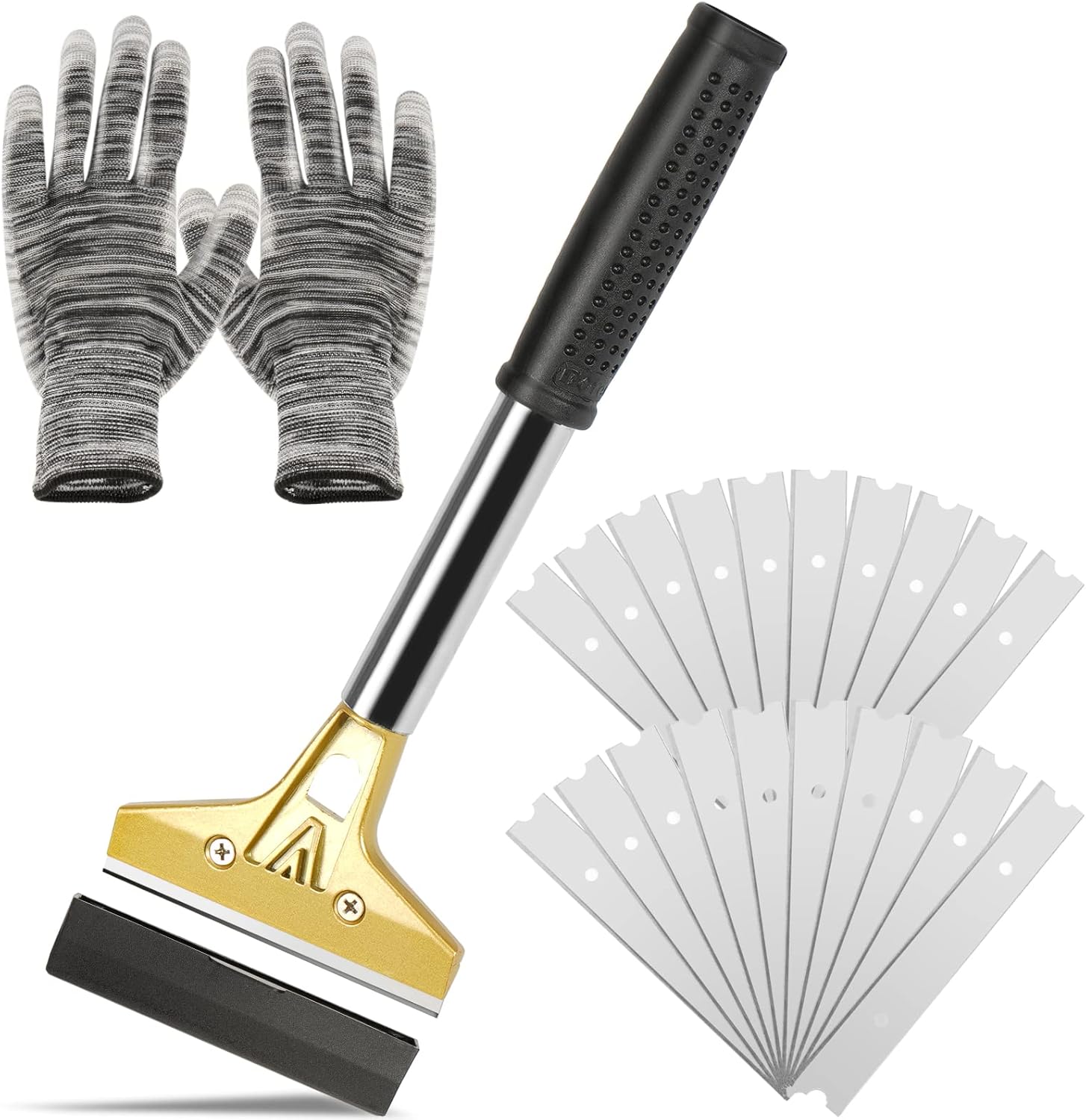 |
Razor Blade Scraper | Complete Scraper Set Rock-Hard Blade Stability Sharp & Efficient Cleaning Built from high-strength aluminum alloy and engineering-grade plastic |
Check Price |
 |
XW Heavy Duty Carbide Scraper | Soft-Grip Ergonomic Handle Heavy-Pressure Pull-Knob Quick Blade Replacement Ultra-Durable Carbide Blade Slim Head for Tight Spaces |
Check Price |
What to Check Before You Buy
Match the Blade to the Surface You Want to Preserve
Start with the material under the paint. Sound hardwood trim can tolerate a more assertive scraper than soft, damaged wood. Glass can work well with a sharp razor-style scraper when the surface is appropriate and the blade is held correctly, while softer surfaces may scratch quickly. Metal can be strong but may still show gouges. Drywall and thin veneers need particularly light pressure.
If a project includes several surfaces, owning one highly versatile tool can be convenient, but convenience should not override fit. The Bates and DEWALT multi-tools are useful because they can stay with your painting supplies and handle scraping plus other prep tasks. That does not make their straight edges a substitute for the Hyde on deep profiles or for a compact razor on smooth glass.
Think About the Coating, Not Only the Surface
Loose, flaking paint needs less aggression than thick varnish or several bonded layers. A scraper that is excellent for lifting chips may struggle against a finish that remains tightly attached. In those cases, the removal method may need to include controlled sanding, an appropriate stripping product, or other preparation rather than expecting a hand scraper to do everything.
If the paint is firmly bonded and the substrate begins to tear before the coating releases, stop and reassess the method. A sharper blade is not always the answer.
Replaceable Blades Can Be a Real Convenience
The MulWark, WEGAZ, Hyde, Boter, and XW tools all use replaceable or interchangeable blades in some form. That is valuable for different reasons. Razor blades are consumable and easy to damage. Contour blades let you match a profile. Carbide blades can eventually need replacement even though they are intended for hard scraping work.
Check how the blade is retained and how you change it. A quick-release system is convenient when you are switching shapes repeatedly. A screw-retained blade can feel secure but requires a tool for replacement. A retractable razor mechanism keeps the sharp edge protected during storage, but only if you actually retract it after use.
Blade Width Determines Speed and Control
A wider scraper can clear paint faster on flat surfaces because each pass covers more area. The Boter’s broad razor blade is aimed at this kind of efficient coverage on suitable smooth surfaces. A compact razor, such as the WEGAZ, is better suited to localized residue and smaller work.
The trade-off is simple: more width gives more coverage, while less width often gives more precise control. Choose the width that suits the majority of the area you actually need to clean.
Multi-Tools Trade Specialization for Convenience
A multi-purpose painter’s tool is handy because it can scrape, spread filler, open a paint can, pull a nail, clean a roller, or tackle other prep tasks depending on the design. This saves trips back to the toolbox and reduces the number of small tools you carry.
The trade-off is that a multi-tool blade must serve several jobs. If your only task is aggressive finish stripping on a large piece of wood, a dedicated carbide scraper may be more efficient. If you are doing a full paint-prep day with patching, opening cans, cleaning edges, and occasional scraping, a multi-tool may earn its space immediately.
Bates 10-in-1 Paint Scraper – A Practical Multi-Tool for General Prep
The Bates Choice 10-in-1 paint scraper is designed as a painter’s multi-tool rather than a single-purpose stripping blade. Bates lists it with a rust-resistant steel blade and a wood grip, and describes uses that include scraping loose paint, removing loose putty, working with joint compound, puttying windows, and removing wall coverings. That range tells you where the tool makes the most sense: it is built for the mixed jobs that happen around surface preparation rather than for one narrowly defined scraping technique.
For furniture repair, trim work, patching, and ordinary painting projects, that versatility can be genuinely useful. You can scrape a flaking edge, shift to filler or putty work, and keep the same tool in hand. Its biggest advantage is not that it outperforms every dedicated scraper; it is that it can handle many of the small jobs that surround paint removal.
How Its Design Helps
The steel blade is stiff enough for general scraping while the shaped multi-tool profile adds functions beyond the main edge. Bates specifically describes the tool as a 10-in-1 design for home-improvement and painting tasks. The wood grip keeps the construction straightforward and gives the tool the familiar feel of a traditional painter’s knife.
Because the blade is intended for more than scraping, it is useful around old window putty, loose paint edges, patching compound, and wall-covering removal. That can matter during a restoration project where surface preparation changes from one small task to another every few minutes.
The tool is also compact. It belongs in the type of pocket or tray where you want one object that can be reached repeatedly during prep. For general renovation work, the convenience of having a scraper, spreading edge, and other painter-oriented functions together can matter more than having the most aggressive edge in the room.
Where It Fits Best
This is a sensible choice for wood trim, doors, furniture, patching work, and other places where paint removal is one part of a broader preparation job. Use the straight scraping edge with controlled pressure and let loose coating come away rather than digging at sound wood.
It is less specialized than the Hyde for ornate shapes and less purpose-built than the XW for hard pull-scraping. That is not a defect; it simply defines the role. The Bates is the kind of tool that stays useful before, during, and after the scraping itself.
- The 10-in-1 layout lets one compact tool handle paint scraping plus several common painter and repair tasks.
- The rigid steel edge is well suited to lifting loose paint and putty from suitable trim, furniture, and similar surfaces.
- A rust-resistant steel blade and wood grip keep the design simple and familiar.
- Its compact multi-tool form makes sense in a painter’s pouch, tray, or small toolbox where space matters.
- A straight multi-tool edge cannot follow deep curves and molding details as closely as a dedicated contour scraper.
Who It Suits Best
The Bates makes the most sense for a DIYer or painter who wants one compact tool to handle general scraping plus the surrounding prep work. It is especially practical when you are moving between loose paint, patching, putty, and light cleanup rather than stripping one large surface all day.
Not Ideal For
If most of your project involves intricate moldings, smooth glass, or thick stubborn finishes across a large area, a more specialized scraper from this list will give you better control or efficiency.
MulWark Razor Blade Scraper Set – Two Handles for Close Work and Extra Reach
The MulWark set approaches scraping from the perspective of reach and blade versatility. The current listing identifies two scraper handles, an extendable-handle scraper for harder-to-reach areas, and a set of replacement blades. That two-handle format is useful because compact scraping and reaching across a window, stovetop, or other broad smooth surface place very different demands on your hand position.
A razor scraper is best thought of as a precision lifting tool for suitable hard surfaces. The thin blade can slip under dried paint, adhesive, decals, residue, and similar material without the thick wedge effect of a traditional painter’s scraper. The value of the MulWark set is that it gives you both close control and additional reach without changing to an entirely different blade system.
How Its Design Helps
The compact handle is the natural choice when you want your fingers close to the blade and need to feel exactly how the edge is moving. That is helpful around corners, localized paint spots, and small patches of residue. The longer handle changes the ergonomics by moving your hand away from the working area and making high, deep, or awkward spots easier to approach.
MulWark’s listing also emphasizes replaceable razor blades. That matters because the effectiveness of this type of scraper depends heavily on the condition of the edge. A blade that is nicked or contaminated with hardened debris should be changed rather than forced across the surface.
The handle uses a non-slip grip style in current retail descriptions, which is valuable around cleaning and prep jobs where hands may be dusty. Still, the blade itself remains the critical part of the design. Keep the metal edge low to the surface and avoid using the extendable handle as an excuse to apply excessive leverage. Reach is useful; uncontrolled pressure is not.
Where It Fits Best
The MulWark is strongest on glass, tile, stovetop surfaces, and other smooth hard materials that are appropriate for razor scraping. It can also be useful for paint or adhesive cleanup after renovation where a traditional thick scraper cannot get beneath a thin residue layer.
The set is not intended to replace a heavy pull scraper on rough timber. Its thin blades excel when the surface is smooth enough for the edge to travel evenly.
- You can use a compact scraper for close control and the extendable version for areas that are awkward to reach.
- Swapping a damaged or dull blade helps maintain a cleaner working edge instead of forcing a worn one.
- The razor format works well for paint spots, labels, decals, adhesive, and similar buildup on suitable hard surfaces.
- The long-handle option can reduce stretching across windows or other broad surfaces.
- A sharp razor edge can scratch or damage materials that are softer or more delicate than the surfaces it is designed to clean.
Who It Suits Best
This set is a good fit if your project involves smooth surfaces in both close and hard-to-reach areas. It is particularly useful for window cleanup, hard-surface residue, and paint spots where a thin edge is more effective than a thick putty-knife style blade.
Not Ideal For
Skip it as your primary tool if the job is mainly heavy paint stripping from rough wood, deep profiles, or surfaces where a razor blade is not appropriate.
WEGAZ Retractable Razor Blade Scraper – Compact Control With Protected Storage
The WEGAZ scraper is a compact retractable razor tool supplied with extra blades. Current product information identifies one installed carbon-steel blade plus additional carbon-steel and plastic blades, for a total kit built around switching the working edge as needed. The handle uses a central sliding control so the blade can be extended for work and retracted for storage.
That retractable format addresses one of the least convenient parts of a small razor scraper: an exposed edge in a drawer or toolbox. Being able to pull the blade back into the handle makes the tool easier to store safely, provided the user actually retracts it every time.
How Its Design Helps
A small scraper gives you close control. Your hand sits near the working edge, which makes it easier to moderate angle and pressure on localized paint spots or adhesive. WEGAZ also combines metal and plastic replacement blades. The metal edge is the more aggressive option for stubborn residue on suitable hard surfaces, while a plastic edge can be considered when a less aggressive contact is appropriate.
The handle has a non-slip rubberized design with horizontal grip texture according to the current listing. That matters on a tool this small because you are often applying pressure through your fingertips and thumb rather than through a long handle.
Blade replacement is simple in concept: extend the blade fully, remove the old one from the side, and install a replacement. Even with a retractable housing, treat every blade change as a sharp-tool task and keep fingers away from the edge.
Where It Fits Best
This WEGAZ tool is best for small areas, glass, tile, mirrors, stovetop surfaces, and localized residue where a broad scraper would be awkward. It is also useful as a compact cleanup tool after painting, especially for drips on appropriate smooth surfaces.
Because the blade is narrow and the handle is short, it is not the fastest choice for a large floor or broad pane if you have extensive material to remove. That is where the Boter’s wider blade or the MulWark’s longer handle may be more comfortable.
- The edge can be drawn back into the handle between uses, reducing the chance of accidental contact in storage.
- The short handle keeps your hand close to the work for careful control on small paint spots and residue.
- Different blade materials give you a less aggressive choice for some surfaces and a sharper steel choice for tougher residue.
- The included extra blades let you restore a clean edge without immediately buying refills.
- Its compact working width is better for targeted cleanup than for clearing broad areas quickly.
Who It Suits Best
Choose the WEGAZ if you want a small, easily stored razor scraper for precise cleanup around glass, tile, mirrors, and similar hard surfaces. It is a practical tool to keep with painting or cleaning supplies for spot work.
Not Ideal For
It is not a strong first choice for wide wall areas, rough timber, large exterior surfaces, or deep decorative profiles.
DEWALT DXTT-2-200 9-in-1 Painter’s Tool – Built for a Full Day of Prep Work
DEWALT’s DXTT-2-200 is a 9-in-1 drywall painter’s knife built around a hardened carbon-steel blade and a lightweight, solvent-resistant nylon handle. DEWALT lists straight and curved scraping functions, a gouger, roller cleaner, can opener, bottle opener, nail puller, screwdriver, and metal hammer end. The handle is riveted to the blade for added strength.
That list makes the intended use very clear. This is not just a paint scraper with a few decorative cutouts. It is designed to live in a painter’s hand through the whole preparation process. If your workday includes scraping, opening paint, cleaning rollers, pulling small nails, and patching or drywall tasks, the DEWALT earns its space by reducing tool changes.
How Its Design Helps
The hardened carbon-steel blade provides the stiffness needed for scraping and related prep work. The straight edge handles ordinary loose paint and flat-surface cleanup, while the concave and convex curved scraper areas add some flexibility around shapes that a plain putty knife would not address as well.
The nylon handle is described by DEWALT as lightweight, solvent resistant, and ergonomically shaped for all-day use. That solvent resistance is relevant around painting because handles inevitably come into contact with cleaners, residue, and wet materials. The riveted blade-to-handle connection is another practical detail because scraping and light prying can put stress on that joint.
The metal hammer end is intended for setting drywall nails and related light striking work. It is not a substitute for a dedicated hammer on heavier tasks. Similarly, the nail puller and screwdriver functions are useful because they are immediately available, not because they replace dedicated tools for demanding fastening or demolition.
Where It Fits Best
The DEWALT is well suited to room preparation, drywall repair, trim touch-ups, and painting jobs where scraping is only one of several tasks. The curved scraper shapes give it more flexibility than a basic straight-edged painter’s knife, although it still does not provide the range of interchangeable profiles offered by the Hyde contour scraper.
For old furniture or trim with broad flat areas, it can remove loose paint effectively. For thick bonded varnish, a carbide scraper will usually be more purpose-driven.
- DEWALT integrates nine practical painter and drywall functions into one tool rather than focusing only on scraping.
- The blade is built for durability and stiffness during scraping and prep work.
- The lightweight handle is designed for repeated use in painting environments where cleanup products and residue are common.
- These details make the tool better suited to active jobsite-style prep than a lightweight disposable scraper.
- Its many functions are convenient, but a dedicated contour, razor, or carbide scraper can be more effective for specialized paint-removal work.
Who It Suits Best
The DEWALT is the strongest fit for someone who wants one durable painter’s tool for scraping plus a wide range of everyday prep tasks. It makes particular sense for frequent painting, drywall repair, and renovation work.
Not Ideal For
If your project is almost entirely finish stripping from detailed profiles or a large expanse of hard coating, a dedicated scraper will likely feel more efficient.
Hyde 10450 Quick-Release Contour Scraper – The Specialist for Moldings and Profiles
The Hyde 10450 solves a problem flat scrapers cannot solve well: painted shapes that keep changing direction. Hyde specifies six stainless-steel blades with 12 scraping edges, a quick-release lever for tool-free blade changes, and a storage case. The tool is intended for moldings, chair rails, stair spindles, door and window casings, and similar detailed work.
If you have ever tried to clean old paint from a rounded spindle with a straight putty knife, the advantage is immediately clear. A flat edge touches only a small part of the curve. You end up tilting the tool, scraping one narrow strip at a time, and risking grooves where the blade corners concentrate pressure. A shaped blade can distribute contact more naturally across the profile, giving you better access with less awkward wrist movement.
How Its Design Helps
The six-blade set is the core of the Hyde’s usefulness. Different blade shapes let you approach flat surfaces, tight corners, round moldings, small channels, and other profiles with an edge that better matches the work. Hyde’s own documentation specifically positions the tool for varied molding shapes and detailed architectural surfaces.
The quick-release lever is more important than it may sound. On an ornate piece, you may move from a convex curve to a recess and then to a narrow channel within a few inches. If every blade change required a screwdriver and loose hardware, users would be tempted to keep using the wrong shape. Tool-free swapping makes the correct blade easier to use at the correct moment.
The stainless-steel blade construction also suits a tool that may be stored between restoration projects. As with any scraper, clean the blades before storage and protect the edges from impact.
Where It Fits Best
This is the most purpose-built option among the seven for moldings, stair parts, decorative furniture, door casings, window trim, grooves, and curved details. It can also work on flat sections, but that is not where its unique value lies.
For a plain tabletop or broad wall, changing profiles offers little advantage. On carved or molded details, however, the Hyde can reach paint that a straight scraper simply leaves behind.
- The interchangeable shapes let the scraper follow curves, channels, corners, and other detailed forms more effectively than a single flat edge.
- Multiple scraping edges extend the practical usefulness of the blade set and give you more options during detailed work.
- Switching profiles without separate tools makes it easier to use the correct edge as the shape changes.
- Keeping the shaped blades organized protects both the edges and your fingers between projects.
- If almost everything you scrape is broad and level, the specialized blade set adds complexity without much extra benefit.
Who It Suits Best
The Hyde is the clear fit for anyone restoring decorative trim, spindles, furniture details, casings, and other shaped surfaces. It is a specialist tool, and that specialization is exactly what makes it valuable.
Not Ideal For
It is unnecessary for simple large flat panels where a straight or carbide scraper can work faster with fewer blade changes.
Boter 4-Inch Razor Blade Scraper – Wider Coverage on Smooth Hard Surfaces
The Boter scraper uses a wider razor-style blade than the compact tools above. Current product information describes a 4-inch scraper supplied with 20 high-carbon-steel spare blades and a pair of safety gloves. The blade holder uses a high-strength aluminum-alloy clamping section with multiple positioning points, while the handle is designed with a non-slip grip and the tool includes a protective cover for storage.
The width changes the job dramatically. A small razor scraper excels at spots. A four-inch edge can clear a strip of dried paint, adhesive, or residue with each pass, making it more efficient on broad smooth surfaces such as suitable glass, tile, and similar hard materials. The wider blade is the main reason to choose this tool: it trades some close-detail agility for faster coverage.
How Its Design Helps
A broad razor edge needs stable support because any flex or twist can make the blade contact unevenly. The Boter’s reinforced metal clamping area is designed to hold the blade securely across its width. That support is important when you are applying consistent pressure over a larger contact area.
The long handle also keeps your hand farther from the edge than a compact scraper does. That can make repeated passes more comfortable and allows a more natural arm movement on larger surfaces. The non-slip grip is useful because a wide blade encourages longer strokes, and losing grip during a stroke would be hazardous.
The included protective cover should be treated as part of the tool rather than disposable packaging. Cover the edge whenever the scraper is not actively in use. A four-inch exposed razor is far less forgiving in a toolbox than a narrow blade.
Where It Fits Best
The Boter is most useful on broad, smooth, hard surfaces where a razor edge is appropriate and where a narrow scraper would take too many passes. It can help with paint residue, labels, film, and other adhered material on suitable surfaces.
It is not intended to follow detailed wood profiles, and a wide sharp edge can be harder to control on uneven materials. Keep the blade low and let the edge work instead of rocking the handle side to side.
- The broad blade removes more material per pass than a compact razor scraper on suitable flat surfaces.
- The included spare blades make it easier to maintain a clean, sharp edge through longer projects.
- The metal clamping structure helps support the wide blade so pressure is distributed more consistently.
- The cover gives the wide razor edge a safer way to be stored between uses.
- The same width that speeds up large flat work makes the tool awkward around corners, narrow trim, and small localized spots.
Who It Suits Best
The Boter suits a buyer who needs faster razor scraping across larger smooth surfaces and wants a long-handled tool with plenty of replacement blades.
Not Ideal For
Choose a smaller razor or a different scraper entirely for intricate work, rough wood, curved profiles, or surfaces that may scratch under a metal razor edge.
XW Heavy Duty Carbide Scraper – A Pull Scraper for Stubborn Finishes
The XW heavy-duty scraper is the most aggressive, purpose-built paint-removal tool in this group. The current listing describes a 2-3/8-inch replaceable carbide blade, an extra carbide blade, a die-cast zinc-alloy scraper body, a soft-grip threaded handle, a large pressure knob, and a slim head intended to reach confined areas. It is designed for pulling away paint, glue, varnish, and rust from suitable surfaces.
Carbide changes the feel of scraping. Rather than a thin disposable razor slipping under surface residue, the XW uses a hard, supported edge that cuts as the tool is pulled. This is the option to consider when ordinary loose-paint scraping has turned into real finish removal and you need controlled pressure on a stubborn coating.
How Its Design Helps
The large round pressure knob gives your second hand a direct place to add force over the blade. That is a more stable way to increase pressure than squeezing a single handle and twisting your wrist. On resistant varnish or paint, the two-hand posture can help keep the blade tracking in the intended direction.
The carbide blade is replaceable and retained with a screw, so blade changes require a screwdriver rather than a quick-release lever. That is slower than the Hyde’s mechanism but appropriate for a blade that is meant to stay locked firmly during heavier scraping.
The narrow head also helps the tool reach areas where a bulky body would interfere with the stroke. Even so, this is not a contour scraper. The blade remains essentially straight, so deep curves and intricate molding still favor the Hyde.
Carbide is hard enough to damage soft wood quickly if you use too much pressure or hold the edge incorrectly. Start with a light pull, observe the surface, and increase pressure only if the coating releases cleanly without tearing the substrate.
Where It Fits Best
The XW is a strong option for furniture stripping, cabinet work, trim, and other suitable wood or hard-surface projects where paint, varnish, glue, or rust needs more force than a light scraper provides. It is especially useful when you prefer a pull stroke and want a two-handed pressure point.
It is less appropriate for fragile veneers, soft damaged wood, glass cleanup, or delicate profiles. The power of the tool is useful only when the surface can tolerate it.
- The blade is designed for demanding scraping and maintains a firm cutting edge under heavier use.
- The large top knob gives you a stable place to add force without relying entirely on grip strength.
- The working edge can be renewed without replacing the entire scraper, and an extra carbide blade is included.
- The narrower scraper head can reach into spaces where a bulkier pull scraper might interfere with the stroke.
- The hard carbide edge and pressure-focused design require a light touch on soft wood, veneers, and other easily damaged materials.
Who It Suits Best
The XW is best for someone facing stubborn paint or finish removal on surfaces that can tolerate a firm pull scraper. It is the most logical choice here for heavier furniture, cabinet, and renovation stripping work.
Not Ideal For
Avoid making it your default scraper for delicate veneers, soft damaged timber, glass, or detailed molding where a finer or shaped edge gives safer control.
Comparing the Seven Scrapers
The easiest way to choose among these seven is to stop asking which scraper has the longest feature list and instead ask what surface, coating, and working position will dominate the job. The best fit changes as soon as the shape or material beneath the paint changes.
For General Wood Prep and Mixed Painting Tasks
The Bates and DEWALT tools overlap because both are multi-purpose painter’s tools, but they are not identical. Bates emphasizes a 10-in-1 layout with a rust-resistant steel blade and wood grip. DEWALT’s DXTT-2-200 uses a hardened carbon-steel blade, solvent-resistant nylon handle, riveted construction, curved scraper functions, and a metal hammer end.
Choose the Bates if you want a simple, compact general-prep tool that covers scraping, putty, joint compound, and related home-improvement jobs. Choose the DEWALT if you expect heavier day-to-day painting and drywall prep and value the nylon handle, riveted construction, curved scraping areas, roller-cleaning function, nail puller, screwdriver, and hammer end.
Neither is the strongest choice for deep decorative profiles or truly stubborn finish stripping. Their strength is broad usefulness across a painting project.
For Glass, Tile, and Other Smooth Hard Surfaces
The MulWark, WEGAZ, and Boter all use razor-style edges, but they serve different scales of work. The WEGAZ is the most compact and easiest to store because of its retractable design. It is ideal for localized drips, labels, small residue patches, and detail cleanup.
The MulWark adds a second handle and extendable reach, making it more adaptable when the same project includes both close work and areas that are difficult to reach comfortably. The Boter goes wider, using a four-inch blade to clear larger flat areas faster.
If you are cleaning one or two paint spots on glass, the WEGAZ makes sense. If you are working across a large pane or surface, the Boter’s width is more efficient. If reach is the annoying part of the job, the MulWark’s two-handle setup is the more useful difference.
For Moldings, Spindles, and Detailed Shapes
The Hyde 10450 stands apart here. Its six shaped stainless-steel blades and quick-release system are specifically intended for changing contours, including molding, chair rails, stair spindles, and casings.
A multi-tool with a straight and curved edge can help with modest shape changes, but the Hyde is the one to choose when the surface profile itself is the main difficulty. Matching the blade to a curve is more controlled than repeatedly tipping a flat scraper onto one corner.
For Thick Paint, Varnish, and More Resistant Coatings
The XW carbide scraper is the most purpose-driven option for harder pull-scraping work. Its carbide blade, top pressure knob, and pull-stroke layout are designed for applying controlled force to resistant coatings.
The trade-off is aggression. A tool that removes stubborn finish quickly can also mark soft or fragile material quickly. Use the XW where the substrate is sound enough for a carbide edge and where a lighter scraper is simply skating over the finish.
For the Smallest Toolbox
If you only want to carry one tool during general painting prep, the DEWALT or Bates makes the most sense because either can do more than scrape. If you already own putty knives, openers, and other prep tools and only need paint removal, a specialized scraper will usually be more satisfying.
Buy the function you will use most, not the largest number printed on the packaging. A seven- or ten-function tool is valuable only if those extra functions match the work you actually do.
How to Remove Paint With a Scraper Without Damaging the Surface
1. Identify the Surface and the Condition of the Paint
Before touching the blade to the project, look closely at what is failing. Is the paint already lifting at the edges? Is it cracked but still bonded? Are you working on hardwood, softwood, glass, tile, metal, or a thin veneer? That inspection should determine both the scraper and the amount of pressure you begin with.
Do not assume that every old painted surface is safe to disturb. In older homes, lead-based paint can be a serious concern; the safety section below explains why that changes how scraping should be approached.
2. Clean Loose Dirt Before Scraping
Dust, grit, and hardened debris between the scraper and the surface can act like an abrasive. Wipe or vacuum the area appropriately before you begin. On glass and other smooth hard surfaces, make sure the blade itself is clean too.
If moisture or cleaner is appropriate for the surface and the paint-removal method, follow the relevant product and safety instructions. Do not improvise with solvents that may damage the substrate or create unnecessary fumes.
3. Test in a Less Visible Spot
Place the scraper at a shallow angle and make a short controlled pass. You are looking for two things: whether the coating releases and whether the substrate remains intact. If the surface scratches, gouges, fuzzes, or tears, change the angle or use a less aggressive tool.
This test matters even if you have used the scraper successfully elsewhere. A tool that was safe on one piece of glass, wood, or metal is not automatically safe on another finish.
4. Use the Edge, Not Excessive Force
A scraper should cut or lift at the interface between the coating and the surface. If you need to bear down hard just to make progress, the edge may be dull, the tool may be wrong for the surface, or the coating may need another removal method.
With a pull scraper, keep the stroke toward your body controlled and make sure your other hand is not in the blade’s path. With a push scraper, maintain a low angle and avoid stabbing forward at a steep angle.
5. Work From Loose Edges Toward Sound Paint
Existing cracks and lifting edges give the blade a natural entry point. Start there rather than trying to drive the edge into firmly bonded paint in the middle of a panel. Short strokes are easier to control than long aggressive ones, especially on wood.
As the loose section comes away, reassess the next edge. The goal is not always to strip every trace of paint. On some repainting jobs, removing only loose and failing material before proper feathering and preparation may be the more sensible approach.
6. Switch Tools as the Shape Changes
A door panel can have a broad flat field, a beveled edge, and narrow molding within a few inches. Trying to force one blade through all three shapes creates unnecessary risk.
Move from a flat scraper to a contour blade or smaller razor when the geometry changes. Changing tools is often faster than correcting damage caused by the wrong one.
7. Stop When the Blade Loses Its Clean Edge
Razor blades are inexpensive compared with repairing a scratched surface. If the edge is nicked, rusty, bent, or dragging, replace it. On reusable blades, clean and maintain them according to the maker’s instructions.
A fresh edge requires less force and tends to track more predictably. Never test sharpness with your fingertip.
8. Finish the Surface for the Next Step
Scraping usually leaves transitions between bare areas and sound coating. Depending on the project, the next step may involve sanding, patching, cleaning, priming, or another preparation method.
Do not judge the finished prep by how much paint is on the floor. Judge it by whether the remaining surface is sound, smooth enough for the next coating, and free of damaged fibers or deep scraper marks.
Maintenance and Care That Keep Scrapers Working Properly
Clean the Edge Before Residue Hardens
Paint, adhesive, varnish, and filler can harden around the blade and alter its working angle. Clean the tool promptly using a method appropriate for the material and the manufacturer’s guidance. Avoid soaking handles or components in products that may damage them.
For multi-tools, pay attention to cutouts, curved edges, and the joint between the blade and handle. Hardened residue in those areas can make the tool uncomfortable and can interfere with functions such as a roller cleaner or nail puller.
Dry Metal Parts Before Storage
Even corrosion-resistant tools benefit from being stored clean and dry. Carbon-steel blades in particular should not be put away wet. A rusty or pitted scraping edge is not only less effective; on smooth surfaces it can become more likely to leave marks.
Store loose replacement razor blades in their original packaging or another secure blade container rather than letting them move freely in a toolbox.
Protect Sharp Edges
Retract the WEGAZ blade. Use the Boter’s protective cover. Keep the Hyde blades organized in their storage case. Make sure loose MulWark replacement blades remain wrapped or otherwise protected. The XW carbide blade should not be allowed to knock against other metal tools during storage.
Edge protection serves two purposes: it helps prevent injury and preserves the working edge. A tiny chip that is difficult to see can be enough to change how a blade tracks across glass or finished wood.
Replace Blades Before They Become a Problem
Do not wait for a razor blade to become obviously unusable. If it takes noticeably more pressure, skips, or leaves inconsistent lines, replace it. With the XW, follow the screw-retained blade-change method and make sure the blade is seated securely before use.
On the Hyde, choose the blade that matches the profile rather than overusing one favorite shape. Uneven wear is normal when one edge handles most of the work.
Where Paint-Removal Jobs Usually Go Wrong
Treating Every Surface as if It Were Hardwood
Users often discover a scraper on a tough piece of trim and then carry the same pressure to softer wood, veneer, drywall, or another fragile surface. The result can be gouging before the paint has even released.
Start lighter than you think you need. If the coating is not moving, determine whether the issue is the blade, angle, or removal method before increasing force.
Holding a Razor Blade Too Steeply
A razor scraper works best when the blade stays at a low, controlled angle on a suitable smooth surface. Raising the handle too high concentrates force on the edge and makes the corners more likely to catch.
If the blade chatters or digs, stop rather than trying to overpower the resistance. Inspect the edge for damage and reconsider the angle.
Continuing With a Nicked Blade
A razor blade can look sharp and still have a tiny damaged spot. That imperfection can leave a line across glass or cause the tool to drag. A reusable scraper blade can develop a similar problem if it hits a nail, screw, hard mineral deposit, or another obstruction.
Replacement blades exist for a reason. Change them before extra force becomes part of your normal technique.
Using a Flat Blade on Decorative Profiles
On molding, a straight blade often contacts only one narrow ridge. Users compensate by tipping the tool and working the corners, which increases the risk of cutting into the profile.
Use a shaped edge that follows the surface more closely. This is where the Hyde’s interchangeable contour blades can save both time and repair work.
Expecting a Hand Scraper to Solve Every Coating Problem
Some paint is loose and ready to come away. Other coatings remain tightly bonded. If repeated scraping damages the base material while the finish barely moves, a different removal approach may be needed.
The scraper is one part of surface preparation, not a test of endurance. Stopping before damage occurs is good technique, not giving up.
Scraping Toward the Other Hand
It is easy to brace a small workpiece with one hand and scrape toward it with the other. That is especially dangerous with razor and carbide edges because a coating can release suddenly and the blade can travel farther than expected.
Reposition the workpiece, clamp it when appropriate, or change your body position so no hand or body part is in the path of the blade.
Storing a Blade Exposed
A scraper left on a bench with the edge up, a razor tossed into a drawer, or an uncovered wide blade in a toolbox creates an avoidable hazard. It can also damage the blade before the next use.
Retract, cover, wrap, or case the edge every time. Make that part of finishing the task rather than something you plan to do later.
Safety Notes Before You Start Scraping
Paint removal combines sharp tools, airborne or falling debris, and sometimes old coatings whose composition is unknown. Eye protection is a sensible baseline because chips can release unpredictably. Gloves can improve grip and help protect hands during cleanup, although no glove should be treated as permission to place a hand in front of a sharp edge.
Older painted homes need special attention because scraping can create hazardous lead-contaminated dust and chips. In the United States, the EPA warns that renovation, repair, or painting work in pre-1978 housing can disturb lead-based paint. EPA guidance for DIYers emphasizes containing the work area, minimizing dust, using lead-safe practices, and cleaning thoroughly; it also recommends considering a lead-safe certified contractor for pre-1978 renovation work.
If lead may be present, do not treat ordinary dry scraping as routine surface prep. Follow current local regulations and authoritative lead-safety guidance for testing, containment, dust control, personal protection, and cleanup. Requirements differ depending on the property and whether work is performed for compensation.
For razor scrapers, keep the blade directed away from hands and body, use a low controlled angle, and replace damaged blades. For pull scrapers such as the XW, keep the free hand out of the pull path. For all tools, secure smaller workpieces so they do not shift under pressure.
If you are using paint stripper, solvent, heat, sanding, or another process alongside scraping, follow the safety instructions for that process as well. Ventilation, fire risk, chemical compatibility, and respiratory protection can change depending on the method and product being used.
Frequently Asked Questions
Which scraper is best for removing paint from wood?
For general loose paint and prep work, a rigid painter’s tool such as the Bates or DEWALT can be practical. For tougher bonded finish on sound wood, the XW carbide pull scraper is more purpose-built. Soft wood, veneer, and damaged timber need lighter pressure regardless of the scraper you choose.
Can I use a razor scraper to remove paint from glass?
A razor scraper is commonly used for paint residue on suitable glass because its thin edge can get beneath dried material. Keep the blade clean, use a shallow angle, and test first. Coated, treated, scratched, or otherwise delicate glass may require different handling, so follow the glass manufacturer’s guidance where available.
Is a carbide scraper better than a steel scraper?
Not universally. Carbide is useful for demanding pull-scraping because it provides a hard cutting edge, but that same aggressiveness can damage soft surfaces quickly. A steel painter’s scraper is often easier to control for general prep and loose paint.
Why would I choose the Hyde contour scraper instead of a normal flat scraper?
The Hyde 10450 includes six shaped stainless-steel blades with 12 scraping edges. Those profiles are designed to reach curves, corners, channels, moldings, chair rails, spindles, and casings that a flat scraper cannot follow closely. If your project is mainly flat, you may not need that specialization.
How often should I replace a razor scraper blade?
There is no useful universal schedule because wear depends on the surface and material being removed. Replace the blade when it becomes nicked, rusty, bent, contaminated, or noticeably harder to push. A fresh blade should reduce the amount of force you need, not encourage you to scrape more aggressively.
Is a wider scraper always faster?
Only on surfaces that are broad, flat, and appropriate for that edge. The Boter’s four-inch blade can cover more area than a small razor scraper, but width becomes a disadvantage in corners and detail work. A narrower blade may finish a complex area faster because it needs fewer corrections.
What is the advantage of a painter’s multi-tool over a dedicated scraper?
A painter’s multi-tool combines scraping with functions used throughout preparation, such as opening cans, pulling nails, spreading or patching material, cleaning rollers, or other tasks depending on the model. It reduces tool changes. A dedicated scraper is usually better when one difficult scraping task dominates the project.
Should I remove every trace of old paint before repainting?
Not always. The correct preparation depends on the condition of the coating, the substrate, and the new finishing system. Often the essential goal is to remove loose or failing material, feather transitions properly, repair defects, clean the surface, and create a sound base for the next coating. Follow the paint or coating manufacturer’s preparation requirements.
Choose the Scraper That Protects the Surface as Well as It Removes Paint
The most useful way to choose the best scraper for removing paint is to focus on the surface you want to save. The Bates and DEWALT tools are strong general-prep choices because they combine scraping with other painter functions.
MulWark and WEGAZ bring razor precision to smooth hard surfaces, while the Boter gives that razor approach a wider working edge. Hyde’s interchangeable profiles make far more sense on moldings and spindles than forcing a flat blade through every curve. And the XW carbide scraper is built for the stubborn finish-removal work where a light scraper no longer has enough bite.
If there is one principle worth carrying into the project, it is this: use the least aggressive scraper that removes the failing coating cleanly. You can always increase pressure or move to a tougher tool after testing. Repairing gouged wood, scratched glass, or damaged trim is much harder than changing scrapers.
Compare the seven options above against the actual surfaces, shapes, and coating condition in your project, then check the current product details before you buy. A scraper is a simple hand tool, but choosing the right edge can make the difference between controlled preparation and unnecessary repair work.