A hand-sewn repair can look neat on the front and still feel miserable while you make it. The difference is often not your stitching skill. It is the needle. A needle that is too thick can leave obvious holes, one that is too fine can flex under resistance, and an eye that is too small can turn a two-minute repair into ten minutes of rethreading and frayed thread.
That is why the best needles for hand sewing are not simply the sharpest needles or the biggest assortments. The useful choice is the one whose point, shaft, eye, and length make sense for the fabric and thread in your hands. A lightweight cotton hem, a denim patch, decorative embroidery, and big-stitch quilting ask for noticeably different tools even though all four jobs are done by hand.
I like to think about needles the same way I think about small tools in any repair box: buy for control first, then convenience. I know it is tempting to pick the largest pack and assume it covers everything. Sometimes it does give you useful flexibility, but a smaller purpose-built pack can be far better if you repeatedly sew the same type of material.
The nine sets below cover broad repair work, large-eye threading, embroidery, heavier fabrics, standard sharps, and bold hand quilting without pretending that one design is equally good at every job.
What Makes a Hand-Sewing Needle Feel Right in the Fabric
Hand-sewing needles look simple because there are no moving parts, but several small design choices change how they behave. The first is the point. A sharp point is meant to pierce woven material cleanly, while a blunt tapestry-style point is designed to pass between yarns rather than cut through them. Most of the products here use sharp points because they are sold for sewing, mending, embroidery, quilting, or repair work.
The second is shaft thickness. A fine shaft creates a smaller path through fabric and usually feels more precise on lighter cloth. A thicker shaft is easier to grip and resists bending when the material pushes back, but it can leave larger holes in delicate fabric. Heavy-duty hand needles use that extra strength deliberately. Fine sharps do the opposite: they favor clean penetration and close control over brute force.
The eye matters just as much as the point. A large or long eye gives thicker thread more room and can make threading much easier for tired eyes or limited dexterity. The trade-off is that the eye area is also part of the needle’s widest section. If the eye is much larger than the thread requires, it can drag through tightly woven fabric and enlarge the hole unnecessarily.
Length changes handling. Longer needles give you more surface to grip and can be comfortable for darning, embroidery, upholstery-style repairs, and some craft work. Shorter needles tend to feel more controlled when you are taking small, repeated stitches. There is no single correct length; the useful length is the one that lets you keep a relaxed grip while placing the stitch where you intended.
Needle names can also be misleading if you mix hand sewing with machine sewing terminology. Hand sharps, embroidery or crewel needles, chenille-style large-eye needles, quilting needles, and heavy-duty repair needles have their own shapes and conventions.
A machine-needle size such as 90/14 does not translate directly into a hand-needle size. Even within hand needles, a size number is most useful when compared inside the same needle type rather than across completely different styles.
For ordinary mending, I would start by asking three questions: how resistant is the fabric, how thick is the thread, and how small do I want the finished holes to be? Those answers tell you more than a dramatic product name ever will.
| Product Image | Product Name | Features | Price |
|---|---|---|---|
 |
FIVEIZERO 80/40 PCS Large Eye Sewing Needles | Premium Stainless Steel Material This set includes 40 large-eye needles in 7 sizes Durable Iron Box Packaging Versatile Use Across Materials |
Check Price |
 |
Singer Large Eye Hand Needles On Magnet, 12-Count | Magnetic Needle Holder Includes 12 hand sewing needles in sizes 16 through 22 Nickel-Plated Steel Construction |
Check Price |
 |
Large Eye Sewing Needles, Embroidery Needles | 25 stainless steel sewing needles Premium Large Eye Needles Available in 5 lengths Wooden Needle Case |
Check Price |
 |
Dritz 9624D Assorted Heavy Duty Hand Needles | Heavy-Duty Needles for Thick Fabrics 7 hand sewing needles in assorted sizes Durable Nickel Construction Slim and easy to store in your sewing kit or drawer |
Check Price |
 |
30 Pack Premium Hand Sewing Needles | 30-Piece Hand Sewing Needle Set Gold-Plated Needles for Smooth Stitching Crafted from 304 stainless steel with a gold-plated end Large Eye Design for Easy Threading |
Check Price |
 |
DMC 1765-5 Embroidery Hand Needles | Alloy steel with premium-grade nickel plating Sleek silver finish Long Eye Design Sharp Point for Clean Piercing |
Check Price |
 |
Bohin Sharps Hand Needles | Crafted from high-quality silver-toned metal Sharp Point for Clean Stitching Needles offer strength, durability, and smooth stitching performance |
Check Price |
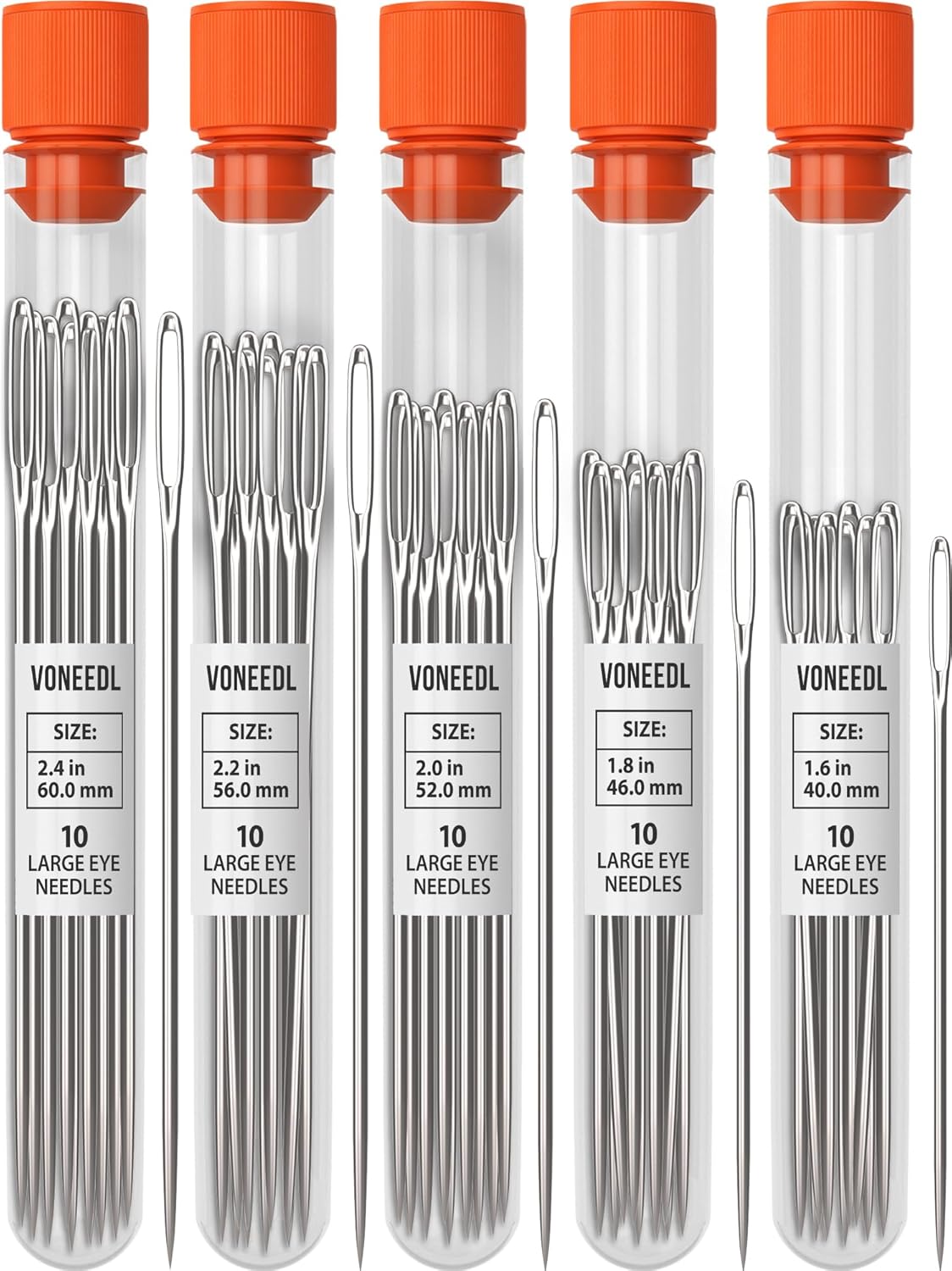 |
VONEEDL 50 PCS Large Eye Sturdy Hand Sewing Needles | Heavy-Duty Stainless Steel Needles for Thick Fabrics Includes 50 large-eye needles in 5 lengths Extra-Large Eyes for Easy Threading High-Quality Stainless Steel |
Check Price |
 |
Dritz Gold-Eye Big Stitch Quilting Needles | Gold-Eye Needles for Big Stitch Quilting Stainless steel Premium Build & Materials |
Check Price |
What to Look For Before You Buy
Match the point to the material, not just the project name
A shirt repair and a canvas repair may both be called “mending,” yet they need different levels of piercing force. Smooth woven cotton usually benefits from a finer sharp needle. Dense canvas, webbing, upholstery fabric, or layered craft material often needs a stronger shaft. If you have to push so hard that the needle bows, the needle is too light for the job or the technique needs to change.
Give the thread enough room in the eye
The eye should accept the thread without scraping it badly and without requiring the thread end to be crushed flat every few stitches. Embroidery floss, pearl cotton, wool yarn, and heavy repair thread need more room than standard all-purpose sewing thread. A large-eye assortment is useful when easy threading matters, but a very large eye is not automatically better on fine cloth.
Think about stiffness and control together
A stiff needle can feel reassuring on dense material because it transfers your pushing force directly into the point. A very rigid, thick needle is less pleasant for tiny hand stitches. On fine work, a slimmer shaft that glides with less resistance usually gives better control, provided it is not being forced through fabric it was never meant to handle.
Buy a broad assortment only if you will use the range
Multi-size kits make sense for a household repair drawer, a travel kit, or a craft room where the fabric changes from project to project. If you mostly embroider, big-stitch quilt, or sew light woven fabric, a purpose-specific pack may reduce the time spent guessing which needle to pick.
Storage is a real feature for a sharp object
Needles disappear easily in soft sewing bags and carpet. Magnetic cards, tubes, dial organizers, metal tins, and wooden cases are not just packaging decoration. Good storage helps prevent bent points, keeps sizes together, and reduces the chance of finding a loose needle the painful way.
Quantity matters less than usable sizes
Forty or fifty needles sound generous, but the useful question is how many of those needles fit your normal work. If most of your sewing uses a medium sharp needle, a smaller pack of well-matched sharps may be more practical than a bulk assortment dominated by long heavy needles.
Easy threading can be worth prioritizing
If threading is the part of hand sewing you dislike most, larger eyes, gold-colored eyes, or included threaders can make the setup less frustrating. That convenience can be more meaningful than having a very wide size range. I don’t see any benefit in buying a theoretically versatile set if you avoid using it because threading each needle feels like a chore.
When These Needle Sets May Not Be the Right Fit
The products here are all hand-sewing needles or hand-sewing assortments, but that does not mean they cover every textile task. Very fine silk, heirloom fabric, delicate appliqué, beadwork, and tightly controlled tailoring can call for narrower specialist needles than many large-eye sets provide.
Leather is another example. Some general heavy-duty needles can pierce or repair leather, but true leather hand sewing often benefits from needle and point designs chosen for the exact leather, pre-punched hole, or stitch method. If the material is expensive or the holes will remain permanently visible, test on scrap rather than treating a broad repair needle as automatically suitable.
Knitted fabric deserves similar care. A sharp hand needle can pierce yarn strands instead of slipping between them. For seaming knitwear or weaving in yarn ends, a blunt or rounded yarn needle may be more appropriate than the sharp products compared here. The main lesson is simple: the needle should cooperate with the structure of the material instead of winning a fight against it.
FIVEIZERO 80/40 PCS Large Eye Sewing Needles – A Broad Seven-Size Set for Mixed Repairs
The FIVEIZERO set is built around breadth. The 40-piece configuration combines premium stainless-steel, sharp, large-eye sewing needles in seven sizes, with lengths from about 1.57 inches to 2.6 inches, plus a needle threader. The set also uses a metal storage box rather than a loose plastic sleeve.
That range makes the set easiest to justify in a household repair drawer. You can move from a shorter needle for ordinary hand sewing to longer needles when you want more grip or need to work with thicker thread. The large eyes reduce threading friction, which is useful if one sewing kit is shared by people with different eyesight or dexterity.
The stainless-steel construction is a sensible choice for a general kit because the surface is intended to stay smooth and resist corrosion. Smoothness matters more than it sounds: a rough or damaged shaft creates drag, distorts stitch tension, and makes you compensate by pulling harder.
Seven lengths also give you a practical way to learn your own preference. Many beginners assume a longer needle is always easier to hold, then discover that a slightly shorter needle gives them better control near hems, button areas, and small repairs. The set lets you make that comparison without buying separate packets.
The trade-off is specialization. These are large-eye sharp needles, not fine tailoring sharps, blunt tapestry needles, or a dedicated quilting design. The longer and thicker choices can be useful on sturdy fabric, but they are not where I would start on very delicate woven material. The broad assortment earns its place by flexibility, not by being the most refined needle for every stitch.
Key features translated into practical benefits
The seven-size spread is the practical feature here because it changes both reach and hand control. Shorter needles are easier to steer for ordinary repairs, while the longer options provide more grip for darning and craft work. The large eyes reduce threading difficulty, and the metal box matters because forty sharp needles are far more useful when they stay sorted and contained.
- The seven-size assortment gives a repair kit useful reach across ordinary sewing, darning, embroidery-style work, and thicker threads.
- Large eyes and an included threader reduce the most common setup frustration before stitching begins.
- Stainless-steel construction and smooth shafts are suited to repeated general hand sewing.
- The metal storage box keeps a large number of sharp needles contained and easier to locate.
- The largest needles are too substantial for delicate cloth.
- A broad assortment is less focused than a purpose-made embroidery or quilting pack.
Who It’s Best For
This set is best for a household, dorm, travel repair kit, or craft drawer where the next job could be a hem, a patch, a decorative stitch, or a thicker repair.
Not Ideal For
It is not the strongest fit for someone who almost always sews fine garments or wants one very specific hand-needle geometry rather than a wide assortment.
SINGER Large Eye Hand Needles On Magnet, 12-Count – Thick Shafts and Easy Storage for Heavier Thread
SINGER model 01824 is a focused large-eye set rather than a general fine-needle pack. It contains 12 needles in sizes 18 through 22, made from nickel-plated steel, with extra-long eyes, sharp points, and comparatively thick shafts. The needles are supplied on a decorative magnetic holder.
Those details tell you how the set wants to be used. A thick shaft and extra-long eye make sense with heavier thread and more resistant woven materials such as canvas, tapestry work, wool, and sturdy repair fabric. You get more to hold, and the thread gets more room through the eye.
The magnet is more than a novelty. Hand sewing often involves setting a needle down repeatedly while you trim thread, reposition fabric, press a seam, or answer the door. A magnetic holder gives the needle an obvious place to return to and makes dropped needles easier to collect from a metal work surface.
The sizes 18 through 22 should not be read as a promise that the set spans every possible hand-sewing job. These are large-eye, sturdy needles. That makes them comfortable with thicker threads but less graceful on lightweight cotton, fine lining fabric, or small invisible repairs where the hole left by the shaft matters.
For a crafter who uses embroidery floss, yarn-like thread, tapestry materials, or heavy mending thread, this SINGER set is easier to understand than a 40-piece mixed pack. Every needle follows the same basic idea, so there is less sorting and less chance of reaching for a very fine needle that is unsuited to the job.
Key features translated into practical benefits
SINGER combines three features that all point toward heavier hand sewing: a thick shaft, a sharp point, and an extra-long eye. The shaft gives your fingers something substantial to control, the point pierces sturdy woven material, and the eye accepts thicker thread without forcing it through a tiny opening. The magnet then gives the needle a safe parking place between stitches.
- Extra-long eyes make the needles easier to thread with thicker sewing and craft threads.
- Thick shafts give better hand feel and resistance to bending on sturdy woven materials.
- The sharp points suit fabric that needs to be pierced rather than pushed apart with a blunt yarn needle.
- The magnetic holder gives the set practical, visible storage between stitches.
- The thick shafts can leave unnecessarily large holes in delicate fabric.
- The set is intentionally narrow in purpose compared with a mixed-size repair assortment.
Who It’s Best For
This SINGER pack suits people who regularly sew with heavier thread, mend sturdy woven items, or prefer a needle that feels substantial between the fingers.
Not Ideal For
It is not ideal for fine hand hemming, delicate garment fabrics, or very small nearly invisible stitches where a slimmer sharp would be more appropriate.
elcprocy Large Eye Sewing Needles, 25-Piece Set with Wooden Case – Five Lengths With a Protective Case
The elcprocy set contains 25 sharp, large-eye stainless-steel needles in five lengths – about 1.6, 1.8, 2.0, 2.2, and 2.36 inches – plus a carved sandalwood-and-brass needle case. It is a compact craft-focused assortment with more emphasis on easy threading and storage than on very fine garment work.
The useful difference here is not simply that the pack contains many needles. It gives five clear length choices while keeping the same large-eye, sharp-point concept. If you like easy threading but are not sure how long a needle feels comfortable in your hand, that range offers useful experimentation.
The wooden case is also a more durable storage idea than thin card packaging. It protects points from rubbing around a drawer and gives the needles a single home. For a compact sewing basket, that can matter because loose needles tend to migrate into thread spools, fabric scraps, and pin cushions where size distinctions become hard to remember.
Large eyes work especially well with embroidery floss, visible mending thread, and other threads that feel cramped in a fine sharp. The caution is fabric penetration. The needle still has to pull its widest eye section through the cloth. On dense fine weaves, using the smallest needle and the least bulky thread that does the job will usually give a cleaner result.
The set is often marketed for leather as well as embroidery and hand sewing, but leather deserves judgment. A sharp stainless-steel needle can be useful for some repairs, especially where holes already exist, yet thick or valuable leather may need a dedicated leather point or pre-punched holes. I would not use a broad claim on a listing as permission to force any needle through any hide.
Key features translated into practical benefits
Five graduated lengths let you change leverage without abandoning the same large-eye, sharp-point format. The stainless-steel shafts are intended to stay smooth through repeated use, while the hard wooden case protects points that would otherwise rub against other sewing notions. This is a set where storage and handling are as important as quantity.
- Five needle lengths provide useful control choices without changing to a completely different needle style.
- Large eyes are friendly to embroidery floss, visible-mending thread, and users who dislike tiny eyelets.
- Stainless-steel construction supports smooth general sewing and craft use.
- The sandalwood-and-brass case protects points and keeps the set contained in a sewing kit.
- The large-eye design is bulkier than a fine sharp for delicate fabric.
- The decorative case adds value mainly if you actually want compact hard storage.
Who It’s Best For
This set is a good match for crafters who want easy-threading sharp needles in several lengths and appreciate a small hard case for storage.
Not Ideal For
It is not ideal for the finest garment sewing or for people who need true blunt tapestry needles rather than sharp sewing points.
Dritz 9624D Assorted Heavy Duty Hand Needles – A Seven-Needle Repair Pack for Tougher Materials
Dritz 9624D is the most clearly repair-oriented product in the group. It is a seven-piece assortment of heavy-duty hand needles intended for upholstery, tapestries, and similar robust sewing jobs. The pack contains assorted sizes and styles rather than seven identical needles, with a nickel finish.
That assorted-shape approach is useful when the problem is access as much as penetration. Heavy repair work can involve awkward seams, thick folded edges, cushions, canvas, or layered materials where a normal straight dressmaking needle is difficult to position. A small heavy-duty pack gives you tools chosen for those situations without filling a box with dozens of duplicates.
Strength is the main benefit. On resistant material, a fine needle can flex enough that you start pushing sideways, which is uncomfortable and unsafe. A heavier repair needle gives you a larger shaft to control. Even so, a thimble or another proper pushing aid is often more important than simply gripping harder.
This set is not a substitute for ordinary sharps. The diameter and shapes that make heavy-duty needles useful can be clumsy on a shirt cuff, lining, quilting cotton, or small hand-finished seam. If the fabric is light enough that a standard sharp passes through without resistance, using the heavy needle only creates larger holes and more hand fatigue.
I would choose Dritz 9624D for a repair drawer that already contains normal sewing needles. It adds capability rather than replacing the basics. That is a more sensible role than treating it as an all-purpose pack just because “heavy duty” sounds stronger.
Key features translated into practical benefits
The useful feature is not a single measurement but the assorted heavy-duty shapes. Different repair angles can require a different needle profile, especially around upholstery seams and thick folded fabric. A stronger shaft gives you more confidence under resistance, but the pack works best when you select the shape that gives a straight, controlled push rather than forcing the first needle you grab.
- The assorted heavy-duty shapes are aimed at upholstery, tapestry, and repair tasks that ordinary fine sharps do not handle comfortably.
- A seven-piece pack is compact and purpose-focused instead of making you sort through a large quantity of similar needles.
- Stronger shafts give better control when fabric resistance would make a fine needle flex.
- The assortment is useful as a companion to a normal sewing kit for occasional tough repairs.
- These needles are too heavy for fine garment work.
- The small pack offers less redundancy if one favorite shape gets lost.
Who It’s Best For
This set is best for upholstery touch-ups, sturdy canvas repairs, tapestry work, and other jobs where ordinary hand needles feel too flexible or too small to control.
Not Ideal For
It is not ideal as your only hand-sewing pack if most of your work is clothing, lightweight cotton, appliqué, or detailed embroidery.
JekiiNova 30 Pack Premium Hand Sewing Needles – Easy Threading With a Dial Organizer
JekiiNova model IGYPZ contains 30 sharp hand-sewing needles in six lengths, made from 304 stainless steel, with gold-plated ends, a pink dial-style organizer, and two needle threaders. The set is designed around easy threading and organized size selection for mixed repair work.
The organizer is the feature that separates this set from a loose bulk pack. Needle assortments become much less useful once the sizes are mixed together. A dial organizer lets you keep length groups separated, so the next repair begins with choosing a needle rather than comparing loose metal shafts on a table.
The listing’s “gold plated” language needs to be read carefully. It describes the end area as gold plated; it does not mean the entire needle is made from gold or that plating changes the basic job of the stainless-steel shaft. The practical benefit is visibility around the eye, while the stainless body does the real piercing work.
Two threaders are useful because threaders are small consumable tools that can bend or disappear. The enlarged eyes may already be easier to use than fine eyes, but a threader still helps with soft, fuzzy, dark, or multi-strand thread whose cut end refuses to stay compact.
Like the FIVEIZERO set, this is primarily a flexible household assortment. It can cover mending, craft sewing, some embroidery, and sturdy repairs, but it does not turn every needle in the organizer into a specialist tool. For repeated fine embroidery or big-stitch quilting, a dedicated needle shape can still feel more controlled.
Key features translated into practical benefits
The dial organizer turns a 30-piece assortment into something you can actually navigate. Six lengths cover different hand positions and fabric resistance, the large eyes reduce threading strain, and the two separate threaders help with fuzzy or multi-strand thread. The gold-colored end adds eye visibility, while the stainless shaft remains the working part that passes through the fabric.
- Thirty needles in six lengths provide useful choice for mixed household sewing and craft repairs.
- The dial organizer keeps different lengths separated and reduces loose-needle clutter.
- Large eyes plus two included threaders make setup easier with a wide range of threads.
- stainless-steel construction gives the set a smooth, corrosion-resistant base material for routine use.
- The broad assortment is less specialized than a dedicated embroidery or quilting pack.
- The longest and heavier needles are unnecessary for delicate fabric.
Who It’s Best For
This set suits a general sewing kit where organization and easy threading matter as much as having several needle lengths available.
Not Ideal For
It is not ideal if you already know that you use one narrow needle type almost exclusively and do not need a large mixed assortment.
DMC 1765-5 Embroidery Hand Needles, 15-Pack, Size 5 – Long Eyes for Multi-Strand Embroidery Thread
DMC 1765-5 is a much more specific product than the general repair packs. It contains 15 size 5 embroidery hand needles made from premium-grade nickel-plated steel, with a long eye for threading multiple strands and a very sharp point intended to pierce closely woven fabric.
That long eye is the reason to choose an embroidery needle instead of squeezing floss through a small standard eye. Embroidery often uses more than one strand at a time, and the eye must hold the bundle without scraping or flattening it badly. A longer eye creates room while keeping the needle shape relatively streamlined.
The sharp point also makes sense for surface embroidery on woven fabric because the stitch needs to enter exactly where the design calls for it. You are not simply following an existing gap in the weave. Precise piercing helps keep outlines, satin-stitch edges, and small details where you planned them.
Size 5 is a deliberate single-size choice. That is good if you already know this size suits your thread and fabric, because every needle in the pack feels familiar. It is less flexible if your embroidery jumps between very fine single-strand work and bulky threads, so the pack makes the most sense when your usual floss and fabric already suit this needle size.
DMC’s guidance to use the finest needle that comfortably carries the chosen thread is sensible. A needle should not be so small that the thread is crushed in the eye, but it also should not open a larger hole than the thread needs. That balance is one of the easiest ways to make hand embroidery look cleaner.
Key features translated into practical benefits
DMC’s long eye is designed around multiple strands of embroidery floss, so the thread can lie in the eye without being crushed as severely as it might be in a small standard eye. The sharp point supports accurate placement in woven fabric, and the repeated size 5 format gives consistent handling across the whole pack.
- The long eye accommodates multiple strands of embroidery floss more comfortably than a small standard eye.
- The sharp point gives precise entry into closely woven fabric for controlled decorative stitches.
- Nickel-plated steel provides the smooth surface expected from a purpose-built embroidery needle.
- A 15-pack of the same size is useful for stitchers who prefer consistent handling rather than mixed lengths.
- One size offers less flexibility across very different thread weights.
- The sharp embroidery point is not intended for yarn work that needs a blunt tapestry needle.
Who It’s Best For
DMC 1765-5 suits hand embroiderers using stranded floss on woven fabrics who want a long eye, sharp point, and consistent size across the pack.
Not Ideal For
It is not ideal as a complete household repair set or for thick upholstery, leather repair, knitting seams, and other jobs far outside normal embroidery work.
Bohin Sharps Hand Needles, Size 3/9, 20 Per Package – Traditional Sharps for Light and Medium Fabrics
The Bohin pack contains 20 sharps in a size 3/9 assortment intended for ordinary sewing of light and medium materials. That positioning makes Bohin the most conventional everyday “sharp” option in this group rather than another oversized large-eye repair set.
Sharps are useful because their proportions are familiar: a pointed tip, a relatively slim shaft, and a shape designed for ordinary hand stitching. That makes them a strong fit for hems, seams, small mending, attaching trims, light patching, and many basic fabric tasks where a bulky large-eye needle feels oversized.
The size 3/9 labeling indicates an assortment rather than one single needle size. Within a sharps range, that gives you room to choose a needle according to the cloth and thread. Use the finer needle that still carries the thread comfortably for lighter fabric, then move toward the more substantial end of the assortment as resistance increases.
The advantage of a traditional sharp becomes obvious when you want small stitch holes. The eye and shaft are not designed around very thick yarn, so the needle can pass through light woven fabric with less disruption than a heavy repair needle. That can make hand-finished hems and discreet mends look more controlled.
The trade-off is threading. A standard sharp does not give you the oversized eye found on several other products here. If eyesight or hand steadiness makes a small eye frustrating, pair the needle with a threader rather than jumping to a much thicker needle simply because it is easier to thread.
Key features translated into practical benefits
The 3/9 sharps assortment is useful because it stays within one familiar hand-sewing style while still giving size choice. Finer sharps can reduce visible holes on lighter cloth, while the more substantial needles in the same pack handle medium woven fabric with less flex. This is a control-first set rather than an easy-threading oversized-eye set.
- Traditional sharps are well suited to ordinary hand sewing on light and medium woven fabrics.
- The 3/9 assortment gives useful size choice without mixing in unrelated heavy-duty needle shapes.
- Slimmer needle proportions can leave cleaner holes than oversized repair needles on garment fabric.
- A 20-needle pack provides useful redundancy for a frequently used everyday sewing tool.
- The smaller eyes are less convenient with thick thread or limited dexterity.
- These sharps are not designed for heavy upholstery-style resistance.
Who It’s Best For
Bohin sharps are best for regular clothing repairs, hems, hand finishing, and general woven-fabric sewing where you want a familiar sharp needle rather than a heavy craft needle.
Not Ideal For
They are not ideal for people whose main priority is an extra-large eye or for jobs involving thick yarn, dense upholstery, or very heavy repair thread.
VONEEDL 50 PCS Large Eye Sturdy Hand Sewing Needles – Bulk Large-Eye Needles in Five Lengths
VONEEDL offers this 50-piece large-eye sharp hand-sewing set in five lengths around 1.57, 1.8, 2.0, 2.2, and 2.36 inches. The set combines large eyes with organized tube storage, making it more practical for bulk use than a loose packet of mixed needles.
Fifty needles is genuinely useful only if you expect to use, share, lose, or distribute a lot of needles. For classrooms, community craft sessions, group sewing, multiple repair kits, or a busy maker space, bulk quantity can be more practical than a small premium packet. For one person who sews once a month, the quantity itself should not drive the decision.
The large eyes make these needles friendly to thicker thread and to people who want easier threading. The five-length spread also gives enough variation for ordinary stitching, darning, embroidery-style craft work, and repairs where a longer grip is useful.
The product is sold as a sturdy sharp set rather than delicate sharps. That wording matches its most sensible use. If you are repairing clothing, craft fabric, blankets, or sturdier textiles, the larger needle format can feel comfortable. If you are making tiny hand stitches on fine lawn or silk, the same generous eye and shaft can feel clumsy.
Bulk sets also make storage discipline more important. A fifty-needle purchase becomes a liability if half the needles end up loose in drawers. Keep the length groups in their supplied tubes or another labeled organizer, and return a needle immediately after use. That habit matters more than the original package count.
Key features translated into practical benefits
VONEEDL combines bulk quantity with five lengths and large eyes. That makes the set practical for shared craft spaces and frequent repairs where needles are used often, while the multiple lengths let each user find a comfortable grip. The organized tubes matter because a bulk pack becomes difficult to use if the lengths are mixed together.
- Fifty needles provide useful supply for shared workspaces, frequent repairs, or multiple sewing kits.
- Five lengths give practical handling options without mixing in completely different needle families.
- Large eyes reduce threading frustration with thicker thread and multi-strand craft work.
- Tube-based storage helps keep a bulk supply contained and easier to organize.
- The bulk quantity is unnecessary for occasional fine sewing.
- Large-eye sturdy needles can feel oversized on delicate cloth.
Who It’s Best For
This VONEEDL set makes the most sense for frequent crafters, shared sewing spaces, repair kits, and users who value easy threading and a generous supply.
Not Ideal For
It is not ideal for highly refined fine-fabric handwork where the smallest possible needle hole and a very slim shaft matter more than quantity.
Dritz Gold-Eye Big Stitch Quilting Needles, Size 5, 12 Count – Purpose-Built for Bold Hand Quilting
Dritz Gold-Eye Big Stitch Quilting Needles are the most specialized choice in the list. The pack contains 12 size 5 needles designed for big-stitch or bold-hand quilting, with gold-colored long eyes sized for heavier size 8 pearl cotton, sharp points for quilt layers, and a glass storage tube.
Big-stitch quilting asks for a different balance from tiny traditional quilting stitches. The thread is intentionally visible and heavier, so the needle eye has to accommodate it. The long eye reduces abrasion on pearl cotton and makes threading less fiddly, while the sharp point still has to penetrate the quilt top, batting, and backing.
The gold eye is mainly a visibility aid. A contrasting eye is easier to find under craft lighting and can make threading simpler, especially against silver needle shafts. It does not replace good lighting, but it is a thoughtful detail on a needle that is repeatedly threaded with relatively thick cotton.
Size 5 keeps the pack consistent. Once you have adjusted your hand to a needle length and thickness, repeating the same motion across a quilt can feel more predictable than switching among assorted needles. The glass tube also makes sense for quilters who transport handwork between rooms, classes, or travel bags.
This is not the needle I would buy for invisible garment mending. Its entire purpose is visible, longer quilting stitches with thicker thread. That narrow role is actually its strength: if big-stitch quilting is the job, you are not paying for dozens of unrelated repair needles you will never use.
Key features translated into practical benefits
The long gold-colored eye is the key design choice because big-stitch quilting uses thicker thread than fine hand quilting. Dritz pairs that roomier eye with a sharp point for passing through quilt top, batting, and backing, then stores the matching size 5 needles in a glass tube so they remain together between quilting sessions.
- The long eye is specifically designed to carry heavier pearl cotton used for bold hand quilting.
- The sharp point is suited to penetrating layered quilt construction rather than only a single thin fabric.
- The gold eye improves visibility during threading.
- Twelve matching size 5 needles and a glass tube create a focused, easy-to-store quilting set.
- The specialized size and eye are unnecessary for fine invisible mending.
- This pack offers no size variety for people who switch between different quilting thread weights.
Who It’s Best For
These Dritz needles are best for quilters using big-stitch techniques with heavier pearl cotton who want a purpose-built needle rather than a general repair assortment.
Not Ideal For
They are not ideal as a first all-purpose sewing needle pack because ordinary hems, buttons, and fine repairs do not need the big-stitch design.
Choosing Among the Nine Sets Without Overcomplicating It
If your sewing changes every week, the FIVEIZERO and JekiiNova assortments make the strongest practical argument. Both give multiple lengths and easy-threading features, so they work well in a general repair box. FIVEIZERO leans into a seven-size spread and metal-box storage, while JekiiNova adds a dial organizer and two threaders. VONEEDL takes the bulk route: it is more compelling when quantity itself matters.
For heavier thread and sturdy woven materials, the SINGER 01824 set is easier to understand than a huge assortment. Its thick shafts, sharp points, and extra-long eyes are intentionally designed around heavier hand-sewing work. Dritz 9624D goes further toward repair work by offering a compact assortment of heavy-duty needle styles for upholstery, tapestry, and similar resistant materials.
For ordinary garment sewing on light and medium woven cloth, Bohin Sharps are the most traditional choice here. They do not prioritize huge eyes or thick shafts, which is exactly why they can feel cleaner and more controlled for hems, hand finishing, and small mends.
For decorative needlework, DMC 1765-5 and Dritz Gold-Eye Big Stitch needles solve two different problems. DMC’s size 5 embroidery needle uses a long eye and sharp point for multi-strand floss on woven fabric. The Dritz size 5 big-stitch quilting needle is designed around heavier pearl cotton and layered quilt construction. They may look similar at a glance, but the thread weight and stitch style are different enough that I would not treat them as interchangeable.
The elcprocy set sits between a craft assortment and a storage-focused kit. Its five lengths and large eyes make it useful across embroidery, mending, and general craft sewing, while the wooden case is appealing if you want hard storage that can live in a small sewing basket.
If you are still undecided, choose by the job you do most often, not the job you might do once. The needle that comes out of the box every week is a better purchase than a larger set that spends most of its life untouched.
How to Get Better Results From Hand-Sewing Needles
1. Inspect the fabric before choosing the needle
Feel the fabric and look at the weave. A loose weave usually accepts a needle more easily than a tightly packed canvas or coated textile. If the cloth is delicate, start with the finest practical sharp needle rather than a thick large-eye needle simply because it is easier to thread.
2. Match the eye to the thread
Cut a clean thread end and pass it through the eye without forcing it. The thread should move through the eye without severe scraping. If it frays immediately, step up to a roomier eye or reduce the thread thickness rather than continuing with a poor match.
3. Use a sensible thread length
Very long thread looks efficient because you need fewer rethreads, but it twists, knots, and abrades as it repeatedly passes through fabric. A manageable arm-length section is usually easier to control. For embroidery floss, separate and recombine strands cleanly before threading so they enter the eye together.
4. Stabilize the fabric instead of gripping harder
Good hand sewing comes from controlled fabric, not white-knuckle pressure on the needle. Support the work on a table, hoop it when the technique calls for a hoop, or hold the seam so the entry and exit points stay visible. Then push in the direction of the needle shaft rather than sideways against it.
5. Use a thimble for resistant fabric
If the needle needs real pushing force, protect the finger doing the pushing. Place the eye end against the thimble and drive the needle forward in line with the shaft. Then pull from the point side. This reduces the temptation to pinch the needle tightly and bend it between your fingers.
6. Let the needle make a hole appropriate to the thread
If the needle is much thicker than the thread, the fabric hole can remain visible after the stitch tightens. If the needle is too fine for the thread, the thread rubs aggressively through the fabric and eye. The goal is a needle large enough to carry the thread comfortably but not so large that it creates unnecessary damage.
7. Keep stitch tension even
Pull the thread until the stitch lies flat, then stop. Over-tightening can pucker fabric, distort quilt layers, and enlarge needle holes. The correct needle makes good tension easier because the thread passes through the fabric with less friction.
8. Stop when the needle stops behaving normally
A needle that suddenly drags, catches, bends, or makes a faint scraping sensation may have a damaged point or surface. Do not keep sewing until it snaps. Replace it, then check whether the fabric resistance is asking for a stronger needle style.
Keeping Needles Smooth, Straight, and Easy to Find
Needles do not need complicated maintenance, but they do need clean, dry storage. Wipe a needle after working with fabric that carries sizing, wax, adhesive residue, or hand oils. Then let it dry before returning it to a closed tube, tin, or case.
Store needles by type or size when possible. A mixed pile defeats the purpose of buying an assortment because you cannot reliably choose the same tool twice. The dial organizer in the JekiiNova set, the SINGER magnet, the FIVEIZERO metal box, the VONEEDL tubes, the elcprocy wooden case, and the Dritz quilting glass tube all solve this problem in different ways.
Do not try to straighten a visibly kinked needle for precision sewing. Metal can fatigue after bending, and a needle that looks nearly straight may still flex unpredictably at the weakened point. Replacing one needle is cheaper than repairing torn fabric or dealing with a broken point.
A dull point is another reason to retire a needle. If a sharp needle that once entered smoothly starts pushing threads aside, making a popping sound, or requiring more force, compare it with a fresh needle from the same pack. The difference is often obvious.
Keep needles away from damp bathrooms, open drinks, and humid storage areas. Stainless steel and plated steel offer useful corrosion resistance, but no sewing needle benefits from being stored wet. A dry case also protects threaders, magnets, and other small notions kept nearby.
Small Needle Choices That Cause Big Sewing Problems
Reaching for the largest eye every time
A large eye is convenient, especially with dark thread or tired eyes, but convenience has a physical cost. The eye area is wider and has to pass through the fabric. On fine cloth, choose only as much eye as the thread needs.
Using a heavy repair needle for lightweight fabric
A sturdy needle can feel safer because it does not flex, yet it may leave holes that a fine sharp would avoid. Heavy-duty tools are for resistance. If a normal sharp enters the fabric easily, there is no advantage in making the hole larger.
Choosing by length without thinking about control
Long needles are not automatically easier. They provide more grip but also create more leverage, which can exaggerate sideways pressure. If your stitches wander or the needle bends, try a shorter option from the same set and keep the push aligned with the shaft.
Pulling fuzzy thread through a tight eye
If the thread frays during threading, it will usually continue to abrade while sewing. Recut the end, reduce the number of strands, use a threader, or move to a needle with a longer or larger eye. Starting with damaged thread only creates weak, untidy stitches.
Treating all sharp needles as leather needles
Some large-eye sets are marketed for leather repair, but leather keeps the holes you make. Test the needle and stitch method on scrap or an inconspicuous area, especially if the leather is finished, thick, or valuable. Forcing a conventional sharp through resistant leather can bend the needle and leave an ugly hole.
Sewing with a bent needle because it still works
A slight bend changes the direction of force and increases the chance of the needle slipping or breaking. Discard bent needles safely. Do not keep a visibly damaged sharp object in the same case as good needles.
Leaving needles loose on the work surface
The most expensive needle in the article is still cheap compared with a foot injury, damaged vacuum, or frightened pet. Put the needle into a magnet, pin cushion, tube, case, or fabric parking spot every time you pause.
Needle Safety Around Worktables, Children, and Pets
Hand-sewing needles are small enough to disappear and sharp enough to cause puncture injuries. Keep the active needle in the work, a pin cushion, or a magnetic holder rather than setting it flat on a table where it blends into fabric or paper.
Count needles when working with children, group classes, or shared craft spaces. A simple start-and-finish count is more reliable than assuming every needle found its way back into the box. Closed containers are better than open dishes for long-term storage.
Use a thimble for repeated pushing, especially with the SINGER and Dritz heavy-duty needles where the material may resist. Do not push the point toward your palm or another person. If a needle is stuck, change your grip and fabric support rather than adding sudden force.
Dispose of bent, rusty, or broken needles in a rigid container that cannot be pierced. A small lidded tin or sharps-safe container is better than dropping them directly into a thin trash bag. If a needle breaks during sewing, stop and locate every piece before continuing.
Frequently Asked Questions About Hand-Sewing Needles
Which needle is easiest to thread?
Large-eye and long-eye designs are generally easier to thread than traditional fine sharps. The FIVEIZERO, SINGER, elcprocy, JekiiNova, VONEEDL, DMC embroidery, and Dritz big-stitch products all increase eye space in different ways. The right choice still depends on how thick your thread is and how fine the fabric needs the needle to be.
Are large-eye needles good for normal clothing repairs?
They can be, especially on medium fabric and with thicker thread, but the largest versions may make more visible holes than necessary. For fine hems and discreet garment repairs, a traditional sharp such as the Bohin assortment is often a cleaner starting point.
What is the difference between an embroidery needle and an ordinary sharp?
Embroidery needles typically provide a longer eye so multiple strands of floss can pass through comfortably while retaining a sharp point for woven fabric. Ordinary sharps prioritize a slim general-sewing profile. The DMC 1765-5 is a good example of the embroidery approach.
Why would I buy heavy-duty hand needles?
Heavy-duty needles make sense when normal needles flex or feel difficult to control in upholstery, canvas, tapestry, and other resistant materials. Dritz 9624D is specifically positioned for that kind of work. Use the heavier needle because the material requires it, not because thicker automatically means better.
Are the Dritz big-stitch quilting needles useful for ordinary quilting?
They are designed specifically for visible big-stitch quilting with thicker thread such as size 8 pearl cotton. If you want tiny traditional quilting stitches, a different quilting needle profile may suit that technique better. The product earns its place here because it solves a specific hand-quilting need, not because it is universal.
How do I know a hand needle is too large for my fabric?
Watch the hole after the needle passes through. If the hole remains obvious after the thread settles, the needle may be larger than necessary. Excess resistance as the eye passes through is another sign that the needle and thread combination is too bulky for the weave.
How often should a hand-sewing needle be replaced?
There is no useful project-count rule that applies to every material. Replace a needle when the point becomes dull, the shaft bends, the surface corrodes, or the needle begins to drag more than a fresh one. Heavy fabric and abrasive thread can wear a needle faster than light cotton sewing.
Can one needle set cover embroidery, mending, quilting, and upholstery?
A broad assortment can cover many occasional jobs, but no single needle shape is equally good at all four. Large general sets are convenient for mixed repairs; purpose-built DMC embroidery, Bohin sharps, Dritz heavy-duty, and Dritz big-stitch quilting needles make more sense when one technique dominates your sewing.
Choosing the Best Needles for Hand Sewing for Your Own Projects
The best needles for hand sewing are the ones that make the fabric feel manageable without creating bigger holes, more hand strain, or more threading frustration than the stitch requires. For a mixed repair box, the larger FIVEIZERO, JekiiNova, and VONEEDL assortments give useful flexibility.
SINGER and Dritz 9624D make more sense as work becomes heavier. Bohin sharps favor ordinary light-to-medium sewing, DMC focuses on embroidery, and Dritz Gold-Eye Big Stitch needles are deliberately built around bold hand quilting.
I would choose based on the fabric and thread you use most, then treat storage and pack size as secondary benefits. If easy threading is your biggest obstacle, prioritize eye design. If bent needles are the problem, move toward a stronger shaft. If visible holes bother you, move toward the finest sharp that still carries your thread cleanly.
Once you know those three preferences, the product descriptions become much easier to read. Compare the nine options above against the sewing you actually do, check the current selected pack details, and choose the needle that gives you the most control with the least unnecessary resistance.