A miniature can look almost finished and still fall apart at the last few millimeters. An eye that spreads beyond the socket, a bright edge highlight that turns into a thick stripe, or a wash that dries in the ferrule can undo careful work surprisingly fast. The brush is only one part of the result, but at miniature scale its point, paint capacity, spring, and handle control become very easy to notice.
That is why the best paint brushes for miniature painting are not automatically the smallest brushes on the desk. A useful brush needs to carry enough paint to complete a controlled stroke, return to a point after contact, and feel predictable while you rotate a figure under the light. For some jobs, a size 1 or 2 with a good point is easier to control than a very short 000. For drybrushing, a pointed detail brush is the wrong shape altogether.
I also think a brush set should earn its space. I don’t want twenty tools that all do nearly the same thing if five carefully chosen shapes would cover the work better. At the same time, inexpensive duplicate detail brushes can be practical when you paint frequently and know that fine tips eventually wear.
The ten products here take different approaches to that balance, from broad detail assortments to a simple three-brush starter set and one wet-palette kit that includes its own miniature brushes.
Why Tiny Paint Jobs Expose Weak Brushes So Quickly
Miniature painting compresses several painting problems into a very small area. A brush has to place pigment accurately, release it smoothly, and stop when your hand stops. If the point forks, the ferrule wobbles, or the belly holds too little paint, the problem becomes visible much sooner than it would on a large canvas.
The point matters more than the number printed on the handle
Brush sizes are not perfectly standardized across brands. A size 0 from one maker may not match a size 0 from another, and a 3/0 can be useful or frustrating depending on the length and shape of its hair. That means the number is a starting reference, not a guarantee of how fine a line the brush will produce.
For miniature work, a well-shaped point is usually more important than buying the tiniest possible brush. A larger round with a sharp point can hold more paint and still touch a small rivet, eye lens, belt buckle, or armor edge. Because it carries more paint, you often get a longer working stroke before the acrylic begins to dry at the tip.
Very small liners still have a place. They are useful for tiny marks, narrow recesses, freehand accents, and controlled line work. The catch is that their small paint load dries quickly, so they demand better paint consistency and faster cleaning.
The belly controls how long a stroke stays usable
The belly is the fuller section of hair behind the point. It acts as a small reservoir. A brush with almost no belly may make a tiny first mark but can run dry before you finish a longer edge or curved highlight. A brush with too much belly for the job can carry more paint than you want near a delicate feature.
This is why a range of round sizes is useful. A size 1 or 2 can handle layering, controlled base coats, and many highlights, while a 0 or smaller brush can take over when clearance becomes tight. The brush should be chosen by the amount of paint and access you need, not by the assumption that smaller always means more accurate.
Spring and softness change the feel of the stroke
Synthetic fibers dominate the sets in this guide. Their behavior varies, but they generally offer a predictable snap back after a stroke and are practical with the water-based acrylic paints commonly used on miniatures. A springier tip can feel direct for edge work and short controlled strokes. A softer brush can make smoother transitions easier but may feel less precise if it bends too readily under pressure.
Neither feel is automatically better. The useful question is whether the brush responds the way your technique expects. If you paint with the tip and use very light pressure, point retention matters most. If you pull longer lines, both spring and paint capacity become important.
Shape determines the job a brush does comfortably
Round brushes handle most miniature tasks because a pointed round can make fine marks while its belly still carries paint. Liners or riggers use longer, narrower hair for extended lines and are useful for freehand, weapon edges, cables, or decorative markings. Flats cover small planar surfaces efficiently and can make crisp bands when the edge is controlled.
Angled brushes help approach edges or recesses from a different direction. Filberts soften the corners of a flat shape. Dedicated drybrushes are usually broader and firmer because drybrushing is a scrubbing and catching technique rather than a fine-point technique.
A set with several shapes makes sense if you actually use those techniques. A set made almost entirely of rounds can be more efficient for a painter who layers, glazes, and details but rarely uses specialized shapes.
Handle design affects control more than it seems
A miniature painter often holds the brush close to the ferrule. A short or moderately sized handle can therefore feel more natural than a long traditional art handle. Triangular grips, used on several products here, give the fingers flat contact surfaces and stop the brush from rolling across the desk.
Round handles are not a problem. Many experienced painters prefer them because they rotate smoothly between the fingers, which helps maintain a point while following a curved edge. The better choice depends on whether you value an indexed grip or easy rotation.
| Product Image | Product Name | Features | Price |
|---|---|---|---|
 |
ARTEZA Detail Paint Brushes | Includes liners, rounds, and flats in sizes 4/0, 3/0, 2/0, 0, and 1 Ideal for Miniatures & Detail Work Maintain shape and precision Nickel-Plated Copper Ferrules |
Check Price |
 |
ARTEGRIA Detail Paint Brush Set | Designed for better control and reduced hand fatigue Ideal for All Skill Levels Works beautifully with acrylics, watercolors, oils, and more Crafted for long-term use with high-quality bristles and stylish finish |
Check Price |
 |
Grabie Paint Brush Set | Includes ultra-fine 5/0 to size 7 brushes Performs flawlessly with acrylics, oils, watercolors, and more Handmade with premium nylon filaments |
Check Price |
 |
The Army Painter | 3 Essential Brushes Designed for Miniature Painting Standard brush delivers consistent base coats across small surfaces High-quality construction ensures long-term use |
Check Price |
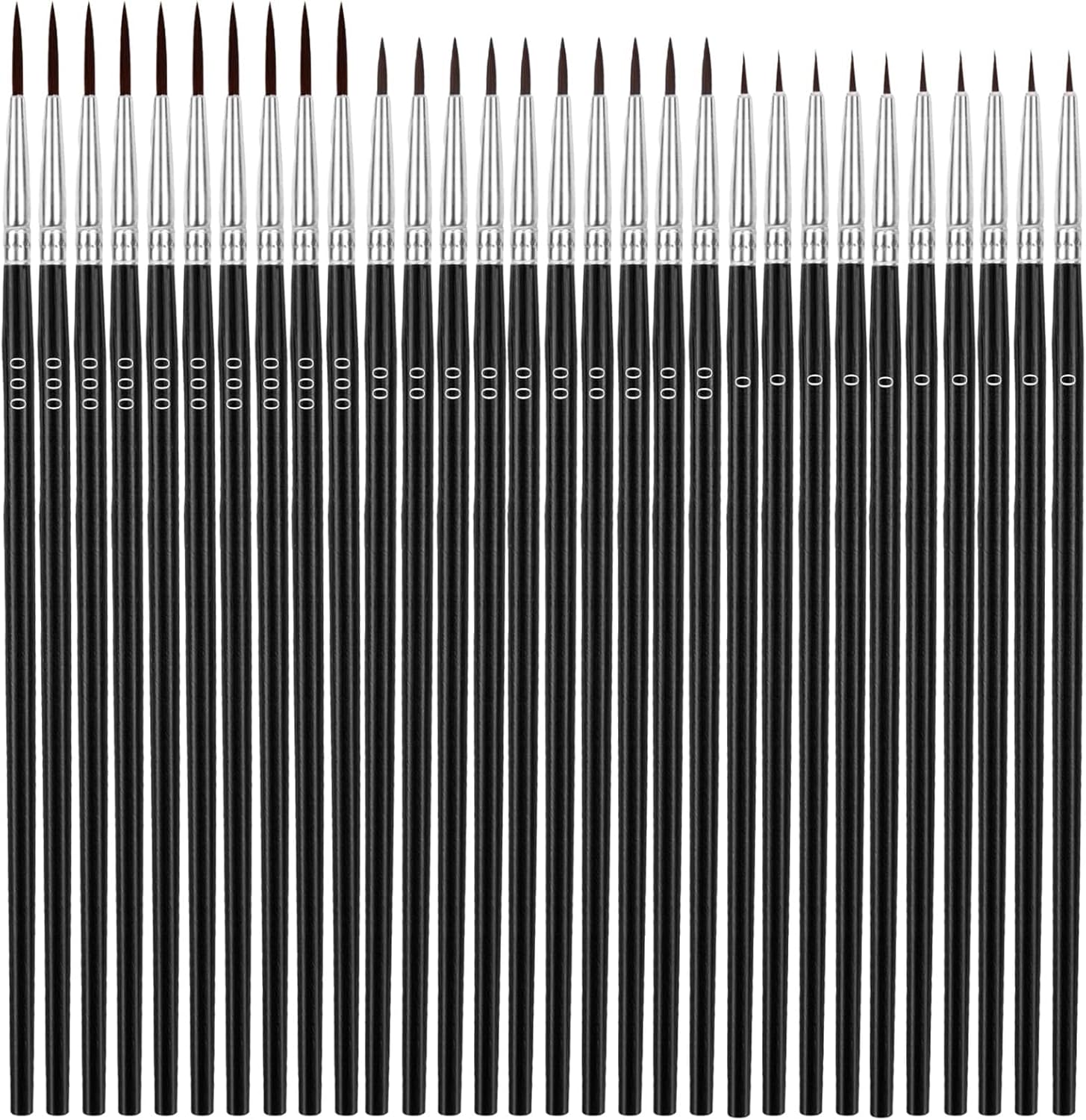 |
Anezus Tiny Detail Paint Brushes | Includes 30 thin liner brushes in assorted sizes Premium Synthetic Bristles Anti-Rust Nickel Ferrules Sturdy Wooden Handles |
Check Price |
 |
Miniature Paint Brushes | Includes 7 unique nib types Rust-Resistant Copper Ferrules Matte-textured triangular grip Works with acrylic, watercolor, tempera, enamel, gouache, oil, and more |
Check Price |
 |
MyArtscape Miniature Paint Brushes with Holder | Includes 12 fine-tip brushes ideal for acrylic, watercolor, oil, and gouache Precision for Miniatures & Linework Rust-Free Ferrules Balanced Birchwood Handles |
Check Price |
 |
ZenART Miniature Paint Brushes for Detailing | Includes 12 precision brushes Exact bristle lengths for consistent control Designed for stability and comfort Offers smooth paint flow |
Check Price |
 |
6Pcs Miniature Paint Brushes Set with Triangular Handles | Easy-Grip Triangular Handles Made from durable wood Maintain shape after every stroke Ideal for long-term use |
Check Price |
 |
Wet Pallet for Painting Miniatures | Keeps Paints Fresh Longer Complete Miniature Painting Kit Easy-clean surfaces make it ideal for long-term use |
Check Price |
What to Check Before You Buy Miniature Brushes
The most useful buying decision starts with the work you actually do. A painter working through tabletop armies needs a different brush mix from someone painting display faces, tiny lettering, or isolated figures one at a time.
Look at the distribution of sizes, not the total brush count
A 30-piece set can sound more complete than an 11-piece set, but those numbers can describe very different assortments. The Anezus set, for example, concentrates on three tiny sizes and gives you many duplicates. Grabie spreads 11 brushes across sizes from 5/0 through 7. The Army Painter set uses only three brushes because each one has a different role.
Before buying, ask how many genuinely different tools you are getting. Duplicates are valuable if you wear through detail brushes, dedicate brushes to certain paints, or want backups. They are less valuable if what you need is one drybrush, one dependable round, one liner, and one larger base-coating brush.
A sharp point is useful only if the brush can keep it
Point retention depends on hair quality, how the fibers are shaped, how the ferrule holds them, and how the brush is treated. Product listings often promise shape retention, but you should still expect every fine brush to be a consumable tool eventually. Acrylic drying near the ferrule, aggressive scrubbing, and storing a wet brush on its point all shorten its useful life.
Protective caps and holders help during storage, but caps should be replaced only after the brush is clean and dry enough not to trap moisture. A cap is most useful for transport and keeping neighboring tools from bending the tip.
Ferrule security matters for fine work
The ferrule joins the hair to the handle. If it loosens, even a good point becomes difficult to control because the working end can move independently of your fingers. Several sets here highlight crimped metal ferrules or rust-resistant finishes.
I’d pay more attention to a secure, straight ferrule than to decorative handle paint. A slightly plain handle with a firm ferrule will usually be more useful than a stylish brush that develops movement at the joint.
Think about paint capacity before choosing ultra-small brushes
Tiny brushes are attractive because the work is tiny, but a very short or thin brush can cause its own problems. Acrylic dries fast. If the brush carries only a trace of paint, the tip can begin drying between palette and miniature, especially under strong lighting, in a warm room, or during a long detail session.
That is one reason a well-pointed size 1 or 2 is often a strong general brush. It can deliver a precise tip while holding enough moisture to keep the stroke smooth. Reserve the smallest sizes for places where physical access or line width really requires them.
Decide whether you want an all-round set or task-specific redundancy
ARTEZA, ARTEGRIA, Fuumuui, MyArtscape, ZenART, and YFLLN all provide multiple shapes or sizes. Grabie gives a broad run of round sizes. Anezus goes the opposite direction by repeating three very small liner sizes. The Army Painter set covers three common miniature techniques with three distinct brushes. Golden Maple combines brushes with a wet-palette system.
There is no reason to buy the widest set if you already know which brush shapes you like. A broad set is most useful while you are discovering your preferences or when you move between miniatures, models, craft details, and freehand work.
Check how the handle feels during a long session
Triangular handles can reduce unwanted rotation and give your fingers a clear resting position. They also stop the brush rolling into paint or onto the floor. Round handles make it easier to turn the brush as you follow a curve or reshape the point between strokes.
If your hand tires quickly, handle thickness matters too. A very thin handle encourages some painters to pinch harder. A slightly fuller grip can make longer sessions more comfortable, though this is personal and difficult to judge from photos alone.
When a Detail Brush Set Is Not the Best Tool for the Job
A fine brush cannot compensate for a technique that needs a different tool. Large scenery, broad vehicle panels, primer application, and large base coats can be painfully slow with miniature brushes. Using a small detail brush for those tasks also wears the point faster because you are forcing it to cover more surface than it was designed to handle.
Drybrushing is another example. A valuable pointed brush should not be your first choice for repeated scrubbing across raised texture. The technique intentionally works the bristles against edges and surfaces. A dedicated drybrush or an older brush is more sensible.
The same logic applies to metallics, texture paints, and some effect products. Coarse particles or thick media can be harder on a fine point. I know it is tempting to reach for the nicest brush because it gives the most control, but preserving that brush for layering and detail work usually gives you more useful life from it.
If hand tremor or grip discomfort is the main problem, buying smaller brushes may not solve it. A comfortable painting handle for the miniature, better forearm support, improved lighting, or a larger brush with a sharp point can make a bigger difference than moving from size 0 to size 000.
ARTEZA Detail Paint Brushes, Set of 15 – A Balanced Mix of Tiny Shapes and Sizes
ARTEZA’s Detail Paint Brushes set uses a straightforward idea: repeat several useful detail shapes across the same small size range. Current ARTEZA product information identifies 15 brushes, with liner, round, and spot shapes in sizes 4/0, 3/0, 2/0, 0, and 1. That gives the painter a chance to choose a shape for the stroke without jumping to a completely different scale of brush.
The set uses white Taklon synthetic hair and nickel-plated copper ferrules. For miniature painting, the practical appeal is not simply that the fibers are synthetic. It is that a synthetic detail set can be used for routine acrylic work without asking you to reserve an expensive natural-hair brush for every small task.
The size range is concentrated on detail work. There is no large brush here for efficiently covering big monsters, terrain, or broad vehicle panels. That is a limitation if you want one purchase to cover an entire painting desk, but it keeps the set focused on linework, small layers, trim, facial features, and controlled accents.
Key features translated into practical benefits
Fifteen brushes spread across three shapes let you compare how a liner, round, and spot behave at similar scales. That is useful for painters who are still learning which geometry feels most natural for eyes, edge highlights, runes, or small freehand marks.
The sizes run from 4/0 through 1. That keeps the set in a genuinely fine range while still giving you size 0 and 1 options that carry more paint than the smallest tips. You can use the larger brushes for many normal miniature strokes and save the smallest ones for final detail.
White Taklon is a synthetic filament. It is easier to treat as a working tool than a precious brush, which matters if you paint often, experiment with different acrylic consistencies, or occasionally use enamel or other media the listing supports.
Nickel-plated copper ferrules are intended to hold the hair securely. On a detail brush, a straight, firm ferrule helps the tip respond directly to small hand movements. The metal finish still needs normal care; do not leave the brushes soaking in water.
- The set provides three detail-oriented brush shapes instead of giving you fifteen nearly identical rounds.
- The 4/0-to-1 size range covers very fine work while retaining a couple of more practical everyday detail sizes.
- Synthetic Taklon hair suits painters who want animal-free fibers and straightforward cleanup after water-based acrylic sessions.
- Repeated sizes across different shapes make this set useful for learning which brush geometry suits your own stroke control.
- The assortment is heavily focused on fine work, so it does not replace a larger base-coating brush or a dedicated drybrush.
- Fifteen small brushes can be more variety than a painter needs if they already rely almost entirely on one or two pointed rounds.
Who It’s Best For
This set suits painters who want a broad introduction to fine brush shapes without moving into large general-art brushes. It also fits hobbyists who paint miniatures alongside small craft details, models, or fine linework and want several tiny options on the desk.
Not Ideal For
It is less suitable if you want a minimalist three- or four-brush setup or if most of your work involves large surfaces. Painters who already know they prefer only pointed rounds may not use the spot and liner repetition enough to justify the full set.
ARTEGRIA Detail Paint Brush Set, 17 Brushes – More Shape Variety and a Dagger Striper
ARTEGRIA’s 17-piece detail set is built around variety and grip control. Current listings identify a range of fine-tip brushes from 4/0 through 4 and include a 1/4-inch dagger striper, a shape that is less common in basic miniature sets. The handles are triangular rather than round, so the brush rests against flat finger surfaces and is less likely to roll across the desk.
That combination makes the set interesting for painters who do more than standard layering. A dagger can place a narrow line from its tip but also create wider ribbon-like marks from the side. You may not use it on every model, yet it can be useful for banners, markings, stylized lines, scenery details, or decorative work around a miniature project.
The larger number of brushes also means you can keep different tools in rotation. That is handy if you paint several colors at once or want to separate harsh tasks from fine work. It is less appealing if you prefer a small, highly familiar brush lineup.
Key features translated into practical benefits
Seventeen brushes give this set one of the broader assortments among the products here. The spread from very small sizes through size 4 means the set can move from tiny details into more normal layering and controlled base-coat work without immediately requiring another purchase.
The 1/4-inch dagger striper is the defining extra. Its angled, elongated shape can produce both a fine tip mark and broader directional strokes. It is especially useful if your miniature work includes banners, shields, line accents, scenery lettering, or decorative motifs.
Triangular handles provide an indexed grip. Your fingers know where the flat sides are, which can make the brush feel stable during short precise strokes. The same shape may feel less fluid to painters who like continuously rolling a round handle between the fingers.
Synthetic nylon bristles make the set practical for acrylics and other listed media. Like any synthetic detail brush, the tips still need protection from dried paint; the ferrule area should stay as clean as possible.
Storage accessories supplied with the set help keep the many brushes organized. Organization matters more with a 17-piece set because unprotected fine tips are easy to bend when they are dropped loosely into a drawer or cup.
- The wide size range gives you more room to move from tiny details into normal miniature layering and small base-coat work.
- A dedicated dagger striper adds a genuinely different stroke option rather than simply increasing the brush count.
- Triangular handles can improve grip stability and keep brushes from rolling off a crowded painting desk.
- The set is useful for painters who want to experiment with several brush forms before settling on a smaller personal lineup.
- The broad assortment may leave some brushes unused once you discover which shapes you actually prefer.
- Triangular handles are comfortable for many painters but less natural for people who rotate a brush constantly while following curved surfaces.
Who It’s Best For
ARTEGRIA suits hobbyists who want one substantial detail set for miniatures, models, decorative work, and freehand. It is particularly useful if you are still discovering whether liners, rounds, flats, or angled shapes match your technique.
Not Ideal For
It is not the best fit for a painter who wants only a couple of dependable rounds and does not want to manage a larger assortment. If your entire process is built around one size 1, one size 0, and a separate drybrush, this set is more expansive than necessary.
Grabie 11-Piece Miniature Detail Paint Brush Set – A Clear Round-Brush Progression from 5/0 to 7
Grabie takes a different approach from shape-heavy sets. Its current 11-piece miniature detail set is arranged as a progression of round sizes: 5/0, 3/0, 2/0, 0, 1, 2, 3, 4, 5, 6, and 7. That makes the set easy to understand. You are not learning a new brush shape each time; you are choosing how much point, belly, and coverage you need.
The manufacturer lists nylon hair, natural-wood handles with a triangular grip, and crimped metal ferrules. For a miniature painter, the broad size spread is the most important part. The smallest rounds can handle tight details, while sizes 1 through 3 can do a large amount of everyday work. The largest brushes are useful for broader controlled areas where a 0 would be needlessly slow.
This is a good reminder that miniature painting does not require living at the 000 end of the rack. A sharp size 2 can often produce a small enough mark while keeping the paint usable longer.
Key features translated into practical benefits
The 5/0-to-7 progression creates a clear ladder of brush capacity. Instead of asking which unusual shape you need, you can choose a larger or smaller round while keeping similar hand behavior.
Nylon fibers are soft enough for controlled painting but designed to return to shape. For acrylic miniature work, that makes the brushes approachable for layering, detail work, and routine practice without making every mistake feel expensive.
The natural-wood triangular handle gives the fingers a stable grip. It also helps stop the brush rolling when you put it down, which is a small but useful feature beside open paint pots and a wet palette.
Crimped ferrules secure the hair bundle to the handle. A firm ferrule matters because a fine point cannot feel accurate if the entire head shifts under pressure.
Protective tubes are useful during transport and storage. They should go back on only after the brush has been cleaned and reshaped; forcing a cap over stray wet hairs can bend the point you are trying to protect.
- The eleven round sizes create a simple, logical progression from ultra-fine work to broader miniature painting tasks.
- Sizes 1 through 3 give the set useful everyday brushes instead of concentrating entirely on tiny liners.
- Triangular handles provide a stable grip and reduce the chance of brushes rolling off the work surface.
- The set makes it easy to learn how brush size changes paint capacity because the basic round geometry remains familiar across the range.
- Painters who want dedicated flats, riggers, angled brushes, or a drybrush will need those shapes elsewhere.
- The very broad size range can still include several brushes you rarely use once you settle into a preferred two- or three-size routine.
Who It’s Best For
Grabie is a strong fit for painters who like pointed rounds and want one set that moves from fine facial details to broader layering. It also makes sense for beginners who would rather learn one versatile brush shape across several sizes before experimenting with specialized forms.
Not Ideal For
It is less suitable if your painting style relies heavily on specialty brushes. A painter who does frequent drybrushing, long freehand lines, or controlled flat-edge work will still want tools built specifically for those jobs.
The Army Painter Hobby Starter Brush Set – Three Brushes with Three Clear Jobs
The Army Painter Hobby Starter Brush Set is the most deliberately minimal brush product in this group. The current manufacturer page lists three synthetic brushes: a Standard Brush for base coating, a Small Detail Brush with an ultra-fine point, and a Drybrush for catching raised texture and highlights.
That three-role design is useful because it teaches a beginner not to make one fine brush do everything. The Standard Brush handles normal coverage, the Small Detail Brush is saved for tight features, and the Drybrush accepts the abrasive work of repeated contact with raised surfaces.
The Standard and Small Detail brushes use the brand’s triangular precision-style grip, while the drybrush uses a more traditional shape. The set does not provide the size-by-size experimentation of ARTEGRIA or Grabie, but it is much easier to understand when you are setting up a first painting desk.
Key features translated into practical benefits
Three brushes keep tool choice simple. You can assign one brush to broad controlled paint, one to fine detail, and one to drybrushing without searching through a large case every time you change technique.
The Standard Brush is intended for base coating miniatures. That matters because base coating with an ultra-small detail brush wastes time and increases the risk of paint drying in the hair before you finish a section.
The Small Detail Brush gives you the pointed tool needed for eyes, buckles, small trim, rivets, and final accents. Because there is only one dedicated detail brush in the set, care matters; it should not be used for scrubbing or rough texture work.
The Drybrush is shaped for a technique that is hard on bristles. Keeping a separate brush for that task protects the precision point of the detail brush and makes the set more sensible than three similarly shaped fine rounds.
Synthetic fibers make the set practical for routine hobby acrylics. The manufacturer’s care guidance emphasizes loading only the tip, cleaning immediately, and storing the brushes tip-up, all of which are good habits for extending useful life.
- Each brush has a clearly different role, which makes the set easy to understand for a new miniature painter.
- Including a dedicated drybrush keeps abrasive drybrushing away from the fine detail point.
- The Standard Brush gives beginners a more sensible tool for base coats than an ultra-tiny liner.
- The small set is easy to store, easy to learn, and less likely to leave you with a dozen unused shapes.
- One detail brush means there is no backup if its point wears or becomes damaged during a project.
- Painters who want several round sizes for layering, glazing, or freehand will outgrow the three-brush selection quickly.
Who It’s Best For
This set is aimed at beginners who want a clear starting point rather than a large brush case. It is also useful as a compact secondary set for travel, club nights, or a simple tabletop painting station.
Not Ideal For
It is not ideal for advanced painters who already know they need multiple sizes of pointed rounds, liners, and specialty shapes. The set is intentionally basic, so it will not replace a developed brush collection.
Anezus Tiny Detail Paint Brushes, 30-Piece Set – Lots of Backups for Three Very Small Sizes
Anezus is less about variety and more about redundancy. The current 30-piece set contains ten brushes each in sizes #0, #00, and #000. They are fine liner-style brushes made with synthetic hair, metal ferrules, and wooden handles. That makes the set fundamentally different from a broad 15- or 17-shape assortment.
Why would you want so many similar brushes? Fine tips wear. Acrylic can dry unexpectedly. A brush can get bent in storage. Some painters also like dedicating inexpensive detail brushes to metallics, washes, enamel work, or specific colors. Having duplicates means one damaged point does not stop the session.
The limitation is obvious: these are all small. They do not give you a size 2 or 4 for efficient layering, a dedicated drybrush, or a broad flat. A painter who tries to basecoat an entire unit with these will spend unnecessary time and dry paint at the tips.
Key features translated into practical benefits
Thirty brushes provide unusually high redundancy. For someone who paints often, teaches a group, shares tools, or goes through fine brushes quickly, backups can be more useful than an assortment of shapes that sit unused.
The three sizes are #0, #00, and #000. They cover fine lines and small-access work, but the differences are still within the detail end of the spectrum. This set should be thought of as a reserve of fine tools rather than a complete brush bench.
Synthetic hair is practical for repeated routine use. If one brush is assigned to a rougher paint or technique and loses its ideal point, you can retire it to less demanding work rather than sacrificing a more expensive detail brush.
Rust-resistant ferrules and wooden handles give the brushes a conventional construction. The product information also notes individual protective tubes, which are useful when many small brushes share the same storage space.
- Ten copies of each of three small sizes give you immediate backups when a point wears, bends, or gets contaminated.
- The set is useful for batch painters who like dedicating brushes to different colors or paint types during a long session.
- Synthetic fibers make the brushes practical for routine acrylic detail work and straightforward soap-and-water cleaning.
- Individual tip protection helps keep a large number of fine brushes from crushing each other in storage.
- The set is heavily concentrated on tiny sizes and does not provide larger rounds, flats, or a drybrush for broader miniature work.
- Thirty fine brushes can be wasteful for a careful painter who uses only a few brushes and replaces them infrequently.
Who It’s Best For
Anezus fits frequent painters who treat fine synthetic brushes as consumable working tools and value backups. It also makes sense for group painting, teaching, batch work, or hobbyists who prefer to keep separate small brushes for different media.
Not Ideal For
It is not a complete first brush set for someone who owns nothing else. A new painter still needs a larger general brush and a tool for drybrushing or other rough techniques.
Fuumuui 11-Piece Miniature Paint Brush Set – Seven Tip Shapes for Tight and Awkward Details
Fuumuui’s 11-piece set is built around shape diversity. Current product information lists seven tip forms across the set: round, spotter, liner, filbert, flat, angle, and angled spot. The angled spotter is especially notable because its bent ferrule changes the approach angle, helping the tip reach details that are awkward to touch with a straight brush.
The brushes use synthetic tips, rust-resistant copper ferrules, and short hardwood handles with a matte triangular grip. That combination is clearly designed around close-up control rather than traditional long-handle studio painting.
A set like this rewards experimentation. The angled brush may feel unnecessary until you have to paint behind a shoulder pad, under a cloak edge, around a mounted weapon, or inside a recess where your hand blocks the view. The flat and filbert shapes can also help with small panels or controlled soft-edged strokes.
Key features translated into practical benefits
Seven different nib shapes give you multiple ways to approach a small surface. A round is the everyday choice, a liner supports longer fine marks, a spotter concentrates paint at a short point, and flat or filbert shapes handle small areas differently from a pointed round.
The angled spot design changes the relationship between your fingers and the painted surface. Instead of twisting your wrist into an uncomfortable position, you can sometimes let the bent ferrule bring the tip around an obstruction.
Synthetic fibers are described as soft, flexible, and neatly trimmed. For miniature work, the important part is that the point stays coherent enough to place paint without stray fibers creating a second line.
The triangular hardwood handle gives the fingers a non-slip reference surface. Because the handles are short, the brush can feel natural when held close to the ferrule, which is common during miniature detail work.
Rust-resistant copper ferrules are intended to keep the joint durable. As with every brush here, that does not make soaking safe; water can still work into the handle and ferrule over time.
- Seven different tip forms make the set more versatile than an assortment made entirely of similar rounds.
- The angled spot brush provides a useful approach for recessed or physically awkward details on assembled miniatures.
- Short triangular handles support close-up control and reduce rolling on the desk.
- The 11-piece count gives meaningful shape variety without becoming as large to manage as a 17- or 30-piece set.
- Specialized shapes are only valuable if you use them; painters who rely on rounds may leave several brushes untouched.
- A very broad shape mix can take more time to learn because each brush responds differently to pressure and rotation.
Who It’s Best For
Fuumuui suits painters who enjoy experimenting with brush geometry and often work around tight recesses, armor panels, scenery, or complex assembled models. It is also useful for crafters who want the same set to handle miniatures and other small detail work.
Not Ideal For
It is less compelling for painters who already know they want a simple progression of pointed rounds. If consistent feel across sizes matters more than shape variety, Grabie or another round-focused set is easier to learn.
MyArtscape Miniature Paint Brushes with Holder, Set of 12 – A Detail Set with Its Own Storage Stand
MyArtscape’s current product page lists 12 miniature brushes plus a black holder. The assortment includes liner, round, and flat shapes across small sizes. The manufacturer describes fine synthetic filament designed to retain a precision point, while the linked product information identifies balanced wooden handles and rust-resistant ferrules.
The holder is more useful than it may sound. Fine brushes are easy to damage when they lie loose among hobby knives, files, clippers, and sculpting tools. A dedicated case or stand gives each brush a predictable place and can keep wet tips away from the desk surface while you work.
The actual brush assortment is conventional, which is a strength if you want familiar tools. You get liners for long narrow marks, rounds for most miniature painting, and flats for small planar areas or crisp bands. There is no unusual bent brush or large drybrush competing for space.
Key features translated into practical benefits
Twelve brushes give you enough repetition to keep several sizes and shapes available without turning the set into a large inventory. The liners and rounds cover most fine painting needs, while the flats add a different edge for small panels and straight bands.
The current manufacturer page emphasizes fine synthetic filament and point retention. A reliable point is what makes a detail brush useful after the first stroke; the brush should come back together after rinsing and shaping rather than spreading into multiple tips.
The included holder solves a real maintenance problem. Storing brushes with the hair protected reduces accidental bending, and using the holder as an organized stand makes it less likely that a fine brush gets buried under other tools.
The handles are designed for balance rather than an exaggerated grip shape. Painters who like rotating a brush naturally between the fingers may prefer this more conventional feel over a strongly triangular handle.
- The set combines three useful brush shapes with a dedicated holder instead of spending the entire package on additional brush count.
- A 12-piece assortment is broad enough for detail work without being difficult to organize or learn.
- The included storage system helps protect fine tips from being crushed by other hobby tools.
- Conventional handle geometry suits painters who like rotating the brush while following curved miniature surfaces.
- The holder adds value mainly if you will actually use it; painters with an established storage system may prefer more brushes instead.
- The set remains detail-focused and does not provide a purpose-built drybrush for aggressive texture work.
Who It’s Best For
MyArtscape is a good fit for painters who want a tidy, self-contained detail set and care about storage as much as brush count. It works especially well for a small hobby station where loose fine brushes would otherwise share space with many other tools.
Not Ideal For
It is less suitable if you want a dedicated drybrush or a very large progression of round sizes. Painters who already have a brush case may not get as much benefit from the included holder.
ZenART Miniature Paint Brushes for Detailing, 12-Piece Set – Synthetic Shapes for Detail and Line Control
ZenART’s 12-piece miniature set uses synthetic, animal-free hair and sculpted birchwood handles. Current product information lists a specific mix of rounds, riggers, flats, an angled brush, and filberts. That makes it one of the more deliberately varied sets here rather than a simple row of sizes.
The listed shapes include rounds in 5/0, 2/0, 1, and 2; riggers in 4/0, 2/0, and 1; flats in 2/0 and 1; an angled size 1; and filberts in 2/0 and 0. For a miniature painter, the useful story is not the exact labels by themselves. It is that the set covers short pointed work, longer line work, flat-edge work, and softer rounded-flat strokes.
That gives you room to learn different techniques while keeping everything at miniature-friendly scale. It also means the set is better for a painter who likes variety than for someone who wants ten copies of the same favorite round.
Key features translated into practical benefits
The mixture of rounds and riggers covers both short details and longer continuous lines. A rigger can hold enough paint along its longer hair to pull a line farther than a tiny spotter, though it requires a steadier pull and lighter pressure.
Small flats can make narrow bands, square edges, and short planar strokes more efficiently than a point. The angled brush can approach edges from the side, while the filberts soften the corners of a flat stroke.
The synthetic fibers are designed to mimic some of the paint-handling qualities painters look for in softer natural hair while remaining vegan and cruelty-free. For a buyer who specifically wants animal-free brushes, that is a clear product distinction.
Birchwood handles are shaped for control and comfort. A sculpted handle can reduce the feeling that you have to pinch a thin stick tightly during a long detail session.
- The 12-piece mix covers several genuinely different stroke types instead of relying on size changes alone.
- Multiple riggers give freehand painters useful options for long fine lines and decorative markings.
- Synthetic animal-free hair is a clear fit for painters who prefer vegan brush materials.
- Rounds, flats, an angle, and filberts make the set adaptable to miniatures, models, and other small-scale art.
- A painter who uses only pointed rounds may find the specialty shapes unnecessary.
- Riggers and small flats take practice to exploit well, so the set has a slightly higher learning curve than a simple round-only progression.
Who It’s Best For
ZenART suits painters who enjoy freehand, lining, small panel work, and experimenting with several brush shapes. It is also one of the more relevant choices here for buyers who specifically want synthetic animal-free fibers.
Not Ideal For
It is not ideal if you want lots of duplicate brushes or a minimal starter layout. The value depends on using the varied shapes rather than treating most of them as backups.
YFLLN 6-Piece Miniature Paint Brush Set with Triangular Handles – A Compact Detail Assortment
The YFLLN set keeps the brush count low while still providing more than one type of tip. Current product information identifies six brushes: round sizes 5/0, 3/0, 0, 2, and 4, plus an angle size 2. The handles are wooden with a triangular grip, and the brushes use nylon hair with protective tubes.
That size spread is sensible for a compact miniature kit. You get very small rounds for tight details, a 0 for precision work, and sizes 2 and 4 for broader controlled painting. The angle brush adds a different edge without turning the set into a large specialty collection.
For painters who dislike buying 15 or 30 brushes at once, six can be enough to establish a working routine. The trade-off is that there are no duplicates. If one favorite size wears out, the set does not contain an immediate replacement of the same size.
Key features translated into practical benefits
Five round sizes cover a broad span of miniature tasks while keeping the familiar pointed-round feel. The larger size 4 is especially useful because many miniature sets stop at very small sizes and leave broad layering to another purchase.
The angle size 2 can place a crisp edge or reach a small surface from the side. It is a simple way to add a specialty shape without asking the painter to learn half a dozen unfamiliar tip forms.
Triangular wooden handles give the fingers flat grip surfaces and prevent rolling. That can be useful on a small desk where brushes sit beside open acrylic paints and water cups.
Nylon hair makes the set practical for routine hobby paints. Protective tubes help during storage and transport, provided the brushes are cleaned, reshaped, and allowed to dry appropriately before being capped.
- Six brushes keep the set compact while still spanning very fine rounds through a useful size 4.
- The single angle brush adds a different stroke option without making the assortment complicated.
- Triangular handles provide a stable grip and help stop brushes rolling off the work surface.
- The small set is easy to travel with and easy to learn because most of the brushes share the same round geometry.
- There are no duplicate sizes, so a worn favorite brush cannot be replaced from within the same set.
- The assortment does not include a dedicated drybrush or long rigger for specialized techniques.
Who It’s Best For
YFLLN suits painters who want a compact set with a useful spread of rounds and one angled option. It is a practical choice for a small desk, travel kit, or someone who would rather learn six brushes thoroughly than manage a large case.
Not Ideal For
It is less suitable for batch painters who want multiple backups or for freehand painters who rely on long liners and riggers. You may need to add specialized brushes later as your technique expands.
Golden Maple 2-in-1 Wet Palette with 11 Miniature Paint Brushes – A Painting Station Rather Than a Brush-Only Set
The Golden Maple product is the outlier in this list, and it should be treated that way. It is not simply an 11-brush set. The current linked listing is a 2-in-1 wet and dry palette kit with a lid, 11 miniature brushes, 100 palette papers, four sponges, and brush-storage features.
That makes its value proposition different from every other product here. A wet palette is designed to slow moisture loss from water-based paint sitting on the palette surface. For acrylic miniature painting, that can make thinning, blending, and repeated color use easier during a session. It does not make the paint permanent, and conditions such as heat, airflow, sponge moisture, and paint thickness still affect working time.
The included brushes make this a broader starter station. The listing confirms 11 miniature brushes, but different retailer descriptions do not consistently agree on the exact split between detail brushes and drybrushes. I would therefore buy this kit for the confirmed combination of palette, brush assortment, papers, sponges, and storage rather than for a specific unverified brush-shape count.
Key features translated into practical benefits
The wet-palette base keeps a damp reservoir beneath palette paper. That helps water-based acrylic stay workable longer than it would on a dry plastic plate, which is useful for mixing intermediate colors and returning to a blend during a painting session.
A separate dry-palette layer gives you wells for paint that you do not want on the wet surface. This is useful for metallics, washes, or products that you personally prefer to keep away from the sponge system.
The lid helps protect the palette during short breaks and storage. It should not be treated as a promise that every paint mix will remain usable indefinitely; moisture balance and hygiene still matter.
The kit includes 100 palette papers and four sponges. Those consumables reduce the need to source matching refills immediately and make the system easier to start using from the box.
Eleven miniature brushes make the kit more complete for someone building a first painting station. Because the exact brush split is inconsistently described across current retailer pages, the safe way to think about them is as an included assortment rather than assuming a precise number of each specialty shape.
- The product combines brushes with a wet-palette system, so it solves both paint handling and tool setup in one purchase.
- Included papers and sponges provide a substantial starting supply for learning wet-palette use.
- A separate dry-palette layer gives you more flexibility than a single wet surface for every paint type.
- The lid and brush-storage features help keep a small miniature painting station organized between sessions.
- This is a larger, more involved setup than a simple brush set, so it makes little sense if you already own a wet palette you like.
- The current listings are not fully consistent about the exact mix of the 11 included brushes, so buyers should verify the current package contents before ordering if specific brush types matter.
Who It’s Best For
Golden Maple is best suited to someone building a miniature painting station from scratch or wanting a combined wet-palette and brush package. It also suits acrylic painters who regularly mix colors and want more working time on the palette.
Not Ideal For
It is not the right choice if your only goal is to upgrade brush quality while keeping your existing palette. Experienced painters with established wet-palette and brush systems may find much of the kit redundant.
How the Ten Options Differ in Practice
These ten products make more sense when you compare their design priorities rather than trying to rank them with one score. The best paint brushes for miniature painting depend heavily on whether you need breadth, backups, a simple starter kit, unusual shapes, or an entire painting station.
For a broad introduction to small brush shapes
ARTEZA gives you 15 brushes across three fine-detail shapes and five small sizes. ARTEGRIA expands the idea with 17 brushes, a wider size range, triangular handles, and a dagger striper. ZenART also leans into shape diversity with rounds, riggers, flats, an angle, and filberts.
These sets make sense when you are still discovering which brush forms fit your painting style. Their weakness is the same as their strength: you may eventually use only a fraction of the shapes regularly.
For painters who prefer pointed rounds
Grabie is the clearest fit because its 11-piece set progresses from 5/0 through size 7 using a familiar round format. Instead of changing shape, you change scale and paint capacity. YFLLN offers a smaller version of that idea with five round sizes plus one angle brush.
If your painting process is mostly layering, controlled base coating, recess work, edge highlights, and detail using pointed rounds, these sets are easier to understand than a large specialty assortment.
For a simple first setup
The Army Painter’s three-brush set is the most direct: Standard, Small Detail, and Drybrush. It teaches good tool separation from the beginning. You do not scrub with the fine brush, and you do not waste time base coating with the smallest tip.
The Golden Maple kit goes in the opposite direction. It is a fuller starter station with a wet palette, dry-palette layer, papers, sponges, brush storage, and 11 included brushes. Choose it because you need the system, not simply because the product count looks large.
For painters who want backups
Anezus is the obvious redundancy-first choice. Thirty brushes divided among three fine sizes means you can lose a point, contaminate a brush, or dedicate several to different tasks without running out immediately.
That approach is practical for high-volume painting but inefficient for someone who maintains brushes carefully and prefers a small set of familiar tools.
For awkward angles and specialty access
Fuumuui stands out because of its seven tip forms and bent angled-spot design. ARTEGRIA’s dagger and ZenART’s riggers also give you linework tools beyond a standard round. These are useful when the model itself creates physical access problems or when your painting includes banners, filigree, markings, or long narrow accents.
A Reliable Painting Workflow for Better Brush Control
Good brushes help, but technique determines how long they stay useful. A careful setup also reduces the temptation to correct mistakes with repeated heavy strokes.
1. Prepare the miniature before opening paint
Remove obvious mold lines, sanding dust, and loose debris before painting. A sharp brush cannot make a rough seam disappear. If the miniature is primed, make sure the primer has cured appropriately and the surface is dry before starting detail work.
Support the miniature on a handle or stable base if possible. The goal is to move the model with your non-painting hand rather than twisting your brush hand into awkward angles.
2. Choose a brush larger than your fear suggests
Start with a pointed round that comfortably reaches the area. For many normal miniature tasks, that may be a size 1 or 2 rather than a 000. A larger belly carries more paint and can make a smoother line as long as the point is sharp.
Move to the smallest brushes only when access, line width, or the shape of the feature requires them. This keeps the paint wetter at the tip and reduces unnecessary brush wear.
3. Thin the paint to suit the stroke
Paint that is too thick can drag, obscure texture, and leave a rough edge. Paint that is too thin can flood a recess or run away from the point. Adjust with small amounts of water or the medium appropriate to your paint system until the brush leaves a controlled, even mark.
A wet palette can make this easier with water-based acrylic because the paint remains workable longer. Still, check consistency on the palette or a test surface before touching the miniature.
4. Load the belly but keep paint away from the ferrule
Draw paint into the working part of the brush, then remove excess on the palette. You want enough paint for the stroke without flooding the metal ferrule. Repeatedly packing acrylic into the ferrule encourages dried paint to spread the hairs and destroy the point.
For very fine work, rotate the brush lightly against the palette to bring the tip to a point after loading.
5. Brace your hands before the detail stroke
Rest wrists or the heels of your hands against each other, the desk, or another stable support. The goal is to reduce independent motion. Then move the miniature until the detail sits at a comfortable angle rather than forcing the brush to approach from a difficult direction.
This is where angled brushes can help, but repositioning the miniature is often the simplest solution.
6. Pull the stroke whenever possible
A brush generally behaves more predictably when pulled than pushed. For an edge highlight or line, place the point at the start and draw it toward you or across the surface with light pressure.
Use the side of the brush against a raised edge when the geometry allows it. That can create a cleaner highlight than trying to balance only the point on the ridge.
7. Rinse before the paint begins to dry
Do not wait for the brush to feel crusty. Rinse frequently, especially when using tiny brushes. Swirl gently rather than grinding the point against the bottom of the water cup.
If you switch colors, rinse until pigment stops releasing, blot gently, reshape, and then load the next paint. Then continue rather than leaving a partly loaded brush on the desk while you make another decision.
8. End the session with a deliberate cleaning routine
Rinse water-based acrylic thoroughly and use a mild brush soap when needed. Work cleaner through the hair gently from ferrule toward tip without crushing the point. Rinse, reshape with clean fingers, and let the brush dry without standing wet on its bristles.
For oil or enamel products, follow the paint manufacturer’s cleaning guidance and use the correct solvent with good ventilation. Do not assume a water-only cleanup is suitable for every medium simply because the brush itself is synthetic.
Brush Care That Protects Fine Points
A good miniature brush often fails from paint buildup before the fibers themselves are truly worn out. The most damaging area is the base of the hair where it enters the ferrule. Dried paint there forces hairs apart and makes a once-sharp brush fork into two or three points.
Rinse often enough that paint never has time to form a skin in the brush. With fast-drying acrylic, that may mean rinsing every few minutes during precise work, even when you are staying with the same color.
Use a separate older brush for transferring paint from pots, mixing aggressively, applying texture products, or working with coarse metallics if those tasks are hard on your fine brushes. Your best point should spend most of its life painting the miniature, not scraping dried material from a palette.
After cleaning, reshape the point gently. Do not twist the hairs hard between fingers. A light draw is enough. Store the brush horizontally or with the bristles up once dry. Never leave it standing point-down in water; that bends the tip and allows water to work into the ferrule and handle.
Protective caps are useful for transport, but replace them carefully. If one hair is caught outside the cap, the cap can kink it. A holder such as the MyArtscape case, or organized slots in a painting station, can be safer than repeatedly capping and uncapping every brush.
Habits That Ruin Fine Brushes Before Their Time
Reaching for the smallest brush for every detail
A 000 seems logical for a tiny model, but it carries very little paint. That makes acrylic dry quickly and forces more frequent reloads. Use the largest brush that can still place the mark accurately. A sharp size 1 may be easier for an eye socket than a dry, scratchy 000.
Letting paint climb into the ferrule
Heavy loading looks efficient because the brush holds more paint, but once acrylic dries near the ferrule, the point begins to spread. Load the working hair, wipe away excess, and rinse before dried paint has time to accumulate at the base.
Using a detail brush for drybrushing
Drybrushing deliberately works the hair across raised texture. That is hard on a precision point. Use a purpose-built drybrush, an older brush, or the dedicated drybrush in a set such as The Army Painter kit rather than sacrificing your fine round.
Leaving brushes resting in rinse water
The point bends against the cup and water can travel into the ferrule and handle. Rinse, blot, and lay the brush safely or place it bristles-up. A brush should not spend a break standing on its hair.
Scrubbing the brush against the bottom of the water cup
Aggressive rinsing bends and spreads fine fibers. Swirl the brush through the water and wipe gently on a suitable surface instead. If dried paint will not release, use appropriate brush cleaner rather than more force.
Returning a protective cap carelessly
Caps help only when the tip enters cleanly. Sliding a cap over a splayed hair can permanently kink it. Look at the point, reshape it, and guide the cap straight on after the brush is clean and ready for storage.
Using one brush for every paint product
Texture paints, coarse metallics, heavy washes, and some specialty media can be harder on a fine brush than normal acrylic layers. Keeping a few less-precious working brushes for rough jobs preserves your best points for the strokes that actually need them.
Safety and Material Handling Notes
Miniature brushes themselves are simple hand tools, but the paints and cleaning products used with them can require more care. Read the label for every paint, primer, varnish, thinner, or solvent you use. The fact that one acrylic cleans with water does not mean every hobby coating does.
Keep rinse water and brush cleaners away from food and drink. A dedicated painting cup reduces the risk of confusing dirty rinse water with a beverage. Wash hands after handling paints, pigments, resins, or solvents, especially before eating.
If you use solvent-based paints, provide effective ventilation and follow the solvent manufacturer’s precautions. Keep flammable products away from ignition sources. Do not pour leftover solvents or paint into drains unless local disposal rules and the product instructions specifically allow it.
Miniature painting also involves sharp hobby knives, clippers, files, and small parts. Store fine brushes so they do not become hidden underneath cutting tools. A clean, organized station protects both your brush tips and your fingers.
Frequently Asked Questions About Miniature Paint Brushes
What brush size is best for painting miniature eyes?
A size 0, 00, or smaller brush can work, but size alone is not the deciding factor. A larger brush with a sharp point can place a tiny dot while holding paint more reliably. Use the smallest brush only when the physical space truly requires it.
Do I need a 000 brush for miniature painting?
No. A 000 is useful for very small marks and tight access, but many painters do most work with sizes 0, 1, and 2. The quality of the point and your paint consistency matter more than the number by itself.
Are synthetic brushes good for acrylic miniatures?
Yes. Every main brush set in this guide uses synthetic fibers, and synthetic brushes are widely suited to water-based acrylic hobby painting. They are practical to clean and replace, although point quality and stiffness still vary from one set to another.
Why does my detail brush split into two points?
Dried paint near the ferrule is a common cause. Bent fibers, rough cleaning, and physical damage can also split a tip. Clean the brush thoroughly with suitable brush soap, reshape it gently, and keep future paint loads away from the ferrule.
Should I use a wet palette with miniature brushes?
A wet palette is useful for water-based acrylic because it slows moisture loss on the palette and can make thinning and mixing easier. It does not replace good brush loading or paint control. The Golden Maple product here combines a wet-palette system with an included brush assortment.
How many brushes does a beginner actually need?
Three to five well-chosen brushes can be enough to start: a general round, a smaller detail brush, a larger brush for coverage, and a drybrush or older brush for rough techniques. Larger sets are useful when you want to explore shapes or keep backups, but a high brush count is not a requirement for good painting.
Is a triangular handle better than a round handle?
Not universally. A triangular handle gives stable finger placement and prevents rolling, while a round handle is easy to rotate during curved strokes. Try both if possible and choose the one that lets you relax your grip rather than pinch harder.
How often should miniature brushes be replaced?
There is no fixed schedule. Replace or retire a brush when it can no longer hold the point or edge needed for its job. An old detail brush can still be useful for mixing, stippling, applying texture, or other rough work after it stops being suitable for eyes and highlights.
Can I use the same brush for acrylic, watercolor, oil, and enamel?
Many of these product listings support several media, but your cleaning routine must match the paint. Water-based acrylic and watercolor usually clean with water and mild soap, while oils and some enamels require appropriate solvent. If you switch between media, clean thoroughly and consider dedicating brushes to avoid contamination.
Which set here is the most complete for a first-time miniature painter?
That depends on what you already own. The Army Painter set is the simplest because its three brushes have clear jobs. Grabie gives a useful size progression. ARTEGRIA and ZenART provide more shape exploration. Golden Maple makes sense if you also need a wet palette and painting-station accessories rather than brushes alone.
Choosing the Right Miniature Brushes for the Way You Paint
The best paint brushes for miniature painting are the brushes that match your actual strokes. If you mostly layer and edge-highlight, a dependable sequence of pointed rounds may matter more than a case full of specialty shapes. If you paint banners, freehand markings, awkward recesses, or mixed-media details, liners, riggers, angles, flats, and bent tips become more useful.
The ten products here make those trade-offs fairly clear. ARTEZA and ARTEGRIA emphasize variety. Grabie emphasizes a wide round-size progression. The Army Painter keeps the decision simple with three task-specific brushes.
Anezus gives you many backups for tiny detail work. Fuumuui and ZenART lean into specialty shapes. MyArtscape adds organized storage. YFLLN keeps the kit compact. Golden Maple combines an included brush assortment with a wet-palette system.
I’d choose based on the work sitting on your painting desk, not the largest brush count or the smallest number on a handle. Check current product details, choose the sizes and shapes you’ll actually use, then protect good points with careful loading, frequent rinsing, and proper storage.