A chalkboard-painted wall can look smooth and ready for lettering, yet the first liquid-chalk stroke may reveal a problem you cannot see by eye: the finish is porous enough to hold pigment. That is why choosing chalk markers for chalkboard paint is not only about bright color or a comfortable tip. The surface underneath the ink matters just as much as the pen in your hand.
Liquid chalk is excellent for crisp menus, calendars, labels, party signs, classroom boards, and decorative lettering because it produces stronger color and cleaner edges than ordinary stick chalk. It is also dust-free, which makes repeated writing less messy. But the easy-erase promise applies most reliably to non-porous surfaces such as glass, sealed boards, acrylic, coated metal, and many manufactured chalkboards. A chalkboard-painted wall or piece of furniture can behave differently.
The best approach is to choose a marker whose tip matches your lettering style, then test it on a hidden part of the painted surface before committing to a full design. Fine tips suit compact calendars and detail work. Reversible tips handle both lettering and fills. Jumbo tips make broad signs faster. Just as importantly, the ink should flow evenly without forcing you to over-pump the nib and flood the surface.
Why Surface Porosity Decides Whether Chalk Ink Erases
Liquid chalk markers use a fluid pigment system rather than a dry piece of chalk. On a smooth sealed surface, that liquid dries on top and can usually be reactivated with water for removal. On a porous finish, some pigment can travel into microscopic openings before the water evaporates. Once pigment has entered the surface, wiping may remove the upper layer while leaving a faint shadow behind.
That shadow is often called ghosting. It can be light enough to ignore on a casual craft board, or obvious enough to ruin a carefully painted kitchen wall. A marker that wipes perfectly from glass can still stain chalkboard paint, unfinished wood, paper, or another absorbent surface. The marker has not necessarily failed; the surface is behaving differently.
Painted chalkboards are not all alike
Chalkboard paints vary in resin, sheen, application thickness, curing time, roller texture, and the material underneath. A dense factory-coated board may resist liquid ink very well, while a homemade wall finished with a more open matte texture may absorb it. Even two boards painted with the same product can differ if one received heavier coats, more sanding, or a longer cure.
Rust-Oleum currently states that its chalkboard coating can be used with chalk markers, while also warning that repeated water-based marker use can wear the coating more quickly and may eventually require a refresh coat. That is a useful reminder: compatibility is not the same as indefinite stain-free performance.
A hidden test is more useful than a surface label
Before writing a large design, place a small mark in a corner or area that will later be covered. Let it dry fully, then wipe it according to the marker instructions. If the color disappears cleanly, repeat the test and leave the second mark longer. A surface that cleans after five minutes may behave differently after several days.
If the test leaves a shadow, do not assume harder scrubbing is the answer. Aggressive abrasion can burnish or remove matte chalkboard paint. It is usually better to switch to traditional chalk, seal the surface appropriately for liquid markers, or use a separate non-porous board.
Priming the marker is different from seasoning the board
Pump-action chalk markers need to be shaken and primed so the liquid reaches the nib. Chalkboard paint may also need to cure and, depending on the paint manufacturer’s directions, be conditioned with ordinary chalk before normal use. These are separate steps.
Do not prime a new marker directly on your finished wall. Pumping too firmly can release a sudden pool of liquid. Use scrap paper, cardboard, or another disposable non-porous test surface until the nib is evenly saturated, then move to the board.
Tip size changes how much liquid reaches the surface
A 1mm fine marker deposits much less ink per stroke than a 10mm jumbo marker. This changes more than line width. On a questionable painted surface, a heavily saturated broad nib puts more liquid in contact with the finish at once and can make ghosting more noticeable.
That does not mean fine markers are always safer, but it is another reason to choose the smallest practical tip for the job. A broad marker is excellent when you genuinely need a broad mark. Using one for tiny letters only makes control harder and may soak the surface unnecessarily.
| Product Image | Product Name | Features | Price |
|---|---|---|---|
 |
STATIONERY ISLAND Chalk Pens for Blackboard | Works perfectly on non-porous blackboards, whiteboards, café menus, windows, glass, metal, ceramic, and plastic. Provides smooth writing with precision for detailed designs, lettering, and artwork. Unlike paint, chalk ink wipes off easily in seconds from non-porous surfaces. Quick clean-up makes them ideal for frequently updated boards. Perfect for arts & crafts, DIY projects, teaching, office work, and professional signage. |
Check Price |
 |
Chalkola Chalk Markers for Blackboard | Easy Erase on Non-Porous Surfaces. Creates lasting designs on wood, paper, and other porous materials. Non-toxic, dustless, and safe for kids; no chalk residue or dirty hands. Richly pigmented liquid chalk delivers consistent coverage without skipping or fading. |
Check Price |
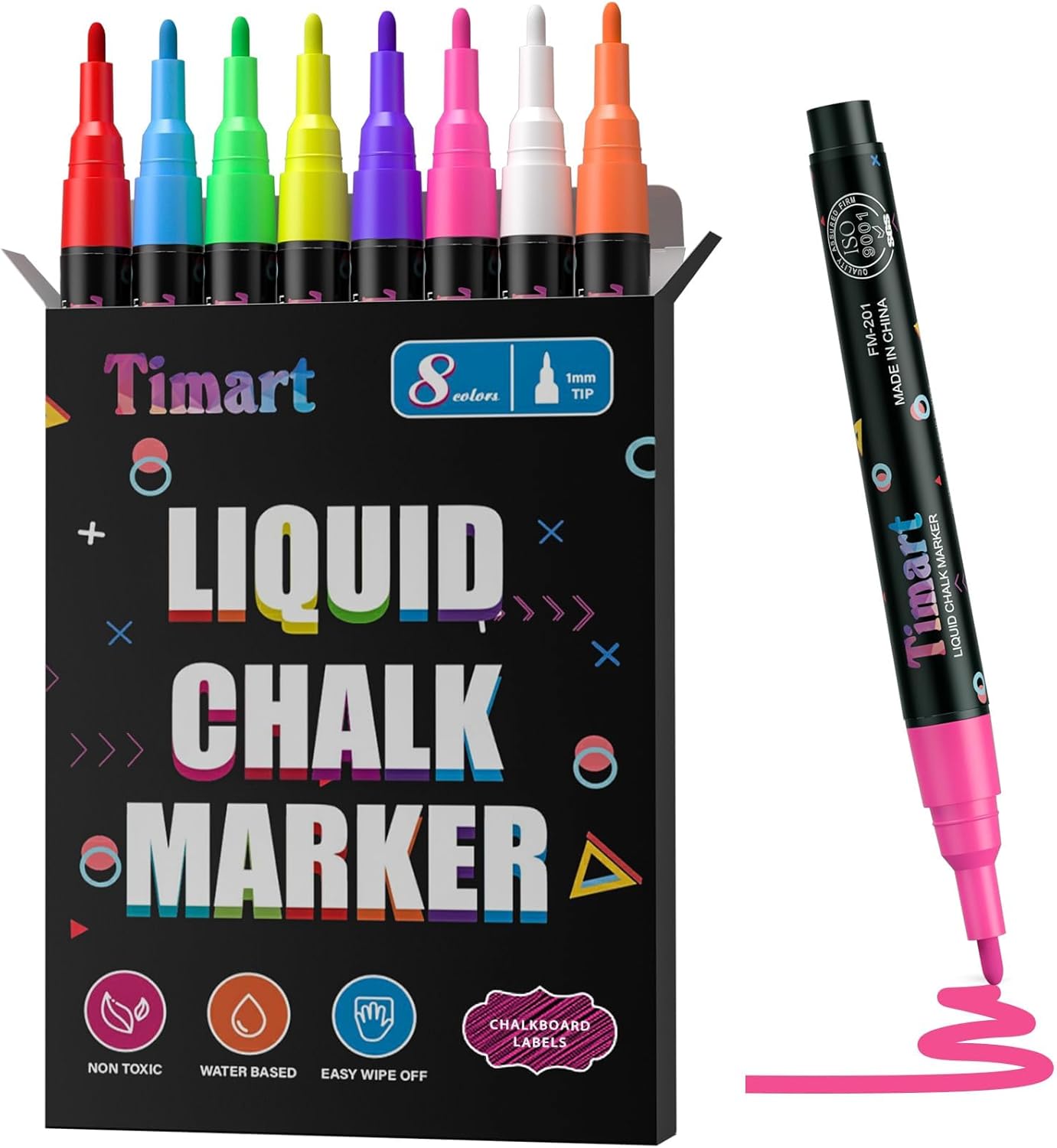 |
Timart Extra Fine Tip Chalk Markers | Super Thin 1mm Tip. Includes vivid fluorescent shades that are highly pigmented, vibrant, and long-lasting. Wipes clean with a damp cloth or paper towel on non-porous surfaces. Fluorescent ink ensures designs stand out clearly on dark or glossy surfaces. |
Check Price |
 |
SILENART Liquid Chalk Markers | Smooth ink flow creates striking designs that stand out even from a distance. Perfect for chalkboards, glass, acrylic calendars, windows, plastic, ceramic, and metal. Long-lasting, non-toxic, odorless, and dust-free formula ensures safe and clean use. |
Check Price |
 |
IJIANG Chalk Markers for Blackboards | Switch between bullet and chisel tips for bold strokes or fine details. Includes 8 fresh shades. Non-toxic, odorless, dust-free, and smooth-flowing for clean, vibrant writing. Holds more ink than standard markers, reducing the need for frequent replacements. Wipes clean with a damp cloth on non-porous surfaces |
Check Price |
 |
LANA & LUCA Liquid Chalk Markers for Blackboards | Non-toxic, odor-free, and dustless, making it safe for children and eco-friendly for home use. Wipes clean with a damp paper towel from non-porous surfaces, ready for fresh designs anytime. Provides consistent coverage without skipping, ensuring professional-looking results. Designed for both kids and adults. |
Check Price |
 |
Labeol 8 Colors 10mm Liquid Chalk Markers | 10mm wide tips allow three styles. Includes a versatile set of bold shades for creative and professional displays. Water-based, odorless, dust-free ink is child-friendly and eco-safe for home or classroom use. Works on blackboards, glass, mirrors, whiteboards, LED boards, posters, and bistro menus. |
Check Price |
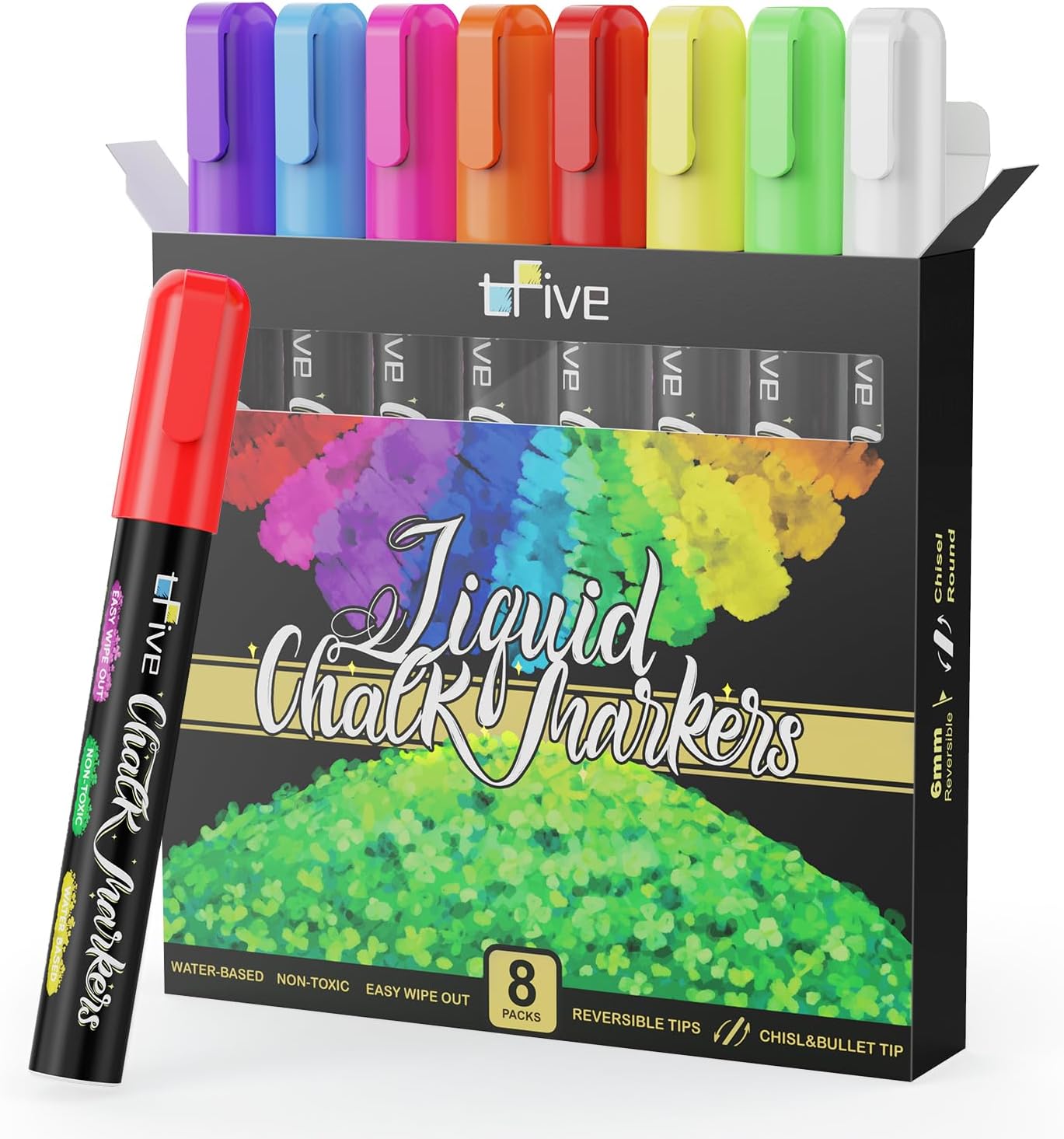 |
TFIVE Chalk Markers – 8 Color Chalk Pens and 24 Labels | Replace dusty chalk with bold, eye-catching ink that stands out from a distance. Ensures even, consistent writing for professional-looking designs and displays. Switch between chisel and bullet tips to create broad, medium, or fine lines. No chalk dust or residue, keeping hands and surfaces clean. |
Check Price |
Details Worth Checking Before You Choose
The eight marker sets here cover several tip widths and color styles, but the most useful choice depends on what you plan to write and how often you expect to erase it. A restaurant-style menu board, a monthly planner, and a child’s drawing board need different kinds of control.
Tip width should match the viewing distance
For compact lettering, planner grids, ingredient labels, and small decorative details, a fine nib around 1mm gives much better control than a broad chisel. Timart is the obvious detail-focused option in this group because its featured set uses 1mm tips.
For ordinary headings and mixed lettering, reversible medium tips are easier to live with. A bullet end gives a consistent rounded stroke, while a chisel orientation can create thicker downstrokes, block letters, or quicker fills. IJIANG, LANA & LUCA, and TFIVE all fit this more flexible middle ground.
A 10mm marker such as Labeol is designed for visibility rather than tiny detail. It is more useful for window messages, menu headings, large signs, and bold decorative shapes where a narrow marker would require too many passes.
Wet-erase behavior is usually better for displays
Most of the featured products use water-based liquid chalk intended to wipe from non-porous surfaces with a damp cloth or paper towel. That is different from a dry-erase marker, which is meant to wipe away without added moisture on compatible boards.
Wet-erase ink tends to stay in place better after it dries, which is helpful on a vertical sign that people may brush against. The trade-off is that you need water for cleanup, and repeated wet wiping can be harder on a painted chalkboard than on glass or acrylic.
Color range matters less than contrast
A large color assortment sounds appealing, but contrast determines whether the lettering is readable. White, yellow, bright pink, turquoise, and neon shades usually stand out strongly against dark boards. Deep blue, dark purple, brown, or muted vintage shades can look elegant up close but may disappear from across a room.
If the board is used for practical information, choose colors by legibility first. Decorative palettes are more useful when viewers stand close enough to appreciate subtle differences.
Smooth flow is better than maximum ink output
A good chalk marker should become evenly saturated after priming and then write without repeated pumping. Too little flow causes scratchy, interrupted lines. Too much flow produces puddles around the nib and makes edges harder to control.
If a marker starts dry, pause and prime it on scrap material rather than repeatedly pressing the tip against the finished board. If it begins to flood, hold it nib-up briefly and wipe excess ink from the tip with a disposable cloth before continuing.
Surface testing should be part of the buying decision
Manufacturers commonly state that erasability is for non-porous surfaces. Chalkola and Stationery Island are particularly clear about this limitation. A painted chalkboard can be more absorbent than glass even when it feels smooth.
If easy removal is essential, buy for the surface you actually have, not the word “chalkboard” printed on the marker package. A separate glass, acrylic, melamine, or properly sealed board is often more predictable for frequently changed liquid-chalk designs than an unsealed chalkboard-painted wall.
When Liquid Chalk Is the Wrong Tool
Liquid chalk is not automatically the better choice for every blackboard-style project. If the surface is intentionally porous, if you want the soft dusty texture of traditional chalk, or if children will cover the entire wall with drawings every day, ordinary stick chalk may be simpler and gentler on the finish.
It can also be the wrong tool when the design needs to disappear without water. A wet-erase marker is useful precisely because it resists casual dry rubbing, but that means a quick finger wipe will not reset the board. For rapid brainstorming where constant erasing matters, a purpose-built dry-erase surface may be more convenient.
If the board is valuable, antique, handmade, or difficult to repaint, a liquid marker deserves extra caution. No marketing claim replaces a hidden surface test. That single step is more valuable than choosing a marker solely because it is described as washable.
STATIONERY ISLAND Chalk Pens for Blackboard — Flexible Nib Choices for Regular Sign Work
Stationery Island is useful here because its chalk-pen line is built around several nib formats rather than one fixed writing style. The current range includes wet- and dry-wipe pens with nibs from roughly 3mm to 8mm, including round, bullet, chisel, and block shapes. That makes the brand particularly practical if your chalkboard work changes between fine lettering, ordinary notes, and larger headings.
For chalkboard paint, the most important feature is not the color selection but the company’s own surface guidance. Stationery Island says its liquid chalk ink should be used on non-porous surfaces and specifically recommends testing a hidden area, allowing the mark to dry, and confirming that it erases before proceeding. That is exactly the kind of caution painted chalkboards require.
Wet-wipe and dry-wipe choices change how the board behaves
A wet-wipe pen needs moisture for removal and therefore resists casual rubbing better once dry. That is useful for menu boards, family calendars, labels, or signs that people may touch. A dry-wipe version is quicker to remove on a compatible board, but it can be easier to smudge accidentally.
Because the product name used here is broad rather than tied to one nib, check the current listing before ordering and make sure the tip type matches your project. A 3mm fine nib and an 8mm block nib may come from the same brand, yet they feel like completely different tools in use.
Water-based, low-odor ink suits indoor projects
Stationery Island describes its chalk pens as water-based, low odor, non-toxic, and compliant with EN71. For a kitchen message board, classroom display, craft room, or home sign, low odor is more pleasant than a strong solvent marker.
Water-based does not mean harmless to every painted finish, however. Water carries pigment into absorbent pores. If your chalkboard paint is matte and open-textured, test first and avoid leaving the initial trial mark for days.
- Multiple nib sizes are available. You can match a fine, medium, chisel, or block-style pen to the scale of your lettering instead of forcing one width to handle every job.
- The brand gives clear non-porous-surface guidance. That helps prevent the common assumption that every black painted board will erase cleanly.
- Wet- and dry-wipe options cover different display needs. A frequently touched sign can benefit from wet-wipe ink, while a fast-changing compatible board may suit dry-wipe ink.
- Water-based, low-odor ink is convenient indoors. It is easier to use around normal home or classroom activity than a strong solvent-based paint marker.
- The broad product range means you need to confirm the exact nib and erase type on the listing rather than assuming every Stationery Island chalk pen behaves the same way.
Who It Suits
This is a sensible choice for someone who uses chalk-style signage regularly and wants to select a nib shape based on the job rather than buying one generic marker format.
Less Suitable When
If you want one preselected multicolor pack with a single known tip specification, one of the more narrowly defined sets below is simpler to compare.
Chalkola Chalk Markers for Blackboard — A Broad Range for Mixed Lettering Styles
Chalkola has one of the widest current chalk-marker ranges, with fine, standard, reversible, and jumbo nibs sold in several color combinations. That makes it a strong fit for crafters who do more than one type of chalk-style project: small labels one week, window lettering the next, then a larger menu or party sign.
The brand’s surface advice is especially important for chalkboard paint. Chalkola states that its markers erase from non-porous materials but can become permanent on porous surfaces such as paper, unfinished wood, concrete, and painted surfaces. Its current guidance goes further and warns that many chalkboard-painted walls are porous enough to ghost.
Nib variety gives you room to match the project
Chalkola currently offers tips from extra-fine 1mm options through 3mm and 6mm reversible tips and up to 15mm jumbo markers. Some reversible nibs can be turned between round and chisel orientations. This gives you the ability to use one brand while changing line width dramatically.
For a home chalkboard calendar, a medium reversible nib is the easiest general-purpose format. For narrow boxes and dates, a fine tip reduces crowding. For a large wedding sign or storefront-style board, a broad nib fills strokes faster and makes letters visible from farther away.
Highly pigmented colors show well on dark surfaces
Chalkola’s liquid chalk range is built around bright opaque color rather than the translucent look of many ordinary markers. The stronger pigment makes a difference on black or dark green boards, where faint ink can disappear unless the viewer stands close.
The same pigmentation that improves visibility also makes porous-surface testing essential. A strong color that looks excellent on a sealed board can leave a more obvious shadow if it penetrates an absorbent painted finish.
Cleanup is easy only on the right surface
On glass, acrylic, coated boards, and other non-porous materials, Chalkola recommends damp-cloth cleanup. This makes the markers useful for temporary decorative signs and frequently updated displays.
Do not treat “chalkboard” as a guarantee of erasability. A factory-made non-porous chalkboard and a wall painted with matte chalkboard paint can respond very differently to the same pen.
- The range covers fine to jumbo nibs. That makes it easier to choose a pen that genuinely fits your lettering scale.
- Strong pigmentation improves contrast on dark boards. Bright and neon colors remain readable from farther away than weak translucent ink.
- Reversible nib options add versatility. Round and chisel strokes can cover normal writing, decorative lettering, outlines, and moderate fills.
- The brand clearly explains porous-surface limits. That is valuable for anyone specifically planning to use liquid chalk on chalkboard paint.
- Because Chalkola sells many different sets, the exact color count and nib size vary, so the listing needs to be checked carefully before purchase.
Who It Suits
Chalkola is a good fit for crafters who expect to work on several non-porous surfaces and want access to different nib widths without changing marker brands.
Less Suitable When
If your only surface is an unsealed chalkboard-painted wall that already shows ghosting, a liquid marker from any brand is a risky choice until the surface is tested or sealed.
Timart Extra Fine Tip Chalk Markers — 1mm Control for Calendars and Small Lettering
Timart’s featured set is much more specific than the broad marker families above. Current listings identify it as an eight-pack with 1mm extra-fine tips and vivid neon colors. That small point is the reason to choose it: it is built for detail rather than fast broad coverage.
A 1mm nib is useful on a monthly chalkboard calendar where each day has limited space, on pantry labels, small price signs, detailed illustrations, outlines, and compact lettering. It lets you place marks close together without the strokes merging into a thick block.
The fine tip reduces the amount of ink in each stroke
A narrow nib naturally lays down less liquid than a jumbo marker. On a painted board, that can make neat lettering easier because there is less chance of a broad wet edge spreading across surface texture. It does not eliminate the possibility of staining, but it gives you more control over placement.
The downside is coverage speed. Filling a large headline with a 1mm point is slow and can create visible overlapping strokes. This is a detail marker, not a substitute for a broad chisel or block pen.
Eight neon colors give strong visual separation
The current Timart set uses eight vivid fluorescent/neon colors. That is useful for planners where color coding has a job: one shade for appointments, another for meals, another for reminders, and a different one for family members.
On dark surfaces, brighter colors generally produce better legibility. Still, test every color you intend to use. Some pigments can leave more visible ghosting than others on a porous paint finish.
Cleanup is intended for non-porous surfaces
Timart’s current listing specifically says the markers wipe away with a damp cloth or paper towel on non-porous surfaces. It also warns that not all chalkboards are suitable and recommends testing a small area first.
That makes the set straightforward to recommend for glass calendars, acrylic boards, coated labels, and well-sealed surfaces. For a wall painted with chalkboard paint, the surface test should come before any large lettering.
- The 1mm point is excellent for fine detail. Small calendar boxes, labels, outlines, and compact handwriting are much easier to control than with a wide marker.
- Eight vivid colors support practical color coding. The palette can separate dates, tasks, names, menu items, or decorative details without relying on one shade.
- The narrow nib is easier to place accurately. It is useful when clean corners and small letterforms matter more than filling speed.
- The listing clearly limits erasability to non-porous surfaces. That helps users avoid assuming the pen will wipe from every chalkboard-painted finish.
- The extra-fine point is inefficient for large headings, broad fills, and signage intended to be read from across a room.
Who It Suits
Timart makes the most sense for detailed planners, small labels, fine chalkboard art, compact menus, and writers who naturally use smaller handwriting.
Less Suitable When
For a large event sign, shop window, wide menu heading, or bold wall quote, a medium or jumbo marker will complete the job with fewer passes.
SILENART Liquid Chalk Markers — Eight Bright Colors for General-Purpose Wet-Erase Writing
SILENART’s current eight-color set is a general-purpose liquid chalk option designed for non-porous chalkboards, glass, windows, acrylic calendars, whiteboards, plastic, ceramic, and metal. The commonly indexed version uses a medium 6mm format, while some current listings show additional nib-size variants under the same product family.
The appeal here is balance. It is not as specialized as Timart’s 1mm set and not as broad as Labeol’s 10mm jumbo markers. A medium tip gives enough width for normal lettering while remaining manageable for decorative details and simple drawings.
Medium-width strokes suit ordinary signs and boards
A 6mm-type nib is a practical everyday size for kitchen boards, classroom notes, bistro-style menus, chore charts, party signs, and decorative quotes. You can write at a comfortable speed without needing repeated parallel strokes to make each letter visible.
Some listings describe a 3–6mm reversible or variable orientation, while others identify the 8-color version simply as 6mm. Because variants exist, confirm the exact tip shown on the current seller page before buying if reversible-tip control matters to you.
The water-based formula is wet-erase on non-porous surfaces
SILENART describes the ink as non-toxic, odorless, and dust-free, with damp-cloth or paper-towel removal on non-porous materials. That makes it suitable for indoor displays where chalk dust would be annoying.
The same rule applies as with every marker here: painted chalkboard walls need testing. If the paint absorbs water quickly or already holds stains, do not assume wet-erase ink will disappear cleanly.
Eight colors cover most everyday decorative work
Eight bright shades give enough range for borders, headings, illustrations, and color-coded notes without creating a large box of pens that may rarely be used. For someone who wants a simple set rather than 20 or 40 colors, that can be an advantage.
- The medium tip is versatile for normal lettering. It handles headings, notes, borders, and simple drawings without feeling excessively fine or bulky.
- Eight bright colors provide useful contrast. The set gives enough variation for color coding and decorative work on dark boards.
- Wet-erase cleanup suits stable displays. Once dry on a compatible non-porous surface, the writing is less likely to disappear from an accidental dry brush.
- The ink is described as odorless and dust-free. That makes repeated indoor use cleaner than traditional chalk.
- Current listings show tip-size variants, so buyers who need one exact nib format should verify the seller’s specific 8-color version before ordering.
Who It Suits
SILENART is a practical middle-ground option for home message boards, school displays, small-business signs, acrylic planners, and mixed decorative work.
Less Suitable When
Choose Timart for very fine writing or Labeol for oversized bold lettering; SILENART’s strength is general-purpose use rather than either extreme.
IJIANG Chalk Markers for Blackboards — Reversible Bullet and Chisel Control
IJIANG’s eight-color reversible-tip sets are useful when you want two stroke styles without carrying separate fine and broad markers. Current listings for its 6mm liquid chalk pens show a reversible nib with bullet and chisel orientations, water-based ink, and wet-erase cleanup from non-porous surfaces.
IJIANG currently sells several eight-color palettes, including metallic, pastel, and other color collections. The exact shades can vary by listing, so the feature to focus on is the 6mm reversible bullet/chisel tip, not a particular color family unless the listing clearly identifies it.
Bullet orientation makes consistent rounded lines
A bullet tip is easy to control for ordinary handwriting, numbers, outlines, and simple drawings because the stroke width changes less as your hand angle moves. That can be helpful for beginners who do not yet want to think about calligraphy-style pen angles.
Flip the nib to the chisel side and the marker becomes better for block lettering, thicker downstrokes, borders, and broader accents. The chisel edge can also fill moderate areas more quickly than a round tip.
Water-based ink is intended to erase with moisture
Current IJIANG listings describe the ink as water based and washable from non-porous blackboards, whiteboards, glass, mirrors, plastic, metal, and varnished surfaces. That is exactly the environment where liquid chalk behaves most predictably.
On chalkboard paint, perform the same hidden test you would use with any other wet-erase marker. A reversible nib improves writing control; it does not change the absorbency of the wall underneath it.
Color collections let you choose the mood
Metallic colors can look more decorative on party signs and glass. Pastels feel softer for calendars and home décor. Neon shades generally maximize visibility. Because the product family spans several palettes, choose based on your board color and viewing distance rather than simply picking the largest number of shades.
- The 6mm reversible nib provides two useful stroke styles. Bullet orientation is easy for ordinary writing, while chisel orientation handles bolder lettering and accents.
- Water-based ink is designed for damp-cloth removal on non-porous surfaces. That suits reusable signs and boards that change often.
- Several eight-color palettes are available. You can choose metallic, pastel, or brighter looks depending on the design rather than accepting one fixed aesthetic.
- The medium size is easier to read from a distance than a 1mm detail pen. It is practical for normal wall boards and signs without becoming a jumbo marker.
- Because IJIANG sells multiple eight-color variants, you need to verify the exact palette and nib specification on the current listing rather than relying on the brand name alone.
Who It Suits
This is a good fit for people who want one marker set to handle ordinary writing plus simple decorative lettering without switching between separate bullet and chisel pens.
Less Suitable When
It is less attractive if you only need ultra-fine calendar details or very broad window lettering, where a purpose-built narrow or jumbo nib is faster.
LANA & LUCA Liquid Chalk Markers for Blackboards — Vintage Colors with a 6mm Reversible Tip
LANA & LUCA’s featured set is an eight-pack built around a vintage color palette and a 6mm reversible tip. Current listings describe the pens as water-based wet-erase markers intended for chalkboards, windows, glass, signs, whiteboards, and other non-porous surfaces.
The palette is the distinguishing feature. Instead of concentrating only on highlighter-bright neon shades, the set is intended to produce a more muted decorative look. That can work well with rustic menu boards, wedding signage, home labels, seasonal displays, and café-style lettering where the board is part of the décor.
A 6mm reversible nib balances style and legibility
The 6mm format is broad enough for readable wall-board lettering while still being controllable in smaller designs. Reversible construction means you can change the shape of the stroke by changing nib orientation, which helps when alternating between normal text and heavier titles.
For very small planners, 6mm may still feel crowded. For a large storefront window, it may feel too narrow. Its natural home is medium-size signage.
Wet-erase ink stays more stable after drying
LANA & LUCA’s current listings say a damp paper towel removes the ink from non-porous materials. That wet-erase behavior is useful for signs you want to leave in place for days because the dried writing is less vulnerable to a casual dry touch.
On chalkboard-painted furniture or walls, test first. Muted colors can still penetrate a porous finish even when they look less intense than neon ink.
The vintage palette suits decorative boards
If your main goal is maximum readability across a classroom, neon colors may make more sense. If you want a softer handmade look for a kitchen sign, wedding board, or craft display, vintage tones can feel less harsh and more coordinated with neutral décor.
- The eight-color vintage palette offers a different visual style. It suits decorative signs that would look too loud in fluorescent neon shades.
- A 6mm reversible tip handles normal writing and broader accents. You get more stroke control than with a fixed bullet nib.
- Wet-erase cleanup is practical on non-porous boards. The design can stay stable until you intentionally wipe it with moisture.
- Water-based ink avoids chalk dust. It is convenient for indoor decorative boards and frequently handled home spaces.
- The muted palette is less visible from a long distance than the brightest neon sets, especially when darker shades are used on a black board.
Who It Suits
LANA & LUCA is well suited to home décor, wedding and party signs, café-style menu boards, and anyone who prefers subdued colors over fluorescent ones.
Less Suitable When
For classroom boards, roadside-facing windows, or any sign that must be read from far away, prioritize maximum contrast rather than the softer vintage aesthetic.
Labeol 8 Colors 10mm Liquid Chalk Markers — Jumbo Coverage for Big Lettering
Labeol’s eight-color set stands out because of its 10mm jumbo nib. Current indexed listings describe it as a washable liquid chalk marker set with a 2-in-1 nib intended for windows, cars, signs, glass, whiteboards, mirrors, and other smooth surfaces.
This is the choice for scale. If you need a heading that can be read across a room, a broad holiday window message, a large menu title, or thick decorative shapes, a 10mm marker covers area much faster than a 1mm or 6mm pen.
Jumbo width reduces repeated passes
Large lettering often looks uneven when it is built from many narrow parallel lines. A 10mm nib creates a naturally broad stroke, so block letters and thick borders look cleaner with fewer passes. It also reduces the time required to fill a shape.
The trade-off is precision. A 10mm nib is awkward in small calendar squares and narrow labels, and it can release a relatively large amount of liquid onto the surface. On chalkboard paint, that makes the hidden test particularly important.
The current listing describes a 2-in-1 nib
Older descriptions of this product sometimes use broader wording about multiple line styles, but the currently indexed Labeol 10mm set is described as a 2-in-1 nib. I would choose it for the verified jumbo width and broad writing capability rather than relying on an unsupported promise of three distinct tip modes.
Eight colors keep large signs visually flexible
A multicolor jumbo set is useful for storefront-style displays, seasonal windows, school-event signs, and party decorations where you may want a contrasting border, headline, and accent shapes. Because the marks are large, the color itself becomes a major part of the design.
- The 10mm nib is efficient for oversized lettering. It creates broad strokes without building every line from several narrow passes.
- Large fills and borders are faster to complete. This is useful for signs where a fine marker would become tedious.
- Eight colors support bold decorative work. You can create headings, accents, and simple illustrations without relying on one shade.
- Washable liquid chalk is intended for smooth non-porous displays. Glass and windows are especially natural matches for a jumbo marker.
- The broad 10mm nib is too large for compact calendars, small labels, and precise lettering, and it can put a lot of liquid onto a porous painted board.
Who It Suits
Labeol is most useful for large menu headings, event signage, windows, big decorative boards, and crafters who intentionally work at a larger scale.
Less Suitable When
If you need to write dates, ingredient names, small prices, or tightly spaced notes, a fine or medium marker will be much easier to control.
TFIVE Chalk Markers — Eight Colors, Reversible Tips, and 24 Labels
TFIVE’s featured set combines eight liquid chalk markers with 24 chalkboard labels. Current listings describe the markers as dry/wet-erase-style chalk pens for non-porous chalkboards, signs, windows, glass, and mirrors, with a reversible tip that can be used in bullet or chisel orientation.
The included labels make this set more practical for pantry jars, storage bins, party food cards, craft organization, and reusable home labeling than a marker-only pack. If labels are already part of your project, the bundle reduces the need to buy them separately.
The reversible tip covers broad, medium, and finer strokes
Current product information describes a 3–6mm reversible chisel/bullet nib. The bullet side is straightforward for names, dates, and ordinary writing. The chisel side gives you a wider edge for headings, borders, and block-style lettering.
That makes TFIVE more flexible than a fixed 1mm pen without becoming as oversized as the 10mm Labeol set. For most household signs and reusable labels, that middle ground is useful.
Twenty-four labels make the set project-ready
The label bundle is not just an accessory count. It gives the markers a clear practical use immediately: jars, boxes, drawers, buffet signs, gift containers, or storage bins. On a smooth coated label, wet-erase chalk tends to be more predictable than on an unsealed painted wall.
If you are buying specifically for a large chalkboard wall and do not need labels, the extra pieces may add little value. But for organization projects, they are genuinely useful.
Wet cleanup is still surface-dependent
TFIVE describes easy damp-paper-towel cleanup on non-porous surfaces. As with every marker in this list, do not transfer that promise blindly to chalkboard paint. Test the exact surface first and allow the trial mark to dry before judging cleanup.
- The eight-marker set includes 24 reusable-style labels. That makes it convenient for organization projects, jars, bins, and party signage.
- The reversible 3–6mm bullet/chisel tip is versatile. It handles normal writing, wider headings, and simple decorative strokes without requiring separate pens.
- The medium width suits everyday boards. It is easier to read than an ultra-fine pen while remaining more controlled than a jumbo nib.
- Wet-erase cleanup works well on compatible smooth surfaces. This suits labels and signs that need to stay readable until intentionally wiped.
- If you do not need the included labels, the bundle is less compelling than choosing a marker set solely by nib style and color palette.
Who It Suits
TFIVE is a practical choice for home organization, pantry labels, event cards, reusable food signs, and medium-size chalkboard or glass lettering.
Less Suitable When
For detailed art, choose a finer pen; for huge storefront-style lettering, a wider jumbo tip will be faster.
Comparing the Eight Options
These sets become much easier to choose once you stop comparing them by color count alone. The deciding factors are tip width, surface behavior, and whether the extras actually support your project.
For fine calendars and detailed lettering
Timart is the clearest choice because its 1mm tip is purpose-built for small strokes. It gives you room to write inside planner grids and make detailed illustrations without crowding the design. Chalkola can also work well if you choose one of its extra-fine variants, but the featured Chalkola name covers many nib sizes, so you need to select carefully.
Stationery Island also offers fine nib choices, though its range spans several formats. If you value having one brand available in many sizes, that flexibility can be more important than buying a fixed set.
For everyday writing and mixed lettering
IJIANG, LANA & LUCA, SILENART, and TFIVE sit in the most useful middle range. Their roughly medium-width formats are broad enough for readable headings without making normal writing feel clumsy.
IJIANG and TFIVE are particularly useful if you want reversible bullet/chisel control. LANA & LUCA is more appealing if the vintage palette suits your décor. SILENART is a straightforward choice if you simply want eight bright general-purpose colors without a strong specialty feature.
For large signs and windows
Labeol’s 10mm nib is the standout. Large letters, borders, simple illustrations, and window messages are faster to create because the nib covers more area with every pass.
A jumbo marker is not automatically better on a chalkboard-painted wall. More liquid reaches the surface at once, so test carefully. On smooth glass or a factory-coated board, the broad tip makes much more sense.
For the broadest nib ecosystem
Chalkola and Stationery Island are better thought of as families of chalk pens rather than one rigid format. Their ranges let you choose among fine, medium, chisel, and jumbo styles. That is useful if you expect to keep expanding your chalk-lettering toolkit.
The drawback is that the product name alone does not tell you the exact nib in the box. Read the current listing rather than assuming one set represents the entire brand.
For labels and household organization
TFIVE has the most obvious advantage because it includes 24 labels with the eight markers. That combination makes sense for jars, bins, drawers, party food signs, and storage projects where you need both the writing tool and the writable surface.
For decorative muted color
LANA & LUCA’s vintage palette is the most distinctive option for softer visual work. It fits rustic boards and décor where fluorescent neon would overpower the design. If maximum distance visibility matters, however, brighter sets from Timart, Chalkola, SILENART, or other vivid palettes are easier to read.
The painted-surface rule applies to every set
No marker here gets an exemption from surface testing. The best chalk marker for chalkboard paint is the one that erases cleanly from your specific cured finish after a hidden test. Tip quality and color are secondary if the pigment leaves a permanent shadow.
How to Get Clean Results on Chalkboard Paint
1. Let the paint cure fully
Do not write on chalkboard paint as soon as it feels dry to the touch. Follow the paint manufacturer’s full cure and ready-for-use instructions. Benjamin Moore’s current INSL-X chalkboard coating, for example, lists a four-day ready-to-use period, while other products may differ.
A surface that is still curing can be softer and more vulnerable to marking, water, pressure, and cleaning. Use the paint label as the authority for cure time.
2. Prepare the board as directed by the paint maker
Some chalkboard coatings instruct users to condition or season the cured surface with the side of ordinary chalk and then erase it before normal use. Rust-Oleum currently gives this instruction for its chalkboard paint.
Seasoning is not a way to make a porous board safe for liquid chalk, but it should still be completed if the paint maker requires it. It helps the coating behave as the manufacturer intended.
3. Test the marker in a hidden area
Shake and prime the marker on scrap material first. Then make a small mark somewhere inconspicuous on the finished board. Let it dry for at least several minutes and wipe it according to the marker instructions.
If it cleans well, make a second test and leave it longer. A board used for weekly menus needs to handle ink that sits for days, not only a five-minute test.
4. Shake with the cap secured
Liquid pigment can separate while stored. Shake the marker with the cap firmly in place so the components mix without spraying ink. The exact number of shakes is less important than achieving a uniform flow.
Do not shake an uncapped marker over furniture, flooring, clothing, or the finished board.
5. Prime on scrap paper, not the board
Press the nib down repeatedly until ink saturates the tip evenly. Pump-action markers can release more liquid than expected when they first start. Scrap material gives that excess somewhere harmless to go.
Once the nib writes a clean uninterrupted line, move to the chalkboard.
6. Use lighter pressure than you think you need
A saturated chalk marker should not require aggressive pressure. Pushing hard can deform the nib, over-release ink, and create puddles around letter corners.
Let the tip glide. If the line becomes dry, pause and reprime briefly on scrap material instead of crushing the nib against the board.
7. Let one color dry before crossing it with another
Liquid chalk can smear when wet. If your design uses outlines, layered colors, shadows, or overlapping lettering, give the first layer time to set before adding the next.
This is particularly important with broad nibs because they deposit more ink and can stay wet longer in heavy strokes.
8. Erase with the gentlest method that works
Start with the method specified by the marker maker, usually a damp microfiber cloth, damp paper towel, or similar soft wipe for wet-erase ink. Avoid abrasive sponges on painted chalkboard finishes unless the paint manufacturer explicitly allows them.
If a mark does not disappear, stop before scrubbing aggressively. A faint stain may be pigment inside the coating rather than residue sitting on top.
9. Dry the board before writing again
After cleaning, wipe away excess moisture and let the surface dry. Writing onto a wet board can dilute the next stroke, change the edge of letters, and make the nib pick up moisture or residue.
A clean dry board also makes it easier to judge whether any ghosting remains.
Keeping Markers and Painted Boards in Better Condition
Store chalk markers horizontally unless the manufacturer says otherwise. Horizontal storage helps keep liquid distributed through the reservoir and reduces the chance that one end dries while the other floods. Keep caps firmly closed so the nib does not dry out.
If a tip becomes crusted with dry pigment, follow the maker’s cleaning instructions rather than scraping it with a knife or pin. Some nibs can be removed, rinsed, or reversed; others are not designed for disassembly.
For the board itself, use soft cloths and mild cleaning methods. Rust-Oleum specifically warns against abrasive sponges on its chalkboard coating. Repeated heavy scrubbing can polish a matte surface unevenly or remove the coating altogether.
If you use liquid chalk on a painted board frequently, expect the coating to be a consumable finish rather than a permanent glass-like surface. Periodic touch-up or repainting may eventually be needed, particularly if the board is cleaned with water every day.
Where Chalk Marker Projects Go Wrong
Assuming every blackboard is non-porous
The word “chalkboard” describes a function, not a single material. Glass, coated melamine, natural slate, painted drywall, acrylic-coated wood, and chalkboard paint can all be sold or used as chalkboards, yet they absorb liquid differently.
Test before making a large design. If the marker leaves a shadow in the corner, do not cover the whole wall and hope the problem disappears.
Pumping the nib directly on the finished surface
New markers often need several presses before ink reaches the tip. The moment it arrives, it can come quickly. Priming directly on the board may create a puddle that is much harder to remove than a normal stroke.
Use scrap material for priming every new pen and anytime a stored marker needs to restart.
Choosing a tip that is too wide for the design
A jumbo nib may look attractive because it produces bold color, but it becomes frustrating in small planner boxes. The writer starts twisting the pen, retracing letters, and pushing ink into tight corners.
Match the nib to the smallest important detail in the project. Broad tips are excellent when the design is genuinely broad.
Choosing a tip that is too fine for the viewing distance
The opposite problem is just as common. A 1mm line can look crisp from a few inches away and vanish across a kitchen or classroom. If the board exists to communicate information at a distance, line weight matters.
Use medium or broad tips for headings and reserve fine pens for supporting details.
Leaving a test mark for only a few seconds
A marker may wipe clean immediately but stain after the pigment has been in contact with the surface for a week. If your real design will stay up for days, your test should include a longer dwell time.
This takes more patience, but it is better than discovering ghosting after a holiday message has been on the wall for a month.
Scrubbing a stain until the paint changes sheen
Matte chalkboard paint can become shiny where it is polished by repeated rubbing. Once the sheen changes, the patch may remain visible even after the ink is gone.
Use soft cloths first. If the mark does not lift with the recommended method, accept that the surface may need touch-up rather than attacking it with abrasives.
Letting the tip dry uncapped
Liquid chalk nibs can crust over quickly. A partially dried tip writes rough, skips across the surface, and tempts the user to press harder. That pressure can release a sudden blob once the ink finally reaches the nib.
Cap markers promptly and store them consistently after use.
Safety and Surface Protection
Liquid chalk markers are generally cleaner than dusty stick chalk, but basic craft precautions still matter. Keep caps and small removable nib parts away from very young children, avoid drawing on skin or food-contact areas unless the product is specifically approved for that use, and wash hands after messy craft sessions.
Protect nearby flooring and furniture while priming broad markers. A 10mm liquid chalk pen can release a surprising amount of colored fluid if it is over-pumped.
For painted walls, the most important protection is restraint during cleaning. Do not use strong solvents, abrasive pads, or aggressive scraping on chalkboard paint unless the paint maker explicitly approves them. Removing the ink is not a success if the cleaner also removes or burnishes the coating.
Frequently Asked Questions
Can I use liquid chalk markers on any chalkboard-painted wall?
No. Some chalkboard paints tolerate liquid markers, while others are porous enough to absorb pigment. Rust-Oleum currently says its chalkboard coating can be used with chalk markers, but marker makers such as Chalkola and Stationery Island still recommend non-porous surfaces and testing. Always test your exact cured finish first.
Why did my chalk marker leave a ghost after I erased it?
The pigment may have entered pores in the surface rather than staying entirely on top. Ghosting is especially common on porous chalkboard paint, unfinished wood, paper, and other absorbent materials. More scrubbing may damage the finish without fully removing pigment below the surface.
Which tip size is best for a chalkboard calendar?
For small date boxes and compact notes, a 1mm fine tip such as Timart is easiest to control. If the calendar has larger spaces or headings, a reversible medium tip from IJIANG, TFIVE, or a suitable Chalkola/Stationery Island variant gives more visibility.
Which featured marker is best for large signs?
Labeol’s 10mm jumbo markers are the most purpose-built for broad lettering and fills. The wide nib reduces repeated passes and produces thicker lines that remain visible from farther away.
How long should I let chalk marker ink dry?
Drying depends on the marker, stroke thickness, humidity, and surface. Stationery Island recommends allowing several minutes for full drying in its current guidance. Broad, heavily saturated strokes need more time than thin fine-tip lines.
Can I use these markers on glass and mirrors?
Yes, glass and mirrors are among the most reliable surfaces for most of the featured liquid chalk markers because they are non-porous. Even so, test specialty coatings, tinted films, or antique mirrors in a hidden spot before decorating a large area.
Are chalk markers better than regular chalk?
They are better for crisp color, fine lettering, dust-free use, and bold signs on compatible surfaces. Regular chalk is often better for porous chalkboard paint, soft traditional shading, children’s free drawing, and situations where you want the surface to erase without repeated wet cleaning.
Choose the Marker by Tip First, Then Prove the Surface
The strongest chalk marker is not simply the brightest set or the pack with the most colors. For a small planner, a 1mm Timart tip is genuinely useful. For medium everyday lettering, reversible-tip sets from IJIANG, LANA & LUCA, or TFIVE give more flexibility. For oversized signs, Labeol’s 10mm nib saves time. Chalkola and Stationery Island offer the broadest choice of nib styles if you want to build a more complete lettering toolkit.
But chalkboard paint changes the decision. Before you trust any liquid chalk marker on a painted wall or piece of furniture, make a hidden test mark, let it dry, and prove that it erases without staining or changing the finish. That one habit protects the project far more effectively than relying on the word “erasable” on a package.