A pale scratch across a dark table can look much larger than it really is. The wood may still be sound, the finish may still be intact around it, and the furniture may have years of useful life left, yet that narrow light line keeps catching your eye every time you walk past.
Furniture touch up markers are useful for exactly that kind of small, cosmetic damage: places where the color has been rubbed, chipped, or scratched away but the piece does not need a full refinishing job.
The important part is knowing what a marker can realistically fix. A stain marker can disguise exposed lighter wood, soften the look of worn edges, and blend a shallow scratch into the surrounding finish. It cannot rebuild a missing corner or make a deep gouge disappear. Some kits add wax sticks for those slightly deeper defects, while simpler marker-only sets focus on color correction.
I’d treat these tools as controlled touch-up products rather than tiny magic wands. The best furniture touch up markers give you the right shade range, a tip you can control, and enough flexibility to build color gradually.
The seven products below cover broad wood-tone sets, marker-and-wax kits, targeted brown shades, black-white-gray repairs, and oil-based stain markers, so the useful differences are much clearer than the old “all repair pens are basically the same” approach.
Why Small Wood Repairs Depend More on Color Control Than Coverage
Furniture markers work because most everyday scratches become noticeable when a lighter substrate shows through a darker finish. The repair does not have to recreate every layer of the original factory coating to improve the appearance. It usually needs to reduce the contrast enough that the scratch stops becoming the first thing your eye sees.
That sounds simple, but wood color is rarely a single flat brown. A walnut-stained table may have warm brown areas, darker grain lines, amber highlights, and nearly black pores. Oak may lean yellow, honey, tan, or gray depending on the stain and age. Painted furniture adds another complication because white and gray finishes can shift noticeably from one manufacturer to another.
This is why a broad set of shades can be more useful than one marker labeled with the “correct” wood species. A cap marked walnut is only a starting point. The final result depends on the finish already on the furniture, how absorbent the exposed scratch is, how much ink you apply, and whether you wipe away excess before it dries.
Surface scratches are mainly a color problem
A shallow scratch that has removed color but not much material is the easiest repair. The surface may feel nearly smooth when you run a fingernail across it. Here, a marker can place pigment into the pale line so the surrounding finish visually takes over again.
The safest technique is usually to start with a lighter shade than you think you need. You can add another pass or move slightly darker. Going too dark on the first stroke is harder to hide because a dark repair can become more noticeable than the original scratch.
Deeper nicks need more than ink
If your fingernail clearly drops into the damaged area, color alone will not level it. A marker may hide the bright exposed wood, but side lighting will still reveal the groove. This is where kits with wax sticks have a practical advantage. The wax can occupy a small depression, and the marker can then help with color.
Wax sticks are still a touch-up solution, not structural repair. They are useful for small dents, edge chips, shallow voids, and narrow scratches. A large missing piece, loose veneer, split wood, or damaged joint needs a different repair method before cosmetic coloring makes sense.
Marker tips change how easily you can stay inside the repair
A broad or chisel point covers worn edges quickly, but it also makes it easier to color beyond a narrow scratch. A finer point is slower over a large scuff but gives more control around molding, corners, grain lines, and small nicks.
The marker does not need to color the whole surrounding surface. In fact, that usually makes the repair worse. The cleaner approach is to place color only where it is missing, then wipe or feather the edge before the excess has a chance to leave a halo.
Wood-look laminate still needs careful testing
Several of the products here are promoted for laminate or wood-look surfaces as well as finished wood. That can be useful because laminate often shows pale scratches very clearly. Still, laminate does not absorb color the same way exposed wood does, and a printed grain pattern may be difficult to match with one flat shade.
I don’t assume a marker will behave the same way on every surface just because the color looks close in the cap. Test underneath a shelf, behind a leg, inside a cabinet, or in another hidden area. Let the test dry before deciding whether the shade is actually usable.
| Product Image | Product Name | Features | Price |
|---|---|---|---|
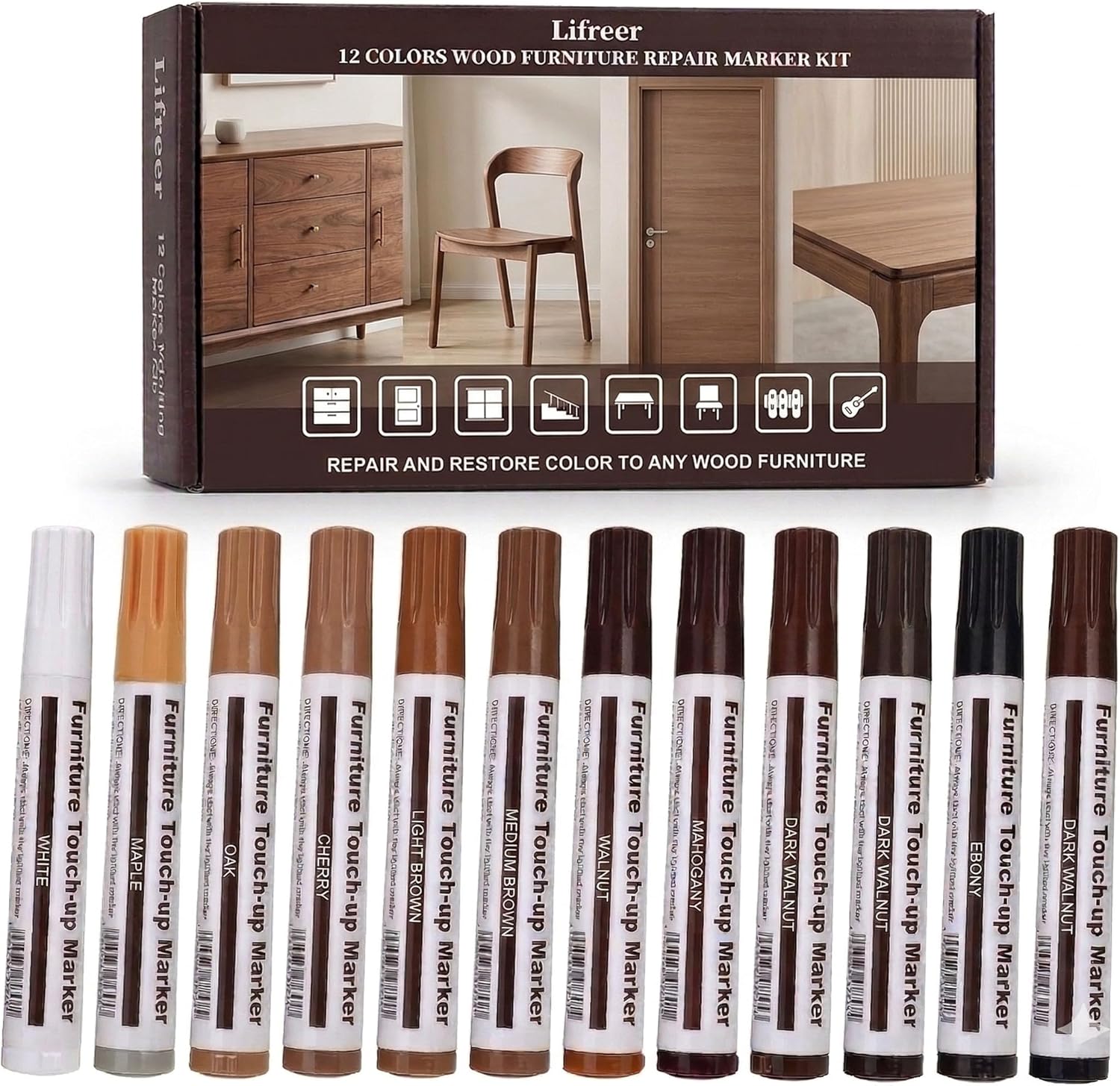 |
Lifreer 12 Colors Furniture Touch Up Markers | 12 Common Wood Tones. Works on furniture, cabinets, wood floors, tables, doors, trim, and bedposts. Easy to Use. Durable & Eco‑Friendly |
Check Price |
 |
DEWEL Furniture Markers Touch Up | Complete 17‑Piece Kit. Wide Color Range. Quick touch‑ups for surface scratches and scuffs.. |
Check Price |
 |
Rejuvenate Exact Match Wood Furniture | Covers scratches, scuffs, and damage on wood furniture and hardwood floors.. Includes Maple, Oak, Cherry, Walnut, Mahogany, and Espresso. Lightweight markers. |
Check Price |
 |
13-Piece Wood Stain and Scratch Repair Kit | Complete 13‑Piece Kit. Maple, Oak, Cherry, Walnut, Mahogany, and Black. Covers light, medium, and dark wood finishes. |
Check Price |
 |
Allary Furniture Touch-Up Markers | 3 Wood Tone Colors: Light Brown, Medium Brown, & Dark Brown. Designed for furniture, cabinets, floors, and trim. Scrub‑resistant formula ensures long‑lasting coverage. |
Check Price |
 |
BOPOVA Furniture Markers Touch Up | Covers both modern finishes (gray/white/black) and classic wood tones (brown shades). Instantly hides blemishes, chips, and nicks. Ink dries quickly and resists leaking. |
Check Price |
 |
Varathane 347840 Wood Stain Repair Marker Kit | Works on furniture, cabinets, floors, doors, and trim. Provide precise application in hard‑to‑reach areas. Warm Tones Kit: Maple, Gray, Cherry, Walnut, Mahogany, Black. |
Check Price |
How to Choose the Best Furniture Touch Up Markers for Your Finish
The first buying decision is not the number of pens in the box. It is the kind of damage you have and the colors already present on the furniture. I know it is tempting to treat a bigger set as automatically better, but a twelve-color set only helps when those extra shades solve real matching problems. Three carefully chosen brown markers may be enough for a room full of similar furniture.
Count the finishes you actually need to repair
Walk through the pieces you want to touch up before ordering. Are they mostly warm brown wood? Do you also have black, white, or gray furniture? Are you repairing one dining set or trying to keep a general-purpose kit for the whole house?
A broad shade range such as the Lifreer set makes sense when you have several different finishes. A targeted three-marker product such as Allary can be easier when all you need is light, medium, and dark brown. BOPOVA is the outlier here because the specific set in this article is black, white, and gray rather than a traditional wood-tone assortment.
Decide whether you need wax filler as well as color
DEWEL and Katzco combine markers with wax sticks. That changes what the kit can do. Instead of only disguising a line, you have a second material for filling a shallow recess before or after color work, depending on the damage and the instructions you follow.
Marker-only sets are simpler to store and use. They make sense for edge wear, fine scratches, pale scuffs, and areas where the surface is still physically level. If your furniture has several little dents and chips from moves, pets, toys, or chair impacts, a combined kit is more adaptable.
Think about warm wood tones versus modern neutrals
Classic marker sets often include names such as maple, oak, cherry, walnut, mahogany, and espresso. Those are useful reference points, but your furniture may not fit neatly into one name. Modern finishes add more gray, black, white, and cool brown tones.
The Lifreer 12-color set spans both traditional and modern-looking shades, including black, gray, and white alongside several browns. DEWEL also includes white and gray in addition to wood colors. BOPOVA is even more focused, with only black, white, and gray in the exact version featured here.
Choose a system that lets you build color slowly
A touch-up marker should not force you to get the shade perfect in one pass. Rejuvenate specifically recommends testing first, applying the matching shade, reapplying to darken, and removing excess pigment with a cloth. Its own directions also encourage starting lighter and blending darker shades when needed.
That is a good general mindset even when another manufacturer phrases the instructions differently. Apply less than you think you need, judge the dry color, and then decide whether another layer helps. Wet marker ink often looks darker or shinier than it will once it settles.
Do not ignore the existing sheen
Color is only half of what your eye sees. A marker may match the brown exactly but still be noticeable if the surrounding finish is glossy and the repair dries matte, or if the furniture is very flat and the marker leaves a shiny patch.
Touch-up markers are strongest at disguising small color breaks. If the finish layer itself has been removed across a larger area, you may eventually need a compatible clear finish or a more complete refinishing process. Do not add a clear coat automatically, though. The wrong topcoat can create a larger mismatch than the scratch you started with.
Check the product instructions before using cleaners or topcoats
Different formulas use different solvents and resins. Rejuvenate’s current product information identifies ethanol in its marker formula and gives specific directions for excess pigment. Varathane’s 347840 markers are oil-based stain markers with their own drying guidance. Those differences matter if you plan to clean, seal, or coat the area afterward.
I’d keep the repair sequence simple: clean the surface with a method safe for the furniture, let it dry fully, test the marker, make the smallest possible repair, and only add another product if the furniture finish genuinely needs it.
Lifreer 12 Colors Furniture Touch Up Markers – Broad Shade Coverage for Mixed Furniture
Lifreer’s set is the broadest marker-only assortment in this group. The current product information lists twelve shades: Black, Gray, White, Mahogany, Maple, Oak, Cherry, Walnut, Chestnut, Burnt Sienna, Espresso, and Bamboo. That mix is useful because it does not assume every repair is a traditional medium-brown wood scratch.
A twelve-marker range gives you more room to approach a finish gradually. A honey-toned shelf may sit closer to Bamboo or Maple, while a dark table may need Walnut, Espresso, or a carefully controlled combination. Black, gray, and white also give the set some usefulness on contemporary furniture where classic brown-only kits would be a poor fit.
The product is intended for scratches, scuffs, nicks, and worn areas on finished wood surfaces such as furniture, cabinets, floors, tables, doors, trim, and bedposts. That makes it best viewed as a color-correction set for small visible damage, not as a filler system for deep gouges.
Key features translated into practical benefits
The twelve-color range is the main reason to choose Lifreer. More shades mean you are less likely to force one medium brown onto every piece in the house. It also lets you test neighboring tones instead of assuming the printed wood name on the barrel will match your furniture perfectly.
The inclusion of black, gray, and white makes the set more flexible around painted or modern-looking surfaces. Those shades can be useful on dark shelving, pale cabinet edges, and gray-toned furniture where traditional stain names would not help much. You should still test first because a “white” marker can be warmer or cooler than the furniture in front of you.
Because this is a marker-only set, the workflow stays simple. Clean, test, apply lightly, wipe any excess, and let the color settle. That simplicity is useful for fast household touch-ups, though it also means you will need a separate filler if the damage has real depth.
- Twelve distinct shades give you more room to match mixed furniture instead of relying on a small brown-only set.
- Black, gray, and white extend its usefulness beyond conventional stained wood tones.
- The marker-only format is easy to store and quick to reach for when a scratch is mainly a color problem.
- The listed use cases cover common household pieces including furniture, cabinets, doors, trim, tables, and finished wood floors.
- There are no wax sticks for filling a groove or chipped edge.
- A large shade range still does not guarantee an exact match on custom stains or aged finishes.
Who It’s Best For
Lifreer suits a home with several different furniture finishes or anyone who wants one broad marker set for ongoing small touch-ups. It is especially practical if your pieces include a mix of warm wood, dark wood, gray, black, or white surfaces.
Not Ideal For
It is not the strongest choice for dents you can clearly feel or chips with missing material. In those cases, a kit that includes wax filler gives you another way to reduce the physical depression before you focus on color.
DEWEL Furniture Touch Up Markers 17-Piece Kit – Markers and Wax for More Than Surface Scuffs
DEWEL is the most complete marker-and-wax kit in this group by piece count. The verified 17-piece set contains eight touch-up markers, eight wax sticks, and one sharpener. The marker and wax colors are Maple, Oak, Cherry, Walnut, Mahogany, White, Gray, and Black.
That combination matters because furniture damage is not always flat. A marker handles missing color. A wax stick can help occupy a shallow nick, small hole, or narrow separation where color alone would still leave a visible shadow. The sharpener helps refine the wax stick so you can work more precisely rather than rubbing a wide blunt end across a small defect.
The eight-color range is also more modern than the typical six-shade brown set because it includes white, gray, and black. That makes the kit useful for a mixed household where a traditional dining table and a painted cabinet may both need attention.
Key features translated into practical benefits
Eight markers plus eight matching wax sticks give you two different repair tools in the same shades. If a scratch is shallow, you may only need the marker. If a small chip has depth, the wax gives you something to work into the recess before you refine the appearance.
The broad point on the markers helps cover worn edges and larger scuffs efficiently. Broad tips can also spread beyond a narrow scratch, so the benefit comes with a technique requirement: use light pressure and wipe away excess rather than dragging a heavy line across the surrounding finish.
The color selection spans light wood, medium wood, dark wood, and neutral painted finishes. Maple and Oak sit at the lighter end, Cherry and Mahogany introduce warmer red-brown directions, Walnut covers deeper brown, while White, Gray, and Black handle nontraditional furniture colors.
The included sharpener is small but useful. Wax crayons become harder to control as the tips flatten. Restoring a narrower point helps you fill the damaged spot instead of coating a wide ring around it.
- The 17-piece format combines color correction and shallow filling in one kit.
- Eight matching marker and wax shades reduce the need to improvise with unrelated filler colors.
- White, gray, and black make the kit more useful for painted or contemporary furniture.
- The sharpener helps keep wax application controlled on small nicks and edge chips.
- The extra components make it more involved than a simple marker-only touch-up.
- Wax-filled repairs can remain visible if the surface texture or sheen differs from the original finish.
Who It’s Best For
DEWEL is a strong fit for households with a mix of scratches, little dents, chipped corners, and worn edges. It also makes sense if you want one repair box that covers both classic wood colors and black, white, or gray furniture.
Not Ideal For
It is unnecessary if every defect you need to hide is a fine, flat surface scratch. For those jobs, a marker-only set is faster and gives you fewer pieces to manage.
Rejuvenate Exact Match Wood Furniture and Floor Repair Markers – Six Natural Wood Tones With Clear Blending Directions
Rejuvenate’s brown Exact Match set is a six-marker system built around familiar natural wood tones: Maple, Oak, Cherry, Walnut, Mahogany, and Espresso. Unlike some generic marker kits, Rejuvenate publishes clear application directions that emphasize testing, gradual darkening, wiping excess pigment, and letting the repair dry before touching it.
That makes this set easy to understand for someone who has never used a repair marker before. The aim is not to draw a thick line over the damage. You test in an inconspicuous spot, choose the closest color, apply it to the damaged area, reapply only if you need a darker result, and remove excess pigment from the surrounding finish.
Rejuvenate also encourages blending from lighter to darker tones when one marker is not enough. That is particularly useful on furniture where the exposed scratch does not correspond neatly to one named shade.
Key features translated into practical benefits
The six-shade selection stays focused on natural-looking wood colors. That is a benefit if your repair list is made up of stained furniture, cabinets, laminate floors, or wood-look surfaces rather than black, gray, or white painted pieces.
The brand’s light-to-dark blending guidance reduces the temptation to start with the darkest plausible pen. Starting with a lighter color gives you a way to build depth while keeping the repair reversible for longer.
The current directions specify testing first, carefully removing excess pigment with a cloth, allowing the color to dry, and tightly recapping the marker afterward. Those steps protect both the appearance of the repair and the usable life of the pen.
The markers are designed for scratches, scuffs, and damaged areas on furniture and flooring. Because there is no filler stick in this six-count set, it remains best for cosmetic color loss rather than deeper missing material.
- The six tones cover the most common natural wood directions without adding colors you may never use.
- Official blending directions make it easier to approach color matching gradually instead of guessing in one pass.
- The marker-only set is compact and straightforward for routine scratches and scuffs.
- It is designed for both furniture and flooring touch-ups, which is useful if the same finishes repeat through a room.
- There are no white, gray, or black markers in this brown six-count version.
- It does not include wax filler for deeper chips or grooves.
Who It’s Best For
Rejuvenate suits buyers whose furniture is mostly conventional stained wood and who value clear, repeatable application instructions. It is also a sensible choice for someone who wants to blend two nearby shades rather than rely on one very broad brown.
Not Ideal For
It is not the best fit for modern painted furniture or a home dominated by white, gray, or black finishes. It is also limited if your main problem is chipped material rather than missing surface color.
Katzco 13-Piece Wood Stain and Scratch Repair Kit – Six Markers Plus Six Wax Crayons
Katzco’s 13-piece kit follows the classic repair-kit formula: six felt-tip touch-up markers, six wax crayons, and a sharpener. The verified shade group is Maple, Oak, Cherry, Walnut, Mahogany, and Black. Those colors cover a useful light-to-dark range while keeping the set centered on stained wood and black accents.
The two-part system lets you separate color repair from shallow filling. Fine scratches may only need marker pigment. Small dents or scratches with a visible groove can take wax first, giving you a chance to reduce the depth before you adjust the color.
Katzco’s current product information describes the markers and wax crayons as matched to the six tones. That is helpful because a filler that is dramatically lighter than the marker can show through if the marker coating wears or the repair is viewed at an angle.
Key features translated into practical benefits
Six markers keep color selection manageable. Maple and Oak cover lighter finishes, Cherry and Mahogany cover redder tones, Walnut handles deep brown, and Black addresses very dark furniture or black-stained details.
Six wax crayons add a filling step that marker-only sets cannot provide. They are useful for narrow grooves, tiny chips, and shallow defects where the depression itself catches light even after the pale exposed material has been darkened.
The sharpener improves precision as the wax crayons wear. A pointed wax tip is easier to press into a small nick without leaving a thick ridge of filler across undamaged finish.
The set is promoted for furniture, cabinets, desks, floors, and similar wood surfaces. As always, the practical limit is the size of the damage. A wax crayon can disguise a small defect; it cannot rebuild a broken edge or repair loose veneer.
- Six markers and six wax crayons cover both color loss and shallow surface depressions.
- The included black shade gives the set more range at the dark end than brown-only kits.
- The sharpener helps keep wax application neat as the crayons become blunt.
- The compact six-color selection is easier to navigate if you do not need white or gray repairs.
- The shade range is narrower than Lifreer or DEWEL.
- There is no white or gray option in this exact six-color set.
Who It’s Best For
Katzco is a practical option for stained wood furniture with a mix of scratches and small nicks. It works especially well for someone who wants wax filler but does not need the larger eight-color spread of the DEWEL kit.
Not Ideal For
It is less useful for cool gray furniture, white cabinetry, or pale painted surfaces. It is also more kit than you need if all you are repairing is a single flat scratch.
Allary Furniture Touch-Up Markers – Three Browns for Simple Matching
Allary takes the opposite approach from the large multi-color kits. The verified pack contains three markers: Light Brown, Medium Brown, and Dark Brown. The current Amazon product information also describes them as fast drying, scrub resistant, and waterproof.
A three-shade system can be easier to use than a twelve-color assortment if your furniture already lives within a fairly narrow brown range. You are choosing among relative depth rather than trying to interpret a long list of species names that may not match the actual stain on your furniture anyway.
The limitation is obvious: there is no red-specific cherry shade, no pale maple label, and no black, white, or gray. That makes Allary a deliberately simple product rather than a universal household repair set.
Key features translated into practical benefits
Light, Medium, and Dark Brown are intuitive choices. If the scratch is on a medium walnut-looking piece, you can test Light Brown first and move darker if needed instead of deciding whether the finish is technically “walnut,” “mahogany,” or “espresso.”
The fast-drying description is useful for small touch-ups where you want to handle the piece again without a long wait. Faster drying also means you should wipe any excess promptly rather than leaving a thick ring of marker around the scratch.
Scrub resistance and waterproof labeling suggest the dried color is intended to tolerate normal handling better than a temporary washable marker. That does not make the repair indestructible, and I would still avoid harsh cleaners directly over a fresh touch-up.
The compact three-pen format is easy to store in a drawer or furniture-care kit. There is less clutter, and for many medium-to-dark brown households, the three depths may cover the repairs that actually occur.
- Three simple brown levels make color selection quick and easy to understand.
- The compact set is convenient for homes with mostly similar brown wood finishes.
- The current listing describes the markers as fast drying, scrub resistant, and waterproof.
- There are no filler tools or extra accessories to manage for a basic surface touch-up.
- Three browns give you much less control over warm, red, gray, black, or white finishes.
- There are no wax sticks for deeper scratches.
Who It’s Best For
Allary is best for someone with a small group of brown wood pieces who wants a straightforward scratch pen rather than a large repair kit. It is also a sensible backup set to keep on hand for quick edge wear and scuffs.
Not Ideal For
It is not a good match for households with widely varied stains or modern neutral furniture. If you regularly need cherry, black, white, or gray repairs, the limited palette will become frustrating.
BOPOVA Furniture Markers Touch Up – Black, White, and Gray for Modern Finishes
The specific BOPOVA set linked from the existing article is a three-marker Black, White, and Gray version. That is important because BOPOVA also sells other color combinations under similar listings, and it would be easy to describe the wrong variant if you relied on the brand name alone.
The verified Amazon details identify a chisel point, quick-drying ink, and a 0.5 mm listed line size for this Black, White, and Gray set. The same listing says it is not water resistant, which is a useful detail to keep in mind if the repaired surface is frequently wet-cleaned.
This palette is aimed at furniture that traditional wood-tone sets often ignore. Black media units, white cabinet edges, gray desks, monochrome shelving, and painted trim can all show pale scuffs that look odd when covered with a brown marker.
Key features translated into practical benefits
Black, White, and Gray target contemporary finishes directly. You are not trying to force a walnut marker onto a charcoal desk or an oak pen onto a white cabinet edge. That makes the set much more relevant for modern painted or wood-look furniture.
The chisel tip gives you two useful contact areas: a broader edge for worn corners and a narrower edge for small lines. Good control still depends on how lightly you press, because a chisel marker can lay down more color than a fine round tip if you lean on it.
Quick-drying ink is convenient on cabinet edges and furniture that needs to go back into use quickly. It also reduces the window for wiping away a heavy application, so test first and use short, controlled strokes.
The listing’s “not water resistant” specification is worth taking seriously. If the repaired surface is frequently wiped with a wet cloth, exposed to splashes, or cleaned aggressively, the touch-up may need more care and may not be as durable as a product labeled for water resistance.
- The black, white, and gray palette directly serves furniture that brown wood-marker sets miss.
- A chisel point gives you more control over both narrow scratches and worn edges.
- Quick-drying ink keeps small repairs convenient for frequently used furniture.
- The three-color pack is compact and focused instead of filling the drawer with unused wood shades.
- The verified listing says the ink is not water resistant.
- The three neutral colors offer little help on natural brown, cherry, or honey-toned wood.
Who It’s Best For
BOPOVA is best for modern furniture, painted cabinets, black shelving, gray desks, and white edges where conventional wood colors are simply wrong. It also works as a useful companion to a brown marker set if your home mixes natural wood and neutral painted finishes.
Not Ideal For
It is not a primary repair set for homes filled with stained oak, walnut, cherry, or mahogany furniture. Those finishes need a more varied brown and warm-tone palette.
Varathane 347840 Wood Stain Repair Marker Kit – Oil-Based Precision for Stained Wood and Laminate
Varathane 347840 is the most finish-oriented marker set in this list. The current verified listing describes oil-based wood stain markers intended for scratches on stained wood and laminate surfaces. The warm-tone set linked from the existing article currently lists Maple, Gray, Cherry, Walnut, Mahogany, and Black.
The oil-based formulation distinguishes it from generic multipurpose marker sets. Varathane positions these as stain repair markers, designed to complement its wood stains and to reach small or awkward areas where brushing stain would be excessive.
The current product information also provides specific drying guidance: dry to the touch in about five minutes and fully dry in about fifteen minutes under the stated conditions. That is useful because it gives you a better sense of when to stop judging the wet appearance and when the repair can be handled more normally.
Key features translated into practical benefits
Oil-based stain markers are designed to behave more like a wood-stain touch-up than a general craft marker. That makes them particularly relevant on stained furniture, cabinets, molding, wood floors, and laminate where you want localized color rather than a paint-like patch.
The six-color set gives you a progression from lighter Maple through warmer Cherry and Mahogany to deeper Walnut and Black, with Gray adding a cooler option. It still will not match every custom stain, so inconspicuous testing remains essential.
The narrow marker format is useful in hard-to-reach areas. You can touch a scratch along a cabinet rail, molding edge, furniture leg, or tight corner without opening a can of stain or trying to control a brush loaded with too much liquid.
The listed five-minute touch-dry and fifteen-minute full-dry times make the workflow predictable. You can apply a small amount, wait for the color to settle, and then decide whether another light pass is necessary rather than immediately stacking wet layers.
- The oil-based stain formula is purpose-built for stained wood and laminate touch-ups.
- The marker format gives precise control in corners, trim, molding, and other small repair areas.
- Published drying guidance makes it easier to judge when the repair has actually settled.
- The six colors cover light, warm, dark, black, and gray directions without an oversized assortment.
- Oil-based stain markers require more care around surrounding finishes than a casual washable pen.
- The six-color set may still need blending or a different product for unusual custom stains.
Who It’s Best For
Varathane is a strong choice for stained furniture, cabinets, molding, flooring, and laminate where you want a focused stain-marker approach rather than a marker-and-wax kit. It is especially useful for narrow scratches and small hard-to-reach blemishes.
Not Ideal For
It is not the first choice for deeper dents that need filler or for someone who specifically wants white furniture touch-ups. A separate filler or a different neutral-color set would suit those needs better.
Comparing the Seven Marker Sets Without Overcomplicating the Choice
The easiest way to compare these products is to start with the repair you need to make, not with the size of the package. I don’t think a large kit is automatically more useful; its extra shades or fillers matter only if they solve a problem you actually have.
For the widest mix of furniture colors
Lifreer gives you the broadest marker-only shade range. Twelve colors make sense if you have several rooms with different furniture finishes and want one compact color kit rather than separate products for each room. Its black, gray, and white markers also extend its usefulness beyond traditional brown wood.
DEWEL covers fewer colors, but it adds matching wax sticks. If your mixed furniture also has small chips and shallow grooves, that combination can be more useful than simply owning more marker shades.
For scratches plus small dents or chips
DEWEL and Katzco are the two clear marker-and-wax choices. DEWEL gives you eight marker colors and eight matching wax sticks, including white and gray. Katzco keeps the set to six wood-oriented colors plus black.
If your furniture palette is traditional and you want a compact kit, Katzco is easier to keep simple. If you need neutral painted finishes as well as brown wood, DEWEL has the stronger color spread.
For classic stained wood only
Rejuvenate is straightforward because its six colors are all conventional natural wood directions: Maple, Oak, Cherry, Walnut, Mahogany, and Espresso. Its published blending directions are also useful for a first-time user who wants a controlled process.
Varathane is more specifically a stain-marker product. Its oil-based formula and published drying times make it appealing for small scratches on stained wood, molding, cabinets, and laminate where precision matters more than having wax filler.
For a simple brown household
Allary is the least complicated option. Light Brown, Medium Brown, and Dark Brown will not match every finish, but the system is intuitive. If your furniture is mostly similar brown wood and the scratches are shallow, three depth levels may be all you need.
For black, white, and gray furniture
BOPOVA is the specialist. The exact linked version contains Black, White, and Gray markers, making it far more useful on modern neutral furniture than a six-pack of warm brown wood stains. Its current listing also identifies quick-drying ink and a chisel point, but notes that the ink is not water resistant.
How to Make a Touch-Up Marker Repair Look Cleaner
A good repair usually comes from restraint. The marker should reduce the visual contrast of the scratch, not create a new colored patch around it. The steps below work as a practical framework, but always follow the specific product directions if they differ.
1. Clean the damaged area gently
Remove dust, loose debris, skin oil, and ordinary grime with a cleaning method that is safe for the furniture’s existing finish. Do not soak the area. If you use any cleaner, let the surface dry completely before you judge the color or apply a marker.
A dirty scratch can look darker or warmer than the real substrate, which makes color matching harder. Residue can also interfere with how evenly the marker lays down pigment.
2. Check whether the damage is flat or recessed
Run a fingernail lightly across the scratch. If you can barely feel it, you are probably dealing mainly with color loss. If your nail drops into a groove, decide whether a wax-filler kit such as DEWEL or Katzco is more appropriate.
Do not try to force a marker to do a filler’s job. Darkening the bottom of a deep gouge may make it less bright, but it will not remove the shadow created by the depression.
3. Test the lightest plausible shade in a hidden spot
Choose an inconspicuous place made from the same finished material if possible. The underside of a shelf, the back edge of a leg, or the inside of a cabinet can work. Apply a small mark, let it dry, and compare it in the same lighting where the furniture is normally seen.
This is especially important with white, gray, cherry, and very dark finishes. Small undertone differences that seem harmless on the marker cap can be obvious on a large clean surface.
4. Apply color to the damaged line, not the whole neighborhood
Use the tip to follow the scratch rather than scribbling across the surrounding finish. For a long scratch, work in short sections so you can wipe excess before it dries. A chisel tip can be turned to its narrower edge for more control.
You are trying to replace missing color, not repaint the finish. The less undamaged surface you touch, the easier the repair is to blend.
5. Wipe excess pigment while you still have control
Several marker systems, including Rejuvenate and Varathane, specifically instruct users to remove excess pigment with a cloth. Use a soft, lint-free material and wipe around the scratch rather than aggressively polishing the colored area away.
If the first pass looks slightly light, that is usually better than being too dark. Let it settle, then add another thin pass if needed.
6. Build the shade gradually
A complex wood tone may need more than one color. Start with the lighter shade and add a darker tone only where it helps. Grain lines are often darker than the surrounding field, so a tiny amount of darker color can sometimes make a repair look more natural than one flat stripe.
Do not overwork the area. More layers are not automatically better. Stop once the scratch stops attracting attention from normal viewing distance.
7. Use wax carefully on recessed damage
If you are using a wax stick, work a small amount into the defect and remove material that sits above the surrounding surface. The goal is to reduce the visible depression, not create a raised wax ridge.
A sharpened wax stick gives you better control on a narrow chip. After the filler looks level enough, use the matching marker only if the color still needs adjustment.
8. Respect the drying time
Do not judge the final color while the ink is still wet. Wet pigment can appear darker and shinier. Rejuvenate instructs users to allow the repair to dry before touching, while Varathane publishes specific touch-dry and full-dry guidance for its 347840 stain markers.
Once the area is dry, look at it from normal standing distance and from the direction where light usually falls. If you cannot find the scratch immediately, the repair has done its job.
Keeping Repair Markers Useful Between Projects
Touch-up pens are easy to forget in a drawer until the next scratch appears. A little storage discipline makes the difference between finding a working marker and finding a dried felt tip six months later.
Cap every marker immediately after use
Rejuvenate’s directions explicitly tell users to cap the marker tightly after use, and the same habit makes sense for any felt-tip stain or repair pen. Solvent or water loss changes flow and can dry the tip.
Do not leave several markers uncapped while you compare shades. Open one, test it, recap it, and then move to the next.
Keep the shade names readable
Furniture colors are surprisingly hard to remember once the markers are out of their package. Keep the original box or label the storage pouch so you know which pen is Maple, Walnut, Espresso, or Gray later.
This is even more important when two barrels look similar. A quick written label prevents you from testing the wrong dark shade on a visible edge.
Protect wax sticks from heat and dirt
Wax crayons can soften in a hot garage, car, or sunny window. Store them somewhere reasonably cool and keep them away from sawdust, grit, and loose hardware that can become embedded in the surface.
If the end becomes dirty, trim or sharpen it before pressing that contamination into a light-colored furniture repair.
Replace markers that no longer flow evenly
A dried or damaged tip can create streaks, blobs, or inconsistent color. If a marker has been stored properly but no longer produces a controlled line, replacing it is usually safer than pressing harder on valuable furniture.
Touch-up work rewards control. A marker that only works when you force ink out of it is no longer giving you that control.
Touch-Up Habits That Make Scratches More Noticeable
Small repairs often go wrong because the user tries to make the scratch disappear completely at arm’s length. That leads to too much color, too much filler, and too much work on the surrounding finish. A good repair usually aims for visual quiet rather than perfection.
Choosing a shade from the cap alone
Marker caps are useful labels, not calibrated samples of how the ink will look on your furniture. The substrate underneath the scratch, the existing stain, and the top finish all change the final appearance.
Test somewhere hidden and wait for the color to dry. If two shades are close, start lighter. You can deepen a light touch-up; removing a dark stain from a pale finish can be much harder.
Coloring far beyond the scratch
A marker can make a narrow scratch less obvious, but a wide patch of mismatched color can make the entire area look repaired. This happens when someone repeatedly scribbles over the same spot trying to “blend” it.
Keep pigment inside the damaged line as much as possible. Wipe the surrounding finish before excess color settles.
Treating a groove as if it were only missing color
Deep scratches reflect light because they change the shape of the surface. Even a perfect color match will not remove that shadow. Marker-only repair is therefore limited when material is actually missing.
Use a wax filler for small recessed damage or move to a proper wood-filler repair when the defect is larger. Color should be the finishing step, not a substitute for rebuilding the surface.
Using black on very dark brown furniture without testing
Black can look close to espresso or very dark walnut in the package, but a solid black repair may look flat and artificial on a brown finish. The same problem happens when a dark walnut pen is used on black furniture.
Look at undertone, not just darkness. BOPOVA’s black marker is useful on black finishes, while deep brown wood may still look better with Walnut or Espresso from another set.
Trying to match white furniture with one universal white
White furniture can be bright blue-white, warm ivory, cream, or gray-white. A marker that is technically white may create a visible cool or warm stripe.
Test white and gray repairs particularly carefully. If the furniture is painted and the damaged area is larger than a small nick, matching the original paint may produce a cleaner result than a repair marker.
Judging the repair before it dries
Wet pigment can look darker, glossier, or more saturated. Adding more color immediately can push the repair past the point where it matches.
Give the product the drying time recommended by its manufacturer. Then check again under normal room lighting before adding another layer.
Scrubbing a fresh repair during cleanup
The instinct to “blend harder” can remove too much color from the scratch while spreading pigment onto the surrounding finish. Use a soft cloth and controlled wiping instead of aggressive rubbing.
If a product provides specific excess-pigment instructions, follow them. Repair markers contain different formulas, so one cleanup method should not be assumed safe for all furniture and all pens.
Sensible Safety and Surface-Protection Steps
Furniture touch-up markers are small household products, but they still contain colorants and solvents or resins that deserve normal care. Rejuvenate’s current label warns about eye and skin irritation and keeping the product away from sparks or flames, while Varathane’s technical information identifies solvent-based components in its stain-marker system.
Work with reasonable ventilation, especially if you are making several repairs in one session. Keep markers away from children and pets, avoid contact with eyes and skin, and wash your hands after handling products that leave residue.
Do not use a marker near an open flame, hot work light, or spark source. This matters most with solvent-containing formulas. Keep the cap on when the marker is not in use.
Surface safety matters too. Test first, particularly on antiques, valuable furniture, thin veneers, specialty finishes, and pieces with an unknown coating history. A touch-up pen is inexpensive; the furniture may not be.
If you are working on a floor, keep people and pets off the repair until it is dry. A shoe, sock, or paw can smear pigment into the surrounding finish and turn a tiny scratch into a larger cleanup job.
Frequently Asked Questions About Furniture Touch Up Markers
Do furniture touch up markers actually remove scratches?
They usually disguise the color contrast rather than physically remove the scratch. On a shallow line, that can make the damage much harder to notice. A deeper groove may still be visible because the surface shape has changed.
Should I choose a lighter or darker marker first?
Start with the lighter plausible shade. Rejuvenate’s own directions support building color gradually, and that approach gives you more control. You can add a darker pass, but a repair that starts too dark is harder to soften.
Are wax sticks better than markers?
They solve different problems. Markers replace missing color; wax sticks can help fill a shallow depression. Kits such as DEWEL and Katzco are useful when you have both flat scratches and small nicks.
Can I use these markers on laminate furniture?
Some products in this article, including Rejuvenate and Varathane, are sold for laminate or wood-look surfaces as well as wood. Laminate does not absorb stain like exposed wood, so always test in a hidden area and keep the application small.
What is the best option for white or gray furniture?
BOPOVA’s exact set here is Black, White, and Gray, so it is the most directly targeted choice. Lifreer and DEWEL also include white and gray in broader assortments. Test carefully because one manufacturer’s white or gray may not match your furniture’s undertone.
Which sets include filler for deeper damage?
DEWEL includes eight wax sticks alongside eight markers, and Katzco includes six wax crayons alongside six markers. Those fillers are useful for small recessed defects, but they are not substitutes for structural repair or rebuilding large missing areas.
How long should I wait before touching the repair?
Follow the product instructions. Rejuvenate tells users to allow the marker to dry before touching. Varathane’s current 347840 information states roughly five minutes to touch dry and fifteen minutes to full dry under the listed conditions.
Can I blend two marker colors together?
Yes, some systems specifically encourage blending. Rejuvenate recommends starting with lighter colors and then blending darker tones to get closer to the surface shade. Work in thin layers and let the color settle rather than mixing a heavy wet patch.
Will a repair marker match an antique or custom stain exactly?
Not necessarily. Older finishes can shift color with age, sunlight, cleaning, and previous repairs. On valuable or historically significant furniture, test very cautiously and consider professional conservation advice before applying a permanent stain marker.
Choosing the Right Furniture Touch Up Marker Without Turning a Scratch Into a Project
The best furniture touch up markers are the ones that match the damage you actually have. Lifreer gives you the widest marker-only color spread in this group. DEWEL and Katzco add wax for small recessed defects. Rejuvenate offers a focused six-tone natural wood set with clear blending directions, while Allary keeps brown repairs simple with light, medium, and dark shades. BOPOVA is the practical specialist for black, white, and gray furniture, and Varathane 347840 takes a more stain-focused oil-based approach for wood and laminate touch-ups.
I’d make the decision in that order: look at the depth of the damage, identify the color family, then decide how much shade flexibility you need. A twelve-pen kit is not automatically better than three pens, and a wax-filled kit is not automatically better than a marker-only set. The useful product is the one that solves your actual scratch without making you disturb more of the original finish than necessary.
Whichever set you choose, keep the technique conservative. Test in a hidden spot, start lighter, apply only to the damaged area, wipe excess gently, and wait for the color to dry before deciding whether it needs another pass. Small repairs look most convincing when they stop demanding attention, not when they announce how hard you worked on them.