Cabinet doors are unusually unforgiving surfaces. A finish can look fine while it is wet, then reveal dry edges, heavy texture, tiny spits, or a sag after the light catches it from the side. Because doors and drawer fronts repeat across a kitchen, one spraying problem rarely stays on one piece; the same setup can repeat that flaw across the whole room.
That is why I would choose an HVLP spray gun for cabinets by looking at control first, not by chasing the biggest motor number or the broadest list of materials. A cabinet sprayer needs to atomize the coating cleanly, let you reduce material flow when you reach narrow rails and edges, and stay manageable through repeated coats. Prep and paint choice still matter just as much, but the sprayer determines how easily you can turn good preparation into an even film.
The five sprayers here take noticeably different approaches. Two are Wagner FLEXiO systems built for broad DIY use, HomeRight and VONFORN are self-contained handheld tools, and the Fuji is a separate-turbine system with a gravity-feed spray gun. Those differences affect hand weight, adjustment, cleanup, material preparation, and the amount of control you have at the cabinet door.
What Makes an HVLP Sprayer Work Well on Cabinet Doors
HVLP stands for high volume, low pressure. Instead of depending on the very high fluid pressure used by an airless sprayer, an HVLP setup moves a large volume of air at comparatively low pressure to break the coating into droplets and carry those droplets to the surface. For cabinet work, the appeal is control. You are usually spraying smaller parts than a wall, working around profiles and edges, and trying to build a smooth film without flooding corners.
A good result still depends on three things working together: the coating must be prepared correctly, the sprayer must be adjusted for that coating, and your hand movement must stay consistent. If any one of those is badly off, even a capable machine can produce orange peel, spitting, dry spray, runs, or a finish that feels rough after curing.
Atomization matters more than raw output
A sprayer can move a lot of paint and still be frustrating on cabinet doors. The question is whether it breaks the coating into a fine, even spray at the flow rate you actually need. Cabinet rails, recessed panels, drawer fronts, and door edges give you very little room to recover from excessive material.
For this reason, I pay close attention to the fine-finish setup supplied with a sprayer. The HomeRight uses interchangeable brass tip sets and a fine air cap. The Wagner systems pair a broader iSpray nozzle with a Detail Finish nozzle. Fuji takes a more traditional turbine-gun approach with a 1.3mm air cap installed on its M-Model gravity gun. VONFORN supplies four nozzle sizes, including smaller options that its manual associates with finer work such as cabinets and shutters.
Tip or nozzle size is only one part of atomization. Air delivery, coating viscosity, fluid adjustment, distance, and gun speed all affect what lands on the door. That is why copying someone else’s dial setting from a video rarely solves the whole problem. Their paint, temperature, thinning, nozzle condition, and spraying pace may be different from yours.
A smaller spray pattern gives you room to work
Kitchen doors have narrow areas where a wall-sized fan is simply too much. If the pattern is very wide while the material flow is high, the edges of a frame-and-panel door can become overloaded before the center is covered evenly. A controllable pattern helps you reduce that risk.
The Fuji M-Model uses a dedicated fan-pattern control. HomeRight lets you alter spray width through its volume and air-cap setup. Wagner gives you spray-pattern and width adjustments, with the Detail Finish nozzle intended for smaller, more precise work. VONFORN provides horizontal, vertical, and circular pattern positions through the air cap.
I would not choose a pattern purely because it looks fine on cardboard. Test it on a vertical scrap panel coated with the same primer or paint you plan to use. A fan that seems tidy in open air may lay down too much material once you slow down to cover a profiled cabinet door.
Hand weight changes how steady you remain
Handheld turbine sprayers keep the motor and paint cup close to your hand. That is convenient because there is no long air hose between a base and the gun. It also means the working weight changes as the cup fills and empties.
HomeRight, VONFORN, and the FLEXiO 590 follow the handheld approach. The FLEXiO 5000 moves the turbine to a stationary base and sends air through an 11.5-foot hose, so the part in your hand is lighter. Fuji also keeps the turbine separate and uses a 25-foot hose with its gravity-feed gun.
For one vanity or a handful of doors, the compactness of a handheld unit can be more useful than the lighter gun of a stationary system. Across a full kitchen, though, fatigue can become a finish issue rather than just a comfort issue. A tired wrist changes gun angle, speed, and distance. Those small changes show up in the film you are laying down.
Gravity feed and bottom-cup layouts behave differently
The Fuji 2203G uses a 400cc pressurized gravity cup above the spray gun. The coating has a short path into the gun, and the cup is relatively small compared with the larger containers on many all-in-one DIY sprayers. That can be pleasant for detailed cabinet work because you are not carrying a large paint reservoir beneath the gun.
The HomeRight and VONFORN designs place larger containers below the spray head. The Wagner systems use interchangeable front-end nozzle assemblies with their own material cups. A larger cup reduces refill interruptions, but it also adds weight. A smaller cup asks you to refill more often but can make the gun easier to position around door edges and smaller furniture parts.
There is no single right layout. Think about the way you will actually spray. If you plan to hang doors vertically, a lighter, more maneuverable gun can be valuable. If you will lay doors flat on stands and work through many pieces in one session, cup capacity and refill speed may matter more.
Thick cabinet coatings can change the whole setup
Many cabinet paints and primers are considerably thicker than stains or clear finishes. A sprayer advertised for paint may still need a different nozzle, more air, less material flow, or some thinning to atomize a specific coating well. The safe rule is to follow both the sprayer manual and the coating manufacturer’s directions rather than assuming that “unthinned” applies to every paint in every situation.
HomeRight states that its Super Finish Max is designed to spray a range of water- and oil-based coatings and may require less thinning than its smaller Finish Max. Wagner says the FLEXiO 590 and 5000 can spray many unthinned paints and stains, but the Detail Finish nozzle may still need the material prepared appropriately for a fine finish. Fuji supplies a viscosity cup and offers different air-cap sizes for coatings of different viscosities. VONFORN includes a viscosity cup and provides nozzle guidance based on material thickness.
This is where I would resist the urge to force a thick paint through a small fine-finish setup simply because the nozzle seems ideal for cabinets. If the pattern pulses, spits, or forms heavy droplets, stop and correct the material/nozzle combination before moving to the actual doors.
| Product Image | Product Name | Features | Price |
|---|---|---|---|
 |
Fuji Spray 2203G Semi-PRO 2 | Adjustable spray pattern: from 1″ circular to 12″ oval. Stainless steel nozzle and needle for durability. 400cc gravity cup for efficient paint flow. |
Check Price |
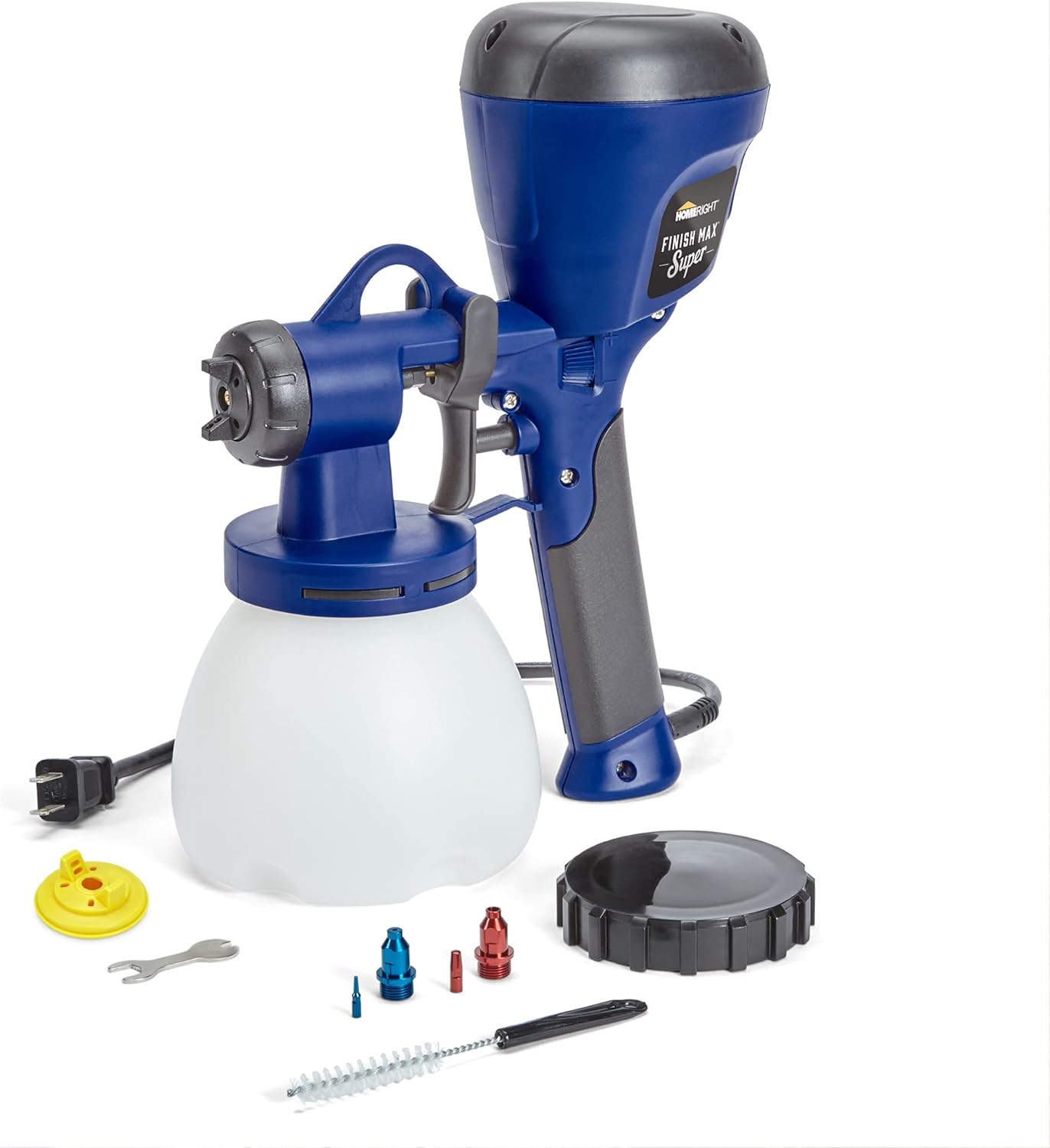 |
HomeRight Super Finish Max HVLP Paint Sprayer | Uses High Volume, Low Pressure (HVLP) technology for smooth, even finishes. Adjustable settings for spray pattern, material flow, and air flow. Comes with 3 brass spray tips (1.5mm, 2.0mm, 4.0mm). |
Check Price |
 |
VONFORN Paint Sprayer | Provides smooth, even finishes with reduced overspray. Ideal for furniture, cabinets, fences, and small home projects. Supports horizontal, vertical, and circular spray modes. |
Check Price |
 |
Wagner Spraytech 0529010 FLEXiO | Provides smooth, even finishes with reduced overspray. Suitable for walls, ceilings, furniture, cabinets, fences, and decks. iSpray Nozzle: For broad surfaces like walls and ceilings. |
Check Price |
 |
Wagner Spraytech 0529091 FLEXiO | Motor stays on the ground, reducing hand fatigue. Lightweight spray gun connected via hose for easier handling. X‑Boost Turbine provides power to spray unthinned paints. |
Check Price |
What to Check Before You Choose a Cabinet Sprayer
A cabinet project is easier to plan if you separate features that affect finish quality from features that mainly affect convenience. Both matter, but not equally. The best HVLP spray gun for cabinets is the one that can handle your chosen coating with enough control while still being practical to clean and use through the number of doors you have.
Start with the finish material, not the sprayer
Choose your primer, paint, enamel, clear coat, or other finish first, then read its application information. Look for guidance on spraying, thinning, recommended tip or nozzle ranges where provided, dry time, recoat time, and required protective equipment. If the coating maker says not to thin, that changes how you should approach a sprayer that depends on aggressive thinning to atomize it.
Water-based cabinet enamels are common in DIY work, but they are not identical. One product may level beautifully through a particular fine-finish nozzle, while another may need a larger opening or more air. Solvent-containing coatings add ventilation, flammability, respirator, and cleanup considerations that must be addressed from the coating label and safety data.
I don’t think it is sensible to buy a sprayer first and then force every future coating to suit it. A sprayer is part of a system. The finish, viscosity, nozzle, airflow, fluid flow, distance, and technique all have to agree with one another.
Decide how much control you actually need
For an occasional furniture flip or a small bathroom vanity, a simple handheld machine with a material-flow control and several nozzle choices may be enough. For repeated kitchen projects, detailed furniture work, or frequent refinishing, finer fan control and a lighter spray gun can justify a more involved turbine system.
The Fuji stands apart here because it is built around a dedicated spray gun and separate turbine rather than a handheld DIY motor body. The FLEXiO 5000 also moves the motor off the gun, but it remains a homeowner-oriented system with two front-end nozzles for broad and detailed work. The FLEXiO 590 keeps the same two-nozzle idea in a handheld format. HomeRight and VONFORN lean toward straightforward all-in-one operation.
More controls are useful only if you will use them. A beginner who changes air, material, fan, and viscosity all at once can make troubleshooting harder. Change one variable at a time and spray a test panel after each adjustment.
Think about a full kitchen, not one test door
A sprayer that feels easy for five minutes can become awkward after an hour. Count the doors, drawer fronts, end panels, face frames, shelves, and trim pieces that will actually be coated. Then think about how many separate sessions the job will require.
A stationary turbine reduces hand weight during longer sessions. A large material cup reduces refills. A small gravity cup can make fine work easier but may interrupt you more often. A long hose gives you more movement but must be kept away from freshly coated surfaces. None of these details is dramatic by itself, yet they shape the rhythm of the whole project.
Also plan where wet parts will go. Spraying thirty doors is not helpful if you only have drying space for six. The finish process should be organized around handling and cure time, not around how fast the sprayer can empty a cup.
Cleanup should influence the purchase
Paint left in a nozzle, air cap, pickup tube, or fluid passage can turn a good sprayer into a sputtering one. Fine cabinet work is especially sensitive because a partially blocked opening can distort the pattern long before the tool stops spraying completely.
HomeRight provides removable tip components and specifies cleaning after use. VONFORN includes a cleaning brush, needle, and a cleaning connector in the VF803 package described by its manual. Wagner uses Lock-N-Go front ends on the FLEXiO 5000 and removable nozzle assemblies. Fuji’s M-Model gun disassembles for cleaning and includes a wrench and cleaning brush in the system package.
If you dislike cleaning spray equipment, choose the design you are most likely to maintain properly. A theoretically finer sprayer is not a better choice if dried paint is going to live in the nozzle after every weekend project.
Check replacement parts and future usability
Cabinet finishing can become a repeating skill. Once you learn to spray doors well, the same tool may get used for furniture, trim, built-ins, shutters, or clear finishes. Replacement nozzles, air caps, filters, cups, seals, and other wear parts matter more over time than an accessory bundle you use once.
Fuji has a broad air-cap range for the M-Model gun, with sizes around the standard 1.3mm set. HomeRight lists additional tip sets for the Super Finish Max beyond the three included sizes. Wagner supports replacement nozzle assemblies and filters for FLEXiO products. For the VONFORN VF803, I would check current parts support at the seller or brand store before buying if you expect heavy long-term use.
That is one of the clearest dividing lines in this group: some systems are designed as long-term finishing platforms, while others are priced and packaged as accessible DIY tools.
Fuji Spray 2203G Semi-PRO 2 Gravity HVLP System – For More Deliberate Fine-Finish Control
The Fuji Spray 2203G Semi-PRO 2 is the most traditional turbine-and-gun setup among these five. Fuji’s current system catalogue identifies it as a two-stage DIY-PRO turbine system with 5.0 PSI output, an M-Model gravity-feed spray gun, a 400cc cup, and a standard 1.3mm air-cap set. The system also includes a 25-foot hose, which keeps the turbine off your hand and gives you room to work around doors or furniture.
That layout changes the spraying experience. Instead of carrying a motor and a large paint cup together, you hold a dedicated gun with the gravity cup above it. For cabinet doors, that can make small adjustments in wrist angle and pass speed feel more controlled. It is still a two-stage turbine, so coating preparation matters, especially with thick cabinet enamels, but the gun gives you a more refined set of controls than the simpler handheld tools here.
The M-Model is a non-bleed gun. Air is not continuously blasting from the gun between trigger pulls in the same way as a bleed-style design, which helps reduce unnecessary airflow around dust in a finishing area. The dedicated fan-pattern control lets you change from a small pattern toward a wider fan without relying on a single fixed pattern for every surface.
What the 1.3mm gravity setup means for cabinets
Fuji supplies the 2203G with a 1.3mm air cap as standard. That size is commonly used for medium-to-thinner finishing materials within Fuji’s system, and it gives cabinet refinishers a sensible starting point for many fine-finish coatings. It does not mean every cabinet enamel should be poured in unchanged. The two-stage turbine has finite atomizing power, so viscosity still has to be compatible with the setup.
The 400cc gravity cup is smaller than the containers on the HomeRight and VONFORN. That means more refills on a large kitchen, but the trade-off is a compact material supply directly above the gun. For door edges, narrow face-frame work, and furniture parts, I would rather refill a smaller cup occasionally than carry unnecessary material weight through every pass.
Fuji also offers multiple air-cap sizes for the M-Model, which makes the system more adaptable if your work expands into stains, clears, heavier finishes, or different furniture coatings. That flexibility matters most to someone who expects to use the system repeatedly rather than once.
Why the separate turbine helps during longer sessions
The turbine stays on the floor or a work surface while the 25-foot hose carries air to the gun. You do have to manage that hose around drying racks and fresh paint, but your spraying hand is not supporting the turbine motor. On a kitchen with many doors, the difference can show up in steadier end-of-day technique.
The hose also includes an air-control valve in common 2203G package descriptions, giving you another way to tame bounce-back and overspray at the gun end. Use that control thoughtfully; starving the gun of too much air can hurt atomization. The goal is not to make the spray cloud disappear. The goal is to get a clean pattern with enough air to atomize the coating while avoiding more air than the job needs.
- The separate turbine keeps motor weight out of your spraying hand, which is useful during long cabinet-door sessions.
- The M-Model gravity gun provides dedicated fan control and a non-bleed design for more deliberate fine-finish work.
- The standard 1.3mm air cap is a sensible fine-finish starting point, and other air-cap sizes are available for different materials.
- The 25-foot hose gives you more freedom to arrange the turbine away from the immediate spray area.
- The 400cc cup needs more frequent refilling than the larger containers on several handheld options.
- A two-stage turbine can require more coating preparation than users expect with especially thick cabinet paints.
Who It’s Best For
This is the strongest fit for a serious DIY refinisher, furniture restorer, or small-shop user who values gun control and expects to spray more than one cabinet project. It makes particular sense if you want a system you can adapt with additional air caps as your finishing work becomes more varied.
Not Ideal For
It is harder to justify for someone painting one small vanity who wants the simplest possible tool. If your priority is filling a cup, plugging in one handheld unit, and finishing a small project with minimal equipment around you, HomeRight or VONFORN is easier to approach.
HomeRight Super Finish Max HVLP Paint Sprayer – A Flexible Handheld Choice for DIY Cabinet Work
The HomeRight Super Finish Max is a 450-watt handheld HVLP sprayer with a 40-ounce container and three included brass spray-tip sets: 1.5mm, 2.0mm, and 4.0mm. HomeRight also supplies two air caps, with its manual identifying the black cap as the fine-finish choice for furniture and cabinets. That combination gives a home user more setup flexibility than a single-nozzle sprayer without moving into a separate-turbine system.
For cabinet painting, the 2.0mm included setup is especially relevant because HomeRight’s own guidance associates it with latex, chalk-type, and milk-type paints on furniture and cabinets.
The 1.5mm set is aimed at thinner materials such as stains and polyurethane, while the 4.0mm setup is intended for heavier, broader applications. I would still let the coating manufacturer’s instructions decide whether your specific cabinet paint is suitable and whether thinning is appropriate.
The sprayer’s flow control changes how much material leaves the gun, and the air-cap/tip choice changes the character and width of the spray. HomeRight says the unit can adjust from roughly a 1-inch to a 12-inch spray width depending on configuration. For cabinet doors, that means you can work narrower than you would on a fence or wall rather than trying to make one broad setup do everything.
Why its three included tip sets are useful
The value of multiple tips is not that you should switch constantly. It is that the sprayer can be configured around different coating jobs. A cabinet primer may behave differently from the enamel topcoat. A clear protective finish can behave differently again. Having several included openings gives you room to select a more appropriate setup before reaching for aggressive thinning.
For a typical painted cabinet project, I would begin with the manufacturer’s fine-finish guidance and then test the actual material. Spray a vertical test board. Look at the center of the fan, the edges, droplet size, and how the film levels after a few minutes. If the unit sputters or the finish looks grainy, diagnose viscosity, tip selection, airflow, fluid flow, and distance rather than simply moving more slowly.
The 40-ounce cup is large enough to reduce refill interruptions across several doors. It also makes the tool heavier when full. That is the basic handheld compromise: convenience and capacity sit in the same hand as the motor.
Material range and cabinet practicality
HomeRight lists latex paint, enamels, primers, stains, varnishes, polyurethane, and several decorative paints among materials the Super Finish Max can handle. That makes it useful for someone who moves between cabinet painting and furniture refinishing rather than buying a tool for one coating only.
The unit does not need an external compressor. That keeps setup straightforward in a garage or temporary spray shelter. You still need extension-cord practices that follow the manual, proper ventilation, masking, and a clean place to put doors while they dry.
Cleanup is conventional for a cup-fed handheld sprayer: empty the material, use the cleaner appropriate for the coating, flush the fluid path, and clean the tip/needle area carefully. Fine cabinet results depend on those small openings staying clean, so I would treat cleanup as part of spraying rather than something to postpone until the next day.
- Three included brass tip sets give useful flexibility for paint, primer, stains, and clear finishes without requiring an immediate accessory purchase.
- The fine air cap and adjustable material control make it easier to reduce the spray for cabinet doors and furniture.
- The 40-ounce cup supports longer runs between refills on a multi-door project.
- The self-contained design is easy to set up without a separate turbine box, long air hose, or compressor.
- A full 40-ounce cup plus the motor puts more weight in your hand than a separate-turbine gun.
- The simpler control system offers less fine tuning than the dedicated spray gun on the Fuji setup.
Who It’s Best For
The Super Finish Max suits a homeowner who wants one accessible sprayer for cabinets, furniture, trim, and occasional larger projects. It is particularly sensible if you value included tip options and do not want to invest in a separate turbine-and-gun system.
Not Ideal For
It is less appealing for someone who sprays cabinets frequently enough that hand weight and highly detailed fan control become major priorities. A separate-turbine system is easier to hold steady through long refinishing sessions.
VONFORN VF803 700W HVLP Paint Sprayer – Lots of Adjustment in a Compact DIY Package
The VONFORN VF803 is a 700-watt handheld HVLP sprayer with a 1200ml material container and four included nozzle sizes: 1.0mm, 1.5mm, 2.0mm, and 3.0mm. Its current manual also describes three spray patterns—horizontal, vertical, and circular—plus a material-flow control, a dust-blowing attachment, and a cleaning connector.
Those details make it one of the most accessory-heavy handheld choices in this set. For cabinet work, the smaller nozzles are the interesting part. VONFORN’s nozzle guidance associates the 1.5mm size with chairs, shutters, and cabinets, while the 1.0mm size is aimed at smaller wood and DIY work. The larger 2.0mm and 3.0mm sizes move toward heavier or broader applications.
The manual lists a maximum flow rate of 1000 ml/min and a 1200ml cup, but maximum output is not what I would chase on cabinet doors. The useful feature is that the flow can be reduced. A narrow rail or raised-panel edge needs much less material than a fence board, and the flow control lets you tune output after you have selected a suitable nozzle and prepared the coating.
Four nozzle sizes give beginners room to learn
Having 1.0, 1.5, 2.0, and 3.0mm nozzles helps you see how opening size changes the way a coating sprays. A small nozzle paired with material that is too thick will not magically create a fine finish; it may simply atomize poorly or clog. A larger nozzle can pass heavier material more easily but may lay down too much coating if your flow and hand speed are not adjusted.
For cabinets, I would start with the manual’s cabinet-oriented nozzle guidance, prepare the coating according to its maker’s rules, and test on scrap. The included viscosity cup is useful for consistency because once you find a material preparation that sprays well, you can reproduce it more reliably across later batches.
The three pattern positions also have practical roles. A vertical fan is useful for horizontal passes, a horizontal fan for vertical passes, and a circular pattern can help on smaller areas or corners. The naming can feel counterintuitive at first, so verify the actual fan on cardboard before approaching a door.
Cleaning and dust attachments are practical, with limits
The dust-blowing joint is meant to clear loose debris before coating, and the cleaning connector is designed to help flush the sprayer. Those are convenient additions, especially for someone new to spray equipment. They do not replace careful surface preparation or full nozzle cleaning.
Cabinet doors should be properly vacuumed and wiped using a method compatible with the finish system. Blowing air across a dusty room can simply move contamination elsewhere.
Likewise, flushing water through a sprayer is useful only for materials whose cleanup instructions call for water. Oil-based or solvent-based coatings may require a different cleaning process specified by the coating manufacturer.
The 1200ml cup reduces refill frequency, but it also adds weight to a handheld motor unit. I would avoid filling it completely just because the capacity is available if you only need enough material for a short batch of doors.
- Four included nozzle sizes give you more room to match the sprayer setup to different viscosities and project scales.
- The 1200ml cup reduces refill interruptions during a larger cabinet session.
- Horizontal, vertical, and circular spray patterns make the unit adaptable to door faces, rails, edges, and smaller parts.
- The included cleaning and dust-blowing attachments add useful convenience for a first-time owner learning sprayer care.
- The large cup and motor are both carried in the hand, so a full setup can become tiring during long sessions.
- Parts support and long-term accessory availability are less established than the broader ecosystems around Fuji, Wagner, or HomeRight.
Who It’s Best For
The VF803 makes sense for a budget-conscious DIYer who wants several nozzle sizes in the box and expects to work on cabinets, furniture, and other household projects. It is also a useful learning tool for someone willing to spend time testing viscosity, nozzle choice, and flow before spraying finished doors.
Not Ideal For
It is not the strongest fit for frequent professional-style refinishing where replacement parts, a lighter spray gun, and a mature accessory system matter as much as the initial feature list.
Wagner FLEXiO 590 0529010 – A Handheld Two-Nozzle System for Mixed Home Projects
Wagner’s FLEXiO 590, model 0529010, is a handheld system built around an X-Boost turbine and two distinct nozzle assemblies. The iSpray nozzle is intended for faster coverage on larger surfaces, while the Detail Finish nozzle is meant for smaller projects and finer finishing such as cabinets, furniture, doors, and trim. That split is more useful than trying to force a single front end to behave equally well on a wall and a cabinet door.
The 590 also provides adjustable material flow and an X-Boost power dial with multiple speed settings. Pattern controls let you orient the fan horizontally or vertically and adjust it from wider to narrower. For cabinet work, the Detail Finish nozzle is the logical place to begin because the goal is controlled atomization and a smoother surface rather than maximum coverage speed.
Wagner states that the FLEXiO line can spray many paints and stains with little or no thinning, depending on the material and nozzle. I would treat that as capability rather than a command. If your cabinet coating’s instructions, the Detail Finish nozzle, and the test pattern tell you a small amount of preparation is needed, follow the coating and sprayer guidance rather than forcing an unthinned material through a setup that is producing poor atomization.
The two-nozzle approach keeps the 590 versatile
A person repainting cabinets may also want to stain a fence, paint a wall, refinish furniture, or spray a door later. The iSpray nozzle gives the 590 a reason to stay useful after the cabinet project is finished. For the cabinets themselves, though, I would keep the broad nozzle out of the decision unless the surface is genuinely large and the finish quality you need allows it.
The Detail Finish nozzle carries a smaller cup than a broad-production setup, which is appropriate for controlled work. The unit is still handheld, meaning the turbine remains in your hand. That keeps the system compact and easy to move but creates the same fatigue issue as other all-in-one sprayers.
A practical advantage is that Wagner has continued to support the FLEXiO family with manuals, replacement front ends, filters, and accessories. The 590 is an older model than current FLEXiO 2500/3500 variants, so I would check current availability of the exact 0529010 and replacement pieces before purchasing rather than assuming every store still treats it as a current shelf model.
Cabinet control depends on the Detail Finish front end
The Detail Finish nozzle is the part that makes the 590 relevant here. It is intended to provide a finer result on furniture, trim, and cabinets than the iSpray nozzle. Set the power high enough to atomize the material cleanly, then reduce material flow to avoid flooding the door. If the finish looks dry or grainy, do not automatically move closer; check atomization, viscosity, material flow, and distance together.
The X-Boost power dial gives you another variable to manage. That can be helpful after you understand what you are seeing on the test panel, but it also means a beginner should make changes slowly. If you change turbine speed and material flow at the same time, you may not know which adjustment improved or harmed the pattern.
- The Detail Finish nozzle gives the 590 a dedicated setup for cabinets, furniture, doors, and trim rather than relying on the broad iSpray nozzle.
- Adjustable turbine power and material flow give you meaningful control over atomization and coating delivery.
- The iSpray nozzle keeps the same tool useful for larger household painting jobs after the cabinets are finished.
- The handheld format is compact and avoids a separate floor turbine and air hose.
- Keeping the turbine in your hand can be tiring through a large kitchen, especially with a filled material cup.
- The 590 is an older FLEXiO model, so buyers should verify exact-model availability and replacement support before ordering.
Who It’s Best For
Choose the FLEXiO 590 if you want one handheld Wagner system that can move between fine cabinet work and larger home projects. It suits a DIYer who appreciates separate nozzles for detailed and broad spraying and does not mind carrying the turbine during use.
Not Ideal For
It is less suited to someone who already knows that hand fatigue is a problem or who plans to spray many doors in long sessions. The FLEXiO 5000 keeps a similar two-nozzle approach while moving the turbine weight to the floor.
Wagner FLEXiO 5000 0529091 – A Stationary Setup That Takes Weight Off Your Hand
The Wagner FLEXiO 5000, model 0529091, separates the turbine from the gun. Wagner’s current product information lists an 11.5-foot air hose between the stationary base and the spray assembly, along with the same basic two-nozzle strategy: an iSpray nozzle for broad surfaces and a Detail Finish nozzle for cabinets, furniture, trim, and smaller work.
For a kitchen project, the separate base is the feature I would notice first. The motor stays on the floor instead of riding in your hand. You still carry the nozzle assembly and coating cup, but removing turbine weight can make it easier to maintain the same gun angle and travel speed across many doors.
The FLEXiO 5000 has variable X-Boost turbine speed plus adjustments for material flow, spray pattern, and spray width. Wagner says it can spray unthinned latex and oil-based paints, stains, urethanes, and paint-and-primer coatings in suitable setups. As with the 590, the Detail Finish nozzle is the more appropriate front end for cabinets, and some materials may need preparation to produce the smoothest pattern through that nozzle.
The 11.5-foot hose changes the way you organize the work area
A stationary turbine is lighter in the hand, but the air hose becomes part of your workflow. Place the base where the hose can reach the spray zone without rubbing against freshly coated doors or dragging across dusty floors. I would rather spend two minutes arranging the hose than discover it has brushed the edge of a wet drawer front.
The base also doubles as storage on the FLEXiO 5000 design, which keeps the nozzles and accessories together between sessions. That matters more than it sounds during a multi-day cabinet job. A system that packs away cleanly is easier to restart without hunting for an air cap, cup, or cleaning piece.
The Detail Finish nozzle gives you the cabinet-oriented spray, while the iSpray nozzle remains useful for broad panels, walls, siding, or other projects. The two are not just different sizes of the same tip; they are different spray front ends designed around different work.
Where it sits between the handheld tools and Fuji
The FLEXiO 5000 gives you a lighter-in-hand setup without moving all the way to the Fuji’s dedicated gravity spray gun. That middle position will appeal to many home users. You get a stationary turbine, hose, adjustable power, and a fine-finish nozzle, while the controls remain oriented toward approachable DIY use.
Fuji offers a more traditional finishing-gun experience and a wider path for air-cap changes. The FLEXiO 5000 is simpler for someone who wants to switch between the supplied broad and detail nozzles rather than build a collection of air caps and gun parts.
I know it is tempting to assume that the stationary machine is automatically the better cabinet choice. It is better only if the hose and base fit your workspace and you value the lower hand weight. In a tiny room with nowhere to place the turbine, a compact handheld sprayer can actually be less awkward.
- The stationary turbine keeps motor weight off your hand, which can improve comfort and consistency across many cabinet doors.
- The Detail Finish nozzle is specifically intended for cabinets, furniture, trim, and other fine-finish work.
- Variable turbine speed, material flow, pattern, and width controls give you several ways to tune the spray after testing.
- The iSpray nozzle extends the system’s usefulness to larger surfaces, while the base provides organized storage between sessions.
- The 11.5-foot hose requires more workspace management than a self-contained handheld sprayer.
- The Detail Finish front end may still require coating preparation even though the broader FLEXiO system can handle many paints unthinned.
Who It’s Best For
The FLEXiO 5000 is a good match for a homeowner repainting a larger kitchen who wants to reduce hand fatigue without stepping into a more traditional turbine spray-gun system. It also fits someone who wants one machine for detailed cabinet work and broader home painting.
Not Ideal For
It is not the most compact choice for a small one-room job, and it is not as configurable as the Fuji for someone who wants to tune a dedicated gun with a range of air-cap sizes over years of refinishing work.
Comparing the Five Sprayers for Cabinet Work
The differences become clearer if you ignore marketing tiers and look at how each sprayer behaves in the hand and how much setup control it gives you. All five can be used around cabinet or furniture work in an appropriate setup, but they do not ask the same things from the user.
If fine gun control is your first priority
The Fuji 2203G is the most focused finishing system here. Its M-Model gravity gun, 1.3mm standard air cap, dedicated fan control, separate turbine, and long hose make it the logical choice for someone who wants the spraying experience to feel closer to a dedicated finishing station than an all-in-one home paint tool.
The price of that control is more system management. You have a turbine, hose, gun, gravity cup, and material preparation to think about. The 400cc cup is also smaller than the containers on the handheld machines. For repeated cabinet and furniture finishing, those are reasonable compromises. For one small project, they may feel unnecessary.
If you want simple handheld versatility
HomeRight Super Finish Max has the strongest balance of included tip sizes and straightforward operation among the compact units. The 1.5, 2.0, and 4.0mm brass tip sets cover a broad range of finishing needs, and the fine air cap is clearly intended for cabinets and furniture.
VONFORN VF803 offers even more included nozzle sizes on paper—1.0, 1.5, 2.0, and 3.0mm—plus a 1200ml cup and cleaning accessories. It is appealing if initial versatility matters more than long-term parts support. HomeRight has the more established finishing-tool ecosystem; VONFORN gives you a lot of included adjustment in an accessible package.
If you want Wagner’s broad/detail two-nozzle approach
The FLEXiO 590 and FLEXiO 5000 are closely related in purpose but different in ergonomics. Both give you an iSpray nozzle for larger work and a Detail Finish nozzle for cabinets and furniture. The 590 keeps the turbine in your hand. The 5000 puts it on the ground and uses an air hose.
For a few doors, the 590’s compactness may win. For a full kitchen, I would lean toward the 5000 if the workspace can accommodate the base and hose. The reason is not that the 5000 magically produces a smoother finish. It is that a lighter handpiece may help you remain consistent for longer.
If you expect to spray more than cabinets
HomeRight, VONFORN, and both Wagner systems are deliberately versatile. Their larger tips or broad nozzles make them useful for furniture, fences, walls, and other household work. Fuji is versatile too, but in a different way: it adapts through a dedicated spray gun and air-cap choices rather than a wall-oriented front end.
Think about what “versatile” means for you. If it means one tool that can paint a fence this month and cabinets next month, Wagner’s iSpray/Detail pairing is practical. If it means one finishing platform for stains, lacquers, enamels, clears, and furniture coatings over time, Fuji’s gun-based system has a stronger long-term argument.
If this is your first cabinet spray project
A first-time user does not need the least expensive tool or the most advanced one. You need a sprayer whose adjustments you can understand, clean, and reproduce. HomeRight is approachable because tip size, air cap, and material flow are easy to relate to the job. VONFORN gives beginners multiple nozzle choices but asks them to learn viscosity and flow. Wagner’s two-nozzle system makes the broad-versus-detail decision obvious.
Fuji rewards a user who is willing to learn finishing technique more deeply. It is not difficult in the sense of being inaccessible, but it gives you enough control that test spraying and material preparation become part of the process rather than optional extras.
How to Set Up an HVLP Sprayer for Smooth Cabinet Finishing
A good sprayer cannot rescue greasy doors, loose dust, incompatible primer, or a coating that has been prepared incorrectly. The best results usually come from treating spraying as the last stage of a finishing system rather than the first exciting step.
1. Remove doors, drawers, and hardware methodically
Label every door and drawer front before removing it. Put hinges and screws into labeled bags, and mark positions in a place that will not be visible after reassembly. Cabinet boxes can be more forgiving than doors, but the doors are where inconsistent handling usually becomes obvious.
If you are reusing hinges, keep each hinge with its original door position where practical. Small alignment differences can matter later. Do the organizational work now so you are not trying to solve fit problems while the finish is still tender.
2. Degrease before sanding
Kitchen residue can be surprisingly stubborn. If you sand first, you can smear grease and contamination into the surface instead of removing it. Use a cleaner suited to the substrate and finish system, then rinse or neutralize it as the product instructions require.
Allow the surface to dry fully. Pay extra attention around handles, lower doors, and cabinets near the range, because those areas often carry the most hand oils and cooking residue.
3. Repair damage before you build a new finish
Fill dents or damaged areas with a repair material compatible with the substrate and coating system. Feather chips, address loose veneer, and fix open joints before primer. Spraying creates a uniform film; it does not make a poor substrate disappear.
If the existing finish is peeling or failing, diagnose why before coating over it. New paint bonded to an unstable old layer can still fail because the weak layer remains underneath.
4. Sand for adhesion and smoothness
The exact abrasive sequence depends on the existing finish and the coating manufacturer. The goal is usually to remove gloss, flatten defects, and create a clean surface for primer or paint without unnecessarily cutting through good substrate.
Vacuum carefully after sanding. Then use the dust-removal method recommended for your coating. Avoid introducing products that leave residue unless the finish maker explicitly allows them.
5. Strain and prepare the coating
Stir rather than aggressively shake if the coating maker recommends it, because trapped air can complicate spraying. Strain material before it enters the cup if the product and sprayer instructions call for straining. Tiny dried flakes that a brush might ignore can partially block a spray opening and distort the fan.
If thinning is permitted and needed, measure it rather than guessing. The goal is repeatability. Write down the ratio or viscosity result that produced a clean test fan so the second batch behaves like the first.
6. Choose the cabinet-oriented nozzle or tip
For the Fuji, begin with the installed 1.3mm air cap if it suits your coating, then change air-cap size only if the material and Fuji guidance point you elsewhere. On HomeRight, use the fine air cap with the tip set suited to your material. On the VONFORN VF803, its manual associates the 1.5mm nozzle with cabinets and shutters, though your coating still has to suit that opening.
On both Wagner systems, start cabinet testing with the Detail Finish nozzle. The iSpray front end is valuable for broad coverage, but cabinet doors usually benefit from the finer setup.
7. Test on a vertical panel, not just cardboard
Cardboard is useful for seeing fan shape, but a smooth vertical test panel tells you much more about the actual finish. Apply the primer or topcoat to a scrap board or spare door with a similar surface. Watch whether the film levels, sags, dries rough, or shows heavy edges.
Then adjust one thing at a time. If the material is atomizing poorly, check coating preparation and air. If the panel is wet and running, reduce material flow or increase travel speed. If the finish is dry and grainy, inspect distance, atomization, temperature, airflow, and coating preparation before simply adding more paint.
8. Keep the gun square to the surface
Move your arm across the door instead of swinging your wrist in an arc. An arcing motion brings the nozzle closer in the center of the pass and farther away at the ends, changing the amount of coating that reaches the surface.
Start moving before fully committing material to the visible area and keep the motion steady through the pass. Maintain the distance recommended by the sprayer and coating guidance. Then overlap passes consistently so the wet film builds evenly.
9. Treat edges differently from broad faces
Door edges can become overloaded quickly because they are narrow. A full-volume pass along an edge may wrap material around onto the face and create a ridge or sag. Reduce output if needed and plan your sequence so edge spraying does not keep doubling the wet film on corners.
Raised-panel details also deserve restraint. Recessed corners catch material. Several light, controlled passes are easier to manage than one attempt to make the profile look fully covered immediately.
10. Let the finish schedule control the pace
Follow the coating manufacturer’s recoat and cure information. Dry-to-touch is not the same as ready for sanding, stacking, hardware, or everyday kitchen use. Cabinet doors can feel dry on the face while remaining soft enough to imprint where they touch a rack or another door.
Plan more drying space than you think you need. Then give the finish time to harden before reassembly. A clean sprayed surface is easy to damage if you rush the last ten percent of the project.
Keeping the Sprayer Clean and Consistent Between Coats
Fine finishing equipment usually gives warning before it fails completely. A fan starts to pull to one side. Droplets become coarser. The gun begins to spit at trigger release. Material flow changes even though the dial has not moved. Those are signs to stop and inspect the setup rather than push through another door.
Do not let coating dry in the nozzle
If a break is long enough for material to skin or dry at the air cap, clean the relevant parts before restarting. Dried paint changes the shape of tiny air and fluid openings, and that can turn a good pattern into an uneven one.
Follow the sprayer manual for disassembly. Needles, nozzles, air caps, and seals are precision parts; scraping them with a hard metal tool can create damage that cleaning was supposed to prevent.
Use the cleaner required by the coating
Water is appropriate for many water-based finishes, but not every coating cleans with water. Use the material maker’s specified cleanup method and verify that the solvent or cleaner is permitted in the sprayer. Never assume that a strong solvent is safe for every seal, hose, cup, or plastic component.
Dispose of coating and cleaning waste according to the product instructions and local rules. Do not turn a paint-sprayer cleanup into a plumbing problem by washing material into a drain when disposal guidance prohibits it.
Keep turbine filters clear
Turbine sprayers need clean airflow. A clogged filter reduces performance and can increase heat. HomeRight, Wagner, and Fuji all use air filtration in their turbine systems, and those filters should be inspected according to their manuals.
Do not operate a turbine in a cloud of sanding dust. Finish preparation and spraying are cleaner when dusty work is completed and the room is settled before the sprayer is switched on.
Store parts together and dry
Once components are clean, let them dry as directed and reassemble them carefully. Keep spare tips, air caps, nozzle assemblies, wrenches, viscosity cups, and cleaning brushes with the sprayer. A missing small part can stop a project even when the main machine is fine.
For multi-day cabinet work, label your coating preparation notes and sprayer settings. You may still need to adjust for temperature or a new batch, but a written starting point is more useful than trying to remember where a dial was three days ago.
Small Setup Errors That Can Ruin an Otherwise Good Cabinet Finish
Spraying before the doors are truly clean
A surface can look clean and still hold grease around handles, corners, and lower rails. The sprayer will coat over contamination, but adhesion may suffer later. Degrease first, then sand and prepare the substrate according to the finish system.
Treating the biggest nozzle as the easiest nozzle
A larger opening can move thicker material, but it can also make it very easy to flood a cabinet edge. Choose nozzle size around the coating and finish goal, then reduce flow until the test panel lays down evenly.
Forcing thick paint through a fine setup
A small fine-finish nozzle does not guarantee a fine surface if the coating is too viscous for the available airflow. Poor atomization can look pebbly or spit droplets. Use the sprayer and coating guidance to adjust material preparation or nozzle choice instead of compensating with an extremely slow pass.
Changing several controls at once
If you increase turbine power, open material flow, and narrow the fan in one step, you will not know which change affected the result. Make one adjustment, spray a test pass, and inspect it. That approach takes a few extra minutes and saves a lot of random dial turning.
Swinging the wrist across the door
An arc changes gun distance across the stroke. Keep the nozzle square to the face and move your arm. Consistent distance is one of the simplest ways to keep the wet film even.
Trying to make the first coat look finished
Heavy first coats are a common route to sags at rail intersections and edges. Build the coating according to the paint maker’s film and recoat instructions. Thin, controlled coats are easier to manage than one overloaded pass.
Ignoring the door edge until the end
Edges and profiles affect how much material lands on the front face. Plan the order of edge and face passes before you begin. If you spray the face heavily and then soak every edge, corners can end up with twice the material you intended.
Letting a partially clogged nozzle finish the batch
If the pattern suddenly becomes uneven, stop. Cleaning one air-cap opening is easier than sanding defects out of six doors. A consistent cabinet finish depends on recognizing pattern changes early.
Reassembling before the coating has hardened enough
Fresh cabinet paint can mark under hinges, bumpers, pulls, and adjacent doors even when it feels dry. Follow the coating’s cure guidance and handle the pieces carefully. The final few days of patience often protect far more work than they cost.
Safety Notes for Spraying Cabinet Finishes
Spraying turns liquid coating into airborne droplets, so personal protection and ventilation are not optional details. Read the sprayer manual, coating label, and safety data before use. Wear the respiratory, eye, skin, and other protection required for the specific material you are spraying.
Do not spray near flames, pilot lights, sparks, heaters, or other ignition sources when the material presents a flammability risk. A household turbine sprayer should never be assumed to be explosion-proof. If a coating or solvent has special spraying restrictions, follow them.
Ventilate the workspace appropriately without creating dirty cross-drafts that blow dust into wet doors. Overspray can travel beyond the visible fan, so mask floors, walls, fixtures, appliances, openings, and nearby belongings carefully. Keep children and pets out of the work area during spraying, drying, and cleanup.
Unplug electric sprayers before disassembly or maintenance. Do not immerse motor housings in water. Inspect cords and hoses before use, and keep them out of wet coating and walkways where they can become trip hazards.
Cabinet preparation also creates sanding dust. Use extraction and respiratory protection appropriate to the substrate and existing finish, especially if you are dealing with an older coating whose composition is unknown. If there is any chance an old painted surface contains lead or another hazardous material, identify the risk and follow applicable remediation guidance before sanding or spraying.
Frequently Asked Questions About HVLP Spray Guns for Cabinets
Which of these five sprayers gives the most fine-finish control?
The Fuji Spray 2203G offers the most dedicated spray-gun style control in this group. Its separate two-stage turbine, M-Model gravity gun, 1.3mm standard air cap, fan control, and available air-cap sizes make it the strongest platform for someone focused on repeated cabinet and furniture finishing.
That does not mean it automatically produces a better finish in untrained hands. Coating preparation, test spraying, gun distance, pass speed, and cleanup still determine the result.
Which option is easiest for an occasional DIY cabinet project?
HomeRight Super Finish Max is easy to make sense of because it is self-contained, uses a 40-ounce cup, and includes three tip sizes with a fine air cap intended for furniture and cabinets. VONFORN VF803 is also approachable and includes four nozzle sizes, but long-term parts support is a point to check before purchase.
If you prefer Wagner’s two-nozzle system, the FLEXiO 590 gives you the Detail Finish nozzle in a compact handheld layout.
Is the FLEXiO 5000 better than the FLEXiO 590 for cabinets?
They solve the hand-weight problem differently. The 590 keeps the turbine in your hand, making it compact. The 5000 uses a stationary base and 11.5-foot air hose, so less weight is carried while spraying.
For a large kitchen, the 5000’s lower hand weight can be valuable. For a small vanity or a workspace where a base and hose would be awkward, the 590 may be simpler.
Do I have to thin cabinet paint for an HVLP sprayer?
Not always. It depends on the coating, sprayer, nozzle, and the manufacturer’s instructions. Wagner and HomeRight both advertise the ability to handle many thicker paints with little or no thinning in suitable setups, while Fuji and VONFORN provide viscosity-related guidance to help match material preparation to the spray system.
Never thin solely because someone online used a particular percentage. Follow the coating maker’s limit and the sprayer manual, then test the actual pattern.
What nozzle size should I use for cabinet paint?
There is no universal size. HomeRight includes 1.5, 2.0, and 4.0mm tip sets and points to the 2.0mm/fine-air-cap setup for several furniture and cabinet paints. VONFORN’s VF803 manual associates 1.5mm with cabinets and shutters. Fuji’s 2203G comes with a 1.3mm air cap, while Wagner uses complete Detail Finish nozzle assemblies rather than asking you to select a simple millimeter tip in the same way.
Use these manufacturer starting points together with your coating instructions and a test panel.
Can I spray primer with the same machine I use for the topcoat?
Often, yes, if the primer is a material the sprayer supports. Primer may need a different nozzle or preparation from the topcoat because viscosity can be different. Clean the sprayer thoroughly between materials so residue from one product does not contaminate the next.
If the primer and topcoat use different cleanup chemistry, follow both product instructions carefully before switching.
Why does sprayed cabinet paint sometimes feel rough instead of smooth?
A rough surface can come from material drying before it levels, poor atomization, spraying too far away, excessive airflow through the room, incorrect viscosity, or a dirty nozzle. Surface temperature and coating conditions also matter.
Do not diagnose roughness by distance alone. Check the entire setup, because moving closer can turn dry spray into runs without fixing the real atomization problem.
Why is my HVLP sprayer spitting at the beginning or end of a pass?
Common causes include dried material around the nozzle, an improperly seated component, air entering the fluid path, poor coating preparation, or trigger technique. Stop and inspect the sprayer rather than trying to hide spits in the next coat.
A clean nozzle and consistent trigger movement are especially important on cabinets because small droplets are easy to see under side lighting.
Should cabinet doors be sprayed flat or vertical?
Both approaches can work. Flat doors reduce the immediate risk of runs but need enough clean horizontal space and careful dust control. Vertical doors save floor area and let you spray both face orientation and edges naturally, but they demand better control of wet-film thickness.
Choose the setup you can keep clean, stable, and repeatable. The sprayer itself does not require one universal orientation for every cabinet project.
Choosing the Best HVLP Spray Gun for Cabinets Without Overcomplicating the Decision
The best HVLP spray gun for cabinets is not simply the one with the most power or the longest feature list. For a smooth cabinet finish, I would put controlled atomization, an appropriate fine-finish setup, manageable hand weight, clean material preparation, and repeatable adjustments ahead of headline specifications.
Fuji’s 2203G is the most convincing choice here for someone who expects cabinet and furniture finishing to become a regular part of their workshop. The M-Model gravity gun, separate turbine, fan control, and air-cap options give it room to grow with the user.
HomeRight Super Finish Max is easier to justify for general DIY work because its three included brass tip sets, fine air cap, and self-contained layout cover a wide range of home projects without much equipment around you.
VONFORN’s VF803 gives a budget-minded buyer four nozzle sizes, a large cup, three spray patterns, and useful cleaning accessories. Wagner’s FLEXiO 590 is the compact choice for someone who likes the iSpray/Detail Finish two-nozzle approach, while the FLEXiO 5000 makes more sense when a larger cabinet job makes lower hand weight worth managing a stationary turbine and hose.
Whichever one fits your work, test the coating before the first door, keep the fluid path clean, and build the finish at the pace the paint requires. A well-prepared test panel tells you more than a marketing claim ever will. Once the fan is even and the coating is leveling properly, you can move through the cabinet doors with far more confidence and far less sanding afterward.