A bobbin can look like the smallest part of a sewing setup, yet a badly wound one can stop a project almost immediately. Loose coils can collapse into one another, overfilled thread can drag against the bobbin case, and using the wrong bobbin shape can create tension problems even when the rest of the machine is threaded correctly. A separate bobbin winder is useful because it lets you prepare bobbins without unthreading the sewing machine or tying up the machine’s built-in winding system.
The most important detail is not simply how fast a winder spins. A useful bobbin winder must match the bobbins your sewing machine actually requires, hold the thread under controlled tension, and stop or be stopped before the bobbin is overfilled. Portability, power source, spool support, and automatic stopping can all make the process easier, but compatibility comes first.
The five products here serve noticeably different users. HimaPro and CKPSMS are bench-style AC-powered winders aimed at frequent sewing and a wider range of bobbins. SINGER’s portable model is more compact and specifically supports Class 15 and 15J bobbins. LRDCREEE combines a compact USB-powered body with Class 15 bobbins in the package. The SPEENSUN product needs special attention because it is actually a hand-crank yarn-ball winder, not a sewing bobbin winder. That makes it useful for knitting and crochet supplies, but not a substitute for the other four when the goal is filling sewing-machine bobbins.
What a Standalone Bobbin Winder Actually Does
A sewing bobbin winder transfers thread from a spool or cone onto an empty bobbin while controlling the path the thread takes. The thread normally passes through one or more guides and around a tension disc before reaching the bobbin. That controlled path is what helps the thread build up in compact, even layers rather than forming a soft, loose mass.
A standalone model performs this job independently of the sewing machine. That separation has practical value. You can wind another bobbin without removing the upper thread from a machine that is already set up for a project, and you can prepare several colors before starting a quilt, embroidery run, garment, or batch of repairs.
Bobbin shape matters more than it appears
Class 15, 15J, 66, L, and M bobbins may look similar at a glance, but they are not automatically interchangeable. SINGER specifically warns that visually similar bobbin styles should not be substituted casually because the wrong type can affect stitch quality and may damage the bobbin case. Brother gives the same basic advice: use the bobbin type designed for the machine.
That means a winder being physically able to spin a bobbin is only part of the decision. Before buying a winder, identify the exact bobbin style required by your sewing machine, then confirm that the winder accepts that style. If your machine requires a proprietary or unusually shaped bobbin, a broadly described “universal” winder may still be unsuitable.
Tension is what turns spinning into useful winding
If thread reaches the bobbin with too little resistance, the resulting wind can feel soft and springy. The layers may shift when the bobbin is handled or installed. If tension is excessive, delicate thread can stretch or the bobbin may be packed too tightly.
SINGER’s winding guidance emphasizes seating thread correctly in the winding tension disc because loose winding can lead to poor stitch quality. A separate winder with an adjustable tension control gives you a way to fine-tune that resistance when you change thread size, spool type, or bobbin style.
Automatic stopping is convenient, but it does not replace setup
Several electric winders use a sensor or mechanical stop to halt the motor when the bobbin reaches a set fill level. This reduces the need to watch every second of the winding cycle and helps prevent thread from piling above the bobbin flanges.
The stop point still needs to suit the bobbin. On adjustable systems, the sensor or stop position may need to be aligned with the outer edge of the specific bobbin you are using. An automatic stop is most useful after the winder has been set up correctly; it should not be treated as proof that every bobbin will fill perfectly straight out of the box.
Standalone winders are especially helpful for large thread cones
A sewing machine’s built-in spool pin is often designed around ordinary domestic spools. Quilters, machine embroiderers, and people who buy thread in larger cones can find a separate stand easier to work with. HimaPro, CKPSMS, and LRDCREEE all use dedicated thread-stand arrangements that keep a larger spool or cone separate from the winding spindle.
This can also make the thread path easier to see. When the spool, guide, tension disc, and bobbin are all exposed, correcting a crossed thread or a poor feed angle is usually simpler than working around the body of a sewing machine.
| Product Image | Product Name | Features | Price |
|---|---|---|---|
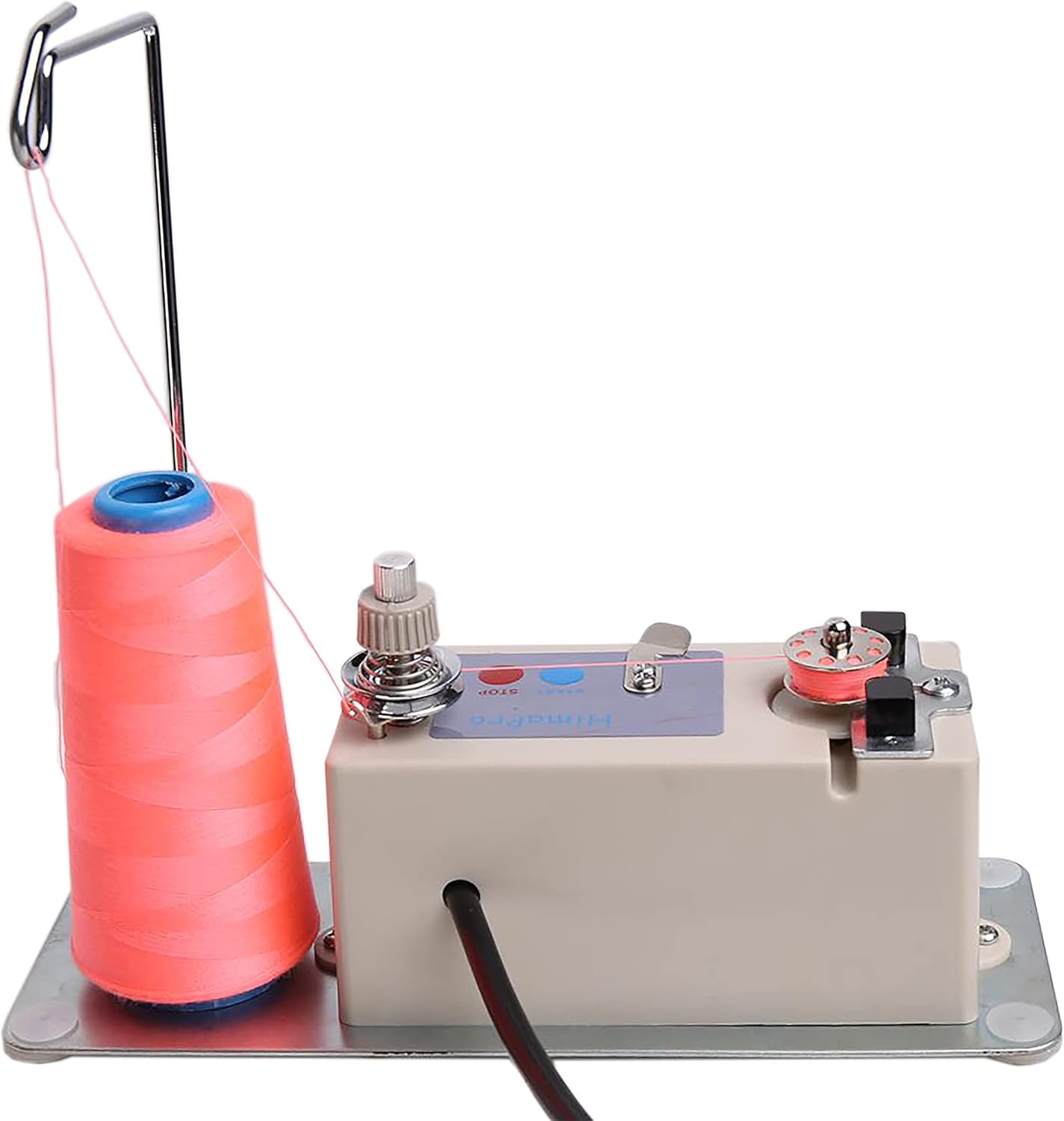 |
HimaPro Automatic Bobbin Winder for Sewing Machine | Includes base plate and thread stand, easy to install directly on your sewing table. Start/Stop button and adjustable tension knob make winding smooth and user-friendly. Prevents overwinding and saves time by stopping once the bobbin is filled |
Check Price |
 |
SINGER Portable Bobbin Winder | Easy to carry for sewing classes, travel, or home use. Stops winding when the bobbin is full, preventing overfilling and wasted thread. No need to pause your sewing; wind bobbins separately while continuing your project. Ideal for multitasking and keeping extra bobbins ready whenever needed. |
Check Price |
 |
SPEENSUN Yarn Winder, 3.5 OZ Easy-to-Install | Makes winding faster and more enjoyable, helping you spend more time knitting or crocheting. ade from strong ABS material for long-lasting use, even with frequent winding. Non-slip silicone base and bolts keep the winder stable. Fits tables up to 1.77″ thick, ensuring stability without wobbling during use. |
Check Price |
 |
CKPSMS Brand -110V Automatic Bobbin Winder | Faster Than Built-In Winder. Can be set up anywhere; slip-resistant bottom plate keeps it stable during use. Simple On/Off switch, adjustable thread tension, and built-in thread cutter for convenience. Stops automatically when the bobbin is full, preventing overwinding and wasted thread. |
Check Price |
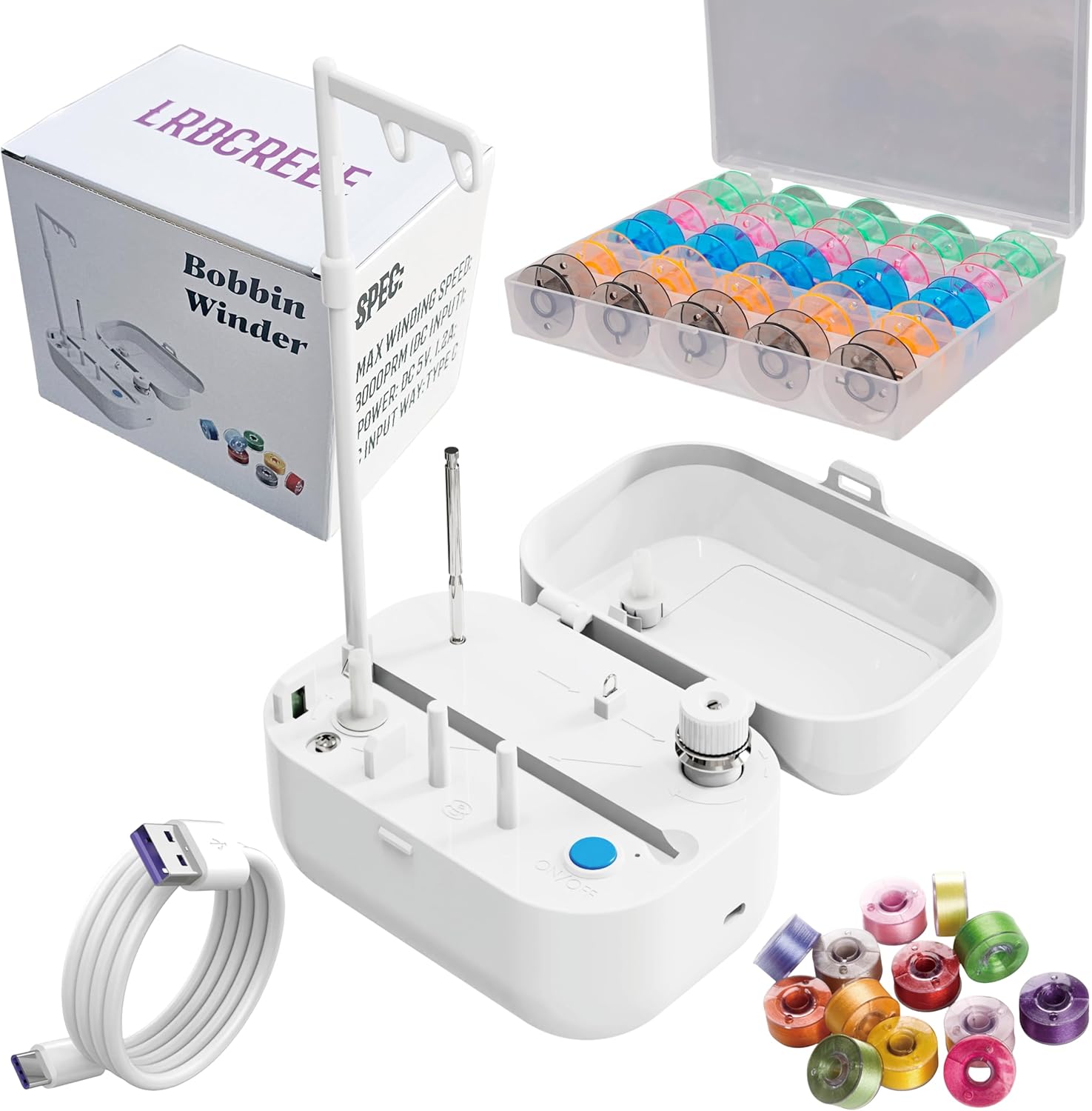 |
LRDCREEE Automatic Bobbin Winder Bobbin Winding Machine | Lightweight design makes it easy to carry for classes, travel, or quick home use. Saves time by winding bobbins efficiently, perfect for busy sewing enthusiasts. Smart sensor halts winding when bobbin is full, preventing overfilling and wasted thread. Includes 25 plastic bobbins, giving you everything needed for multiple projects. |
Check Price |
Details Worth Checking Before You Choose
Start with your machine’s required bobbin
Check the sewing machine manual, the manufacturer’s bobbin guide, or the exact part number of a bobbin you already know works correctly. Do not rely only on diameter. Two bobbins can have similar outside dimensions but different side profiles, heights, center holes, or materials.
The SINGER portable winder is one of the easiest options to understand because SINGER specifies Class 15 and 15J compatibility and excludes specialty and commercial bobbins. HimaPro publishes a broader list that includes A, L, M, 15J, 66, a Bernina part number, and a Juki part number, while noting that Husqvarna Viking-specific bobbins may not work. CKPSMS is organized around a 1/4-inch (6 mm) center hole, which is a different way of defining fit.
Decide how much portability you actually need
A compact winder is useful for classes, retreats, travel, and a sewing room where storage is tight. SINGER is particularly portable because it can run independently of a sewing machine and supports both corded and battery power. LRDCREEE is also compact and USB-powered.
Bench-style units are less convenient to throw into a project bag, but they make more sense when the winder will live beside a sewing or embroidery setup. HimaPro includes a base plate and thread stand, while CKPSMS uses a stable base with a separate thread stand. For frequent batch winding, a larger fixed setup can be easier to thread and less likely to move around.
Look at how the winder supports thread cones
If you use ordinary small spools, nearly any properly designed sewing bobbin winder can feed the thread. Large cones need more space and a stable vertical stand. A dedicated cone holder can reduce wobbling and help the thread lift cleanly upward before passing through the guide.
This is one reason industrial-style winders often look larger than portable domestic models. The extra footprint is not just motor housing; some of it is there to create a clean thread path from tall cones.
Adjustable tension becomes more valuable as your thread collection grows
A person who winds one familiar all-purpose polyester thread may rarely touch a tension control after the first setup. Someone who moves among fine bobbin thread, cotton, embroidery thread, and different spool constructions has more reason to want an accessible tension knob.
HimaPro, CKPSMS, and LRDCREEE provide tension adjustment. SINGER focuses more on straightforward one-touch operation and defined bobbin compatibility. Neither approach is automatically better. The right choice depends on whether you want a simple appliance-like tool or a winder that gives you more setup control.
Power source changes where the tool fits into your workflow
AC-powered bench models are straightforward for a permanent sewing station. HimaPro supports 110-240V AC according to the manufacturer, while the CKPSMS model listed here is the 110V American-plug version. SINGER includes a 120V power adapter and can also operate from batteries. LRDCREEE uses USB power, which is convenient near a laptop, power bank, or USB adapter.
Match the voltage and plug to where you will actually use the winder. Do not assume an imported AC model is safe to use with your local mains supply merely because the plug can be adapted physically.
Included bobbins are only valuable if your machine uses them
The LRDCREEE package includes 25 Class 15 plastic bobbins. That can be a genuinely useful starter supply for a machine that takes that exact bobbin style. If your machine uses 15J, 66, L, M, or a proprietary bobbin, those included bobbins may have little or no value.
This is a good example of why accessory count should come after compatibility, not before it. A bundle is only economical when the included parts belong in your actual sewing setup.
HimaPro Automatic Bobbin Winder for Sewing Machine — Broad Compatibility for a Dedicated Sewing Station
HimaPro’s automatic bobbin winder is the most workshop-like option in this group. It uses a separate base plate and thread stand, runs from AC power, and is built around an adjustable bobbin slot rather than one narrowly defined domestic bobbin style. Hima Products lists compatibility with A, L, and M styles as well as Class 15J and 66, plus specific Bernina and Juki bobbins.
That broad fit is useful for a sewing room with more than one machine. A quilter may have a domestic machine beside a straight-stitch machine, while an embroiderer may keep several bobbin styles on hand. A winder that can be adjusted to different widths and diameters can reduce the need for a separate winding device for each machine.
Adjustable bobbin positioning is the key feature
HimaPro’s bobbin area can be adjusted, and the manufacturer explains that the sensor position can also be aligned to suit the bobbin edge. This matters because the automatic stop needs to recognize when the thread has reached the intended fill level.
The flexibility comes with a small setup responsibility. The first bobbin of a new style should be watched closely. If the sensor sits too far out, the thread may fill higher than you want; if it sits too far inward, the winder may stop early. Once adjusted properly, repeated bobbins of the same style should be much easier to batch.
The separate stand suits cones as well as ordinary spools
The included thread stand gives tall cones a stable vertical position. This can be especially helpful for quilting and machine embroidery, where larger cones are common. The thread lifts from the cone, passes through the guide and tension assembly, and then reaches the bobbin spindle without needing to fit on a sewing machine’s spool pin.
A separate stand also makes it easier to leave a favorite cone in place while the sewing machine is threaded with something else. That separation is one of the main reasons frequent sewists buy a standalone winder in the first place.
Start, stop, tension, and cutting controls are all accessible
Operation is straightforward: the unit has START and STOP controls, a tension-adjustment disc, automatic stopping when the bobbin is full, and a thread cutter on the side. Those controls keep the whole winding process at one station.
The tension adjustment is particularly useful when the bobbin looks too soft or too densely packed. Rather than changing the way you hold the thread by hand, you can make small changes at the tension disc and test another bobbin.
Compatibility is broad, but it is not unlimited
HimaPro specifically cautions that the unit may not work with Husqvarna Viking-specific bobbins. That is exactly the kind of limitation worth checking before purchase. A winder can be broadly compatible without being truly universal.
If you own a Viking machine or another model with a distinctive center hole or side profile, compare your bobbin with the manufacturer’s compatibility information before relying on the HimaPro as your only winder.
- The adjustable bobbin slot supports a wide range of commonly used bobbin styles. That makes the unit practical in a sewing room with several machines rather than only one domestic model.
- The separate base plate and thread stand create a stable permanent winding station. Large cones can sit upright without occupying the sewing machine’s spool pin.
- Automatic stopping reduces the need to supervise every full winding cycle. Once the stop position is correctly adjusted, batch preparation becomes less tedious.
- An accessible tension knob and side thread cutter keep the winding controls in one place. These details are useful when changing thread types or preparing many bobbins in sequence.
- Husqvarna Viking-specific bobbins may not fit, so owners of those machines need to verify compatibility carefully.
Who It Suits
HimaPro is a strong fit for quilters, embroiderers, multi-machine sewing rooms, and anyone who regularly winds batches of bobbins from larger thread cones. It also makes sense when you want to reduce wear or interruption on a sewing machine’s built-in winder.
Less Suitable When
It is more equipment than an occasional sewist needs if one portable Class 15/15J winder would cover every machine in the house. It is also not the safest choice for a bobbin style the manufacturer does not clearly support.
SINGER Portable Bobbin Winder — Simple Class 15 and 15J Winding Away From the Machine
SINGER’s portable bobbin winder takes the opposite approach from the larger bench-style units. It is compact, designed as a self-contained domestic accessory, and has very clearly defined compatibility: SINGER states that it is for Class 15 and Class 15J bobbins and not for specialty or commercial bobbins.
That narrower fit is actually helpful if those are the bobbins you use. There is less setup ambiguity, and the one-touch winding system is designed for people who want a convenient separate winder rather than a highly adjustable workshop tool.
Dual power makes it genuinely portable
The winder includes a 120V power adapter for continuous use and can also operate from batteries. SINGER’s current product information contains inconsistent battery-count wording in different parts of the page, so the safest approach is to follow the instructions included with the current unit rather than buying batteries based on an older description.
The important practical point is that the winder is not tied to a wall outlet. That is useful at a sewing class, retreat, shared craft table, or any place where the sewing machine is already occupying the most convenient power connection.
One-touch winding lowers the setup burden
SINGER positions this as an easy one-touch system with automatic shut-off when the bobbin is full. For users who do not want to adjust sensor positions or tune a more industrial-style winder, that simplicity is appealing.
You still need to thread the unit correctly and seat the bobbin properly. Automatic stopping cannot correct a crossed thread path or an incompatible bobbin. The right bobbin plus correct threading is what makes the simple controls work as intended.
It is especially useful for keeping the sewing machine threaded
A common interruption occurs when the upper thread is already routed through the sewing machine for a project and the bobbin runs empty. Depending on the machine design, winding another bobbin may require unthreading or partially reconfiguring the machine.
A portable standalone winder lets you fill the replacement bobbin separately. That can be convenient during color-sensitive work, decorative stitching, or any project where you do not want to disturb the current top-thread setup.
The defined bobbin limit should be treated seriously
Class 15 and 15J bobbins are similar enough that many people confuse them, yet SINGER itself warns that bobbin styles should be matched correctly to the sewing machine. The portable winder can wind both, but the sewing machine still needs whichever one its manual specifies.
Do not take the winder’s compatibility as permission to swap 15 and 15J bobbins inside the machine. The winder can support both styles while the sewing machine may require only one of them.
- The compact body is easy to store, carry, or take to a sewing class. It occupies far less permanent worktable space than a base-plate winder with a tall cone stand.
- Corded and battery operation give you more freedom over where bobbins are prepared. You are not forced to wind directly beside the sewing machine.
- One-touch operation and automatic shut-off keep the process simple. This is useful for home sewists who value convenience more than extensive adjustment.
- SINGER clearly specifies Class 15 and 15J compatibility. Defined compatibility is easier to shop around than vague “universal” claims.
- It is not intended for specialty or commercial bobbins, so its portability comes with a narrower compatibility range.
Who It Suits
This is well suited to home sewists whose machines use Class 15 or 15J bobbins, especially people who travel to classes, sew in more than one room, or want a compact backup to a built-in machine winder.
Less Suitable When
Choose a broader adjustable winder if your sewing room includes L, M, 66, industrial, or proprietary bobbin styles that fall outside SINGER’s stated range.
SPEENSUN 3.5 OZ Yarn Winder — Useful for Yarn Cakes, Not Sewing-Machine Bobbins
The SPEENSUN product needs to be understood correctly before anyone buys it for sewing. It is a manual yarn winder designed to turn loose yarn, skeins, or leftover yarn into compact center-pull cakes for knitting and crochet. Its winding drum is far too large for a sewing-machine bobbin, and its thread path is designed around yarn rather than sewing thread.
If your goal is to fill a sewing bobbin, this product does not perform that job. It belongs on a yarn-craft table, not beside the sewing machine as a replacement for HimaPro, SINGER, CKPSMS, or LRDCREEE.
The 3.5-ounce capacity refers to a yarn cake
SPEENSUN describes the winder as capable of forming yarn cakes up to about 3.5 ounces (100 g). That capacity has nothing to do with bobbin size. The yarn is wrapped around a large removable drum, creating a cake that can feed from the center during knitting or crochet.
This can still be useful in a mixed craft room. If you sew, knit, crochet, weave, or repurpose leftover yarn for textile projects, organizing partial skeins into compact cakes can reduce tangles and make storage neater.
It clamps to a table and works by hand crank
The body is ABS plastic with a non-slip silicone base and a clamp system designed for table edges up to about 1.77 inches thick. Once attached, you guide yarn through the wire arm and turn the handle to rotate the winding drum.
Because the user provides the power, winding speed is entirely manual. That is an advantage with delicate yarn because you can slow down immediately when a knot or join approaches. It is irrelevant to sewing bobbins, however, because the spindle and drum are built for a completely different purpose.
The distinction matters for searchers who see the word “winder”
Yarn winders and bobbin winders solve two different storage and feeding problems. A yarn winder organizes a large length of yarn into a cake. A sewing bobbin winder packs fine sewing thread onto a small machine-specific bobbin that fits inside a bobbin case or drop-in system.
The terms are similar enough that product searches can mix them together. For sewing-machine use, always look for explicit bobbin-style compatibility rather than simply searching for a “thread winder” or “winder.”
- The hand crank gives direct control over yarn-cake speed. That can be helpful when rewinding soft, delicate, or loosely spun yarn.
- A clamp and non-slip base create a stable winding position on a suitable table edge. The tool does not need to be held in one hand while the other manages the yarn.
- The 3.5-ounce capacity works well for many small and medium yarn skeins or leftovers. It can make mixed craft storage more orderly.
- ABS construction keeps the tool light and easy to move between storage and the worktable. It does not require electricity or batteries.
- It does not wind sewing-machine bobbins, so it should not be chosen as a bobbin-winder substitute.
Who It Suits
SPEENSUN suits a sewist who also knits or crochets and specifically wants a compact manual yarn-cake winder. It can also be useful for organizing leftover yarn used in weaving, tassels, pompoms, visible mending, and other fiber crafts.
Less Suitable When
It is the wrong tool for anyone whose only goal is winding Class 15, 15J, 66, L, M, or other sewing-machine bobbins.
CKPSMS 110V Automatic Bobbin Winder — A Stable AC Option for 6 mm Center-Hole Bobbins
The CKPSMS KP-SBW01 is another bench-style electric bobbin winder, but its compatibility is described differently from HimaPro’s. CKPSMS specifies bobbins with a 1/4-inch (6 mm) center hole and lists Type M, Type L, and Type 15 among the supported styles. The listing also warns that some Husqvarna Viking bobbins, including styles with a different center design, are not applicable.
For a user who already knows the center-hole specification of the bobbins in the sewing room, that is a clear way to judge fit. It is particularly relevant to quilting, embroidery, and straight-stitch setups that use L or M bobbins and need repeated winding from large cones.
The 110V model is intended for an American-style mains supply
The version featured here is the 110V American-plug model. That makes it straightforward in a compatible 110-120V sewing room, but it is not an invitation to use the unit directly on a different mains voltage.
If you live in a 220-240V region, buy the appropriate voltage version rather than relying on a simple plug-shape adapter. A plug adapter changes the physical connection; it does not automatically convert voltage.
The base and thread stand suit a permanent station
CKPSMS uses a slip-resistant bottom plate and a separate thread stand. The design is meant to sit independently on a sewing table rather than clip to the sewing machine. Large cones can be placed on the stand and left ready for repeated use.
This is useful in production-style sewing because the upper thread path on the sewing machine can remain untouched. You can wind a new bobbin while another machine is set up with a different thread color or needle configuration.
Tension adjustment and a cutter support repeated winding
The winder includes an adjustable thread-tension system and a built-in thread cutter. Those sound like small details, but they reduce extra hand movements when preparing a batch of bobbins. After one bobbin stops, you can cut the thread, replace the bobbin, and continue without reaching for scissors.
The tension control also helps correct a wind that is visibly too soft or too dense. As with any winder, adjustment should be gradual. Over-tight winding is not an improvement merely because the thread looks compact.
Automatic stopping makes batch work easier
CKPSMS states that the unit shuts off automatically when the bobbin is full. A reliable stop reduces the need to hover over the winder during every cycle, especially when preparing several identical bobbins from the same cone.
Even so, the first fill of a new bobbin style deserves attention. Check that the thread remains between the flanges, builds evenly across the width, and stops at a sensible level before treating the setup as repeatable.
- The 6 mm center-hole specification gives a concrete compatibility check. Type M, L, and 15 users can compare their bobbins more confidently than with an unspecified “universal” claim.
- The 110V AC design suits a permanent high-use sewing station. There are no batteries to manage during long winding sessions.
- Adjustable thread tension and a built-in cutter streamline repeated bobbin preparation. Both features are useful when winding from large cones.
- Automatic shut-off reduces the risk of unattended overfilling once the setup is correct. This is especially convenient during batch winding.
- The 6 mm center-hole requirement excludes some proprietary bobbins, including certain Husqvarna Viking styles.
Who It Suits
CKPSMS is a practical option for frequent quilters, embroiderers, and sewists who use compatible M, L, or Class 15-style bobbins and want a stable AC-powered station beside the sewing machine.
Less Suitable When
It is a poor fit if your bobbins do not have the required center hole, or if you need a compact travel winder that can run without mains power.
LRDCREEE Automatic Bobbin Winder — Compact USB Winding With 25 Class 15 Bobbins
LRDCREEE combines several features that appeal to home sewists who want a ready-to-use compact kit: USB power, an automatic stop sensor, adjustable thread tension, a large spool holder, and 25 Class 15 plastic bobbins in the package. Compared with HimaPro and CKPSMS, the unit is less like a permanent industrial-style station and more like a portable desktop accessory.
The included Class 15 bobbins are useful only if your sewing machine actually uses Class 15. That detail deserves emphasis because 15 and 15J can look similar, and some machines require a different bobbin entirely. The bundle should never override the sewing machine manual.
USB power simplifies desk and travel use
The winder is supplied with a USB power cable. That gives you several practical power options: a compatible wall adapter, computer USB port, or suitable power bank. The compact power arrangement can be easier to manage at a class or on a small craft desk than a full-size AC base.
A USB-powered motor is also one reason this product belongs more naturally in occasional or moderate home use than in a high-volume production station. If you routinely prepare dozens of bobbins at a time, a larger AC unit may better match the workload.
The infrared sensor handles automatic stopping
LRDCREEE uses an infrared sensor to detect the fill level and stop the winding process. This reduces the chance of thread stacking above the bobbin edge when the sensor is aligned correctly.
Infrared sensing also means placement conditions matter. Keep the sensor area clean and follow the current setup instructions. If a bobbin repeatedly stops too early or winds too far, check alignment before assuming the motor or thread is the problem.
A large spool holder broadens the thread setup
The separate holder accommodates larger spools and cones that may be awkward on a portable sewing machine. This is useful for embroidery bobbin thread, quilting thread, and economical larger cones of general-purpose thread.
The thread then passes through the tension system before reaching the bobbin spindle. If the wind looks loose, confirm the thread is actually seated in the tension path before tightening the knob. Incorrect threading is a common reason a tension control appears ineffective.
The included bobbins make sense for the right machine
Twenty-five empty bobbins can save a separate purchase and make color organization easier. You can keep dedicated bobbins for common thread shades instead of constantly unwinding leftovers.
But a Class 15 bobbin should not be installed in a machine that calls for 15J, 66, L, M, or another specific style. SINGER and Brother both warn against substituting visually similar bobbins simply because they seem to fit.
- USB power makes the winder easy to use at a small desk, class, or travel setup. It does not require a dedicated 110V base-plate station.
- The infrared auto-stop sensor reduces supervision during routine winding. Once aligned correctly, it helps prevent overfilling.
- Adjustable tension and a large spool holder support more thread setups than a very basic portable winder. Larger cones can feed without occupying the sewing machine.
- The package includes 25 Class 15 plastic bobbins. For a compatible machine, that creates a convenient ready-to-organize bobbin supply.
- The bundled bobbins are Class 15, so owners of machines requiring another bobbin style gain little from that part of the package.
Who It Suits
LRDCREEE is a good fit for a home sewist with a Class 15 machine who wants a compact external winder, extra bobbins, and the convenience of USB power rather than a larger permanent AC setup.
Less Suitable When
It is less compelling for heavy daily batch winding, and the included bobbins should not influence the decision if your machine requires a different type.
Comparing the Five Options Without Overcomplicating the Choice
The easiest way to compare these products is to separate them by what they actually wind, which bobbins they accept, and where they are meant to live. Speed matters, but it is a poor starting point if the bobbin itself does not fit.
For the widest sewing-bobbin flexibility
HimaPro offers the broadest clearly stated mix of named bobbin styles in this group. Its adjustable bobbin slot is designed for A, L, M, 15J, and 66 styles plus certain Bernina and Juki bobbins. That makes it attractive for a multi-machine sewing or embroidery room.
CKPSMS is also broad, but its fit is centered on a 1/4-inch (6 mm) center hole. If your bobbins meet that physical requirement, the 110V unit is a solid permanent-station option. Both HimaPro and CKPSMS include thread stands that make large cones easy to manage.
For a portable domestic sewing setup
SINGER is the simplest recommendation when you use Class 15 or 15J bobbins and want portability. Its defined compatibility removes much of the guesswork, and the ability to use corded or battery power makes it easier to carry to classes or retreats.
LRDCREEE is also portable, but it is more appealing to a Class 15 user because the package includes 25 Class 15 bobbins. USB power fits modern craft desks well, and the adjustable tension plus large spool holder give it more setup flexibility than a very basic travel accessory.
For frequent work from large thread cones
HimaPro and CKPSMS are the most natural fits. Their separate thread stands and AC-powered bench designs are comfortable in a permanent sewing room. LRDCREEE can also hold a large spool, but its compact USB format is more oriented toward convenience than a workshop-style station.
If you regularly prepare bobbins for machine embroidery, long quilting sessions, or production sewing, a stable stand and easy tension access matter more than shaving a few inches off the footprint.
For knitting and crochet yarn organization
SPEENSUN is the only product here that belongs in this conversation for a completely different reason. It winds yarn cakes, not sewing bobbins. If you sew and also work with yarn, it may still be useful in the same craft room, but it should be removed from consideration the moment your question is simply, “Which tool will fill my sewing-machine bobbins?”
For the fewest compatibility surprises
There is no universal answer because the sewing machine determines the required bobbin. SINGER is easy to evaluate if you use 15 or 15J. LRDCREEE is easy to evaluate if you use Class 15. CKPSMS is straightforward if you have a 6 mm center hole. HimaPro offers broader adjustment but still publishes exceptions.
The best buying habit is to write down your bobbin class or part number before comparing any winder. That one step prevents far more frustration than chasing motor speed, accessory count, or marketing labels.
How to Wind a Bobbin Neatly With a Standalone Winder
The exact threading path differs by model, so the manufacturer’s instructions should always take priority. The sequence below explains the logic common to most electric sewing bobbin winders.
1. Confirm the bobbin before you thread anything
Place the empty bobbin beside one you already use successfully in the sewing machine. Confirm the class, part number, material, and shape rather than judging only by outside diameter. If the winder has an adjustable spindle or sensor, set it for that bobbin before starting.
Never use an included or convenient bobbin in the sewing machine simply because the winder can fill it. The sewing machine’s required bobbin specification is the final authority.
2. Place the thread spool or cone so it feeds freely
Set the spool on the supplied pin or cone stand. The thread should leave the spool without catching on a label edge, crossed winding, nearby object, or the top of a tall cone. If the thread jerks as it unwinds, the bobbin cannot build evenly.
Large cones usually work best when the thread lifts upward through a guide before turning toward the tension disc. Follow the winder’s intended guide path instead of inventing a shortcut.
3. Route the thread through the tension system exactly as shown
Pass the thread through each guide and seat it fully in or around the tension disc. SINGER notes that a thread not seated correctly in the winding tension disc can produce a loose bobbin and poor stitch quality later.
Do not compensate for incorrect threading by simply tightening the knob. If the thread is outside the disc, the tension mechanism may barely affect it.
4. Start the thread on the bobbin securely
Many bobbins have a small hole in the flange for the thread end. Depending on the winder, you may pass the thread through that hole and hold the tail for the first few turns, or manually wrap several turns around the bobbin before starting.
Keep fingers clear of the rotating spindle. Once several wraps are secure, trim or release the tail as the instructions direct so it cannot whip around the mechanism.
5. Watch the first part of the wind
The thread should begin building evenly across the bobbin width rather than piling heavily against one flange. If it crowds one side, stop early and check the thread guide alignment, bobbin seating, and tension path.
A slightly uneven first test bobbin is much easier to correct than a full bobbin that must be unwound completely.
6. Let the stop system work, but verify the fill level
If the winder has automatic shut-off, allow it to stop the first test bobbin while you watch. The thread should remain below the outer flange rather than bulging beyond it. If the unit has an adjustable sensor or stop, refine the position before winding a large batch.
On a manual-stop model, stop before the bobbin is packed to the absolute edge. A small amount of clearance is preferable to an overfilled bobbin rubbing in the case.
7. Inspect the wound bobbin before installing it
The surface should look firm and reasonably even. Squeeze lightly with a fingertip; the thread should not collapse or shift in loose layers. Also look for crossed loops, thread tails, or a cone of thread built higher on one side.
If the winding is poor, fix the winder setup and rewind rather than hoping the sewing machine will compensate through tension adjustments.
8. Label or store prepared bobbins by thread
When winding several colors, use a bobbin box, clips, or other organizer to keep thread tails contained. If two similar threads have different fiber content or weight, label them so they are not mixed later.
A standalone winder is most valuable when it improves preparation as well as speed. Neatly stored ready-to-use bobbins can reduce interruptions throughout an entire project.
Keeping the Winder Reliable Between Projects
Bobbin winders are simple machines, but thread lint and loose tails can accumulate around moving parts. Unplug or disconnect power before cleaning. Use a soft brush or dry cloth around accessible guides, the spindle area, and the base rather than pushing debris farther inside the housing.
Keep the tension discs clean. A stray thread fragment caught between the discs can change how firmly the thread is controlled. If the wind suddenly becomes loose after working well for weeks, inspect the thread path before assuming the tension knob itself has failed.
Store power cables without sharp bends and keep USB or AC connectors away from damp areas. Bench-style winders should sit on a stable surface, and portable units should be stored where the spindle and sensor cannot be crushed by heavier sewing tools.
For the SPEENSUN yarn winder, remove loose fibers from the winding drum, guide, and crank mechanism. Check the table clamp periodically so it does not loosen during use. Its maintenance needs are different because it handles yarn and uses a hand crank rather than an electric bobbin spindle.
Where Bobbin Winding Usually Goes Wrong
Using a bobbin that merely looks right
This is the most consequential error because several bobbin classes are deceptively similar. The winder may fill the bobbin perfectly, yet the sewing machine can still produce jams, poor tension, skipped stitches, or damage if the bobbin is the wrong style.
Check the machine manual or manufacturer’s part number first. A bobbin that physically fits into the case is not automatically the correct bobbin.
Skipping the tension disc
It is easy to guide the thread around the outside of a tension disc instead of seating it between the intended surfaces. The motor still spins, so the setup appears to work, but the bobbin fills softly.
If the wound thread feels spongy or can be pushed sideways easily, recheck the exact threading path before increasing tension.
Treating the first automatic stop as perfectly calibrated
Adjustable winders can require sensor positioning for a new bobbin width or diameter. If the stop triggers too early, you lose useful capacity. If it triggers too late, thread can stack beyond the flange.
Watch the first bobbin after any compatibility adjustment and fine-tune the stop before walking away from the machine.
Winding through a snagging thread path
A spool label, tangled cone, crossed loop, or unstable spool can create sudden changes in feed tension. Those jerks show up in the bobbin as uneven density.
Before starting a batch, pull a short length of thread through the path by hand. It should move smoothly with controlled resistance rather than alternating between slack and sudden catches.
Overfilling because more thread seems more efficient
Packing thread right to or above the flange can make the bobbin drag in its case. The tiny amount of extra thread rarely compensates for the risk of inconsistent feeding.
Stop at the intended fill line and prioritize smooth rotation. One correctly filled spare bobbin is more useful than an overstuffed bobbin that causes trouble halfway through a seam.
Assuming a yarn winder can do the same job
The SPEENSUN unit demonstrates why product names need to be read carefully. It is a winder, but its job is forming yarn cakes. It cannot create machine-ready sewing bobbins.
If you need both tools, keep them as separate pieces of equipment and choose each one around the material it is designed to handle.
Safety and Machine-Protection Notes
Electric bobbin winders have exposed rotating spindles, thread paths, and small moving parts. Keep fingers, loose sleeves, long hair, cords, and dangling jewelry clear while the motor is running. Turn the unit off and disconnect power before removing tangled thread from around the spindle or opening any accessible cover.
Use the correct power supply. A 110V AC winder should not be connected directly to 220-240V mains unless the manufacturer explicitly rates the unit for that voltage. USB-powered products should be connected to a suitable USB power source rather than an improvised adapter.
The sewing machine also needs protection from the wrong bobbin. SINGER and Brother both emphasize using the specified bobbin style, and Brother notes that badly wound bobbins can contribute to tension problems and even needle damage. A standalone winder does not make incompatible bobbins safe to use.
Keep children away from running winders and loose bobbins. Small bobbins and cut thread ends can become choking or entanglement hazards, and a powered spindle is not a toy.
Frequently Asked Questions
Is a separate bobbin winder worth buying if my sewing machine already has one?
It can be, especially if you sew frequently. A standalone unit lets you prepare bobbins without disturbing the upper threading on the sewing machine and can be useful when the built-in winder is slow, inconvenient, or worn. For occasional sewing, the built-in system may be all you need.
Can one bobbin winder work with every sewing machine?
No. Winders differ in spindle size, bobbin width adjustment, sensor position, and supported bobbin shapes. HimaPro and CKPSMS support several common styles, but both have limits, while SINGER’s portable model is specifically for Class 15 and 15J bobbins.
Are Class 15 and Class 15J bobbins interchangeable?
Do not assume they are. SINGER explains that the shapes differ and warns against substituting bobbin styles in machines that require one specific type. A winder may accept both while the sewing machine itself requires only one.
Why does my bobbin wind loosely even though the motor is fast?
Speed is not the main cause of a soft wind. First check that the thread is routed through every guide and seated correctly in the winding tension disc. Then make small tension adjustments if the model allows it.
Should a bobbin be filled all the way to the outer edge?
It should be full without thread bulging beyond the flanges or rubbing inside the bobbin case. Automatic-stop systems are designed to help with this, but the first bobbin of a new style should be watched to confirm the stopping point is appropriate.
Is the SPEENSUN 3.5 oz winder useful for sewing thread?
Not for winding sewing-machine bobbins. It is a manual yarn-ball winder intended to form center-pull yarn cakes. It can still be useful in a mixed sewing, knitting, or crochet room, but it performs a different job.
A Better Bobbin Setup Starts With Compatibility
The best bobbin winder for sewing is not automatically the fastest or the one with the longest feature list. It is the one that fits the bobbins your machine actually requires and winds them with controlled, repeatable tension.
HimaPro makes the strongest case for a dedicated multi-machine sewing station because of its adjustable fit and broad published compatibility. SINGER keeps things simpler and more portable for Class 15 and 15J users. CKPSMS is a practical 110V bench option when your bobbins have the required 6 mm center hole, while LRDCREEE is convenient for a Class 15 home setup that benefits from USB power and included bobbins. SPEENSUN is useful only if you also need to organize knitting or crochet yarn; it is not a sewing-bobbin solution.
Write down your sewing machine’s exact bobbin type before choosing anything else. Once that detail is settled, power source, portability, cone support, tension adjustment, and automatic stopping become much easier to compare. A well-matched winder should disappear into the workflow: load the correct bobbin, guide the thread, wind it evenly, and get back to sewing without turning a tiny spool of thread into the most frustrating part of the project.