Thick cardboard can make an ordinary pair of scissors feel dull even when the blades are still sharp. The problem is not only the thickness of the board. Corrugated cardboard combines two flat liners with a fluted middle layer, so the blades have to compress, shear, and keep the material from sliding at the same time. On a large shipping box, that resistance repeats over every inch of the cut.
That is why the best scissors for cutting thick cardboard are not simply the longest scissors or the ones with the most aggressive-looking blades. What matters is how the blade shape grips the board, how much leverage the handles create, how comfortably your hand can repeat the motion, and whether the tool stays controllable when the cut reaches a fold, glued seam, or double-wall section.
I know it is tempting to judge heavy-duty scissors by the first hard squeeze. A tool that bites through one corner impressively can still become tiring over a long straight cut, while a shorter, more controlled shear can be slower but cleaner around a template.
The useful goal is not to find one shape that wins every cardboard job. It is to match the tool to the way you actually cut: breaking boxes down for recycling, trimming panels for crafts, cutting long strips, opening dense packaging, or working through several materials in the same workshop.
Why Thick Cardboard Changes the Way Scissors Have to Work
Cardboard looks simple from the outside, but the structure that gives it stiffness also creates resistance. A normal sheet of paper shears between two blades with very little compression. Corrugated board behaves differently because the flutes deform before they separate, and that deformation can push the blades apart or make the material creep forward.
Once you understand where that resistance comes from, features such as serrations, curved blades, spring assistance, and oversized handles make more sense. They are not decorative details. Each one changes how the cutting force reaches the board.
Corrugated Flutes Resist in More Than One Direction
A corrugated panel is not equally stiff in every direction. The flutes run in one direction between the liners, so a cut that crosses them can feel different from a cut that follows them. Crossing the flutes asks the blades to sever a repeated series of small arches, while cutting with the flute direction may allow the board to collapse or wander if the blades do not grip well.
Double-wall cardboard increases that effect because there is another liner and flute layer inside the panel. The cutting edge may enter easily, then meet a denser section farther into the stroke. That changing resistance is one reason a smooth household scissor can twist in the hand or leave a torn, compressed edge.
A heavy-duty shear works better when the blades stay aligned under load. Stiff blades, a solid pivot, and a handle that lets you apply pressure without squeezing at an awkward angle all help keep the cut predictable.
Blade Geometry Can Matter More Than Overall Length
Long scissors are useful for covering distance, but length alone does not create power. The important relationship is between the pivot, the place where the material sits between the blades, and the part of the handle where your fingers apply force. Thick material is usually easiest to cut closer to the pivot, where the mechanical advantage is greater.
This is why some heavy-duty shears use short working blades with long handles. They sacrifice the number of inches cut in one stroke in exchange for a stronger bite. Aviation snips take that idea even further, using a compact cutting jaw and spring-assisted action rather than the long slicing stroke of ordinary craft scissors.
For cardboard craft work, though, very short jaws can mean more openings and closings along a long line. A powerful tool is not automatically the fastest tool if it requires twice as many strokes to reach the end of a panel.
Serrations Help the Board Stay Between the Blades
A polished straight blade can push dense cardboard forward as the blades close. Fine serrations add tiny points of contact that resist that sliding. On slick coated packaging, laminated board, or cardboard with a smooth printed surface, that extra grip can make the start of a cut feel much more controlled.
Serrations also have a trade-off. A pronounced tooth pattern can leave a more textured cut edge than a smooth blade, especially on soft or lightly compressed board. That may not matter at all when you are breaking down boxes, but it can matter on visible craft edges that will not be covered later.
The best choice depends on the finish you need. Grip is valuable when the board fights the cut; a cleaner blade path matters more when the edge itself is part of the finished project.
Leverage Reduces the Amount of Grip Strength You Need
Thick cardboard punishes weak leverage because the hand has to make up the difference. If the handles are short, slippery, or poorly shaped, you end up clenching harder just to keep the blades moving. That extra effort shows up quickly in the thumb joint and the muscles at the base of the hand.
Longer levers, curved blade arrangements, and spring-return mechanisms can all reduce part of that effort. They do not make resistance disappear, but they change how the force is delivered. A spring can reopen the jaws between cuts; a long lever can increase force at the blade; a curved cutting path can help keep the board seated deeper in the jaws.
I would pay attention to how the tool feels after ten repeated cuts, not only the first one. Cardboard breakdown is repetitive work, and small ergonomic differences become much more noticeable after several boxes.
Handle Shape Becomes Part of Cutting Performance
With thin paper, a mediocre handle is an annoyance. With corrugated board, it can directly affect control because the hand is working under higher load. Large finger openings can spread pressure more comfortably, while rubberized or TPR surfaces can help keep the grip stable when the hand begins to tire.
Hand size also matters. An extra-large handle may be comfortable for a larger hand or for someone wearing work gloves, yet feel loose and difficult to steer for a smaller hand. A compact handle can offer precision but concentrate pressure on the fingers during heavy cuts.
Handedness deserves attention as well. Some symmetrical utility scissors work comfortably in either hand, while molded ergonomic handles and blade orientation can favor one side. A tool that technically closes in the left hand may still feel awkward if the handle contours are shaped for right-handed use.
| Product Image | Product Name | Features | Price |
|---|---|---|---|
 |
HURRICANE 10 Inch Aviation Tin Snips | Versatile Cutting Performance Durable Chrome Vanadium Blades Built-in locking latch keeps blades safely closed during storage or transport Rubberized grip ensures comfort and control during extended use |
Check Price |
 |
stedi 9-Inch Scissor Heavy-Duty, All-Purpose Scissor | Premium 420J2 Stainless Steel Blades Finely Serrated Blade Edge Adjustable Cutting Range & Wire Groove Ergonomic TPR Handle with Safety Lock |
Check Price |
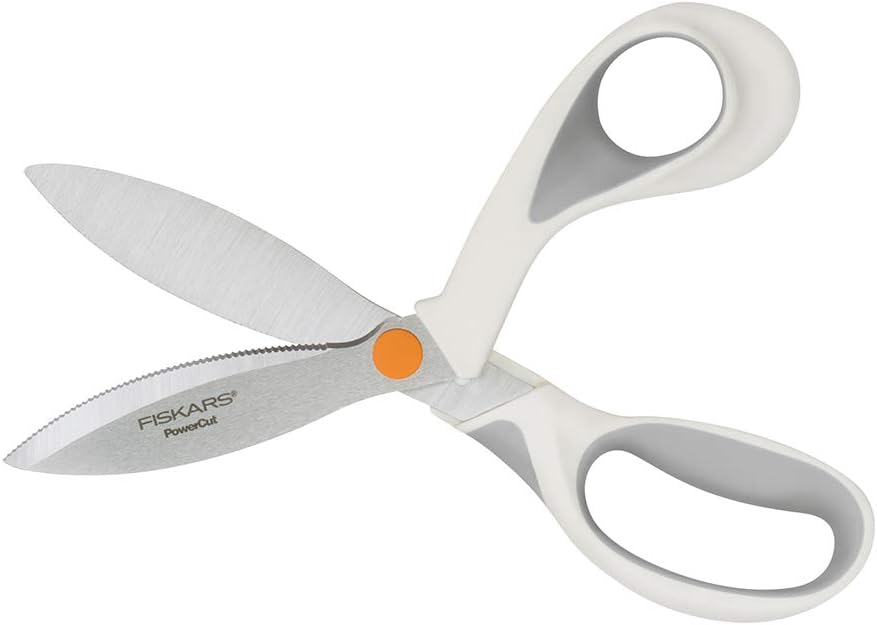 |
Fiskars SoftGrip PowerCut Fabric and Mixed Media Scissor | Enhanced Cutting Power Heavy-Duty Precision Blades Comes with a durable sheath to prevent damage and extend blade life Clean Tip-to-Grip Cutting |
Check Price |
 |
ENGINEER PH-57 Versatile Scissor | Exceptional Cutting Versatility Durable 2-in-1 Stainless Steel Blades Enhanced Thumb Pad Design Protective Blade Cap |
Check Price |
 |
Utility Scissors Heavy Duty | Powerful Multi-Material Cutting Universal Utility Across Spaces Serrated Blade for Grip & Precision Oversized Ergonomic Handle |
Check Price |
 |
DUROX – Heavy Duty Scissor | Multi-Zone Cutting Versatility 30% Boosted Cutting Power Maximum Material Capacity Extra-large, non-slip finger holes offer a secure grip |
Check Price |
What Matters Before You Choose Scissors for Thick Cardboard
The most useful buying decision starts with the cardboard you cut most often and the finish you expect afterward. Someone flattening shipping cartons has different priorities from someone making architectural models, drawer dividers, storage bins, or decorative craft forms.
The six tools in this article range from very force-focused snips to more conventional mixed-media scissors. Comparing them becomes easier when you separate cutting power, edge quality, control, and comfort instead of treating all heavy-duty scissors as the same tool.
Start With the Cardboard You Actually Cut
Single-wall shipping cartons are the easiest case. Most genuinely heavy-duty scissors can handle them if the board is dry and the blades are sharp. Dense double-wall board, reinforced corners, glued seams, and folded flaps demand much more force because several layers may overlap at the exact point you are trying to cut.
If your main job is box breakdown, strong leverage and a blade that grips the board may matter more than a beautifully smooth edge. If you are cutting display board or craft panels, the ability to follow a marked line without crushing the edge becomes more important.
Do not assume every part of one box has the same thickness. A flap intersection can stack two or three layers, and tape can add a slick surface that changes how the blades enter. The tool should have enough reserve strength that a normal dense spot does not require a dangerous surge of force.
Choose Between Long Shearing Strokes and Short Power Bites
Longer conventional shears can move through a straight line efficiently because each stroke covers more distance. They are often easier to steer for craft cuts because the blades behave in the familiar scissor pattern most people already use.
Short-bladed power shears and aviation snips concentrate force closer to the pivot. They can feel stronger on dense material, but they may require more individual bites to finish a long cut. That is a sensible trade when the job is dismantling boxes, but less attractive if you need several feet of smooth edge.
Think about your normal cut length before choosing. A tool that is excellent for opening one stubborn panel may feel slow if every project involves trimming twenty long strips.
Decide How Much Serration You Want
Fine serrations are useful on cardboard because they resist slip without feeling as coarse as the teeth on some industrial cutters. They can make a noticeable difference on printed cartons, coated stock, plastic-laminated packaging, and any surface that tends to slide away from the blades.
For a visible craft edge, however, check how much texture the serrations leave. The cut may be functionally clean but still show tiny impressions. If the edge will be painted, wrapped, glued inside a seam, or hidden in a structure, that usually matters much less.
A mixed-media shear with fine serrations is often a good compromise. A more aggressive serrated snip is better understood as a demolition and workshop tool than a finishing tool.
Match the Handle to Your Hand and Work Session
A handle that spreads pressure over several fingers can reduce fatigue, especially when you are cutting a stack of boxes for recycling. Soft-grip surfaces help when the hand needs to hold the tool securely without clenching harder than necessary.
Oversized handles are particularly useful with work gloves, but they are not automatically better for everyone. Smaller hands may lose some steering precision if the openings are too large. The best handle lets you close the blades fully without shifting your grip or pushing the thumb into a hard edge.
If you have limited hand strength, spring-assisted snips can be worth considering because the spring reopens the jaws. You still supply the cutting force, but the return motion requires less active effort from the fingers.
Look at Locks, Sheaths, and Storage Protection
Heavy-duty scissors deserve more careful storage than ordinary paper scissors because the blades are thicker, sharper, and often used around harder materials. A locking latch keeps spring-loaded jaws closed. A sheath or blade cap protects both the edge and anything else sharing the drawer or tool bag.
Storage protection also helps preserve alignment. Dropping an open tool into a crowded box can knock the tips, expose the edge to grime, and make accidental contact more likely. If the tool includes a lock or cap, using it should become part of the normal routine rather than an optional extra.
For a shared workshop, I would favor a tool with an obvious closed position. It reduces the chance that someone reaches into a drawer and meets an exposed heavy-duty blade.
Separate Cardboard Performance From Metal-Cutting Claims
One of the six products is an aviation snip designed primarily for sheet metal, and several others are sold for a broad range of tough materials. Those claims tell you that the tool has strength, but they do not guarantee a better cardboard edge.
Cardboard is softer and more compressible than metal. A jaw designed to grip sheet metal aggressively can pinch or texture cardboard more than a conventional shear. Likewise, a multi-material tool with wire-cutting grooves may be very useful in a workshop without being the most precise option for detailed paper craft.
Choose based on the actual cardboard task, not the toughest material listed on the packaging. More capacity is useful only when it improves the job you are doing.
When Heavy-Duty Scissors Are Not the Whole Solution
Scissors are excellent when you need controlled hand cutting, curved paths, short straight runs, or quick box breakdown. They are less efficient when a project demands a perfectly straight edge across a large panel or dozens of identical pieces. In those situations, the limiting factor may be the cutting method rather than the strength of the scissors.
Board condition matters too. Wet cardboard crushes and tears differently from dry board. A heavily creased box can shift under the blades, and adhesive residue can make the cutting action feel rough even with sharp edges. Flattening the panel, removing loose tape, and planning the cut away from bulky overlaps often improves the result more than simply squeezing harder.
If the blades stall repeatedly, stop and inspect the material. Forcing the handles through a glued seam or a hidden staple can damage the cutting edge and create a sudden slip when the obstruction gives way. The safer approach is to reposition the cut or separate the obstructed section first.
The goal is controlled cutting, not proving how much force the tool can survive. A heavy-duty pair should make the work easier, but it should still feel predictable in the hand.
HURRICANE 10 Inch Aviation Tin Snips – Spring-Assisted Leverage for Fast Box Breakdown
The HURRICANE 02-024 is different from the other five tools because it is a straight-cut aviation snip rather than a conventional pair of household scissors. The current listing identifies the 10-inch model with chrome vanadium steel blades, a straight cutting profile, rubberized TPR-style grips, a spring-assisted action, and a locking latch for storage.
That construction is meant to create leverage on sheet material. For thick cardboard, the same mechanical advantage can be useful when the job is rough breakdown work: opening a dense panel, cutting through a folded edge, or reducing a large carton into pieces that fit a recycling bin. The compact jaws keep the working part of the cut close to the pivot, where the tool has strong mechanical advantage.
The experience is not the same as using long craft scissors. You work in shorter bites, and the serrated jaws hold the material firmly. That can feel reassuring on stubborn board, but it can also leave more compression on the cut edge. I would treat this as a force-focused choice rather than the first pick for decorative cardboard edges.
The spring return is especially relevant during repeated box breakdown. After each squeeze, the handles reopen without requiring the fingers to actively spread them. That does not reduce the force needed to close the jaws, but it can make a series of short cuts feel less repetitive.
Key Features Translated Into Practical Benefits
The chrome vanadium steel cutting jaws are built for demanding material, and the blade edges use serrations to keep the work from sliding. On corrugated cardboard, that grip helps at the start of a cut where a smooth blade might push the liner forward. It is particularly useful on glossy printed cartons or taped areas where surface slip is noticeable.
The straight-cut jaw profile favors direct cuts rather than delicate curves. Because the jaws are relatively short compared with full-length scissors, you get strong pressure near the pivot but cover less distance per squeeze. That makes the tool efficient for dismantling panels and trimming rough sections, not for sweeping through long craft lines in one motion.
A spring-assisted mechanism reopens the handles after each cut. When you are reducing several boxes, that repeated automatic return can make the cutting rhythm feel quicker. The spring does not make the closing stroke effortless, but it removes one half of the repetitive open-close movement.
The rubberized grip gives the hand a more secure surface than bare metal handles. That matters because aviation snips ask you to apply firm pressure while also steering a short cutting head. A stable grip reduces the temptation to twist the wrist when the cardboard thickens.
The locking latch keeps the jaws closed during storage. With a spring-loaded tool, this is more than a convenience because the handles naturally want to open. Closing the lock before the snips go into a drawer or tool bag protects the cutting edge and keeps the sharp jaws from opening unexpectedly.
- The short, high-leverage cutting jaws deliver a strong bite on dense corrugated board, folded flaps, and other stubborn sections.
- Spring-assisted reopening makes repeated short cuts feel more efficient during box breakdown.
- Serrated jaws hold slick or compressed cardboard securely instead of pushing it forward as the blades close.
- The locking latch and rubberized handle make storage and firm two-finger control more practical in a workshop setting.
- The aviation-snips geometry can compress or texture the cardboard edge more than conventional scissors, so it is better for breakdown work than for visible craft finishing.
Who It’s Best For
The HURRICANE snips suit someone who regularly breaks down sturdy shipping boxes, cuts through folded corrugated sections, or wants a workshop tool with more leverage than ordinary scissors. They make the most sense when speed and force matter more than a pristine decorative edge.
Not Ideal For
They are not ideal for detailed curves, long smooth craft cuts, or projects where the cardboard edge will remain exposed and needs to look exceptionally clean. The short jaws and aggressive grip are designed around control under load rather than a long, flowing scissor stroke.
stedi 9-Inch Heavy-Duty Scissors – Serrated Curved Blades With an Adjustable Cutting Range
The stedi heavy-duty scissors linked from the original post are the B097HGGQSD model, commonly listed as the 9-inch JD-11 curved-blade version. Current product information describes 420J2 stainless steel blades, a finely serrated cutting edge, an adjustable-range mechanism, a TPR soft handle, and a safety lock.
This is a more conventional scissor shape than the HURRICANE snips, but it still leans toward workshop use. The blade line curves upward from the handle, which can help keep the hand slightly above the surface while cutting flat material. On a large cardboard panel, that can be more comfortable than dragging the knuckles close to the board.
The fine serration is one of the features that makes sense for corrugated board. Cardboard often wants to slide forward just as the blades start to close, especially when the surface is glossy or taped. The small teeth help hold the material in place so the cut can progress with less repositioning.
The adjustable cutting range changes how wide the blades open for different tasks. That can be useful when moving between thin packaging and thicker board because you do not always need the full opening. As with any adjustable mechanism, the benefit is most noticeable when you actually take a moment to set it for the material rather than leaving the tool in one position for everything.
Key Features Translated Into Practical Benefits
The 420J2 stainless steel construction gives the blades the stiffness and wear resistance expected from a heavy-duty utility shear. For cardboard, stiffness is important because the blades should stay aligned instead of flexing apart when the board compresses between them. A stable blade pair produces a cleaner, more predictable cut under load.
Fine serrations run along the cutting edge to grip the material. The advantage is most obvious when starting into a dense liner or moving through a surface that would otherwise creep. The serrations can also leave a slightly more textured finish than a polished smooth blade, so they are better viewed as a control feature than a cosmetic one.
The curved-blade layout changes the hand position relative to the material. When cutting a flat box panel on a bench, the angle can help keep the knuckles from pressing into the work surface. It also encourages the cardboard to remain seated deeper in the blade area instead of migrating toward the tips.
The adjustable-range design lets you limit the blade opening for different shearing sizes. A smaller opening can shorten the hand movement on repetitive cuts, while a wider setting gives more room to enter thick material. This is a practical feature if you cut several types of packaging rather than one consistent board thickness.
The TPR handle and safety lock address comfort and storage. A soft, non-slip surface helps during forceful cuts, and the lock keeps the blades closed when the scissors are carried in a workshop box or stored with other tools.
- The finely serrated 420J2 stainless steel blades grip corrugated board well and resist the sliding that can make thick cardboard hard to control.
- The curved blade layout keeps the hand in a useful position for cutting flat panels on a bench or table.
- An adjustable cutting range lets you tune the opening for lighter packaging or thicker board instead of using the maximum stroke every time.
- The TPR grip and safety lock make the tool comfortable to hold firmly and straightforward to store after heavy use.
- The curved, serrated utility profile favors power and grip over very fine detail, so intricate cardboard craft shapes may feel easier with a lighter precision-focused shear.
Who It’s Best For
The stedi scissors fit a DIY user who wants one heavy-duty pair for cardboard, carpet-like materials, leather, and other workshop jobs without moving all the way to aviation snips. They are especially sensible for long cardboard cuts where grip and hand clearance matter.
Not Ideal For
They are not ideal if your work is mostly tiny curves, narrow cutouts, or delicate visible edges. The heavy-duty construction is built to manage resistance, and that strength comes with a bulkier feel than a small craft scissor.
Fiskars SoftGrip PowerCut 8-Inch Shears – A Cardboard-Friendly Mixed-Media Design
The Fiskars option from the original post is the 8-inch SoftGrip PowerCut mixed-media shear. Fiskars currently describes the PowerCut 8-inch design with strength-enhancing curved blades, heavy-duty stainless steel, a serrated edge, ergonomic handles with SoftGrip touchpoints, and a protective sheath. The manufacturer specifically lists cardboard among the thick materials the shears are designed to cut.
That direct focus on mixed media makes this model different from a metal snip or a general workshop utility scissor. It is still heavy-duty, but the cutting motion stays familiar: long enough blades for useful progress along a line, scissor-style handles, and a shape intended to balance power with control.
For craft use, that balance is important. Cardboard projects often alternate between long straight cuts and shorter corrective snips around corners. A tool that is powerful only near the pivot can become slow, while a long lightweight scissor may flex or stall. The PowerCut design aims to keep more cutting strength available farther along the blades.
The protective sheath is also well suited to a craft room where the scissors may share storage with rulers, pens, fabric tools, and small supplies. Keeping the edge covered prevents accidental contact and reduces the chance that the serrations scrape against other metal items.
Key Features Translated Into Practical Benefits
Fiskars uses curved blades as the central part of the PowerCut design. The manufacturer says the geometry increases cutting power compared with traditional scissors. On cardboard, the practical benefit is that the board is encouraged to stay closer to the stronger inner portion of the blade instead of being pushed toward the tips as the handles close.
The heavy-duty stainless steel blades are designed for materials such as cardboard, cork, leather, and other mixed media. That makes this a purpose-aligned choice for crafters who do not want a tool that feels like it was borrowed from metalwork. The blades are substantial enough for tough stock but still shaped for a conventional cutting path.
A serrated edge adds grip. On coated board or a printed shipping carton, the teeth help keep the material from skating sideways. The serration is fine enough to support controlled craft cutting, though any toothed edge can still leave a slight texture on especially soft cardboard.
The ergonomic handle includes SoftGrip touchpoints where the hand carries pressure. That matters during repeated cuts because hard plastic edges can become uncomfortable when the cardboard resists. A cushioned contact zone helps distribute the squeeze and encourages a steadier grip.
The included sheath covers the blade during storage and transport. For a household or craft-room tool, this is a practical safety feature and a simple way to protect the cutting edge from knocks when the scissors are not being used.
- The curved PowerCut blade design is specifically intended to increase cutting leverage while preserving a familiar scissor motion.
- Fiskars explicitly lists cardboard among the materials these heavy-duty stainless steel shears are designed to handle.
- Fine serration improves grip on coated or smooth board without turning the tool into an aggressive demolition snip.
- SoftGrip handle contact points and the included sheath make the scissors comfortable for craft sessions and easy to store safely afterward.
- The ergonomic handle shape is strongly molded around a conventional grip, so people who need a truly neutral left-hand feel should check fit carefully before choosing it.
Who It’s Best For
The Fiskars PowerCut is the most natural fit for crafters, upcyclers, and home DIY users who cut cardboard frequently but still care about a controlled, familiar scissor feel. It works especially well when one project includes both long panel cuts and shorter shaping cuts.
Not Ideal For
It is not ideal if your main task is repeatedly attacking very dense folded seams or materials that benefit from the compact jaw leverage of aviation snips. The PowerCut is powerful for a scissor, but it remains a craft-oriented shear rather than a short-jaw metal cutter.
ENGINEER PH-57 Versatile Scissors – Short 2-in-1 Blades for Controlled Heavy Cutting
The ENGINEER PH-57 is a Japanese-made combination shear with a compact, technical design. ENGINEER documentation identifies the PH-57 as a 210 mm tool with 3 mm-thick stainless steel blades, a 2-in-1 combination of anti-slip serrations and a U-shaped blade, cushioned ABS and TPR handles, and a protective cap. The working blade length is much shorter than the overall tool, which concentrates force close to the pivot.
Current distributor information specifically lists corrugated cardboard among the materials the PH-57 can cut, along with tougher industrial materials. That helps explain the design: the tool is not trying to create a long dressmaking-style slice. It is designed to hold resistant material securely and cut it in strong, controlled bites.
The two-part blade geometry is particularly relevant to cardboard. The serrated area helps stop the board from sliding, while the U-shaped portion supports a more secure cut through the material. On a stubborn fold or dense corner, that combination can feel more controlled than a long blade that allows the board to migrate toward the tip.
The compact blade also has a clear trade-off. A short cutting edge means more strokes on long straight cuts. For small cardboard components, cable-like materials, or dense sections, that is reasonable. For breaking down a very large number of cartons, a longer blade may cover distance faster.
Key Features Translated Into Practical Benefits
The PH-57 uses 3 mm-thick stainless steel blades, which gives the cutting section substantial stiffness. Thick cardboard puts sideways pressure on the blades as it collapses, so a rigid blade pair helps keep the edges aligned rather than flexing apart under force.
Its 2-in-1 blade combines anti-slip serrations with a U-shaped cutting area. The serrations hold the material, while the shaped blade helps keep the work seated as the cut progresses. That design is useful on corrugated board because the liners and flutes can otherwise shift at different rates.
The relatively short blade length keeps the working material close to the pivot, where the hand has better leverage. This makes the PH-57 feel strong on dense spots and small pieces, but it also means you will open and close the scissors more often over a long cardboard strip.
Cushioned TPR and ABS handles include a finger-pinch guard and a broad area for applying thumb pressure. Those details matter when the tool is used hard. They help the hand stay behind the cutting area and spread pressure more comfortably during forceful squeezes.
A protective cap covers the blade for storage. Because the PH-57 is compact enough to live in a tool pouch or craft box, the cap is useful both for protecting the edge and for preventing the short sharp blades from contacting other tools.
- The 3 mm-thick stainless steel blades stay rigid under pressure and suit dense corrugated sections that make lighter scissors flex.
- The combination of anti-slip serrations and a U-shaped blade helps hold cardboard securely during a strong cut.
- Short working blades concentrate leverage close to the pivot, giving the tool a controlled bite on stubborn folds and small heavy pieces.
- Cushioned handles, a finger guard, and a blade cap make the PH-57 well suited to a busy workshop or tool pouch.
- The short 58 mm working blade requires more individual strokes than longer shears when you are cutting long straight lines across large cardboard panels.
Who It’s Best For
The PH-57 suits a maker or workshop user who values compact strength, controlled bites, and the ability to cut cardboard alongside other demanding materials. It is particularly useful for smaller pieces, dense folds, and jobs where material grip matters more than long cutting speed.
Not Ideal For
It is not ideal for someone whose work consists mainly of long, smooth cardboard strips or large craft panels. The compact cutting section is deliberately power-focused, so a longer mixed-media shear can be more efficient for distance.
BoFuYuan 8-Inch Utility Scissors Heavy Duty – Serrated Multipurpose Shears With Large Grips
The generic “Utility Scissors Heavy Duty” entry in the original article links to the BoFuYuan FY-8, an 8-inch multipurpose shear. Current product information identifies stainless steel serrated blades, oversized comfort-grip handles, an ambidextrous layout, a protective cover, and extra utility functions built into the tool, including wire-related slots and a nutcracker-style grip area.
For cardboard, the most important parts are simpler than the multifunction claims: the serrated blade, the handle size, and the conventional scissor motion. The teeth help grip corrugated liners, while the large handle provides room to apply pressure with several fingers instead of concentrating the load in a small opening.
The 8-inch overall size keeps the tool manageable for household use. It is large enough to feel substantial on packaging but not so long that it becomes awkward around corners or smaller craft pieces. The listed blade length is shorter than the overall tool, so much of the design is devoted to handle leverage and utility features rather than a very long slicing edge.
The ambidextrous specification is useful in a shared home or workshop. Unlike strongly sculpted right-hand handles, the more balanced grip is intended to work from either side. That does not guarantee identical comfort for every hand, but it gives left-handed users a better starting point than a clearly one-sided molded design.
Key Features Translated Into Practical Benefits
The stainless steel blade uses a serrated edge to increase grip. This helps on thick cardboard because the liner can otherwise slide as the blades begin to close. The teeth keep the material engaged so the hand can focus on following the cut line rather than repeatedly reseating the board.
Oversized PP and TPR-style handles spread pressure across a larger area of the hand. That can be helpful when cutting several panels in a row or when wearing light work gloves. The trade-off is that a very small hand may find the grip more spacious than necessary for delicate steering.
The tool is listed as suitable for both right- and left-handed use. A shared household scissor benefits from that flexibility, particularly if it moves between a craft room, garage, and packaging area rather than belonging to one user.
Built-in wire cutting and stripping areas add utility outside cardboard work. Those functions do not improve the cardboard edge directly, but they explain why the tool feels more like a workshop shear than a dedicated paper scissor. If you prefer one multipurpose cutter in a drawer, that versatility can be useful.
The protective cover shields the blades in storage. Heavy-duty serrated edges can snag soft items or scratch other tools if left exposed, so a cover is worth using consistently rather than leaving loose in the drawer.
- The serrated stainless steel blade grips corrugated board well and keeps slick packaging from sliding away during the cut.
- Large comfort-grip handles give the hand plenty of room to apply pressure during repeated cardboard breakdown.
- The balanced ambidextrous layout makes the scissors more practical in a shared household or workshop.
- A protective cover and extra utility functions make the tool useful beyond cardboard without adding separate loose accessories.
- The bulky multipurpose handle and extra utility geometry are less refined for small decorative cutouts than a simpler craft-focused shear.
Who It’s Best For
The BoFuYuan scissors are a good fit for households, garages, and craft spaces that want one sturdy utility shear for cardboard, packaging, fabric-like materials, and general chores. They are especially appealing when large handle openings and left-or-right-hand usability matter.
Not Ideal For
They are not ideal for precision model making or intricate cardboard shapes where a slimmer handle and more delicate blade tip would make tight turns easier. Their design emphasizes versatility and grip rather than fine-detail refinement.
DUROX Heavy Duty Scissors – Curved Serrated Blades and a Long Lever for Tough Materials
The DUROX listing linked from the original article is the B0BFBM7QV9 heavy-duty multipurpose shear, also identified in current product information as model DIN-01. The design uses stainless steel curved blades with serrations, an extended lever, extra-large non-slip finger openings, and a blade cap. Current specifications also identify the tool as right-hand oriented.
For thick cardboard, the curved blade and long-lever concept are the features that matter most. A curved cutting path helps keep material from being pushed outward toward the tips, while the longer lever gives the hand more mechanical advantage at the blade. That can make repeated cuts through dense board feel more deliberate than with short-handled household scissors.
DUROX markets the tool for a wide mix of materials, including cardboard, leather, carpet, plastic, rope, and household cutting jobs. The same versatility makes it a workshop-style choice rather than a pure paper-craft tool. Its handle is intentionally large, which suits bigger hands and forceful cutting but can feel oversized if you prefer a compact grip.
The listing also warns that the scissors are not meant for steel wire or iron sheet. That limitation is useful because it clarifies that “heavy duty” does not mean the tool should be treated as an unrestricted metal cutter. For cardboard use, keeping it away from harder materials helps preserve the edge for the work it handles well.
Key Features Translated Into Practical Benefits
Curved blades help keep the cardboard seated in the stronger inner part of the scissors as the cut progresses. On a thick panel, that reduces the tendency for the board to walk toward the tips, where leverage is weaker and the hand has to squeeze harder.
Fine serrations provide traction on the cardboard surface. They are particularly helpful on glossy packaging, coated cartons, and taped areas where a smooth blade can skate. The texture also makes the tool feel secure on mixed household materials, though visible cardboard edges may show slight tooth impressions.
The extended lever design increases mechanical advantage between the handle and cutting edge. The practical effect is not that every material becomes effortless, but that the hand can apply a strong cut without relying only on finger strength at a short handle.
Extra-large non-slip finger openings give medium and larger hands more room to spread pressure. They can also accommodate some light glove use. For a smaller hand, the same space may reduce the snug feeling that helps with fine steering, so handle fit is worth considering.
A protective blade cap makes storage safer and protects the edge from contact with other tools. The current specifications describe the scissors as right-hand oriented, so handedness should be checked before choosing if the primary user cuts with the left hand.
- Curved serrated blades grip thick cardboard and help keep the material from sliding toward the weaker blade tips.
- The extended lever gives the hand useful mechanical advantage during dense or repetitive cuts.
- Extra-large non-slip handle openings spread pressure well for medium and larger hands and can accommodate light work gloves.
- The protective cap gives the heavy-duty blades a clear, safe storage position between projects.
- The current specification is right-hand oriented, so left-handed users may find the handle and blade relationship less natural than an ambidextrous utility shear.
Who It’s Best For
The DUROX scissors suit a right-handed home or workshop user who wants strong leverage, a large grip, and serrated control for cardboard alongside other tough household materials. They are particularly sensible for frequent box cutting where comfort under pressure matters.
Not Ideal For
They are not ideal for a left-handed primary user or for someone with a very small hand who prefers a close, compact handle. The design is built around force and a roomy grip rather than delicate finger positioning.
Comparing the Six Scissors by Power, Control, and Cardboard Task
All six tools can be used on cardboard, but they do not produce the same cutting experience. The easiest way to compare them is to decide whether your priority is raw leverage, long-line efficiency, craft control, hand comfort, or all-purpose workshop versatility.
For Breaking Down Large Shipping Boxes
The HURRICANE aviation snips are the most demolition-oriented choice. Their compact serrated jaws, spring return, and locking action make sense when you are reducing boxes quickly and do not care whether the cut edge looks decorative. They bite hard and reopen automatically, which suits repeated short cuts through folded flaps and dense corners.
The trade-off is edge finish and stroke length. If you need a long straight cut that will stay visible, the Fiskars or stedi shears provide a more familiar cutting path and cover more distance per opening and closing.
For Long Straight Craft Cuts
The Fiskars PowerCut has the strongest craft-oriented balance in this group. Its blades are long enough to make useful progress, the curved geometry is designed to maintain cutting power, and the SoftGrip handle feels like a conventional pair of serious scissors rather than a shop snip.
The stedi also works well on long cuts, especially if the board has a slick surface that benefits from fine serrations. Its curved blade angle can keep the hand above the board, which is useful when the panel lies flat on a table.
For Dense Double-Wall Board and Folded Seams
The PH-57 and HURRICANE both concentrate force close to the pivot, making them strong choices for sections where several layers overlap. The ENGINEER feels more like a compact technical scissor, while the HURRICANE feels like a spring-loaded snip. Both favor short controlled bites over long slicing strokes.
The DUROX is another strong option when you want more leverage but prefer conventional scissor handles. Its long lever and curved serrated blade help keep thick material seated in the cutting area as the handles close.
For Mixed Workshop Materials
The BoFuYuan, stedi, ENGINEER, and DUROX all lean toward multipurpose use, but in different ways. BoFuYuan adds utility functions around the handle and an ambidextrous layout. stedi combines serrated stainless blades with an adjustable opening range. ENGINEER uses a compact 2-in-1 technical blade. DUROX emphasizes a large handle and extended lever.
If cardboard is only one of many materials on your bench, these broader designs make sense. If cardboard crafts are the main job and edge control is more important than workshop versatility, the Fiskars shape is easier to justify.
For Smaller Controlled Pieces
The ENGINEER PH-57 is particularly useful on short, resistant sections because its blade stays close to the pivot. You can make deliberate bites without managing a long blade beyond the work. That can help when trimming thick tabs, corners, and small structural pieces.
The BoFuYuan can also handle smaller work, but its larger handle and multipurpose profile feel less precise. The HURRICANE is powerful but too aggressive for many fine craft details.
For Grip Comfort and Hand Size
Fiskars uses SoftGrip contact points and a shaped ergonomic handle, which can feel comfortable for repeated craft cutting. stedi uses a TPR grip with a utility-style handle. BoFuYuan and DUROX provide larger openings that can suit bigger hands or light glove use. ENGINEER combines cushioned grips with a finger guard and broad thumb-pressure area.
The most important point is that handle comfort is personal. A larger opening does not automatically reduce fatigue if the hand has to shift around inside it. Choose the handle that lets you close the blades through the cardboard while keeping the wrist straight and the fingers relaxed between cuts.
For Left-Handed Use
BoFuYuan is the clearest ambidextrous option in the current specifications. HURRICANE listings also describe the snips as ambidextrous, though the short-jaw snip motion is different from ordinary scissors. The current DUROX specification identifies right-hand orientation, so it is the one that deserves the most caution for a left-handed primary user.
For the other models, the safest approach is to consider both handle molding and blade visibility. A tool can physically open and close in either hand while still making the cut line harder to see from one side.
How to Cut Thick Cardboard Without Fighting the Scissors
Even a strong pair of scissors works better when the cardboard is prepared and the cutting motion keeps the material near the powerful part of the blades. The goal is a steady sequence of controlled cuts rather than one heroic squeeze through every dense section.
1. Flatten the Panel Before You Start
Open the box along an existing seam if possible and lay the panel flat. A flat panel is easier to support, easier to mark, and less likely to twist the scissors as you cut. Remove loose tape that catches on the blades, but do not spend time stripping adhesive that is firmly bonded unless it interferes with the cut line.
If the box is heavily creased, decide whether the crease should become part of the cut. Cutting along an existing fold can reduce resistance, while trying to cross several folded layers at once can turn a simple cut into the hardest part of the job.
2. Mark the Line Clearly
For craft work, draw the line where you can see it from the side of your dominant hand. A strong pair of scissors can still wander if you are watching the blade tips instead of the line just ahead of the cut.
On box breakdown, precision may not matter, but a rough line can still help you divide a large panel into manageable sections. Plan the route to avoid staples, reinforced corners, and thick glued overlaps whenever possible.
3. Start With the Cardboard Deep in the Blades
Open the scissors far enough to place the cardboard near the pivot rather than only at the tips. The inner part of the blades has more mechanical advantage, so the first part of the stroke should do most of the difficult work.
With short-bladed tools such as the PH-57 or HURRICANE snips, this happens naturally. With longer scissors, you may need to consciously advance the board after each stroke so the next dense section returns to the stronger inner blade area.
4. Use Smooth Pressure Instead of a Sudden Squeeze
Close the handles firmly and steadily. A sudden squeeze can make the board jump, the cut line veer, or the hand twist when the resistance changes. Smooth pressure lets you feel whether the blades are shearing the board or merely crushing it.
If the handles stop unexpectedly, do not force them farther. Open slightly, reposition the cardboard deeper in the blades, and try again from a better angle. Resistance that feels unusually hard may indicate a hidden staple or a much thicker glued area.
5. Let Serrations Hold the Material
If your scissors have serrated edges, avoid sawing the blades back and forth. The teeth are designed to hold the material while the blades close. Let them bite, complete the stroke, then advance the board.
Sawing can roughen the edge and pull fibers from the liner. A clean open-close rhythm usually produces a more controlled result, even if the tool is aggressive enough to cut much tougher materials than cardboard.
6. Rotate the Cardboard for Curves
For curved craft cuts, keep the scissors in a comfortable hand position and rotate the cardboard instead of constantly twisting the wrist. This helps the blades stay aligned and makes it easier to keep the line visible.
Use shorter strokes as the curve tightens. Long blades can overshoot a small corner, while a compact tool may be easier to steer. Then return to longer strokes once the path straightens again.
7. Treat Folded Seams as Separate Obstacles
A box flap intersection can contain multiple layers plus adhesive. Do not assume the same stroke that handled the flat panel will pass through the seam. Move the seam deeper toward the pivot and take a shorter, stronger bite.
If the section still requires excessive force, change the cut path. Preserving control is more important than following a line through the thickest possible point.
8. Stop Before Hand Fatigue Changes Your Grip
The first sign of fatigue is often a change in technique rather than pain. You may begin lifting the elbow, bending the wrist, or squeezing the handles with only the fingertips. Those changes make the cut less predictable and increase the chance of a slip.
Pause, shake out the hand, and reset your grip before continuing. Then resume with the cardboard supported and the blades working close to the pivot. A short pause is faster than repairing a crooked craft cut or dealing with a strained thumb.
Keeping Heavy-Duty Scissors Smooth, Clean, and Ready
Cardboard itself is not especially corrosive, but it produces paper dust and often carries tape adhesive, label glue, packing residue, and grime. A few simple habits keep the blades moving freely and help preserve the cutting edge.
Wipe Away Cardboard Dust After Larger Jobs
Fine paper dust collects around the pivot and along serrations. After breaking down several boxes, wipe the blades with a dry cloth and brush debris out of obvious grooves. This prevents the dust from mixing with oil or adhesive into a gritty paste.
Pay particular attention to short serrated jaws, where debris has less room to escape. The goal is not a polished appearance; it is a clean cutting path and smooth pivot movement.
Remove Adhesive Before It Builds Up
Tape residue can create more drag than the cardboard itself. If the blades begin to feel sticky or the board clings after each cut, clean the affected area with a method suitable for the tool material and dry it thoroughly afterward.
Do not scrape hardened adhesive off with another sharp metal object. That can nick the blade surface or damage a coating. Gentle cleaning is slower but safer for the cutting edge.
Use Only a Small Amount of Pivot Lubrication
If the hinge becomes stiff, a tiny amount of suitable light tool oil at the pivot can restore smooth movement. Open and close the scissors several times, then wipe away excess so it does not migrate onto cardboard or attract dust.
More oil is not better. Cardboard fibers stick readily to oily surfaces, and an over-lubricated hinge can become dirtier than a dry one.
Protect Serrated Edges From Harder Materials
Several of these scissors are sold for wire, sheet material, or other tough jobs, but mixing very hard cutting tasks with cardboard use can shorten the life of the edge. ENGINEER specifically warns against applying certain wire to its micro-serrated blade, and DUROX states that its scissors are not intended for steel wire or iron sheet.
If clean cardboard performance matters, reserve the main cutting edges for materials they are designed to handle comfortably. A small nick that barely matters on rough workshop material can show up immediately as a snag in corrugated liner paper.
Use the Lock or Blade Cover Every Time
HURRICANE uses a locking latch, while Fiskars, ENGINEER, BoFuYuan, and DUROX include some form of blade protection in their current product information. These features are worth using. They keep the cutting edge from striking other tools and make storage safer.
Do not toss heavy-duty scissors open into a drawer. The sharper and more powerful the tool, the more important a consistent storage routine becomes.
Replace a Tool That No Longer Closes Cleanly
If the blades develop a gap, the pivot becomes loose, the handle cracks, or a serrated edge is visibly damaged, stop treating the scissors as a force tool. Thick cardboard magnifies alignment problems because the material pushes the blades apart during the cut.
A damaged heavy-duty scissor can require more force while giving less control. That is the opposite of what you want from a tool intended to make difficult cutting safer and easier.
Cutting Habits That Make Thick Cardboard Harder Than It Needs to Be
A strong pair of scissors can still feel ineffective if the cutting method keeps moving the board into the weakest part of the blades. These are the habits I would correct before deciding the tool lacks power.
Starting Every Cut at the Blade Tips
The tips are useful for precision, but they provide less leverage than the inner blade area. Trying to begin a dense double-wall cut at the very end of the scissors forces the hand to work harder and can make the tips separate slightly under load.
Open the blades and move the cardboard closer to the pivot. Use the tip only when the shape truly requires it.
Forcing Through Folded Corners Without Repositioning
A flat panel and a folded corner are not the same material thickness. When the blades suddenly stall, many people squeeze harder without changing anything else. That increases hand strain and can twist the cardboard away from the line.
Treat the fold as a new cut. Open the tool, move the thick section deeper into the blades, and use a short controlled stroke.
Ignoring the Direction of the Corrugation
Cuts across the flutes can feel more resistant than cuts that travel along them. If a project allows you to choose panel orientation, pay attention to that difference before marking every piece.
You do not need to avoid cross-flute cuts, but knowing they may require more pressure helps you plan the direction and choose the stronger part of the scissors for the job.
Trying to Cut Through Tape, Labels, and Board as One Clean Layer
Packaging tape changes friction, and thick labels can drag adhesive into the blade. A taped seam may also hide multiple board layers. Treating it like ordinary corrugated sheet can make the cut feel unexpectedly sticky or resistant.
Remove loose tape, avoid heavily layered label areas when possible, and clean the blade if adhesive begins to transfer.
Using Long Strokes on Tight Curves
Long strokes are efficient on straight lines but difficult to steer through a small curve. The blade may cut past the line before the cardboard has rotated enough to follow the shape.
Shorten the stroke, rotate the panel, and keep the cutting point close to where you can see the line. Then lengthen the stroke again after the curve opens.
Treating a Serrated Edge Like a Saw
Serrations are there to grip the material during a closing stroke. Sawing back and forth can tear the outer liner, roughen the edge, and spread paper dust along the teeth.
Let the blade close cleanly, reopen, advance the board, and repeat. The rhythm is slower than sawing but usually gives more control.
Continuing After the Hand Starts to Tire
Fatigue changes grip pressure and wrist angle. Once that happens, even a well-designed scissor can begin to feel awkward because the hand is no longer applying force in the direction the handles were designed to receive it.
Pause before discomfort becomes strain. A short break keeps the next cuts straighter and reduces the temptation to force the handles through resistant material.
Safety Notes for Heavy-Duty Scissors and Dense Cardboard
Heavy-duty scissors deserve the same attention you would give any sharp workshop tool. Keep the free hand away from the line of cut, especially when the board is thick enough that the blades may release suddenly after a resistant section.
Support large panels so they do not fall or twist while you are cutting. A hanging section can pull the cardboard sideways and turn the scissors in your hand. On a bench, keep the panel flat enough that the wrist does not have to bend sharply to follow the line.
Always inspect reused cardboard for staples, metal clips, hidden plastic ties, and other packaging hardware. A sudden encounter with metal can damage the blades and cause an uncontrolled slip. This is especially important with box bottoms and reinforced shipping seams.
Use the safety lock, sheath, or cap whenever the tool is stored. Keep heavy-duty scissors out of reach of children, and do not leave spring-loaded snips unlocked where the handles can open inside a drawer.
If a cut requires so much force that your hand is shaking or the blades are twisting visibly, stop. Reposition the material or choose a less resistant path. Controlled force is useful; uncontrolled force is a warning that the setup needs to change.
Frequently Asked Questions
Are Regular Household Scissors Strong Enough for Thick Cardboard?
They can handle light single-wall cardboard occasionally, but many household scissors are not designed for repeated heavy cuts. Thick board can flex the blades, stress the pivot, and make the handles uncomfortable. A heavy-duty shear gives you more stiffness, grip, and leverage when cardboard cutting is a regular task.
Do Serrated Blades Work Better on Corrugated Cardboard?
Serrations often improve control because they grip the liner instead of pushing the board forward as the blades close. They are especially useful on glossy or taped surfaces. The trade-off is that a pronounced serration can leave a slightly textured edge, which matters more on visible craft work than on box breakdown.
Are Aviation Tin Snips Good for Cardboard?
They can be very effective for rough box breakdown because their short jaws and spring-assisted action provide strong leverage. The HURRICANE model in this article is a straight-cut aviation snip, so it behaves differently from conventional scissors. It is better for forceful dismantling than for long decorative cuts where edge finish matters.
Which of These Six Is Most Craft-Oriented?
The Fiskars SoftGrip PowerCut is the most directly aligned with mixed-media craft work because the manufacturer specifically lists cardboard and designs the shears around a conventional scissor motion with added leverage. It balances long-line cutting, serrated grip, and comfortable handles without feeling like a metalworking snip.
Which One Gives the Strongest Short Bite?
The HURRICANE aviation snips and ENGINEER PH-57 both keep the working material close to the pivot, which concentrates leverage. The HURRICANE uses spring-assisted snip action, while the PH-57 uses short 2-in-1 stainless steel blades. Either makes more sense on stubborn short sections than on very long uninterrupted lines.
Can I Use These Scissors on Double-Wall Cardboard?
Heavy-duty models can handle many double-wall panels, but thickness varies and folded seams can be much denser than the flat board. Work near the pivot, take shorter strokes, and stop if the blades twist or the handles require excessive force. Repositioning is safer than trying to crush through every overlap in one squeeze.
Why Does Cardboard Slide Out of My Scissors?
The board is usually sitting too far toward the tips, the blades are too smooth for the surface, or the cut is beginning at an angle that pushes the material outward. Move the board deeper toward the pivot and use a model with serrated or curved blades if slipping is a frequent problem.
Should I Sharpen Serrated Heavy-Duty Scissors at Home?
Serrated and specialty blade profiles are easier to damage with casual sharpening than simple straight scissors. If the edge is genuinely dull, follow the maker guidance or use a professional service familiar with the blade type. Cleaning adhesive and checking the pivot first can solve many problems that feel like dullness.
Can Left-Handed Users Use All Six Models?
No. BoFuYuan is currently listed as ambidextrous, and HURRICANE listings describe the snips as ambidextrous. DUROX is currently specified as right-hand oriented. For the remaining models, handle molding and blade visibility should be checked because a tool can physically cut in the left hand without feeling equally comfortable.
How Do I Get a Cleaner Edge on Thick Cardboard?
Use sharp, aligned blades, keep the board supported, and make controlled strokes rather than crushing through the entire thickness at the tips. For visible craft edges, favor a mixed-media shear over aggressive aviation snips and avoid cutting through bulky folds when the line can be moved to a flatter part of the panel.
Why Do My Hands Hurt After Cutting Boxes?
The usual causes are poor leverage, a handle that does not fit, gripping too tightly, or continuing after fatigue changes your wrist position. Use the inner blade area, choose a grip that spreads pressure comfortably, and pause during large breakdown jobs. Spring-assisted snips can reduce the effort of reopening the tool between cuts.
Do I Need the Same Scissors for Box Breakdown and Cardboard Crafts?
Not necessarily. Rough breakdown rewards leverage, serrated grip, and fast repeated cuts. Craft work rewards line visibility, smoother steering, and a cleaner edge. If you do both often, choose the compromise that matches the work you do most or keep one of the six focused on each type of task.
Choosing the Best Scissors for Cutting Thick Cardboard Without Overcomplicating It
The best scissors for cutting thick cardboard are the pair that matches the resistance you face and the finish you need. HURRICANE puts maximum emphasis on short, spring-assisted leverage. stedi combines a curved serrated utility blade with adjustable range.
Fiskars keeps the feel closest to a powerful craft shear. ENGINEER concentrates strength into a compact 2-in-1 cutting section. BoFuYuan favors broad household versatility and ambidextrous handling. DUROX adds a long lever, curved serrations, and a large right-hand grip.
If your cardboard mostly comes from shipping boxes, I would start by thinking about leverage and hand comfort. If you make visible craft pieces, blade control and edge quality deserve equal weight. There is no benefit in choosing the most aggressive cutter if it leaves you correcting every edge afterward.
I do not think thick cardboard should require brute force from the hand. The right tool keeps the board seated, gives you mechanical advantage where you need it, and lets you stop before the grip turns into a strain.
Compare the six designs against your usual cardboard thickness, cut length, hand size, and preferred finish, then choose the one whose strengths solve the work you actually do.