Old paint rarely comes off in one neat layer. On furniture, doors, trim, and other painted surfaces, the coating may be hard on top but weak underneath, or it may have several generations of finish stacked together. Controlled heat can soften that film so a scraper does more of the work and the surface sees less aggressive sanding.
The important word is controlled. A heat gun that is hotter on paper is not automatically better for paint removal. The useful tool is the one that lets you put enough heat into the coating to make it release while still protecting the wood, metal, glass, filler, adhesive, or previous repair below it. That is why temperature choice, airflow, nozzle shape, size, and working rhythm matter as much as maximum output.
I also think the distinction between a full-size heat gun and a mini craft-style tool deserves to be clear. Several products in this list are compact tools built for localized heating, while others are 1500W to 1800W models intended for larger, more demanding work. They can all produce hot air, but they are not interchangeable on a paint-stripping job.
Why Heat Works on Old Paint – and Where It Can Go Wrong
The goal is to soften the film, not cook the surface
A heat gun removes paint indirectly. It warms the coating until the paint becomes softer and loses some of its grip, then a scraper lifts the loosened film. On many oil-based or layered finishes, you can actually see the surface wrinkle, blister, or relax before the scraper reaches it. The most efficient rhythm is usually to heat a small area, move the gun forward, and scrape the area that has just softened.
Too little heat does almost nothing, so you end up forcing the scraper and gouging the substrate. Too much heat creates a different set of problems: scorched wood, bubbling veneer glue, damaged filler, cracked glass, smoke, unpleasant fumes, or even ignition of hidden combustible material. If the paint is smoking or the wood is darkening, you are past the useful heating point.
This is why I would start lower than you think you need. Give the coating a few seconds to respond, keep the nozzle moving, and increase heat only if the paint stays stubborn. A slower first pass is easier to correct than a scorched panel.
Temperature tells only part of the story
Two heat guns can show similar temperature figures and still feel very different in use. Airflow determines how much heated air reaches the work and how wide the useful heating zone feels. A full-size gun with a broad nozzle can soften a larger strip of paint quickly; a pencil-shaped mini gun may reach a respectable temperature but deliver that heat over a much smaller area.
Full-size guns suit broad stripping; mini guns suit localized work
For a painted door, tabletop edge, baseboard, or furniture side panel, a conventional pistol-grip heat gun is normally the more practical shape. You have enough output to keep moving across the surface, and the body is designed around sustained hot-air work. Variable-temperature models add another advantage because you can reduce heat for delicate areas and raise it when a thick coating needs more energy.
Mini heat guns are closer to precision hot-air tools. Their narrow bodies are easy to aim and convenient at a craft bench, but their lower output and smaller heating pattern limit how quickly they can soften broad coatings. Some of the fixed-output mini models here are listed around 200 C/392 F, which is far below the maximum temperatures of the full-size tools. That can be useful for gentle localized warming, yet it can also be insufficient for thick, stubborn architectural paint.
For large paint-removal work, choose the tool around the size and toughness of the surface rather than the smallest body or the highest advertised temperature.
Nozzles change how heat reaches the paint
A bare round nozzle sends a general stream of hot air. That works for many open areas, but attachments can make the same heat gun more useful. A concentrator narrows the stream for edges and stubborn spots. A broad or flare-style nozzle spreads heat across a wider strip. A reflector-style nozzle wraps heat around tubing or other rounded objects rather than being primarily aimed at flat painted surfaces.
A glass-protector or heat-shield nozzle matters near windows because it helps deflect direct hot air away from the glass. It is still not permission to park the gun in one place. Glass can crack from thermal stress, especially when one section heats much faster than another.
The surface below the paint sets the real limit
Solid wood can tolerate careful heat, but corners and thin edges scorch faster than a broad flat area. Veneer needs more restraint because excessive heat may soften the adhesive beneath it. Metal carries heat away from the work zone and can become hot well beyond the point you are aiming at. Plastic trim, laminates, and some composite panels can distort before a thick coating releases.
| Product Image | Product Name | Features | Price |
|---|---|---|---|
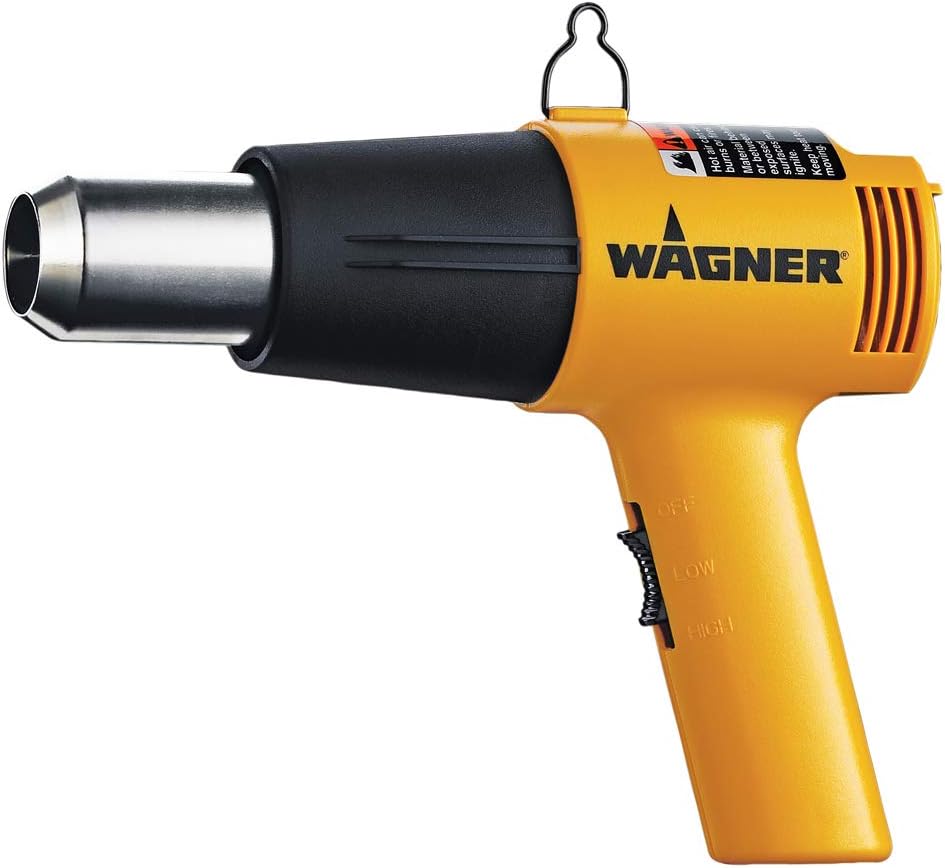 |
Wagner Spraytech 0503008 HT1000 Heat Gun | Dual Temperature Settings Offers 750°F and 1000°F heat levels for versatile use Two fan speeds for customized airflow and control Corrosion-resistant nozzle |
Check Price |
 |
6.56FT Long Heat Gun | Comes with a 6.56 ft (2-meter) cable for flexible movement while crafting Made with high-quality stainless steel interior Lightweight and space-saving Heats up to 200°C in seconds with 110V power |
Check Price |
 |
BLACK+DECKER Heat Gun for Crafts | 1,350 watts of heating power for a wide range of tasks Easily switch between 750°F and 1,000°F settings Comfortable grip and enhanced control Keeps hot nozzle elevated to protect surfaces |
Check Price |
 |
SEEKONE Mini Heat Gun | Offers two heat levels: 500°F (260°C) and 842°F (450°C) verheat protection automatically shuts off power if temperatures get too high Lightweight and easy to handle |
Check Price |
 |
TGK® 1800W Heavy Duty Hot Air Gun | 1800W motor heats up to 1202°F (650°C) in just 1.5 seconds Two airflow modes: Mode I: 122°F–572°F at 250L/min Mode II: 122°F–1202°F at 500L/min Built-in overload protection Non-slip handle |
Check Price |
 |
Mini Hot Air Gun for DIY Crafts | Durable Build & Quality Materials Heats up to 200°C (392°F) in seconds Fixed temperature design One-button activation with optimal heating angle: 45° and 5–6cm distance for best results |
Check Price |
 |
ROMECH 350W Heat Gun with 2 Nozzles | Heats up in seconds with two adjustable modes: 400°F (150L/min airflow) for delicate tasks 660°F (200L/min airflow) for larger project Overheat protection automatically shuts off power at unsafe temperatures Lightweight Pencil-shaped body |
Check Price |
 |
Sumi Living Mini Heat Gun | Compact dimensions: 225×45mm (8.86×1.77in) for easy handling Heats up to 200°C (392°F) in seconds with 110V power Includes a 12-month warranty and 100% satisfaction promise |
Check Price |
 |
ROMECH 1500W Heavy Duty Heat Gun | Rapid Heating & Adjustable Output Heats up to peak temperature in just 1.5 seconds Adjustable airflow: 66 gal/min for delicate tasks, 132 gal/min for heavy-duty projects Overload protection automatically shuts off power when overheated |
Check Price |
 |
A Nice Heat Gun, Compact but Powerful | 1800W motor heats up in just 1.5 seconds Reaches up to 1202°F (650°C) for high-efficiency performance 20% smaller than standard heat guns temperature settings from 122°F to 1202°F Two airflow modes |
Check Price |
What Matters Most Before You Choose a Heat Gun
Look for usable temperature control, not just a large maximum number
A two-setting gun is simple: choose the lower heat, see how the paint responds, then move to the higher setting if needed. That is enough control for many straightforward stripping jobs. The Wagner HT1000 and BLACK+DECKER HG1300 both use 750 F and 1000 F settings, which gives you a clear low/high choice without a temperature dial to manage.
Variable-temperature models give you a wider working window. The TGK 1800W and ROMECH 1500W models are listed with broad adjustable ranges that extend from low temperatures into roughly 1200 F territory. The linked TDAGRO model also uses stepped temperature adjustment. This extra control is useful when one project moves from broad solid wood to delicate moulding, repaired edges, or a surface that starts responding at much less heat.
A wide range only helps if you actually use it. Begin at the lower end and raise heat because the coating requires it, not because the tool can go hotter.
Airflow affects stripping speed and control
Hot air has to transfer energy into the paint. Higher airflow can warm a wider moving area and make a full-size gun feel more productive on broad surfaces. Lower airflow can be easier to manage around details because it reduces the blast that can spread dust, move small parts, or overheat adjacent material.
The TGK listing specifies two airflow levels alongside its two operating modes, while the ROMECH 350W model lists 150 L/min on its lower setting and 200 L/min on its higher setting. That kind of information is useful because it explains why two temperature levels may behave differently beyond the temperature number alone.
Decide whether you need full-size output or pencil-like precision
A compact 300W mini heat gun can be comfortable for a small furniture detail, label removal, embossing, or shrink material. It is much less convincing for stripping several square feet of old paint. The narrow heated zone means you have to make many more passes, and some mini designs are specifically sold with short continuous-use guidance.
By contrast, the 1500W to 1800W models are designed around stronger sustained heating and broader work. They are physically larger, and that may feel less precise in a tight carving or corner, but they fit the workload of a door, trim run, cabinet side, or larger restoration project better.
I know it is tempting to choose the smallest tool because it looks easier to control. For paint removal, control comes from the combination of temperature, airflow, distance, movement, and nozzle choice – not body size alone.
A stable stand is more useful than it sounds
Heat-gun nozzles remain dangerously hot after the switch is turned off. An integrated stand lets the gun cool without laying the metal nozzle on a workbench, drop cloth, cord, or painted floor. Some stands also support hands-free use when the workpiece is brought toward a controlled heat stream, although paint stripping is usually safer and easier with the gun moving in your hand.
Think about the scraper at the same time as the heat gun
Heat does not remove the softened coating by itself. A sharp scraper that matches the profile of the work is what lifts the paint. A broad flat scraper works on panels; a narrower or shaped tool is more useful in mouldings and corners. Dull edges force you to press harder and make gouges more likely.
Cord length and work-area setup matter on real projects
Full-size heat guns draw substantial power, so use a properly rated outlet and extension cord if one is necessary. A light-duty household extension lead that is too long or undersized can heat up under load. Keep the power cord behind the tool so the hot nozzle cannot cross it as you change direction.
Wagner Spraytech 0503008 HT1000 Heat Gun – Straightforward Dual-Heat Control for Broad Work
Wagner positions the HT1000 as a basic heat tool for jobs that include removing paint, and its current product information keeps the controls deliberately simple. It has two temperature settings: 750 F on low and 1000 F on high. Wagner also lists two fan speeds, a corrosion-resistant nozzle, an integrated hanging hook, and a rugged lightweight body.
That combination makes sense for someone who wants a conventional paint-stripping heat gun without a digital display or a wide adjustment dial. The lower setting gives you a sensible starting point for many painted wood surfaces, while the higher setting is available when a tougher coating is not responding. Wagner’s own support guidance specifically places paint-related work among the HT1000’s intended uses.
The trade-off is equally clear. You can choose low or high, but you cannot tune the tool to an intermediate temperature. If a particular finish responds best somewhere between those two points, your practical adjustment becomes nozzle distance and movement speed rather than a finer heat setting.
Key features translated into practical benefits
The 750 F/1000 F layout is easy to understand at a glance. On a stripping job, that means you can start low without guessing at a dial position, then move up only if the coating remains hard. It also reduces the chance of accidentally leaving a variable dial at maximum from a previous task.
Wagner lists two fan speeds, which adds useful control beyond the two heat settings. A lower-moving stream can be easier around an edge or profile, while stronger airflow helps move heat across a larger patch. The gun’s full-size pistol shape also suits the repeated heat-and-scrape rhythm of doors, trim, and furniture better than a narrow craft tool.
The corrosion-resistant nozzle and hanging hook are practical rather than decorative features. A nozzle that sees scraping dust, old finish, and workshop storage benefits from basic durability, and the hook gives you another safe storage option once the gun is fully cool.
The HT1000 makes the most sense when you want predictable low/high heat and do not need fine temperature adjustment.
- Simple 750 F and 1000 F settings make it easy to begin conservatively and increase heat only when the coating needs it.
- Two fan speeds give more control over how aggressively hot air reaches broad areas and smaller details.
- Wagner specifically lists paint removal among the tool’s intended jobs, so its design is aligned with stripping rather than being only a craft heater.
- The lightweight full-size shape, corrosion-resistant nozzle, and hanging hook suit repeated workshop use without adding complicated controls.
- Only two temperature choices are available, so delicate or unusual finishes may be easier to manage with a genuinely variable-temperature model.
Who It’s Best For
This is a strong fit for furniture refinishers and DIY renovators who want a conventional heat gun with a clear low/high decision rather than a large adjustment range. It is especially sensible for broad painted woodwork where 750 F provides a useful starting point and 1000 F gives extra heat for stubborn layers.
Not Ideal For
It is less suitable if your work regularly shifts between heat-sensitive materials and thick coatings that benefit from very fine temperature tuning. A variable model can make those transitions easier because you can adjust the tool instead of relying so heavily on distance and speed.
6.56FT Long Heat Gun – Homidic’s 300W Mini Tool for Small, Low-Heat Tasks
The product linked from the original article resolves to Homidic’s 300W mini handheld heat gun with a 6.56-foot cable. Its current product information describes a stainless-steel inner construction with an ABS outer body, a built-in stand, rear cooling vents, and a compact form. The nozzle is listed as reaching about 200 C/392 F in seconds.
That specification immediately tells you how to think about it for paint work. This is not a smaller version of an 1800W stripping gun. It is a compact hot-air tool originally aimed at tasks such as embossing, shrink material, clay, and paint drying. A temperature around 392 F can gently warm some coatings or adhesives in a very small area, but it will be slow or ineffective on many thick, hard architectural finishes.
The long cord is genuinely useful at a bench or around small furniture because the tool remains easy to position without putting a plug directly beside the project. The built-in stand is also a good fit for a mini tool that may be set down frequently between short detail tasks.
Key features translated into practical benefits
The 300W output and approximately 200 C/392 F nozzle temperature keep this model in light-duty territory. That lower ceiling can reduce the temptation to blast a delicate craft surface with extreme heat, but it also limits how quickly you can soften a tough painted door, trim board, or heavily layered furniture panel.
Its 6.56-foot cable is one of the clearest differentiators in this group of mini tools. Extra reach can make small restoration work more comfortable, especially when the piece sits on a bench away from the nearest socket. You still need to route the cable behind the hot nozzle and away from your scraper.
The stainless-steel interior, ABS exterior, rear vents, and stand all support the tool’s compact bench-use design. None of those features change its fundamental limitation: the hot-air footprint and available heat are much smaller than on the full-size models here.
Treat the Homidic as a precision warming tool first and a paint-removal tool only for small, responsive areas.
- The narrow body is easy to aim around tiny details, hardware recesses, craft pieces, and localized repairs.
- A 6.56-foot cable gives more working reach than many small bench tools without immediately relying on an extension cord.
- The built-in stand provides a defined cooling position between short heating passes.
- The lower fixed output can be easier to manage on heat-sensitive small work where an industrial gun would be excessive.
- Its fixed roughly 200 C/392 F output and 300W power make broad or stubborn paint stripping much slower than with a full-size heat gun.
Who It’s Best For
Choose it for small DIY work, craft-scale restoration, localized warming, or tiny paint patches where a broad high-output heat stream would be awkward. It can also be useful as a secondary detail tool beside a full-size gun.
Not Ideal For
Do not choose it as your main tool for a full door, long skirting board, thick multi-layer paint, or any job where you need strong adjustable heat. The small heated area and fixed temperature become the limiting factors very quickly.
BLACK+DECKER Heat Gun for Crafts – A Compact Full-Size Gun With Two Familiar Temperatures
The linked BLACK+DECKER model is the HG1300, a corded 120V heat gun with two settings at 750 F and 1000 F. BLACK+DECKER’s current product page specifically lists stripping paint and varnish among its uses, and the tool includes a built-in stand for cooldown plus a glass-protector nozzle.
Despite the old article’s “for crafts” wording, this is not a low-output pencil tool. It uses the familiar pistol-grip shape of a household heat gun and is designed for high-heat jobs. That makes it much more credible for broad paint removal than the 300W fixed-temperature mini models.
The two-setting approach feels similar in principle to the Wagner HT1000. You do not get a continuously variable dial, but you do get a clearly defined lower and higher heat level. For someone who would rather manage paint by moving the gun and changing distance than by constantly changing a temperature control, that simplicity can be an advantage.
Key features translated into practical benefits
The official 750 F and 1000 F settings cover a useful paint-removal range while remaining simple enough to operate without stopping to read a display. Start with 750 F, watch for the finish to soften, and use 1000 F only where the coating and substrate justify more heat.
The built-in stand gives the hot nozzle a safer place to cool. That is especially useful on paint projects because the gun is often set down while you change scraper, reposition the work, or clear softened paint from the edge of the blade.
BLACK+DECKER includes a glass-protector nozzle with the HG1300. That attachment can help redirect heat when working near a window, but the operator still has to keep the gun moving and avoid creating a steep temperature difference across the glass.
The tool is also listed as lightweight and compact for a full-size gun. That helps in corners and on vertical trim, although the pistol body is still larger than the SEEKONE, Homidic, Sumi Living, and other mini tools here.
- The 750 F and 1000 F settings provide a straightforward lower-and-higher heat choice for common stripping work.
- BLACK+DECKER explicitly lists stripping paint and varnish as intended applications for the HG1300.
- A built-in stand gives the hot nozzle a safer cooldown position during stop-and-start restoration work.
- The included glass-protector nozzle is useful when a project involves painted window frames or other areas close to glass.
- Two fixed heat levels offer less fine control than the TGK, ROMECH 1500W, or linked TDAGRO variable-temperature designs.
Who It’s Best For
This model suits a homeowner or furniture restorer who wants a recognizable full-size heat-gun format, simple controls, and an attachment that is useful around windows. It is a sensible general-purpose choice for painted woodwork where two temperature settings are enough.
Not Ideal For
It is not the strongest match for someone who needs to dial down to very low heat for sensitive materials or tune temperature in small increments. For that kind of mixed-material work, a broad variable range gives more room to adapt.
SEEKONE Mini Heat Gun – 350W Detail Control With Two Temperature Levels
SEEKONE’s HG350 is a more capable mini tool than the fixed-output 200 C craft guns because it offers two temperature settings: 500 F/260 C and 842 F/450 C. SEEKONE lists 350W power, a compact pencil-like body, a retractable stand, a reflector nozzle, and built-in overheat protection that cuts power if the tool becomes too hot.
For paint removal, the key is the 842 F high setting. That puts considerably more usable heat into a small area than a 392 F mini gun can, so the SEEKONE can soften responsive coatings on details, narrow mouldings, small furniture parts, and repair zones. It still delivers that heat through a mini format, though, so covering a door or long piece of trim will be slower than with a full-size 1500W or 1800W tool.
The 500 F lower setting also has value. It gives you a gentler starting point for thin material, craft work, adhesive softening, or areas where you want to see how the surface reacts before moving to higher heat.
Key features translated into practical benefits
Dual temperature is the biggest practical improvement over the fixed-output mini designs. Instead of changing only distance and movement speed, you can select 500 F for gentler work or 842 F when the coating needs more energy. That makes the HG350 easier to adapt across small restoration tasks.
SEEKONE lists built-in overheat protection. This is a protective feature for the tool rather than a substitute for safe technique, but it adds a useful layer of protection during compact high-temperature operation. The air inlet and outlet still need to stay clear.
The retractable stand supports cooldown and hands-free positioning, and the reflector nozzle is useful for wrapping heat around small cylindrical work. For flat paint removal, the standard nozzle will usually make more sense because the reflector is not designed to spread heat over a broad panel.
The HG350 is one of the better mini choices here when you genuinely need small size but still want more than one temperature.
- Two settings at 500 F and 842 F give much more flexibility than a fixed 392 F craft-style heater.
- The 350W pencil-like format is easy to aim at carved details, narrow trim, small furniture parts, and repair patches.
- Built-in overheat protection adds a useful protective layer for a compact tool that can reach high nozzle temperatures.
- The retractable stand makes short pauses and cooling safer on a crowded workbench.
- Its small hot-air footprint still makes large doors, walls, and long trim runs inefficient compared with full-size models.
Who It’s Best For
It suits detail-focused restorers, crafters, and DIY users who want a compact gun but do not want to be locked into one low temperature. It is especially useful where the workpiece is small enough that precision matters more than square-foot coverage.
Not Ideal For
It is not the right primary tool for removing several layers of paint across large flat surfaces. The 842 F high setting is useful, but the 350W mini form cannot match the working pace of a full-size high-output gun.
TGK® 1800W Heavy Duty Hot Air Gun – Wide Temperature Adjustment for Demanding Stripping
The TGK linked in the original post is a full-size 1800W heat gun with a listed variable temperature range from 122 F to 1202 F. Its current listing separates operation into two airflow modes: the lower mode is listed at 250 L/min and the higher at 500 L/min, with the upper mode extending to the tool’s maximum temperature. It also lists overload protection, an integrated stand, and multiple nozzle attachments.
That wide adjustment range is the main reason this model deserves different treatment from a simple two-temperature gun. Paint does not always need maximum heat, and a dial that can come down toward much lower temperatures gives you a better chance of matching the coating and substrate. On a furniture project, for example, you can work more cautiously near repaired corners or thin edges and use stronger heat on broad solid sections.
The 1800W power level and stronger airflow also suit larger jobs. A full-size variable gun can keep a productive heat-and-scrape rhythm across doors, trim, and furniture panels where a mini tool would require many narrow passes.
Key features translated into practical benefits
The 122 F to 1202 F listed range gives the operator a lot of latitude, but the useful benefit is not the 1202 F maximum by itself. The benefit is being able to start much lower, observe the coating, and increase gradually. That is especially valuable when you do not know how a previous finish or repair compound will react.
Two airflow modes add another level of control. The lower airflow is easier to direct around smaller areas, while the higher flow can move more heated air across broad paint. Temperature and airflow should be considered together rather than treating the hottest mode as the default.
The integrated stand is important on an 1800W tool because the nozzle and metal attachments retain substantial heat after use. Multiple nozzles also let you narrow or spread the heat footprint as the job changes.
Because the listed maximum exceeds 1100 F, do not run this gun at maximum on lead-painted surfaces; EPA lead-safe guidance calls for a low-temperature heat gun under 1100 F when heat is used for lead-related renovation.
- A broad variable temperature range lets you match heat more closely to the coating instead of choosing only low or high.
- Two airflow modes make the gun easier to adapt between localized work and broad stripping passes.
- The 1800W full-size design is better suited to sustained doors, trim, and furniture panels than the mini tools in this list.
- Overload protection, a stand, and multiple nozzle attachments add practical control and safer handling around a hot tool.
- The very high maximum makes disciplined temperature selection essential, particularly on old paint where lead may be present or the substrate is easy to scorch.
Who It’s Best For
This model fits larger restoration and renovation jobs where you want full-size output plus more temperature adjustment than a two-setting gun provides. It is especially useful for users who work across different woods, coatings, and detail levels during the same project.
Not Ideal For
It is more tool than you need for tiny craft jobs or occasional shrink tubing, and the broad heat range can be a liability if the operator simply turns the dial to maximum. Buyers who prefer one uncomplicated switch may be more comfortable with the Wagner or BLACK+DECKER designs.
Mini Hot Air Gun for DIY Crafts – Fixed 392 F Heat for Tiny Work Areas
The linked item is a QYQRQF mini hot-air gun sold for DIY and craft work. Current listings describe a stainless-steel interior, ABS plastic exterior, ergonomic nonslip grip, rear heat vents, a built-in stand, and a fixed temperature that reaches about 200 C/392 F. The temperature is not adjustable.
That fixed 392 F output is the defining fact for paint removal. Some thin or soft finishes may respond to gentle warming, and the narrow stream can be useful around a small repair. Thick old paint, however, often needs more heat and more airflow than this tool can provide efficiently. It should not be presented as a direct substitute for a 1000 F full-size gun simply because both products are called heat guns.
The listing also describes a short-duty-use approach, advising against running it continuously for more than about ten minutes at one time. That further reinforces its bench-tool role rather than sustained stripping across a large surface.
Key features translated into practical benefits
A simple on/off control makes the tool easy to operate, but you cannot reduce or increase temperature at the switch. Your only heat-management tools are working distance, movement, and how long you stay on one area. That is adequate for simple craft heating but less flexible on old paint.
The stainless-steel inner section and vented ABS outer body are common construction choices for compact hot-air tools. The rear vents need to remain unobstructed so the internal heat can escape. Holding the gun by the insulated grip rather than the front body is essential after it has been running.
The built-in stand is useful because even a 392 F nozzle is hot enough to melt plastic, damage a finished bench, or cause a burn. Give it a clear cooling area and keep scraps away from the nozzle.
The sensible reason to choose this tool is precision and gentle output, not stripping speed.
- The narrow lightweight body is easy to position around tiny objects and small restoration details.
- Its roughly 392 F fixed output is less aggressive than the high settings on industrial-style guns, which can be useful for gentle localized warming.
- Rear cooling vents and an integrated stand support short bench sessions and safer cooldown.
- The simple on/off operation requires almost no setup for occasional small DIY tasks.
- Non-adjustable temperature, low output, and short-duty guidance make it unsuitable for efficient broad paint removal.
Who It’s Best For
This is for small craft work, tiny paint patches, and users who mainly need controlled localized warming rather than a dedicated stripping machine. It makes more sense as a secondary precision tool than as the only heat gun in a furniture-refinishing setup.
Not Ideal For
Avoid it for thick multi-layer paint, large furniture panels, full doors, or long architectural trim. Those surfaces need more working area, stronger airflow, and preferably adjustable heat.
ROMECH 350W Heat Gun with 2 Nozzles – Compact Dual-Heat Control at 400 F and 660 F
ROMECH’s 350W model sits between the fixed low-output craft guns and the hotter full-size tools. Its current instructions list two modes: 400 F at 150 L/min for delicate work and 660 F at 200 L/min for larger work. The product is sold with two nozzles and an integrated stand, and its listing includes overheating protection.
For paint removal, 660 F is enough to make this tool more useful than a fixed 392 F mini heater on responsive coatings. The 400 F setting also gives you a clearly lower option for sensitive details. Still, this is a 350W compact tool, so the useful heating footprint and work pace remain smaller than with a full-size 1200W to 1800W gun.
That makes the ROMECH 350W particularly interesting for furniture edges, decorative profiles, small frames, repair patches, and other places where a broad blast of hot air is harder to control. It can also be a good companion to a larger stripping gun: use the full-size tool on open surfaces, then switch to the 350W gun for detail work.
Key features translated into practical benefits
The 400 F and 660 F settings give a clear two-stage progression. Start at 400 F on delicate work, watch the coating and substrate, and move to 660 F if the paint stays firm. Unlike a fixed-output mini gun, you do not have to control every change in heat only by moving farther away.
Published airflow of 150 L/min on low and 200 L/min on high helps explain the working difference between the two modes. The high mode does not only get hotter; it also moves more air, which can soften a slightly broader area more quickly.
Two nozzles give you some control over the shape of the hot-air stream, while the integrated stand provides a safer cooldown position. Overheating protection is a useful tool-protection feature, but the operator still has to keep vents clear and respect the surface temperature.
- Two settings at 400 F and 660 F give more useful paint-control range than a fixed 392 F mini gun.
- The 350W compact body is easy to aim at mouldings, edges, small frames, and repair zones.
- Published low/high airflow figures make the two modes meaningfully different for delicate versus larger localized work.
- Two nozzles, a stand, and overheating protection add useful practicality without turning the tool into a bulky full-size gun.
- The compact 350W format remains too slow for extensive door, wall, or long-trim stripping compared with the higher-power full-size models.
Who It’s Best For
It fits detail-heavy furniture work and small restoration projects where a narrow tool is easier to control but a fixed 392 F craft gun feels too limited. It is also a sensible secondary gun for corners and profiles after broad areas have been stripped with a larger model.
Not Ideal For
It is not ideal if your main goal is square-foot coverage. For large panels and repeated architectural stripping, a full-size gun with stronger airflow will usually save substantial time.
Sumi Living Mini Heat Gun – Simple 200 C Output for Short Detail Sessions
The Sumi Living mini heat gun is another fixed-output craft-style model. Current product information lists a stainless-steel and ABS body, 110V operation, approximately 300W power, a built-in stand, a nonslip grip, and a working temperature around 200 C/390-392 F. The listing also cautions against using it for more than about ten minutes at one time.
For stripping paint, that short-duty guidance is as important as the temperature. It tells you the tool is designed around small tasks and breaks rather than continuous coverage. A tiny patch on a craft project, picture frame, or furniture detail can fit that rhythm. A six-panel door does not.
The Sumi Living’s strength is that it is easy to hold and easy to place on a bench. There is no temperature dial to learn, and the stand gives the hot nozzle somewhere to rest. The weakness is that there is no way to raise output when a hard coating refuses to soften.
Key features translated into practical benefits
The roughly 200 C output keeps the tool in the same heat class as the other fixed mini guns. That can be gentle enough for small sensitive tasks, but it also means the user may be tempted to hold the nozzle still for too long when paint does not release. Do not compensate for low output by parking the nozzle in one spot until the substrate overheats.
A nonslip grip and narrow body help with precise positioning. The built-in stand is valuable during the short breaks encouraged by the listing’s use guidance, and it keeps the hot nozzle off the work surface while the tool cools.
Because there is no temperature adjustment, good technique matters more. Keep a consistent distance, use short passes, and stop if the coating is not responding rather than forcing a process the tool is not powerful enough to perform efficiently.
- The slim nonslip body is easy to control around tiny parts, frames, decorative edges, and bench-scale projects.
- A built-in stand supports the short heat-and-rest rhythm described in the product guidance.
- The roughly 200 C output can be useful for gentle localized warming where a high-output gun would be excessive.
- Simple operation makes it easy to use for occasional craft and small repair work without managing a temperature dial.
- Fixed low heat and a roughly ten-minute continuous-use caution make it a poor choice for sustained paint stripping over large surfaces.
Who It’s Best For
This model suits light DIY and craft users who may occasionally need to soften a tiny paint area but spend more time on localized heating tasks. It is easier to justify for detail work than for dedicated furniture stripping.
Not Ideal For
It is not intended for long continuous stripping sessions, thick paint buildup, or broad architectural work. If paint removal is your main purpose, a full-size adjustable model will give you more useful control and faster coverage.
ROMECH 1500W Heavy Duty Heat Gun – Full-Size Variable Heat With Four Nozzles
ROMECH’s 1500W heavy-duty model moves back into full-size paint-stripping territory. Its current listing describes variable temperature control from about 120 F to 1200 F, two airflow settings, and four nozzle attachments. That combination gives you the broad output needed for larger work while retaining the ability to reduce heat for more delicate sections.
The value of the 120 F to 1200 F range is not that paint stripping should be done at 1200 F. It is that you have room to find the lowest setting that softens a particular coating. A thick finish on a solid wood panel may need substantially more heat than a thin coating near veneer, filler, or a repaired corner.
Four nozzles also make the tool more adaptable. Depending on the attachment, you can concentrate heat on an edge, spread it across a wider strip, or direct it more carefully around a specific shape. Always check the supplied attachment’s intended orientation before heating a finished surface.
Key features translated into practical benefits
The variable temperature control gives you a wide working window. Start low, increase gradually, and watch the paint rather than the dial. Once the finish begins to soften cleanly, there is little reason to keep increasing temperature just to work faster.
Two airflow settings let you pair lower movement with detail work and stronger airflow with broad stripping. This matters on large painted surfaces because productive heat transfer comes from both temperature and the volume of hot air reaching the coating.
The 1500W power level is well suited to repeated heat-and-scrape passes. Compared with a 300W mini gun, it can heat a larger working area while you keep the nozzle moving, which reduces the temptation to dwell on one tiny spot for too long.
The listed maximum reaches about 1200 F, so old or suspected lead paint requires special restraint and lead-safe work practices; EPA guidance specifies a low-temperature heat gun under 1100 F when heat is used.
- Variable control from roughly 120 F to 1200 F gives much finer adjustment than a two-setting gun.
- The 1500W full-size design suits broad furniture panels, doors, and architectural trim where sustained heat output matters.
- Two airflow levels help balance localized control with faster coverage on open surfaces.
- Four nozzle attachments give more ways to shape the heat stream for edges, broad strips, and other project details.
- Its high upper temperature demands careful setup and restraint, especially around lead paint, veneer, glass, filler, and dry wood.
Who It’s Best For
This is a good match for users who expect to strip paint regularly and want one full-size tool that can move from cautious low heat to stronger output as the job changes. It is particularly practical for furniture restoration and home trim work with a mix of broad and detailed surfaces.
Not Ideal For
It is unnecessary for simple embossing or tiny craft tasks, and it may feel bulky where pencil-like control is the priority. Users who dislike variable controls may also prefer the simpler two-setting Wagner or BLACK+DECKER models.
A Nice Heat Gun, Compact but Powerful – TDAGRO’s 1800W Stepped-Temperature Model
The final product link from the original article resolves to a TDAGRO heat gun sold under the description “A Nice Heat Gun, Compact but Powerful.” Current listings identify an 1800W motor, a temperature range from 122 F to 1202 F, seven temperature settings, two fan settings, an integrated stand, overload protection, and four additional nozzles.
Those seven steps create a middle ground between a basic two-temperature switch and a continuously variable dial. You have more choice than low/high, but the adjustment is still organized into defined positions. That can be useful for someone who wants repeatable settings and does not need to chase a precise dial position every time the tool is picked up.
At 1800W, this is built for larger hot-air work rather than only craft use. For paint removal, that means it has the output to cover doors, furniture panels, and trim more efficiently than a mini tool. The same caution applies as with every high-output gun: high capacity should be used to keep the tool moving, not to hold maximum heat on one spot.
Key features translated into practical benefits
A listed 122 F to 1202 F span gives the tool enough range to move from gentle heating to aggressive hot-air work. The seven-step control makes that range easier to repeat than an unmarked continuous dial because you can return to a known step after testing a scrap or inconspicuous area.
Two fan settings let you control how quickly heated air reaches the work. Use lower airflow when you need to protect a nearby edge or reduce the heated footprint, and stronger airflow when you are moving across a broad panel.
The integrated stand and overload protection are useful support features on an 1800W gun. Four nozzles also broaden the type of work the tool can handle, although the attachment should always be chosen for the surface rather than simply fitted because it is in the box.
Its 1202 F maximum is above the EPA’s under-1100 F heat-gun guidance for lead-related renovation, so use lower settings and follow the applicable lead-safe rules whenever lead paint may be present.
- Seven temperature steps provide more repeatable adjustment than a basic low/high switch.
- An 1800W full-size design gives the output needed for broad doors, trim, and furniture panels.
- Two fan settings let the user balance heat coverage with more localized control.
- The integrated stand, overload protection, and four nozzles make the tool adaptable for varied restoration work.
- Because the highest setting exceeds 1100 F, careless use can create unnecessary safety and surface-damage risks on old painted work.
Who It’s Best For
This model suits DIY renovators who want full-size output with several defined heat choices instead of only two settings. It is particularly useful if you switch frequently between broad stripping and more controlled edge work and want a repeatable way to reduce heat.
Not Ideal For
It is not the best fit for users who only need a small craft heater or who prefer a continuously variable dial. Its high maximum also requires more attention to lead-paint limits and substrate protection than a lower-output mini tool.
Comparing the 10 Heat Guns for Paint Removal
For broad doors, trim, and furniture panels
The full-size options are the sensible starting point. Wagner HT1000 and BLACK+DECKER HG1300 offer simple 750 F/1000 F control, which is enough for many ordinary stripping jobs. TGK’s 1800W model, ROMECH’s 1500W model, and the linked TDAGRO 1800W model add a much wider range and stronger adjustment options for projects that move between different coatings and substrates.
If you strip paint only occasionally and value simplicity, the two-setting guns keep decisions easy. If you work on mixed furniture, detailed mouldings, and larger architectural surfaces, variable or stepped temperature control provides more room to tune the heat instead of constantly changing your working distance.
For a large surface, the full-size guns are not merely faster; they also let you keep the nozzle moving while still delivering enough heat to soften a useful strip of coating.
For carved detail, small repairs, and narrow work
SEEKONE’s 350W dual-temperature mini gun and ROMECH’s 350W model stand out among the compact tools because each gives you two heat levels. SEEKONE reaches 842 F on high, while the ROMECH lists 660 F on high with published airflow levels. Both give more control than the fixed approximately 392 F mini designs.
Homidic, the QYQRQF Mini Hot Air Gun for DIY Crafts, and Sumi Living all make more sense where gentle localized heat is the goal. Their fixed output around 200 C is easier to manage on tiny areas but can become frustrating on hard old paint. I would not buy one of those three expecting it to replace a conventional full-size stripper.
If you want the simplest controls
Wagner and BLACK+DECKER reduce the decision to two temperatures. That can be refreshing on a dusty restoration job: start at 750 F, watch the finish, then use 1000 F if the coating needs more heat. There is less adjustment flexibility, but there is also less temptation to chase settings when technique is the real issue.
The fixed 200 C mini guns are even simpler, but simplicity there comes from lack of heat control rather than a purpose-built low/high system. For paint stripping, I prefer simple controls that still provide a meaningful choice.
If you want the widest adjustment
TGK 1800W, ROMECH 1500W, and the TDAGRO model give you much more room to reduce heat. This is useful on projects with unknown coatings, veneer, repaired areas, thin edges, and mixed materials. The lowest effective heat is almost always a better starting point than maximum output.
The TDAGRO’s seven defined temperature steps are useful if you like repeatability. TGK and ROMECH use broad variable ranges, giving you more freedom to tune the tool between extremes. The exact control feel may matter less than the habit of beginning low and changing settings deliberately.
If lead paint is possible
This comparison changes immediately if the paint may contain lead. EPA’s current DIY guidance for pre-1978 U.S. homes says lead-based paint may be present and recommends lead-safe work practices; when a heat gun is used, EPA specifies a low-temperature heat gun under 1100 F. That means the highest settings on models that reach roughly 1200 F are not appropriate for lead-painted surfaces.
A maximum below 1100 F does not make a heat gun automatically “lead safe.” Containment, personal protection, cleanup, local rules, and the user’s legal status still matter. If you cannot determine whether old paint contains lead, treat the uncertainty seriously before heating or scraping it.
If you work in short bench sessions
The Homidic, QYQRQF, and Sumi Living mini tools are comfortable at a craft bench and easy to place on their stands. Sumi Living and similar listings include short continuous-use guidance around ten minutes, which matches occasional detail work better than an all-afternoon stripping session.
SEEKONE and ROMECH 350W are still compact but give more heat choice, so they make better sense if the bench work includes actual coating removal rather than mainly embossing, shrink material, or paint drying.
A Safer, Cleaner Way to Strip Paint With Controlled Heat
1. Identify the coating risk before plugging in the gun
First decide whether lead paint may be present. In the United States, EPA says pre-1978 homes may contain lead-based paint and recommends testing or using lead-safe work practices when the answer is uncertain. Other countries and local authorities have their own requirements, so check the rules that apply where you are working.
Also look for flammable materials, old solvent residue, insulation, dust pockets, dry debris, curtains, paper, and plastic near the surface. Remove what you can and protect what must stay. Do not use a heat gun as an ordinary stripping tool until you understand what the heat may expose or ignite.
2. Prepare a small working zone, not the whole room at once
Set up a heat-resistant place for the gun, a scraper suited to the profile, a metal or otherwise appropriate container for hot scrapings, and good lighting. Keep the power cord behind your working hand and out of the path of the nozzle.
3. Start at the lowest useful heat
Select the lower setting on a two-temperature gun or begin low on a variable model. Hold the nozzle back from the surface rather than starting almost against it. Move the gun continuously and watch for the paint to change texture.
If nothing happens, move a little closer or raise heat gradually. Change one variable at a time so you can tell what improved the result. This is much safer than switching immediately to maximum temperature and trying to compensate by moving faster.
4. Heat ahead of the scraper
Once the coating begins to soften, move the gun forward and scrape the just-heated area behind it. The heat gun and scraper should work as a pair: the gun prepares the finish, and the scraper removes it while it is receptive.
5. Keep the nozzle moving around corners and edges
Edges receive heat from more than one direction and can scorch quickly. Reduce temperature or increase distance as you approach a corner, routed profile, narrow stile, or thin furniture edge. A concentrator nozzle may improve control, but it also increases heat density, so movement becomes even more important.
Around glass, use the correct protective attachment when available and avoid pointing a concentrated stream directly at the pane. Thermal shock can crack glass even if the paint itself looks fine.
6. Stop if the paint smokes, chars, or smells sharply different
Smoke is not a sign that the heat gun is “working harder.” It is a sign that material is degrading beyond the useful softening stage. Pull the heat away, ventilate appropriately, and reassess the temperature and distance.
If the substrate darkens, bubbles, warps, or releases glue, stop before continuing. A few minutes spent reducing heat is cheaper than repairing veneer, replacing trim, or dealing with scorched wood.
7. Let the tool cool on its stand before changing attachments
Metal nozzles can remain hot long after the fan stops. Do not remove an attachment with bare hands, place the gun nozzle-down on a plastic sheet, or wrap the cord around a warm barrel. Use the integrated stand and allow full cooldown.
8. Finish with the least aggressive cleanup that gives a sound surface
Heat removal often leaves a thin residue or small islands of finish. Once the surface is cool and the work area is safe, use the appropriate follow-up method rather than reheating every speck. That might be careful hand scraping, a suitable chemical product, or controlled sanding with the dust precautions required for the coating involved.
Keep the Tool Working Cleanly Between Projects
Keep the air inlets clear
Heat guns depend on airflow to manage their own internal temperature. Paint chips, sanding dust, workshop fluff, and fabric can restrict the rear vents. Inspect the inlet before each session and brush away loose debris with the tool unplugged and fully cool.
Never run the gun while it is resting against a cushion, rag, or pile of scrapings that blocks ventilation. Overheat protection is useful on models that have it, but it should be a backup rather than the normal way the tool tells you the vents are blocked.
Clean the nozzle only after full cooldown
Soft paint can transfer to the metal nozzle or attachment, especially when you work close to a raised edge. Let the tool cool completely before removing residue. Avoid gouging or deforming the nozzle because a damaged outlet can change the hot-air pattern.
If the manufacturer gives a cleaning method, follow it. Do not spray solvents into a heat gun, and do not soak electrical components. A dry or lightly damp exterior wipe is usually safer than aggressive cleaning around openings.
Inspect the cord before high-power use
Full-size guns draw meaningful current. Check for cuts, crushed sections, loose plugs, or heat damage before starting. Do the same with any extension cord, and make sure it is rated for the tool and working length.
A cable that has touched a hot nozzle can look only slightly marked while the insulation underneath has been weakened. Replace damaged electrical components rather than taping over a questionable section and continuing.
Store the gun only when the metal parts are cold
A heat gun can feel cool at the handle while the nozzle is still hot enough to damage a case, shelf, or adjacent cord. Give it time on the stand. Then store attachments so their edges do not dent the nozzle or abrade the power cable.
For a workshop that includes children or pets, choose a storage location that cannot be reached accidentally. The same applies to scrapers and loose metal nozzles, which may have sharp edges even when they are cold.
Where Heat-Gun Paint Removal Usually Goes Wrong
Starting at maximum heat because the paint looks thick
Thick paint may eventually need more heat, but the substrate reaches its damage point independently of the coating. Starting at maximum can scorch the base before you learn how quickly the finish responds. Begin low and increase in small steps, particularly on furniture with unknown repairs or veneer.
Holding the nozzle still while waiting for a bubble
A stationary heat stream creates a hot spot. Wood may darken underneath before the entire paint patch loosens, and metal can conduct that heat into areas you are not watching. Keep the nozzle moving in small passes and let heat build across an area rather than at one point.
Treating mini heat guns as smaller industrial strippers
The 300W fixed-output mini tools are convenient, but convenience does not change their heat-transfer limits. If a full-size gun softens a broad strip in one pass, a mini tool may need many narrow passes and still fail on a hard coating.
Use Homidic, QYQRQF, and Sumi Living where their small heated area is an advantage. Use SEEKONE or ROMECH 350W when you want compact size with more temperature choice. For broad stripping, step up to a full-size design instead of forcing a bench tool through the job.
Choosing maximum temperature instead of the right nozzle
Sometimes the problem is coverage, not heat. A narrow stream may overheat the center of a patch while the edges stay hard. A broad attachment can distribute hot air more evenly; a concentrator can help in a groove that a wide stream cannot reach.
Scraping before the paint is ready
If the blade chatters, digs into the substrate, or produces tiny hard chips, the finish may not be soft enough. More pressure is not the answer. Rewarm the area at a safe temperature and adjust your working rhythm so the scraper follows the heat closely.
A sharp blade matters too. A dull scraper encourages force, and force is what turns a refinishing project into a gouge-repair project.
Ignoring the possibility of lead because there is no visible dust yet
Heat and scraping can disturb lead paint even if the work feels cleaner than aggressive sanding. EPA’s current guidance specifically addresses lead-safe renovation and recommends an under-1100 F heat gun when heat is used. Testing, containment, cleanup, and legal requirements still matter.
The age and history of the painted surface should be part of your setup, not an afterthought once stripping has begun.
Setting a hot gun on the nearest flat surface
The bench may be wood, laminate, plastic, paper-covered, or dusty. Any of those can be damaged by a hot nozzle. Use the stand and create a clear cooldown zone before you start work, so you never have to improvise with a live or recently switched-off tool in your hand.
Safety Rules That Matter More Than Speed
A heat gun can ignite material without showing an open flame. Dry wood dust, paper, solvent vapors, old insulation, and hidden debris can all be hazardous. Keep flammables away, maintain a clear work area, and have the appropriate fire-safety equipment nearby. Never point the gun into a cavity where you cannot see what is heating behind the surface.
Lead paint changes the job. EPA says homes built before 1978 may contain lead-based paint and recommends lead-safe work practices for DIY renovation. Its current guidance lists a low-temperature heat gun under 1100 F as an option for removing lead-containing coatings. If you are a contractor, landlord, house flipper, or working in a child-occupied facility, additional legal requirements may apply. Check the rules where you live before disturbing old paint.
Ventilation also matters, but ventilation is not permission to overheat a coating. Avoid creating smoke or fumes in the first place. Wear eye protection appropriate to hot scraping work, keep loose clothing and hair away from the hot nozzle, and use gloves suited to handling tools and scrapings without relying on them to protect against direct nozzle contact.
Do not touch the metal nozzle or attachment during use or cooldown. Keep the cord away from the hot front end. Unplug the tool before inspecting, cleaning, or changing parts unless the manufacturer’s instructions specifically require a powered cooldown procedure.
Be especially cautious near glass, plastic, wiring, caulk, foam, veneer, and thin decorative trim. These materials can crack, melt, soften, or ignite at temperatures below the setting you might choose for a thick paint film.
Frequently Asked Questions About Heat Guns for Removing Paint
What temperature should I start with for paint removal?
Start at the lowest setting that has a realistic chance of softening the coating. On the Wagner and BLACK+DECKER models, that means trying 750 F before 1000 F. On a variable-temperature gun, begin lower and raise heat gradually while keeping the nozzle moving. The correct point is where the finish softens without smoking, charring, or damaging the substrate.
Is a 300W mini heat gun powerful enough to strip paint?
It can help on a tiny area or a finish that softens at relatively low temperature, but it is not the practical choice for broad or stubborn paint. Homidic, QYQRQF, and Sumi Living are fixed around 200 C/392 F, so their strength is localized light-duty work rather than fast removal across a door or panel.
Are the SEEKONE and ROMECH 350W mini guns better for paint than fixed mini tools?
They are more flexible because each provides two temperature levels. SEEKONE offers 500 F and 842 F, while the ROMECH 350W lists 400 F and 660 F. That extra heat and control make them more credible for small stripping tasks, but their compact output still limits working speed on large surfaces.
Do I need a variable-temperature heat gun?
Not always. A two-setting model can handle many ordinary paint jobs if you work carefully with distance, speed, and nozzle choice. Variable heat becomes more valuable when the same project includes different woods, thin edges, veneer, repaired areas, or coatings that respond at noticeably different temperatures.
Can I use a heat gun on paint near a window?
Yes, but glass needs special care. Use a glass-protector or heat-shield attachment when the tool provides one, keep the hot-air stream moving, and avoid creating a concentrated hot spot on the pane. BLACK+DECKER includes a glass-protector nozzle with the HG1300, but technique is still essential.
Is 1200 F better for removing paint than 1000 F?
No. A higher maximum only gives you more available heat; it does not mean the coating should be stripped at that temperature. Use the lowest effective setting. Around old lead paint, EPA guidance calls for a low-temperature heat gun under 1100 F when heat is used, so a 1200 F maximum is a reason to be more careful, not a reason to work hotter.
How close should I hold the nozzle to the painted surface?
There is no universal distance because temperature, airflow, nozzle shape, coating, and substrate all change the result. Start farther back, keep the gun moving, and move closer only if the paint is not responding. The manufacturer’s manual should always take priority for minimum clearances and operating technique.
Why does paint sometimes turn sticky instead of lifting cleanly?
Different coatings soften in different ways. Some become rubbery or tacky before they release, and multiple paint layers may respond at different speeds. Heat a smaller area, use a sharp scraper, and avoid overheating the sticky film into smoke. If the coating smears rather than lifts after careful adjustment, another removal method may be more appropriate for that layer.
Choose Control First, Then Heat
The best heat gun for removing paint is not simply the one with the biggest wattage figure or hottest maximum setting. It is the tool that matches the scale of the work and gives you enough control to soften the coating without punishing the surface underneath.
For broad furniture, doors, and architectural trim, the Wagner HT1000 and BLACK+DECKER HG1300 keep the process simple with two defined temperatures, while the TGK 1800W, ROMECH 1500W, and linked TDAGRO model provide wider adjustment for mixed and demanding work. For detail areas, SEEKONE and ROMECH 350W give compact handling with two heat levels. The Homidic, QYQRQF, and Sumi Living mini tools are better understood as low-output precision heaters for small tasks rather than full-size paint strippers.
I don’t think you need the most complicated tool to get clean results. You need a heat range that suits the finish, a scraper that suits the profile, and the discipline to keep both heat and pressure under control. Start lower, move continuously, scrape while the coating is receptive, and treat old paint as a safety question before you treat it as a speed problem.
Compare the ten options above against the size of your project, the materials under the paint, and the amount of temperature control you genuinely need. That decision will matter far more than chasing the highest number printed on a product page.