White cabinets are forgiving about color, but surprisingly unforgiving about hardware. A knob that looks warm and balanced in a product photo can read too yellow under cool kitchen lighting, while a tiny black knob can disappear on a wide drawer front even though the contrast itself looks sharp. Hardware is small, yet you touch it dozens of times a day and see it repeated across every door and drawer.
That repetition is why I’d treat cabinet knobs as a design decision rather than a last-minute accessory. On white cabinetry, the finish sets the mood, the shape changes how traditional or modern the doors feel, and the projection determines whether the knob is pleasant to grip or annoying after a week.
The good news is that you don’t need elaborate hardware to make white cabinets feel finished. You need proportions that make sense, a finish that relates to the room, and enough grip for the way the kitchen is actually used.
Understanding Knobs for White Cabinets
White cabinets are a neutral background, which means hardware does more visual work than many people expect. On dark cabinetry, a black knob may visually disappear. On white cabinetry, the same knob creates a repeated punctuation mark across the room. Brass behaves differently: instead of outlining every door, it adds warmth and can soften a kitchen that otherwise feels cool or stark.
A cabinet knob is both a handle and a repeated design element
Mechanically, a cabinet knob is simple. Most of the products in this guide use a single mounting point through the cabinet door or drawer front. The screw passes from the inside of the cabinet face into the base of the knob, pulling the two together. That single-hole attachment makes knobs easier to replace than many multi-hole pulls because you normally don’t have to match an existing center-to-center spacing.
Design-wise, though, one knob never appears alone. A kitchen may repeat the same piece twenty or thirty times. That repetition magnifies small choices. A finish that is slightly warmer than your faucet can still look intentional if another warm metal repeats elsewhere.
A shape that seems oversized in your hand may look well proportioned once it is spread across tall pantry doors. The reverse is true too: a delicate knob can look under-scaled on large drawers.
I don’t think there is one universally correct finish for white cabinets. The better question is what you want the white to do. Do you want it to feel crisp and graphic? Matte black is a direct route.
Do you want the cabinetry to feel warmer and less clinical? Brushed brass, aged brass, and champagne bronze are more useful directions. Do you want the hardware to recede? A quieter silver-toned finish can do that. The options compared here focus instead on matte black and warmer brass or bronze tones.
Round knobs, mushroom-style knobs, and T-bar knobs feel different in use
A traditional round or mushroom-like cabinet knob gives you a compact grip. You pinch or hook your fingers around the edge and pull. On light cabinet doors this is usually easy, but projection matters. A knob with more clearance between the cabinet surface and the grip area can be friendlier for larger hands and for people who dislike pinching small hardware.
T-bar knobs work differently. They still use a single mounting point, but the grip extends horizontally. That gives you two short ends to catch with a finger and creates a more linear look on the cabinet face.
The LONTAN and Goldenwarm products in this guide are examples of that approach. They can read more contemporary than a plain round knob, even if the finish itself is warm and traditional.
Knurled knobs add another variable: texture. The Asidrama option uses a textured surface rather than a completely smooth face. Texture can improve tactile feedback and gives a flat white door more visual detail, but grooves can also collect fine kitchen residue more readily than a smooth surface. That doesn’t make knurling a bad idea; it simply means the texture should be chosen for both feel and appearance.
Finish is not the same thing as base material
One of the biggest problems in low-quality hardware descriptions is that they blur the difference between what a knob is made from and what color or surface treatment you see. “Brass” can describe a metal, a color family, or a finish name. A knob can look brass-colored without being solid brass.
That distinction matters here because these products use different base constructions. The Ravinte matte-black models and the Asidrama knob are zinc-based. The Ravinte Decor champagne-bronze knob is listed as zinc, with its current product information describing solid zinc-alloy construction.
NIZADO’s current listing identifies a zinc-based heavy-duty construction with an aged-brass/champagne-bronze appearance. LONTAN and Goldenwarm use stainless-steel construction for their T-bar knobs, with brushed-brass color on the visible surface.
You don’t need to become a metallurgist to buy cabinet hardware. You do need to avoid assuming that a gold-colored knob is solid brass, or that “stainless” automatically means the finish cannot show wear. The coating, plating, brushing, cleaning method, installation quality, and daily handling all affect how hardware ages.
White is not one color
A bright, cool white can make warm gold hardware look more saturated. A creamy off-white can make the same hardware feel softer and more integrated. Before choosing a finish, hold a sample against the actual cabinet door in morning and evening light. Kitchen bulbs change the appearance of metal dramatically, especially warm finishes.
This is where phone screens cause trouble. Product photography is lit, edited, and viewed through a display that may not resemble your room at all. If you are choosing between aged brass and champagne bronze, a single sample on one real door is often more useful than an hour of comparing photos online.
Contrast controls how much attention the hardware gets
Matte black on white creates the strongest contrast among the products here. Every knob becomes visible from across the room. That can be a benefit if the cabinet fronts need definition, particularly on white Shaker doors where black hardware reinforces the geometry of the rails and stiles.
Warm gold finishes create a softer contrast. They are still clearly visible, but they tend to read as warmth rather than outline. Champagne bronze usually appears less yellow than bright polished gold, while aged brass can feel deeper and more traditional. The exact tone varies by maker, so do not assume that two products using the word “brass” will match each other.
Pack size affects the project, not just the price
Two of the Ravinte options are sold here as 30-packs, while other featured choices come in 10- or 12-pack configurations. A large pack can simplify a full kitchen because it reduces the risk of mixing batches or discovering halfway through installation that you are short. Smaller packs can make more sense for a bathroom vanity, island, coffee bar, or selective update.
Count every door and drawer before ordering. Then think about spares. A spare knob stored in a labeled bag is cheap insurance against future damage or a finish being discontinued. I know it’s tempting to order the exact number and be done, but hardware is one of those projects where one extra piece can save a lot of hunting later.
| Product Image | Product Name | Features | Price |
|---|---|---|---|
 |
Ravinte 30 Pack 1-1/4 inch | Made of stainless steel with a brushed nickel finish. Resistant to rust and corrosion, ideal for kitchens and bathrooms. Sleek, straight bar style for a contemporary look. |
Check Price |
 |
NIZADO Aged Brass Knobs 12 Pack | Made of high‑quality zinc alloy. Champagne bronze finish for a warm, luxurious tone. Resistant to rust and wear. Smooth surface with a subtle metallic sheen. |
Check Price |
 |
Ravinte Decor Cabinet Knobs | Made of stainless steel with a champagne bronze finish. Rust‑resistant and durable for long‑term use. Round, minimalist style with smooth edges. |
Check Price |
 |
Asidrama 10 Pack Matte Black | Made of durable stainless steel. Matte black finish for a bold, modern look. Knurled texture adds grip and visual interest. |
Check Price |
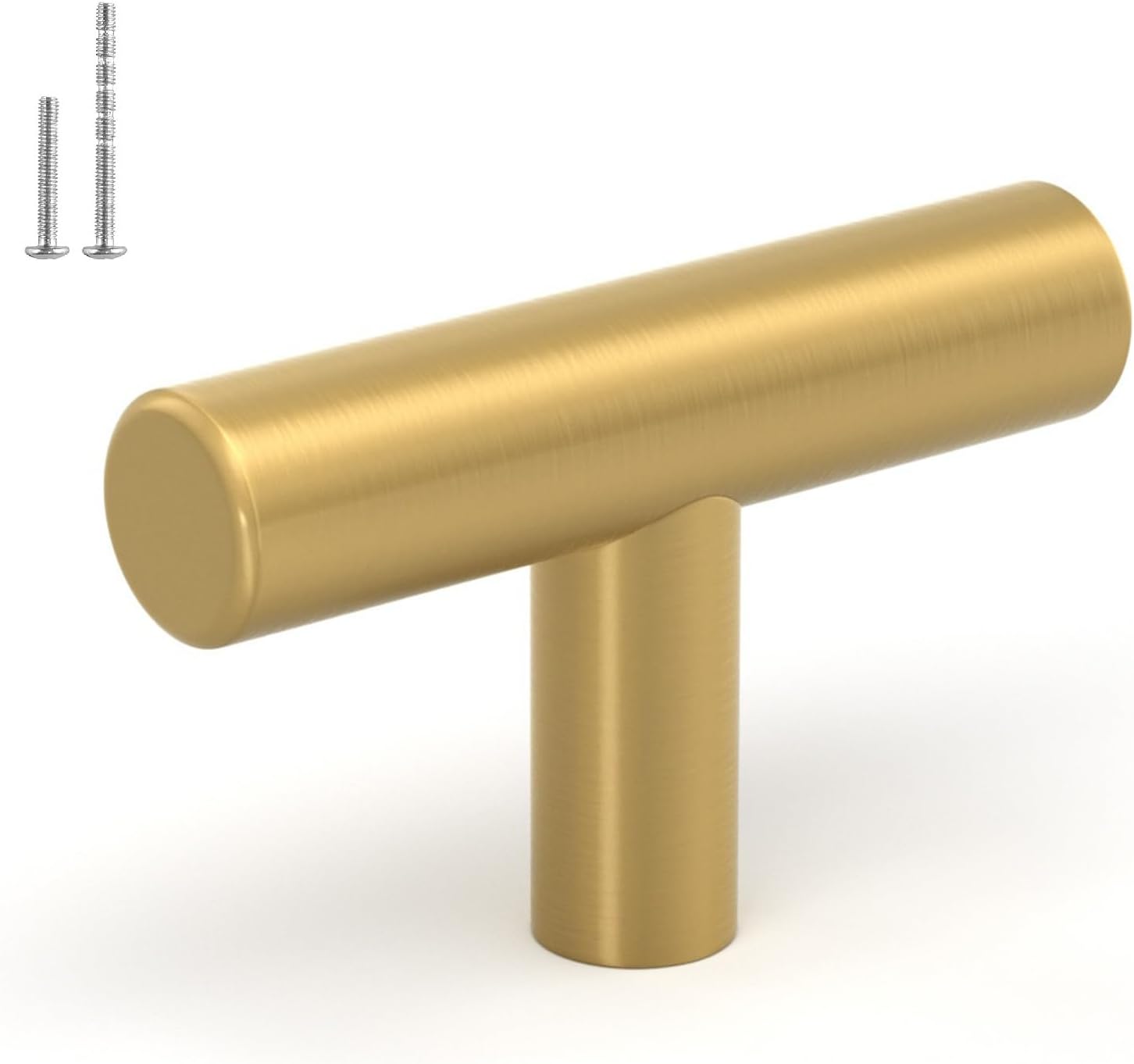 |
LONTAN 12 Pack Gold Cabinet Knobs | Made of high‑quality stainless steel. T‑Bar knob style with a sleek, modern profile. Smooth surface, comfortable grip. |
Check Price |
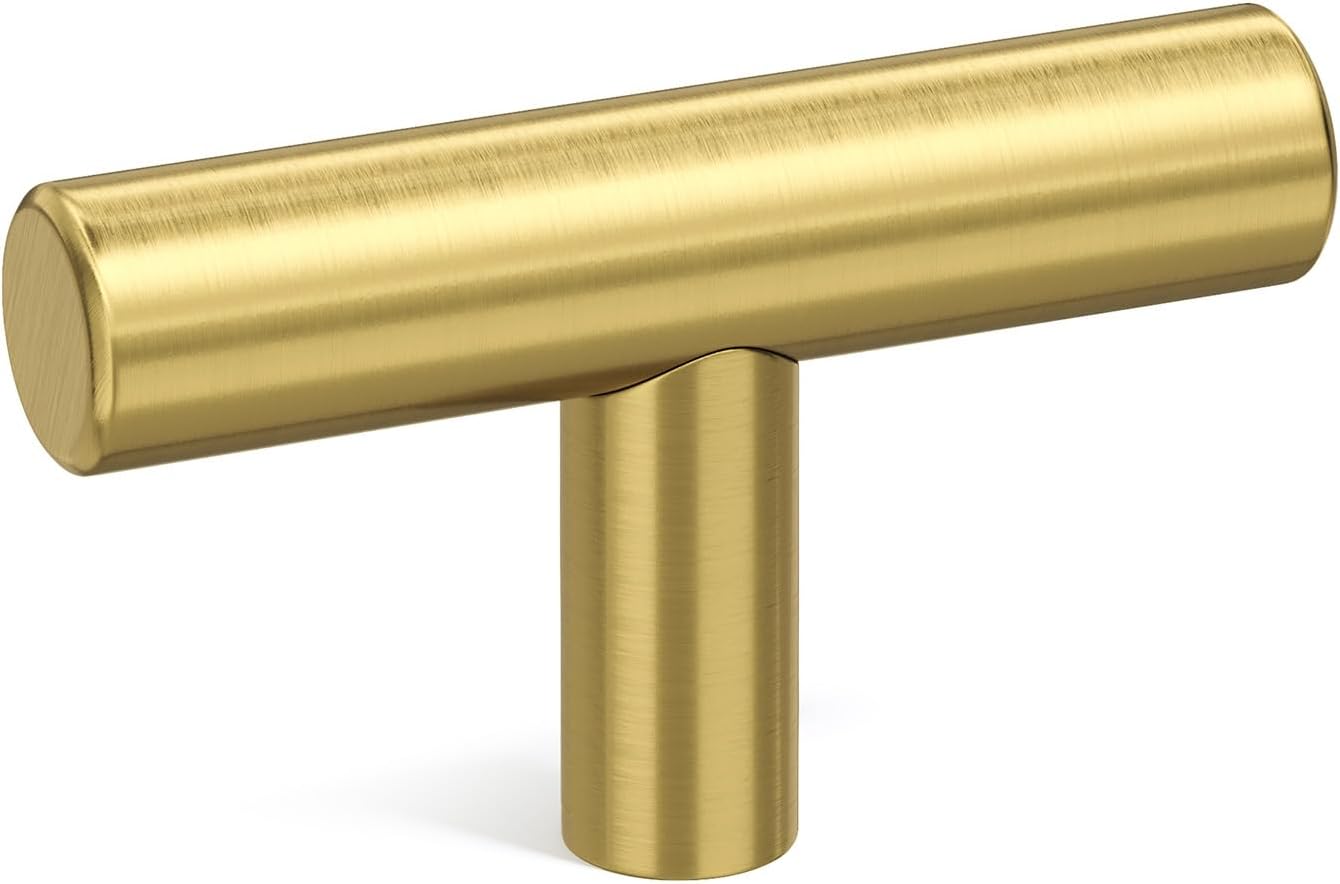 |
Goldenwarm 10 Pack Gold | Made of hollow stainless steel for durability and lightweight use. Straight bar pull with clean, minimalist lines. Brushed nickel finish for a sleek, modern look. |
Check Price |
What to Look For Before You Buy
The best knobs for white cabinets are not chosen by finish alone. Size, projection, cabinet construction, screw length, cleaning habits, and the rest of the room all change what feels like the right choice.
Start with the hole you already have
If you are replacing existing knobs, remove one and inspect the hole. A single-hole knob replacement is usually straightforward because you can reuse that mounting point. If the cabinet currently has a pull with two holes, switching to a single-hole knob leaves an unused hole that must be filled and finished properly. On painted white cabinets, a sloppy patch is easy to see.
If you are drilling new doors, use a hardware jig or template rather than measuring every cabinet from scratch. Consistency matters more than chasing an abstract “perfect” location.
On framed cabinet doors, many installers position the knob on the stile near the rail intersection; on slab doors, the placement is commonly offset a few inches from the opening edges. Whichever layout you choose, test one door visually before drilling the whole kitchen.
Diameter changes the visual weight
The featured round knobs are roughly in the one-inch to one-and-a-quarter-inch range, depending on the model. That difference sounds small. Repeated across twenty doors, it is not small at all.
A larger round face gives more visual presence and can feel easier to find with your hand. A smaller face looks quieter and may suit compact doors or a restrained design. If your cabinetry includes very wide drawers, you may prefer T-bars or pulls instead of tiny round knobs because a small dot at the center can look visually weak and provide less leverage on a heavy drawer.
Projection affects finger clearance
Projection is the distance the hardware stands away from the cabinet face. Too little clearance can make you pinch the knob rather than comfortably hook your fingers around it. More projection often improves access, but extremely projecting hardware can catch clothing in narrow walkways or feel bulky on small doors.
For this specific group, the current listings show meaningful differences. The first Ravinte round knob stands lower from the cabinet than some of the taller round options. The second Ravinte matte-black zinc model is listed with more height. Ravinte Decor’s spherical knob is also taller than its face diameter. The T-bar models project about an inch and a quarter, giving the fingers more room behind the horizontal bar.
Think about door weight and how you grip it
Most standard cabinet doors are light enough that a conventional knob works well. Wide drawers filled with pans, small appliances, or dishes demand more grip. If a drawer is heavy, a T-bar or conventional pull may be more comfortable because you can engage more than one finger.
Also think about who uses the kitchen. Someone with reduced grip strength may prefer larger hardware with more clearance. A tiny smooth sphere that looks beautiful can be frustrating if it requires a strong pinch. Texture helps some users, but deeply textured surfaces can be harder to wipe clean.
Check screw compatibility before installation day
Cabinet doors and drawer fronts are not all the same thickness. Some product packs include more than one screw length; others include breakaway screws that can be shortened at preset sections. The NIZADO listing includes two screw lengths, and the Ravinte Decor listing specifies breakaway screws. LONTAN and Goldenwarm also list multiple screw lengths with their T-bar knobs.
That’s useful, but never assume included hardware will fit every door. Measure the panel thickness from the inside surface to the front. If there is a separate drawer box plus a decorative drawer front, the screw may have to pass through more material than it would on a simple cabinet door.
Choose a finish family, not a fake exact match
Trying to match every metal in a kitchen perfectly can create more stress than harmony because “brushed brass,” “champagne bronze,” and “warm gold” are not standardized color formulas across brands. I’d rather see two intentionally related warm metals than three products that almost match but fail under real light.
A useful approach is to decide whether your room is primarily warm, cool, or high contrast. Black hardware can connect to black window frames, pendant fixtures, appliance details, or a dark faucet. Brass-toned hardware can echo lighting, a faucet, shelf brackets, or warm wood. If you mix metal families, repeat each one enough that it feels planned.
Smooth versus textured surfaces
Smooth knobs are easier to wipe quickly. A soft cloth can move over the surface without catching. Knurled hardware creates tiny recesses that improve grip and add detail, but those recesses can hold grease or dust if the knob sits close to a cooktop or busy prep area.
If you cook often and know that hardware gets touched with floury or oily hands, maintenance deserves real weight in the decision. A design you are happy to clean is better than a design you resent every Saturday.
Pack quantity should follow your cabinet count
Count doors, drawers, false fronts that will receive hardware, pantry doors, and any matching pieces on an island. Then decide whether every location truly needs the same hardware. Some kitchens use knobs on doors and T-bars or pulls on drawers; that is perfectly valid, but it changes your quantity calculation.
For a single-style project, a 30-pack can be efficient. For a smaller kitchen or mixed-hardware scheme, 10- or 12-packs may reduce leftovers. Do not use pack size as a quality signal. It is simply a project-planning variable.
Be careful with words such as “rust-proof” and “fingerprint-resistant”
Product marketing often stretches durable finishes into absolute promises. I prefer more conservative language. Zinc alloy and stainless steel are common hardware materials, and many coated finishes handle normal indoor kitchen use well, but no finish should be treated as immune to scratches, harsh chemicals, standing moisture, or abrasion.
Use mild cleaning methods, dry the hardware after wet cleaning, and avoid abrasive pads unless the manufacturer specifically says they are safe. That protects both the finish and the cabinet paint around it.
Who Should Think Twice About This Category
Cabinet knobs are not always the best answer. If you have very heavy drawers, reduced hand strength, or a strong preference for opening cabinets with a full-hand grip, longer pulls may be easier. If you are replacing existing two-hole pulls and do not want to repair the extra holes, staying with pulls that match the original spacing is usually cleaner.
You should also pause if your cabinets use an integrated finger channel, push-to-open mechanism, or a highly minimalist slab design where visible hardware would work against the intended look. And if you rent, check the lease before drilling new holes. Hardware changes can be wonderfully reversible when they reuse existing holes; they are not fully reversible once new drilling starts.
Ravinte 30 Pack 1-1/4 Inch Matte Black Euro-Style Cabinet Knobs – Strong Contrast With a Broader Round Face
This Ravinte set is the larger-faced of the two matte-black Ravinte round-knob options compared here. The product specifications identify a 30-pack of matte-black round cabinet knobs with a face diameter of about 1-1/4 inches, a base around 3/4 inch, and a height around 7/8 inch. The listing title identifies the knobs as zinc pulls, while the product overview uses the broader material label “metal.”
That slightly wider, lower profile is what makes this model an easy general-purpose starting point. Against white Shaker cabinetry, a 1-1/4-inch black circle is visible without becoming an ornament. It outlines the cabinetry clearly, yet the simple geometry does not compete with veined counters, tile backsplashes, or decorative lighting.
Key features translated into practical benefits
The approximately 1-1/4-inch face has useful visual presence. On standard cabinet doors, that diameter creates a deliberate black accent rather than a tiny dot. It is especially useful if your white doors have broad stiles or if you want the hardware to be visible from across an open-plan room. The trade-off is that the larger face can feel a little heavy on very narrow doors or tiny furniture drawers.
The roughly 7/8-inch height keeps the profile relatively compact. A lower projection can look tidy and reduces how far the knob extends into a walkway. The limitation is finger clearance: people who prefer to hook two fingers behind hardware may find a taller knob or T-bar easier to grab.
The matte-black finish creates maximum contrast with white. That gives cabinet edges more definition and can tie the room to black lighting, dark appliance trim, or a black faucet. Strong contrast also means every piece is noticeable, so uneven placement or a visibly crooked installation will stand out more than it would with low-contrast hardware.
A 30-pack suits a whole-kitchen replacement. If your count falls within the pack quantity, you can update many doors at once without mixing styles. The downside is obvious: a small vanity or compact kitchenette may leave you with more hardware than you need.
- The approximately 1-1/4-inch round face is large enough to read clearly against white cabinetry without requiring an elongated pull.
- Matte black gives crisp contrast and works especially well with white Shaker doors, flat white fronts, and kitchens that already repeat black accents.
- The compact height keeps the knob from projecting excessively into narrow circulation areas.
- A 30-pack is convenient for buyers replacing hardware across a full kitchen rather than buying several small packs.
- The single-hole format makes it straightforward to replace many existing cabinet knobs without matching two-hole spacing.
- The lower projection may not provide as much finger clearance as taller knobs or T-bar designs.
- Strong black-on-white contrast makes alignment errors and finish damage easier to notice.
- A 30-pack can be wasteful for a small project unless you want spares or plan to use the same hardware elsewhere.
- The simple round profile may feel too plain if your goal is a decorative, vintage, or highly detailed kitchen.
Who It’s Best For
This is a strong fit for homeowners who want white cabinets to look more defined with minimal visual fuss. It works particularly well for Shaker and transitional kitchens where black accents already appear elsewhere and for larger projects that benefit from a 30-piece pack.
Not Ideal For
It is less compelling if you want warm hardware, a jewelry-like decorative detail, or generous finger clearance. It is also not the most interesting choice for a kitchen that already has many black elements and needs warmth rather than more contrast.
Might Give You Pause
The main hesitation is the lower profile. A knob can be proportionally attractive and still feel small in the hand, so test one on the door you use most. Open it several times with dry hands, damp hands, and a loose grip. If your fingers keep slipping toward the cabinet face, a taller round knob or T-bar is the better answer, even if you prefer this one visually.
NIZADO Aged Brass Knobs 12 Pack – Warm, Vintage-Leaning Color With a Solid Zinc Build
NIZADO takes the design in the opposite direction from matte black. The current listing describes these 12 knobs as warm gold with an aged-brass/champagne-bronze appearance, built from heavy-duty solid zinc alloy. The listed face diameter is about 1-1/5 inches and the height about 1-1/8 inches. The pack includes two screw lengths, which broadens the range of cabinet and drawer-front thicknesses it can accommodate.
On white cabinets, that warm finish changes the mood more than the shape does. Instead of drawing a crisp dark outline around every door, the hardware introduces warmth and a slightly aged character. This is particularly useful in kitchens with creamier white paint, warm wood flooring, beige stone, walnut shelves, or lighting that already leans brass.
Key features translated into practical benefits
The warm aged-brass color softens stark white. If your kitchen feels cold or overly monochrome, a warm metal adds color without repainting anything. The limitation is matching: “aged brass,” “warm gold,” and “champagne bronze” vary across brands, so a faucet with the same marketing name may still be a visibly different shade.
Solid zinc-alloy construction gives the knob a substantial base. That can feel more solid than a thin hollow form and is well suited to daily handling. It also means you should not describe the piece as solid brass; the brass language refers to the appearance, not the core metal.
The roughly 1-1/5-inch diameter is a middle-ground size. It is large enough to look intentional on many standard doors but not so large that it dominates. On very small furniture drawers, though, it may still feel oversized compared with delicate vintage hardware.
The roughly 1-1/8-inch height provides usable clearance. Your fingers have room to get behind the knob, which can feel more comfortable than a flatter button style. That height also gives the hardware a stronger three-dimensional presence when viewed from the side.
Two included screw lengths reduce installation friction. The current listing specifies approximately 25 mm and 45 mm M4 screws. That does not guarantee compatibility with every door thickness, but it gives you more flexibility than a pack with only one short screw.
- Warm aged-brass/champagne-bronze coloring adds warmth to white cabinetry without the hard contrast of black.
- Solid zinc-alloy construction gives the knob a substantial metal body for frequent use.
- The approximately 1-1/5-inch face is versatile across many standard cabinet doors and drawer fronts.
- Taller projection provides comfortable clearance for fingers on everyday doors.
- Two supplied screw lengths make the set easier to adapt to common cabinet and drawer-front thicknesses.
- The finish may not exactly match other products labeled brass, champagne bronze, or warm gold.
- Warm metal can look too yellow or too traditional in a cool, ultra-minimal white kitchen.
- A round knob offers less leverage than a longer pull on heavy drawers.
- The 12-pack may require multiple packs for a large kitchen, increasing the importance of checking finish consistency between batches.
Who It’s Best For
This is a good match for white kitchens that need warmth and for people who prefer a classic or softly vintage metal tone rather than stark black. It is especially convincing next to warm wood, creamy stone, beige tile, or repeated brass-toned accents.
Not Ideal For
Skip it if your kitchen is intentionally icy, monochrome, or built around chrome and cool stainless tones with no other warm elements. It may also be less useful on heavy drawers where a T-bar or pull gives better leverage.
Might Give You Pause
Color matching deserves more thought than the material itself. Aged brass is not a standard swatch. Order a small enough quantity to test if possible, or hold one knob next to the faucet, lighting, and cabinet paint before committing to the whole room. If the metals are different but related, repeat the difference intentionally; if they look like a failed attempt at an exact match, the result can feel accidental.
Ravinte Decor 12 Pack Champagne Bronze Cabinet Knobs – A Softer Warm-Metal Look With a Compact Spherical Shape
The Ravinte Decor 12-pack is a more restrained warm-metal option than the NIZADO set. Its current listing identifies the finish as champagne bronze, the construction as zinc, and the style as modern. The listed knob diameter is about 0.95 inch, the height about 1-1/6 inch, and the base about 0.9 inch. The same listing describes solid zinc-alloy construction and includes breakaway screws that can be shortened for different panel thicknesses.
That combination gives the knob a small face but a relatively tall profile. Visually, it is lighter on white cabinetry than the larger NIZADO knob. Tactilely, it still stands far enough from the door to give your fingers room. If you like warm hardware but do not want every cabinet door to look heavily decorated, that balance is useful.
Key features translated into practical benefits
Champagne bronze is a softer warm finish than bright gold. On white cabinets it can add warmth without creating the sharper yellow note that some polished gold finishes produce. The caution is consistency: champagne bronze is a manufacturer-specific color description, so do not assume it will be identical to another brand’s faucet or light fixture.
The roughly 0.95-inch diameter keeps the face compact. That makes it visually tidy on narrow doors, small drawers, and furniture-like cabinet sections. It can look too delicate on a very wide drawer, especially if the drawer carries a lot of visual weight.
The height is greater than the face diameter. The listed height of about 1-1/6 inch means the knob projects enough to give fingers clearance despite the smaller face. That is a practical advantage for a minimalist-looking knob because it does not have to sit almost flush to appear refined.
The zinc-alloy body is suited to everyday hardware use. A solid metal body should feel more substantial than a very thin shell. The exterior finish still needs care; avoid treating “solid zinc alloy” as a promise that the visible bronze color cannot scratch or change.
Breakaway screws make installation more adaptable. These screws are designed so excess length can be removed at set points, which is helpful when cabinet fronts differ in thickness. They still need to be shortened carefully, and it is smart to protect the threads while breaking or trimming them so the screw starts cleanly in the knob.
- Champagne bronze adds warmth to white cabinets with less visual heaviness than black and less yellow intensity than some gold finishes.
- The compact face works well on narrow cabinet stiles, small doors, and furniture-style cabinetry.
- The taller profile provides more grip clearance than the small face might suggest.
- Zinc-alloy construction gives the knob a solid metal base for routine cabinet use.
- Breakaway screws offer useful installation flexibility across different panel thicknesses.
- The compact diameter can look under-scaled on oversized drawers and tall pantry doors.
- Champagne bronze from one brand may not match similarly named finishes from another manufacturer.
- A smooth spherical shape can be less secure for wet or greasy hands than a textured knob or T-bar.
- Breakaway screws are convenient, but trimming them adds a small installation step and can damage threads if done carelessly.
Who It’s Best For
This model suits white kitchens that need a quiet warm-metal accent rather than a bold statement. I’d consider it for transitional, soft-modern, and warm minimalist spaces where brass lighting or wood tones are present but the hardware should stay visually compact.
Not Ideal For
It is less suitable for broad heavy drawers, for users who need a full-hand grip, or for rooms where the hardware needs to be a strong decorative focal point. It is also a risky blind buy if you must exactly match an existing champagne-bronze fixture from another manufacturer.
Might Give You Pause
The small face is the detail to test. In close-up photography it looks balanced, but a kitchen is viewed from several feet away. Tape a paper circle about the same diameter onto one upper door and one lower drawer before ordering. If it disappears visually, a larger round knob or a T-bar will make more sense.
Asidrama 10 Pack Matte Black Knurled Cabinet Knobs – Texture and Grip for a More Industrial Look
The Asidrama option is the most tactile product in the group. Its current listing identifies zinc-alloy construction with a matte-black finish, a roughly 1-inch diameter, a base around 0.78 inch, and a height around 1.1 inches. The defining feature is the knurled surface, which creates a ridged texture rather than the smooth face used by the Ravinte black knobs.
On white cabinets, that texture changes the effect in two ways. From a distance, you still get black-and-white contrast. Up close, the ridges make the hardware feel more engineered and less generic. That can be a good fit for modern, industrial, contemporary, or mixed-material kitchens with black metal shelving, dark lighting, or ribbed details.
Key features translated into practical benefits
Knurling improves tactile feedback. Your fingertips meet ridges instead of a slick surface, which can help the knob feel more secure in the hand. The trade-off is cleaning: fine grooves can hold dust, flour, and grease more readily than a smooth knob.
The approximately 1-inch face is compact. It does not dominate the door, so the texture becomes a close-up detail rather than a large decorative shape. On broad drawers, though, a one-inch round knob may not provide enough visual or mechanical leverage.
The roughly 1.1-inch height gives the fingers clearance. This helps balance the smaller diameter, because the knob is easier to catch from the side. More stand-off also makes the textured edge easier to engage rather than forcing you to pinch the front face.
Zinc-alloy construction is a solid everyday choice. It gives the knob a metal body and supports the crisp machined look of the knurled surface. As with the other coated black hardware here, the finish should be cleaned gently to preserve the appearance.
Individual packaging can reduce transit contact. The current listing says the knobs are individually packaged. That is useful for a dark finish because rubbing between pieces during shipping can be especially visible on black surfaces.
- Knurled texture gives better tactile feedback than a completely smooth round knob.
- Matte black creates clear, modern contrast against white doors and drawers.
- The roughly 1.1-inch height offers useful finger clearance despite the compact face.
- Zinc-alloy construction supports a substantial, machined feel.
- Individual packaging can help protect the textured black surfaces before installation.
- Grooves take more effort to clean than a smooth knob, especially near cooking zones.
- The industrial texture may look out of place in a soft cottage, ornate traditional, or delicate vintage kitchen.
- A roughly 1-inch face can feel visually small on wide drawers or large pantry fronts.
- Matte black finish wear is easier to notice if a high point on the knurling gets scratched.
Who It’s Best For
This is the most convincing choice in the group for a modern white kitchen that needs texture rather than ornament. It is useful for people who like black hardware but find plain round knobs too basic, and for users who appreciate a more tactile grip.
Not Ideal For
It is not ideal if you want the easiest possible cleaning routine or if the room leans traditional and soft. It is also not the first choice for heavy drawers, where a longer bar gives more leverage.
Might Give You Pause
The texture is both the reason to buy it and the reason to hesitate. If your cabinet hardware gets greasy quickly, imagine cleaning each groove rather than wiping one smooth curve. A soft brush can help, but if that extra maintenance already sounds irritating, choose a smooth black option instead.
LONTAN 12 Pack Gold Drawer Knobs, Brushed Brass T-Bar Knobs – A Slim Horizontal Grip for Drawers and Doors
The LONTAN hardware is not a conventional round knob even though it mounts through a single hole. It uses a T-bar shape made from stainless steel with a brushed-brass finish. Current product information lists an overall length of about 2 inches, a height/projection around 1.25 inches, and a bar diameter around half an inch. The 12-pack includes mounting screws in more than one length.
This shape matters more than the finish. A two-inch horizontal bar gives you a wider target than a one-inch round knob. You can hook one or two fingers around an end, which often feels easier on drawers. Visually, it creates a tiny line rather than a dot, helping flat white cabinet fronts look more structured and contemporary.
Key features translated into practical benefits
The T-bar creates a broader gripping area. Rather than pinching a sphere, you can catch the horizontal bar from either side. That can be more comfortable on frequently used drawers, although it still does not provide as much leverage as a longer two-screw pull.
The roughly 2-inch overall length makes the hardware visually directional. On white drawers, the bar can echo longer cabinet pulls without requiring a second mounting hole. The limitation is alignment: because a T-bar can rotate if it loosens, a crooked bar is more obvious than a round knob.
Stainless-steel construction keeps the body relatively light and practical. The product is described as hollow but sturdy, which means it is not trying to imitate the heavy feel of a solid cast knob. Some buyers prefer that lighter construction; others equate weight with a more premium feel and may be disappointed.
The brushed-brass surface adds warmth without a mirror-like shine. Brushing reduces glare and generally looks softer against white than polished gold. It can still differ from other brass finishes in the room, so sample matching remains important.
Multiple included screw lengths make replacement easier. That is useful for mixing cabinet doors and drawer fronts in one project. Measure first, because a decorative drawer front attached to a drawer box may need more screw length than a standard door.
- T-bar shape provides more horizontal gripping surface than a small round knob.
- The 2-inch length gives white drawers a more linear, contemporary look while still using one mounting hole.
- Brushed brass warms white cabinetry without the glare of a polished gold surface.
- Stainless-steel construction is practical for everyday indoor cabinet use.
- Multiple screw lengths improve the odds of fitting both doors and common drawer-front thicknesses.
- Hollow construction may feel lighter than buyers expecting a heavy solid-metal knob.
- The bar can look visibly crooked if the mounting screw loosens and the knob rotates.
- A T-bar end can catch loose clothing more readily than a smooth round knob in a tight aisle.
- The brushed-brass tone may not exactly match other warm-metal fixtures, even if the names sound similar.
Who It’s Best For
LONTAN is a strong option for white drawers and cabinet doors where you want more grip than a round knob but do not want to drill a second hole for a pull. It suits modern, transitional, and warm contemporary kitchens particularly well.
Not Ideal For
It is less attractive for ornate traditional doors or for narrow walkways where projecting T-bar ends may snag clothing. If you want a weighty, cast-metal feel, the hollow stainless construction may also seem too light.
Might Give You Pause
Rotation is the practical issue to think about. A round knob can turn slightly and you may never notice; a T-bar that rotates five degrees looks wrong immediately. Install it firmly without over-tightening the cabinet face, and check the bar after the first week of use. If it shifts, a careful retightening usually matters more than simply forcing the screw harder on day one.
Goldenwarm 10 Pack Gold Cabinet Knobs, Brushed Brass – A Similar T-Bar Idea in a Smaller Pack
Goldenwarm’s featured 10-pack shares the same basic T-bar idea as LONTAN. The current listing identifies stainless-steel construction, a brushed-brass color, a 2-inch overall length, and a projection around 1-1/4 inches. It also describes the body as hollow but sturdy and supplies two common mounting-screw lengths.
That makes Goldenwarm less of a completely different hardware concept and more of an alternative pack configuration and brand choice within the same general form. If you like the look of a small gold bar on white cabinetry, the real decision is likely to come down to pack quantity, finish tone in your room, how the bar feels in your hand, and which set matches the cabinet count more efficiently.
Key features translated into practical benefits
The 2-inch T-bar gives fingers more to grab. This can be more pleasant than a tiny round knob on drawers used throughout the day. It is still compact hardware, so very heavy drawers may benefit from a longer pull.
About 1-1/4 inches of projection creates generous clearance. Your fingers can get behind the bar instead of scraping the painted cabinet face. The downside is that projecting hardware is easier to bump or catch in a narrow aisle.
The brushed-brass color adds a warm line across white cabinet fronts. Because the shape is narrow, the warm metal feels crisp rather than ornate. This is useful in modern kitchens where you want gold warmth without a decorative mushroom knob.
Stainless-steel construction keeps the form simple and light. The listing’s hollow construction reduces material mass while retaining the bar shape. That makes the hardware easy to handle during installation, but it may not satisfy someone who specifically wants the heft of solid cast hardware.
The 10-pack can fit smaller projects efficiently. A ten-piece set can be a better match for a vanity, island, coffee station, or compact kitchen than a 30-pack. A larger kitchen will need multiple packs, so count carefully and consider keeping one spare.
- Horizontal T-bar shape offers an easy finger catch on doors and drawers.
- Approximately 1-1/4 inches of projection gives comfortable clearance from the cabinet surface.
- Brushed-brass coloring provides a warm accent against white without high-gloss reflection.
- Stainless-steel construction is suitable for normal indoor cabinet hardware use.
- A 10-pack can reduce leftovers on smaller projects compared with a large bulk set.
- Hollow construction can feel less substantial than a solid zinc-alloy knob.
- Small pack size means a full kitchen may require several packs and careful batch checking.
- T-bars can rotate out of level if the mounting connection loosens.
- The projecting ends are more likely to snag clothing than a smooth round knob.
Who It’s Best For
This set works for smaller white-cabinet projects or mixed-hardware schemes where you want brushed-brass T-bars on selected drawers. It also suits anyone who prefers a linear modern accent but wants to reuse a single existing knob hole.
Not Ideal For
It is less suitable if you want a heavy solid feel, if your kitchen has very tight walkways, or if your drawer fronts are so wide and heavy that a small T-bar does not provide enough leverage.
Might Give You Pause
LONTAN and Goldenwarm are close enough in concept that buying by product photo alone is not useful. Compare the actual number of pieces you need, the listed dimensions, and a sample of the finish if possible. The “better” choice is the one that fits your cabinet count and room tone with the least compromise, not the one with the more dramatic listing photo.
Comparing the Seven Options
These products fall into three functional groups: smooth black round knobs, warm-metal round knobs, and brushed-brass T-bars. That is a more useful way to compare them than pretending all seven solve exactly the same problem.
If you want crisp black-and-white definition
Start with the Ravinte matte-black round knobs. It has the broader face and lower profile, so it looks stronger on the cabinet and sits closer to the door.
Choose the Asidrama instead if you want black hardware with tactile texture. Its knurling makes it look more industrial and can provide a more secure feel, but it asks more from you during cleaning.
If you want warmth without a T-bar shape
NIZADO is the more substantial warm round knob in this group. Its aged-brass/champagne-bronze tone and larger face suit classic, transitional, and warmly layered kitchens. Ravinte Decor is smaller and more restrained, with a champagne-bronze finish and compact spherical face.
If the room already has strong veining, patterned tile, or decorative lighting, the smaller Ravinte Decor can be a smart choice because it does not compete. If the hardware itself needs more presence, NIZADO makes the stronger visual statement.
If grip matters more than a traditional round shape
LONTAN and Goldenwarm are the two T-bar choices. Both create a wider finger catch and a linear look while still using a single mounting point. They make particular sense on drawers or flat-panel doors where a tiny circle feels too delicate.
Their main trade-offs are also similar: projecting bar ends can catch clothing, hollow construction feels lighter than solid cast hardware, and the bar needs to stay level. Pack size is one of the practical differences, with LONTAN featured here as a 12-pack and Goldenwarm as a 10-pack.
If your kitchen has large pantry doors or wide drawers
None of these small single-hole pieces should be chosen automatically. The broader Ravinte round knob or a T-bar will usually look more balanced than a tiny sphere, but a truly wide or heavy drawer may still be better served by a longer pull outside this product set. The fact that an item fits the hole does not mean it is ergonomically right for the load.
If you are trying to coordinate with existing fixtures
Black is relatively easy to coordinate because small tonal differences between matte blacks are often less noticeable than differences between warm metals. Warm finishes require more care. NIZADO’s aged brass, Ravinte Decor’s champagne bronze, and the brushed-brass T-bars are three distinct finish descriptions. Treat them as related families, not interchangeable exact matches.
A Few Real-World Scenarios
A white Shaker kitchen with black lighting and stainless appliances
The first Ravinte 1-1/4-inch matte-black round knob is the easiest fit if you want the hardware to repeat the black lighting and outline the Shaker doors. If you prefer a smaller visual dot with more clearance, use the second Ravinte black model. Asidrama makes sense if the lighting or shelving already has an industrial texture and you want the hardware to echo it.
The stainless appliances do not force you into silver hardware. Appliances are large functional surfaces; cabinet hardware can act as an accent. Black works best here if it appears in more than one place so the contrast looks deliberate.
A creamy white kitchen with warm oak floors and brass pendants
NIZADO or Ravinte Decor is the natural comparison. NIZADO gives the cabinet face more visual weight and a warmer, vintage-leaning note. Ravinte Decor stays quieter and may suit a cleaner transitional room.
Before ordering the full quantity, compare a sample next to the pendant finish. If the two warm metals are different, decide whether they are intentionally different. A slightly aged brass next to a softer champagne bronze can work; two nearly identical golds that clash under evening light are harder to ignore.
A small rental kitchen with existing single knob holes
If the lease allows hardware swaps and the original knobs can be stored safely, Goldenwarm or LONTAN can change the look without drilling a second hole. The T-bar gives a more contemporary appearance and is easy to reverse later. For a simple black update, one of the Ravinte round styles may be even safer because round knobs are less likely to snag in a compact galley.
Keep every original screw and knob in a labeled bag. Then the update is truly reversible rather than “reversible if I can remember where I put the old hardware.”
Alternatives Worth Knowing About
Other hardware approaches are worth understanding before you commit, especially if a single-hole knob does not suit the way your cabinets are built or used.
A longer two-hole pull gives more leverage on wide or heavy drawers and can be easier for people with limited grip strength. The drawback is installation: you need two accurately spaced holes, and replacing existing hardware means matching or repairing the old spacing.
Cup pulls create a more traditional or farmhouse look and give fingers a broad underside to grip. They also occupy more visual space and are less neutral than a simple round knob.
Integrated edge pulls and finger channels suit very clean slab cabinetry. They reduce the visual punctuation of visible knobs, but they can require different door construction or precise installation.
Push-to-open hardware removes visible handles entirely. That can create a very minimal front, but it changes how the cabinet functions and may be less convenient in a busy kitchen where hands are wet, floury, or full.
The point is not that one of these approaches is better. It is that a cabinet knob should solve the physical opening task first and the styling task second. If a small single-hole knob makes a heavy drawer awkward, a different hardware type is the more sensible choice.
How to Install Cabinet Knobs and Get the Most From Them
A hardware swap is one of the more approachable kitchen projects, but the easy part is turning a screw. The part that deserves care is choosing the position, protecting the painted surface, and making sure every piece ends up aligned. White cabinets show pencil marks, chipped paint, and crooked hardware quickly, so a slow first door is better than a rushed whole kitchen.
1. Count, sort, and inspect the hardware before removing anything
Open every pack and confirm that you have enough knobs for the project. Sort the knobs by finish and shape, and set aside any piece with a visible scratch, unusual color shift, damaged thread, or bent bar. Then match the included screws to your cabinet thickness rather than assuming one screw works everywhere.
This is especially useful with the warm-metal sets because finish tone can look different under room lighting. Place several pieces together on a white towel and check them in daylight. If a noticeable variation exists, you want to discover it before half the kitchen is installed.
2. Remove one existing knob and measure the cabinet front
Take off a knob from a typical door and another from a typical drawer. Measure the panel thickness where the screw passes through. A door may be straightforward, while a drawer can have a separate decorative front attached to the drawer box, creating a thicker assembly.
Keep the old screw until the new hardware is fully installed. It gives you a useful reference for thread length and prevents a simple replacement project from stopping because the new screw is unexpectedly short.
3. Test the new knob in the existing hole
Install a single new knob on the most frequently used door. Do not tighten it aggressively yet. Check how it feels with your fingers, whether the base covers any old paint marks around the hole, and whether the projection is comfortable.
Then step back several feet. A knob can feel right in your hand but look too small or too dominant from across the room. Testing one piece is especially important if you are moving between the larger Ravinte round knob, the smaller Ravinte Decor sphere, or one of the T-bars.
4. If you are drilling new holes, make a repeatable template
Use a cabinet-hardware jig, purchased template, or carefully made drilling guide. Mark one reference position, verify it on the door, then use the same guide for every matching door. On framed doors, a common approach is to align the knob near the meeting point of the stile and rail; on slab doors, consistent offsets from the opening edges create a clean rhythm.
Before drilling, place painter’s tape over the mark. The tape gives you a visible surface to mark and can help reduce minor finish splintering. Measure twice, compare the location to neighboring doors, and only then drill.
5. Drill cleanly and support the back of the panel
Use the drill bit size appropriate for the screw supplied with the hardware. Hold the drill square to the cabinet face so the screw passes straight through rather than entering the knob at an angle. If possible, support the back of the drilling area with scrap wood to reduce breakout as the bit exits.
Drill steadily rather than forcing the bit. White painted doors can show chipped edges around a new hole, so sharp tooling and controlled pressure matter. If you are uncomfortable drilling finished cabinetry, this is a sensible point to bring in a carpenter or installer rather than learning on the most visible door in the room.
6. Install the knob snugly, not brutally
Insert the screw from inside the cabinet and thread the knob onto it by hand. Once the threads are engaged, hold the knob in its final orientation and tighten from the inside. Stop when the hardware is secure and the base sits flat.
Over-tightening can compress softer cabinet materials, damage paint around the base, distort a hollow T-bar, or make future removal more difficult. A secure connection does not require maximum force. For LONTAN and Goldenwarm T-bars, keep the bar level while tightening because its orientation is visible.
7. Align the entire run before declaring the job finished
Stand at the end of the kitchen and look across several cabinet fronts at once. Round knobs are forgiving about rotation, but their vertical and horizontal placement still needs to line up. T-bars demand an extra check because each bar should appear level and consistent with its neighbors.
Then open every door and drawer. Listen for rubbing, feel for loose movement, and confirm that long screws do not protrude into a place where hands or stored items can catch them. Once that’s done, keep a small bag containing spare hardware, screw information, and the product name somewhere you can actually find later.
Maintenance and Care for Cabinet Knobs
Cabinet hardware lives in a difficult little zone. It gets skin oils, cooking residue, steam, cleaning spray, and repeated friction, yet it is often cleaned less carefully than the countertop around it. A simple routine protects both the finish and the cabinet paint.
Use the mildest cleaning method that works
For ordinary fingerprints and dust, start with a soft damp microfiber cloth. If grease is present, use a small amount of mild dish soap diluted in water, then wipe again with a clean damp cloth. Dry the knob rather than leaving water sitting around the base.
Avoid abrasive pads, powdered cleaners, and strong solvents unless the hardware manufacturer explicitly approves them. Those products may clean quickly but can change the sheen of brushed finishes or wear through a coating at high-contact edges.
Clean around the base, not just the grip
Residue often builds where the knob base meets the painted cabinet surface. That ring is easy to miss and especially visible on white paint. Use a soft cloth wrapped around a fingertip or a cotton swab with mild solution, taking care not to flood the screw hole.
For the Asidrama knurled knob, use a soft dry toothbrush or detailing brush to lift dust from the grooves. Follow with a lightly damp cloth if needed, then dry the surface. A metal brush is unnecessary and can be too aggressive for the finish.
Retighten hardware that starts to rotate
Any single-hole knob can loosen after repeated use. Round knobs may rotate without looking wrong, while T-bars reveal looseness immediately because the bar tilts. If you notice movement, hold the knob in the correct position and tighten the mounting screw from inside the cabinet.
Do not solve repeated loosening by applying excessive force. First check whether the screw length is appropriate and whether the hole in the cabinet has become enlarged. If the substrate is damaged, a proper repair may be needed before the hardware will stay secure.
Protect spare pieces
Store spare knobs individually wrapped rather than tossing them into a drawer with screws and tools. Black finishes can show scratches, and warm brushed finishes can pick up marks from rubbing against harder metal. Label the bag with the room and exact product name so a future repair does not turn into a guessing exercise.
Common Mistakes to Avoid With Knobs for White Cabinets
Mistake 1: Choosing the finish from a screen instead of the actual room
Buyers do this because product photography makes finish comparison feel precise. It is not. Screen brightness, editing, daylight, cabinet undertones, and bulb color all change what a warm metal looks like.
Instead, test a real sample against one cabinet door. Look at it in daylight and after the kitchen lights come on. This is especially important for NIZADO, Ravinte Decor, LONTAN, and Goldenwarm because all four live in the warm-metal family but do not use the same finish name or construction.
Mistake 2: Treating every “gold” or “brass” label as the same color
The mistake happens because retailers group finish names loosely. Aged brass, brushed brass, warm gold, and champagne bronze may sit next to one another in search results while looking noticeably different in person.
Instead, coordinate by undertone and repetition. If your pendant lights are a deep aged brass, a softer champagne knob can still work if the difference looks intentional. Do not force an exact-match story that the products themselves do not support.
Mistake 3: Ignoring projection until after installation
A buyer sees the face diameter and assumes that tells the whole size story. It doesn’t. Two knobs with similar faces can feel completely different if one sits close to the door and the other gives your fingertips more clearance.
Instead, compare height or projection alongside diameter. The two Ravinte black options demonstrate why this matters: one has a broader, lower profile, while the other is smaller across the face and taller from the cabinet.
Mistake 4: Using a tiny round knob on a heavy wide drawer
This usually happens because people want one hardware style everywhere. Visually uniform hardware can be attractive, but a wide drawer full of cookware asks more from the hand than a light upper cabinet door.
Instead, judge function by location. A T-bar may improve grip while preserving a single-hole installation, and a longer pull outside this fixed product group may be even better for especially heavy drawers. Uniformity is not worth uncomfortable daily use.
Mistake 5: Drilling the whole kitchen before testing one door
Once the first mark is measured, it is tempting to repeat it everywhere. A small placement error then becomes twenty matching errors. White cabinet fronts make those mistakes obvious because the surface is visually clean.
Instead, install one sample, close the door, view it from multiple angles, and compare it with the neighboring drawer. Then make the template. Testing first costs minutes; correcting a full run can cost hours.
Mistake 6: Over-tightening hollow T-bars
A hollow stainless-steel T-bar is sturdy in normal use, but it does not benefit from being crushed against the cabinet face. Buyers over-tighten because they want to prevent rotation.
Instead, tighten until the base is secure, then recheck it after normal use. If it loosens repeatedly, investigate screw fit rather than simply increasing force. The same approach protects the cabinet paint and substrate.
Mistake 7: Cleaning hardware with whatever is already in the spray bottle
Kitchen cleaners are designed for different surfaces. A product that works on a counter or stainless appliance may be unnecessarily harsh for a decorative cabinet finish.
Instead, begin with mild soap, water, and a soft cloth. Stronger chemistry should be used only if the hardware maker confirms compatibility. That keeps matte black, brushed brass, and champagne-bronze surfaces looking closer to their original sheen.
Mistake 8: Ordering the exact cabinet count with no spare
It feels efficient, especially on a budget. The problem appears later when one knob is damaged, a screw thread strips, or you add a cabinet and discover the finish has changed or the model is hard to find.
Instead, keep at least one matching spare when the pack quantity allows it. Store it safely with its screws and label. That small bit of planning is far more useful than relying on a product name you may not remember in three years.
Safety Notes for Installation and Everyday Use
Cabinet knobs are low-risk products in normal use, but installation involves drilling, sharp bits, finished surfaces, and sometimes awkward working positions. Wear eye protection while drilling, especially when working overhead or into material that can chip. Keep hands behind the drilling path and clamp or support removable panels rather than holding them near the bit.
Check for wiring, plumbing, or other hidden components before drilling into any unusual built-in panel. Standard cabinet doors and drawer fronts are normally straightforward, but a decorative panel attached near an appliance or utility run deserves extra attention.
After installation, make sure screws do not protrude dangerously into drawer interiors or cabinet spaces where hands reach blindly. T-bars should also be checked in narrow walkways. If a projecting end repeatedly catches clothing, changing the hardware is safer and less frustrating than simply learning to avoid it.
Frequently Asked Questions About the Best Knobs for White Cabinets
What color knobs look good on white cabinets?
Matte black gives the strongest contrast, while aged brass, brushed brass, and champagne bronze add warmth. The better choice depends on the undertone of the white paint and the other finishes in the room. Test warm metals in your actual kitchen because the same knob can look softer under warm bulbs and more yellow against a cool white door.
Should cabinet knobs match the faucet exactly?
No. Exact matching is difficult because finish names are not standardized across manufacturers. A more reliable approach is to keep the metals related by undertone and repeat them intentionally, so a brass-toned knob can sit comfortably with a slightly different warm-metal faucet if the room supports both.
Are knobs or T-bars easier to use on drawers?
A T-bar usually gives you more horizontal surface to catch with your fingers, which can be helpful on frequently used drawers. A round knob is compact and simple, but it provides less leverage on a heavy drawer. For very wide or loaded drawers, a longer pull may be more comfortable than either option.
How large should a knob be on a white cabinet door?
There is no single size that fits every door. Around one inch to one and a quarter inches is common territory for many standard knobs, but door width, stile width, projection, and visual style all matter. Tape a paper circle matching the proposed diameter to the door and view it from across the room before deciding.
Does matte black hardware show fingerprints?
A matte surface generally makes ordinary fingerprints less reflective than a polished metal, but it is not maintenance-free. Oils, flour, grease, and cleaning residue can still build up. Wipe black hardware with a soft damp cloth and mild soap rather than relying on abrasive cleaners.
Is zinc alloy a poor choice for cabinet knobs?
Not inherently. Zinc alloy is widely used in decorative hardware because it can be cast into precise shapes and provides a solid metal body. What matters to the buyer is the quality of the construction and surface finish, plus how the hardware is cleaned and used. Do not confuse a brass-colored finish over zinc with solid brass construction.
Can I replace a two-hole pull with one of these single-hole knobs?
You can physically install a single-hole knob, but the unused pull hole must be repaired. On painted white cabinetry, that patch can be obvious unless it is filled, sanded, primed, and color-matched carefully. If you do not want paint repair, choose hardware that uses the existing hole pattern instead.
How do I stop a T-bar knob from turning crooked?
Hold the bar level while tightening the screw from inside the cabinet. Tighten it snugly without crushing the cabinet face or hollow hardware. If it loosens repeatedly, check that the screw is the right length and that the cabinet hole has not widened rather than simply applying more force.
Choosing the Right Knobs for White Cabinets Without Overcomplicating It
The most useful decision is not “black or gold?” in isolation. Start with how the cabinet feels in your hand, then use finish and shape to support the room. If you want clear definition and simple styling, the broader Ravinte 1-1/4-inch matte-black round knob is the easiest all-purpose choice among these seven. If you want a smaller black profile with more finger clearance, the second Ravinte model makes more sense, while Asidrama adds texture for a more industrial direction.
For warmth, NIZADO gives you the fuller aged-brass look and a substantial zinc-alloy body. Ravinte Decor is quieter and smaller, which can be useful in a soft-modern kitchen. LONTAN and Goldenwarm shift the grip entirely with their brushed-brass T-bars, making them worth considering for drawers or for anyone who prefers a small horizontal handle over a round button.
That is the way I’d approach the best knobs for white cabinets: choose for the cabinet you actually have, the hand that will open it, and the light that hits it every day. Compare the listed sizes, test one piece before drilling or replacing the whole room, and check the latest product details before you commit to the full quantity.