Scandinavian bedrooms rarely depend on one dramatic feature. What makes them feel restful is the way several quiet choices work together: a restrained colour palette, furniture that leaves room to move, soft natural texture, useful lighting, and enough empty space for the eye to settle. The result can look simple, but good simplicity is usually very deliberate.
The part I like most about Scandinavian bedroom design is that it encourages you to work with what already serves the room. An older wooden bedside table can be cleaned and refinished instead of replaced. A plain white duvet can become the base for richer texture. A woven basket, an old ceramic vase, or a simple framed print can feel completely at home once the rest of the room is edited with care.
A bedroom also has to function when the styling photographs are over. You need somewhere to put a book, store clothes, charge a phone, soften morning light, and feel comfortable at night. That practical side is what keeps Scandinavian style from turning into an empty white room with nowhere to put anything.
Decide What the Bedroom Needs to Feel Like
Before changing colours or buying furniture, decide what you want the bedroom to do emotionally. Most Scandinavian bedrooms lean toward calm, softness, and clarity, but those words can mean different things in different homes. A bright city bedroom may need visual quiet after a busy day, while a darker room may need lighter surfaces and more reflective elements to stop it feeling heavy.
Look at the room at the times you use it most. Morning light can reveal that a cool grey wall feels colder than expected, while evening lighting may show that a white bedroom needs warmer lamps and more texture. I would make those observations before choosing a new palette, because the same beige, white, or wood tone can behave very differently depending on the direction of the windows and the type of bulbs you use.
It also helps to define one or two priorities. If sleep is the main goal, keep visual stimulation low and invest your attention in bedding, window treatments, and lighting. If the bedroom doubles as storage for a small home, make concealed storage part of the plan from the beginning rather than adding boxes wherever they happen to fit later. If the room needs to feel larger, furniture scale and clear floor area matter more than decorative objects.
Scandinavian design is often described as minimal, but I don’t think minimal should mean deprived. The better aim is intentional. Keep the things that support comfort, routine, or character, and reduce the things that make the room harder to use or visually noisy. That approach is kinder to your budget as well because you can often edit, move, refinish, and reuse before you buy anything new.
Edit the Room Before You Buy Anything New
A bedroom can look much more Scandinavian after a careful edit even if the furniture stays exactly the same. Clear the tops of dressers and nightstands, remove bedding layers that do not work together, and collect small accessories into one place so you can see how much visual weight they create. This is where the room usually tells you what it actually needs.
Instead of throwing unwanted pieces away immediately, ask whether they could work differently. A dark bedside table may suit the room after sanding and a lighter finish. An old bench can move to the foot of the bed once the upholstery is simplified. A mismatched pair of lamps can sometimes look more intentional if the shades are replaced with similar neutral ones. Even a slightly dated picture frame can be reused if the artwork and surrounding colours feel right.
I would also pay attention to storage clutter that is technically hidden but constantly escaping. If clothes pile on a chair every evening, the problem is not that you need a more decorative chair; the room needs a better landing place. A basket, a few wall hooks, or a bench with storage may solve more than another piece of styling. Scandinavian interiors feel calm partly because practical routines have somewhere to go.
Once the room is reduced to the things that matter, you can see real gaps. Perhaps the bedside lamp is too harsh, the rug is too small, or the curtains block too much light. Those are useful purchases because they improve function and atmosphere. Buying decor first usually works in reverse: you add more objects and still have the same lighting, storage, or layout problem underneath.
Choose a Limited Material Palette and Repeat It
Scandinavian bedrooms often feel cohesive because a small family of materials repeats across the room. Light oak or ash tones may appear in the bed, nightstands, shelf, and picture frames. Linen-like fabric can repeat in curtains, bedding, and cushion covers. Woven texture may appear in a rug, basket, or pendant shade. Repetition makes a room feel considered without demanding matching furniture sets.
You do not have to replace furniture to create this effect. If you already own several wood pieces in different finishes, you can decide which ones deserve to remain visible and which could be painted, refinished, or moved elsewhere. Sometimes leaving one darker wood piece gives the room useful depth. I’d rather see a thoughtful mix of old and new than a bedroom where every item has been replaced just to make the timber colour identical.
Keep the palette narrow enough that the textures can do the work. White, warm cream, oatmeal, pale grey, taupe, and muted brown all sit comfortably with natural timber. Black can be useful as a small accent in lighting or frames. Greenery provides a natural colour break without making the room feel themed. If you want a stronger colour, use it in one controlled layer such as a cushion, blanket, or artwork instead of distributing several unrelated shades around the room.
Texture is what stops the limited palette from becoming flat. Combine smooth cotton or linen bedding with a looped rug, a knitted throw, visible wood grain, matte ceramics, or woven fibre. The room can remain almost entirely neutral and still feel layered because the surfaces respond differently to light. That is one of the most useful Scandinavian bedroom design tips if you already own simple furniture and want to make it feel more complete.
Build the Room Around a Light Wood Bed and Quiet Neutral Bedding
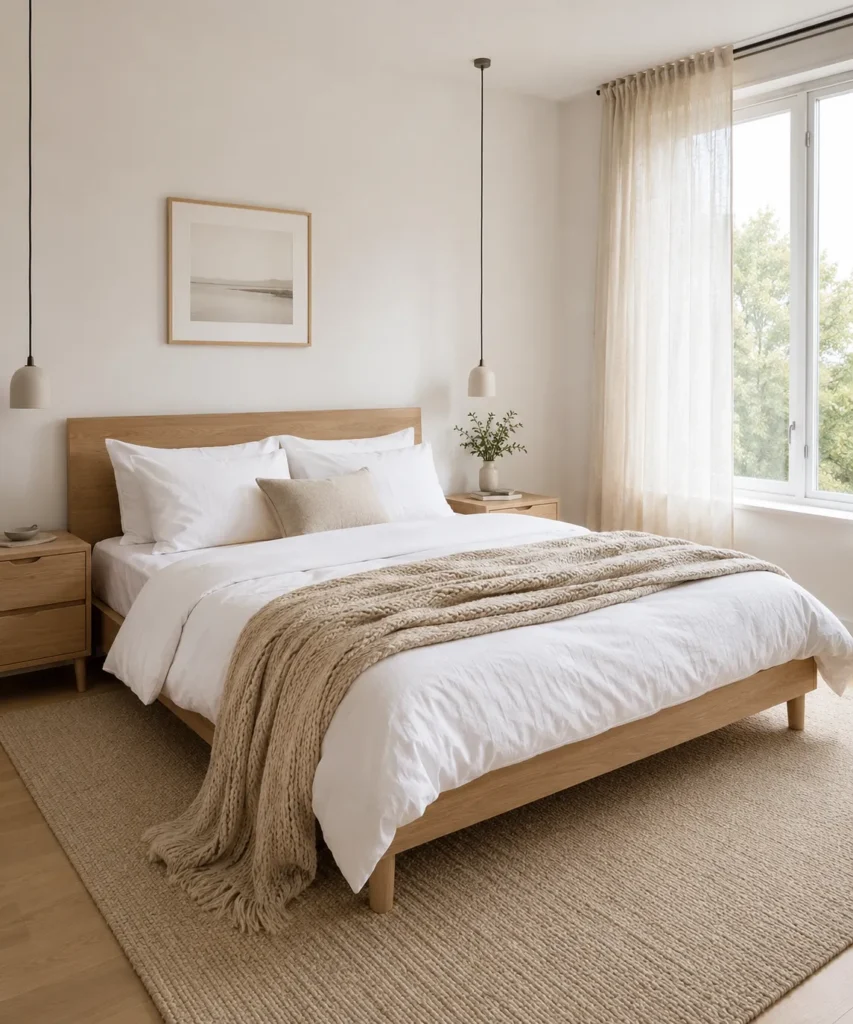
A light wood bed gives a Scandinavian bedroom an immediate sense of warmth without making the largest piece of furniture feel heavy. The simple grain becomes part of the decoration, so the rest of the room can stay restrained. White bedding keeps the visual mass of the bed soft, while a beige knitted throw and woven rug add the texture that an all-white scheme would otherwise lack.
The useful detail here is how little competes with the bed. The pendant lights are small, the wall art is quiet, and the bedside surfaces stay mostly clear. That gives the wood, fabric, and daylight room to register. If your bedroom already has a solid wooden bed that looks darker or more traditional, you may not need a new frame. Cleaning it, simplifying surrounding furniture, or refinishing the visible wood can often bring the overall mood much closer to this look.
White bedding is often treated as essential to Scandinavian style, but the real point is visual calm. Warm ivory, stone, pale grey, and soft oatmeal can work just as well. What matters is avoiding too many strong patterns at once. I would use a plain duvet or coverlet as the main field, then create interest with the weave of a blanket, the texture of a lumbar cushion, and the rug under the bed.
Scale matters as much as colour. The rug should feel connected to the bed rather than looking like a small mat placed in front of it. The nightstands should be large enough to be useful but low-key enough that they do not create a wall of furniture around the headboard. If the room is narrow, a floating shelf or compact stool can replace a full bedside cabinet on one side.
The pendant lights are especially helpful because they leave the nightstands free for practical items. If hardwiring is not realistic, wall-mounted plug-in lamps can create a similar effect. A simple table lamp is also completely fine. Scandinavian bedroom design is not about copying one fixture type; it is about keeping the lighting visually simple and placing it where it supports the way you use the bed.
Keep decoration above the headboard controlled. One framed landscape or abstract print can give the wall focus without creating a gallery effect. Reuse an existing frame if the scale is right, and change the print or mat rather than replacing the whole thing. That small decision is an easy example of how a calmer room can come from editing what you already have.
Materials and Useful Pieces
· Light wood or refinished wooden bed frame
· Plain white, cream, stone, or pale grey bedding
· Textured neutral throw or blanket
· Large woven or wool-look rug
· Two compact nightstands or small side tables
· Pendant, wall, or table lights with simple shades
· One framed artwork and a small vase or plant
A Practical Way to Recreate the Look
1. Set the bed and rug before styling anything else. Place the bed where movement around it feels easiest, then position the rug so it visually supports the full bed rather than sitting as a small isolated rectangle. Once those two large elements feel balanced, the rest of the room becomes easier to judge.
2. Simplify the bedding into a calm base. Use a plain duvet or coverlet and keep the pillows mostly within the same soft colour family. Then add one textured blanket across the lower third of the bed. Let the fabric fall naturally instead of arranging every fold too precisely.
3. Balance the bedside area. Choose nightstands with enough surface for the things you genuinely use, and place the lights so both sides of the bed feel visually connected. If one side has less room, match the lighting rather than forcing identical furniture into a tight gap.
4. Finish with a small number of quiet details. Add one piece of art, a branch or small plant, and perhaps a book or shallow dish. Then remove anything that makes the surfaces feel crowded. The room should still look like somewhere you sleep, not a display table that happens to contain a bed.
For me, the bed should carry most of the softness
If the room already has clean walls and simple furniture, there is no need to decorate every corner. Let the bedding, rug, and curtain fabric provide the softness, then keep the hard surfaces much calmer.
Variations and Alternatives
· Keep a darker existing bed and lighten the room with bedding, curtains, and rug instead of refinishing it.
· Use mismatched wooden nightstands if their scale and general tone feel balanced.
· Replace pendant lights with plug-in wall lamps for a simpler or rental-friendly setup.
· Use a washable cotton rug if a thick woven rug is impractical for pets or allergies.
Make a Small Scandinavian Bedroom Work Harder With Hidden Storage
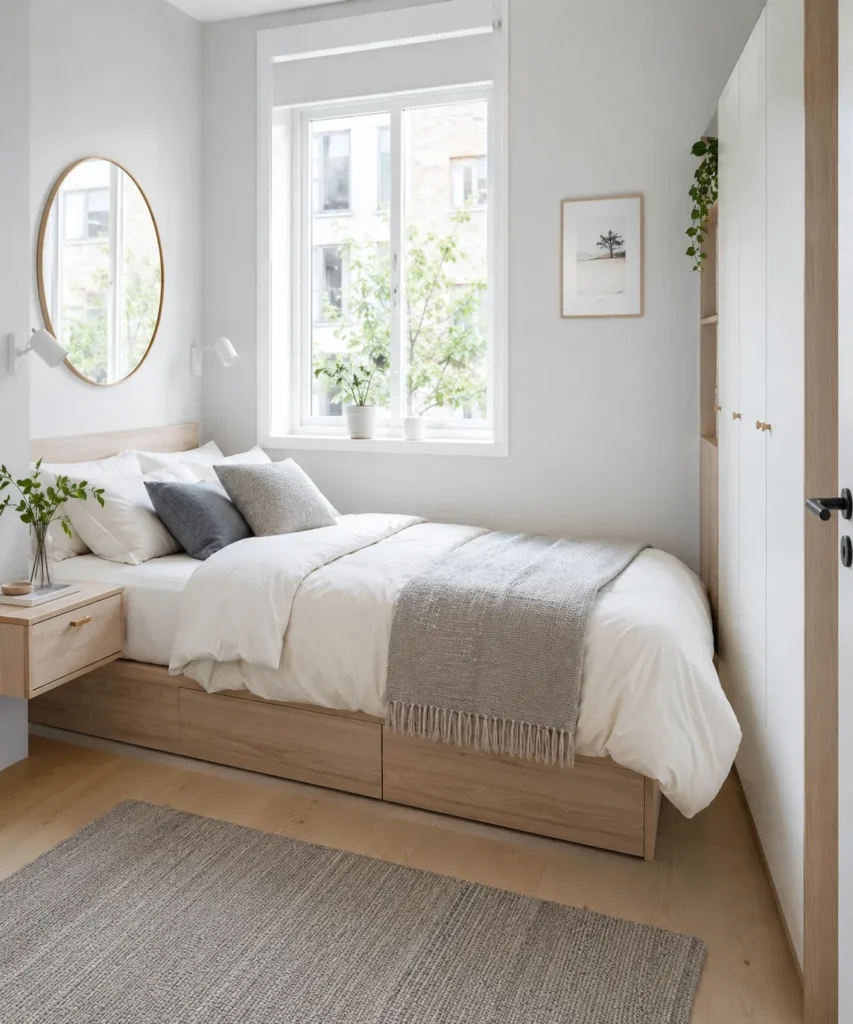
Small bedrooms benefit from Scandinavian design because the style rewards clarity, but minimalism alone will not solve a storage problem. The compact room here works because the bed itself contributes storage, the bedside surface floats away from the floor, and the wardrobe forms a clean vertical plane rather than breaking the wall into several freestanding pieces.
Under-bed drawers are particularly useful when a room cannot accommodate a large chest of drawers. They can hold spare bedding, seasonal clothes, or items that would otherwise end up in visible boxes. If your current bed has enough clearance, shallow lidded containers can provide a similar function without replacing the frame. Matching containers are less important than making sure the system is easy enough to use that things actually return to it.
The round mirror is another practical choice. It reflects window light and adds a soft shape without occupying floor space. Mirrors do not magically enlarge a room, but they can make light travel more effectively and prevent a blank wall from feeling closed in. Position one where it reflects daylight or a calm part of the room rather than a busy doorway or overflowing storage area.
A wall-mounted nightstand is helpful because it exposes more floor and gives the eye a cleaner line. You can recreate the idea with a small floating shelf, a salvaged drawer mounted securely to the wall, or a compact bracketed shelf made from leftover timber. If you reuse an old piece, check the fixings carefully and match the wall anchors to the surface. A bedside shelf carrying books and a lamp still needs to be properly supported.
The built-in wardrobe works because the doors are plain and close to the wall colour. If you already have a bulky wardrobe, consider whether a simple repaint or new handles could reduce its visual weight. Even replacing ornate hardware with smaller pulls can change the impression. I know it can feel tempting to add open shelving because it looks lighter, but in a small bedroom, closed storage often keeps the room calmer because daily clutter disappears behind one surface.
Keep accessories limited in compact rooms, but do not remove personality. One small plant, one framed print, and a few textured cushions are enough to keep the room from feeling temporary. The important thing is that each object has space around it. When every shelf edge is occupied, the room may be tidy but still feel crowded.
Materials and Useful Pieces
· Bed with drawers, lift-up storage, or room for shallow storage boxes
· Compact wall-mounted shelf or small bedside unit
· Closed wardrobe or cabinet storage
· Round or softly shaped wall mirror
· Plain neutral bedding with one or two accent cushions
· Small rug with low visual contrast
· Simple wall light or compact bedside lamp
A Practical Way to Recreate the Look
1. List what the room must store. Before buying organizers, identify the bulky categories that have nowhere to go: spare bedding, shoes, seasonal clothes, bags, or books. Give the largest categories the most efficient storage zones first so small decorative items do not consume the useful space.
2. Use the bed and walls as storage opportunities. Move suitable items under the bed or into built-in drawers, then look for a compact wall-mounted bedside solution. Keep the floor as clear as possible around circulation routes, because visible floor area helps a small room feel calmer.
3. Reduce the visual weight of tall storage. Keep wardrobe doors plain, handles simple, and colours close to the surrounding wall or timber palette. If you are refreshing an older wardrobe, clean and repair it first, then consider paint or replacement hardware only if those changes suit the material.
4. Use mirrors and lighting to support the layout. Place a mirror where it catches useful daylight and add compact lighting that does not consume the whole bedside surface. Then check the room at night as well; a small bedroom still needs gentle light, not just bright daytime styling.
5. Edit the visible decoration. Choose a small number of objects that genuinely add warmth and remove duplicates or filler pieces. Then live with the room for a few days and adjust the storage based on what keeps drifting back onto the floor or nightstand.
The storage system has to be easier than the clutter
A beautifully hidden drawer is useless if opening it requires moving three other things first. I would choose the simplest storage route you can maintain every day, even if it looks less clever in theory.
Variations and Alternatives
· Use lidded under-bed boxes when a storage bed is not in the budget.
· Turn an old drawer or short shelf into a compact wall-mounted bedside surface if it can be secured safely.
· Paint a mismatched wardrobe close to the wall colour to reduce contrast.
· Hang a full-length mirror on the back of a door when wall space is limited.
Layer Hygge Warmth With Textiles and Gentle Evening Lighting
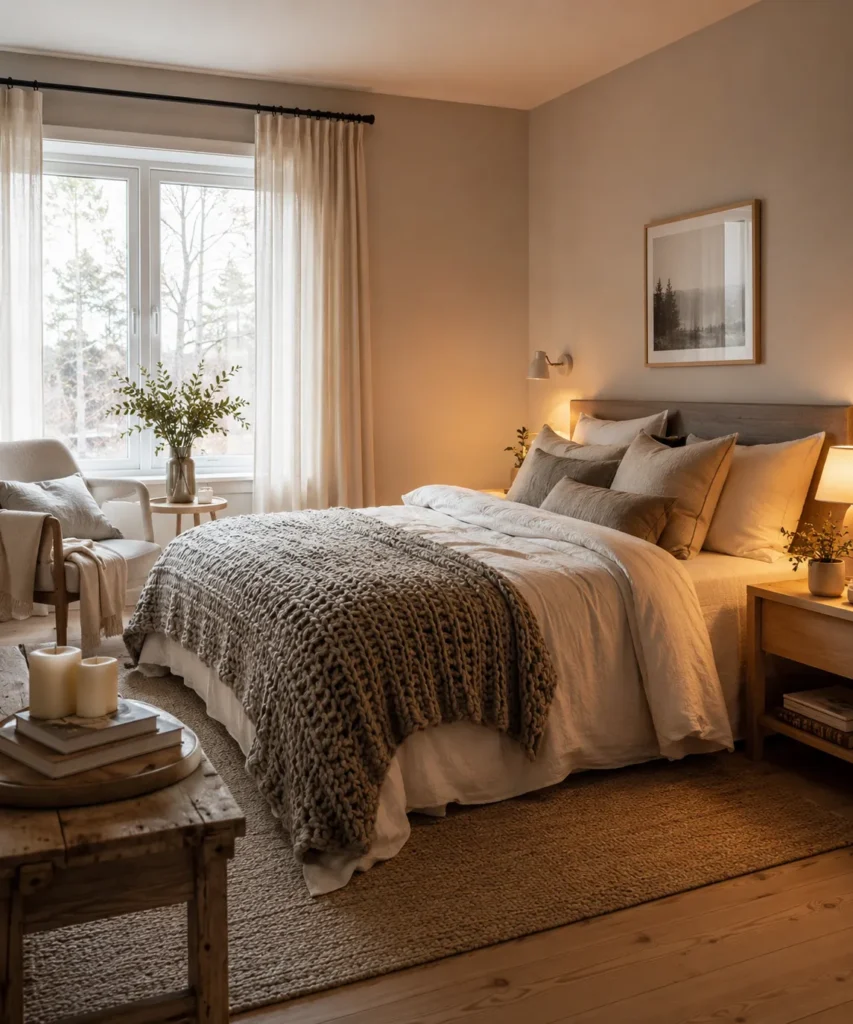
A Scandinavian bedroom can be visually simple and still feel deeply comfortable. The warmer room here leans into hygge through texture, low lighting, and a small reading area. The colours remain quiet, but the materials feel soft enough that the room invites you to stay rather than simply admire the styling.
The chunky blanket creates most of the visual weight on the bed. That is useful because you can change the atmosphere without changing the furniture. If you already own a plain bed and basic white bedding, a heavier throw, a textured coverlet, or a second blanket can make the room feel much warmer. Reuse what you already have first and combine layers before deciding that you need a new coordinated bedding set.
Lighting does equally important work. The bedside lamps are warmer and lower than a central ceiling light, which creates a softer pool around the bed. A wall sconce or reading lamp adds another layer without flooding the entire room. In the evening, I would rather have two or three small light sources than one very bright overhead fixture. It gives the bedroom a calmer transition toward sleep and makes the neutral surfaces look warmer.
The reading chair is not essential, but it makes the room feel lived in. If you already own a chair that is structurally sound but visually busy, a plain slipcover or neutral throw can help it sit more quietly in the bedroom. The small side table can be an old stool, a refinished occasional table, or even a sturdy crate with a smooth top. Scandinavian style often gets more interesting when useful older pieces are simplified rather than replaced.
Candles can contribute to a hygge mood, but they are not necessary, and real flames require care. Unlit candles can simply act as sculptural objects, while warm lamps provide the safer everyday atmosphere. If you do use candles, place them away from bedding, curtains, books, and other flammable materials, and never leave them unattended.
The main lesson from this room is that coziness comes from layers, not clutter. You can have a rug, blanket, armchair, cushions, books, and plants without making the room busy if the colours relate and the surfaces remain edited. The room feels generous because the materials vary, not because every surface is decorated.
Materials and Useful Pieces
· Plain bedding in cream, white, taupe, or soft grey
· Chunky knit or heavily textured throw
· Large rug with soft or woven texture
· Warm bedside lamps and optional wall reading light
· Comfortable chair or reused accent chair
· Small side table, stool, or refinished occasional table
· Books, simple ceramics, and optional unlit candles
A Practical Way to Recreate the Look
1. Create a soft base on the bed. Keep the main duvet or coverlet plain, then layer a heavier blanket across the foot or lower half. Add two or three supportive cushions rather than building a large decorative pillow stack that has to be removed every night.
2. Change the evening light before adding decor. Turn off the overhead light and see what the existing bedside lamps actually do. Add or reposition a reading lamp if the room feels too dark in useful areas, and choose shades that diffuse the light rather than producing a harsh exposed glare.
3. Build one comfort corner if space allows. Use a chair, small table, and lamp near the window or in an otherwise unused corner. Reuse existing furniture if the scale works; a new throw or cushion can often make an older chair relate to the rest of the room.
4. Finish with restrained personal objects. Add a few books, a vase, or a small tray, then stop before every surface is filled. This is where hygge can easily turn into clutter if every cozy object is displayed at once.
Warmth should come from use, not just appearance
The chair should be comfortable enough to sit in, the lamp should be bright enough to read by, and the blanket should actually be pleasant to use. If the “cozy” pieces only look good, the room will not feel convincing for long.
Variations and Alternatives
· Use a woven wool-style blanket instead of a chunky knit if you prefer a flatter bed surface.
· Move an existing living-room chair into the bedroom before buying a new one.
· Use LED candles or no candles at all and rely on layered lamps for evening warmth.
· Choose deeper taupe or charcoal textiles if a very pale room needs more visual grounding.
Use Small Black Accents to Give a Pale Bedroom Definition
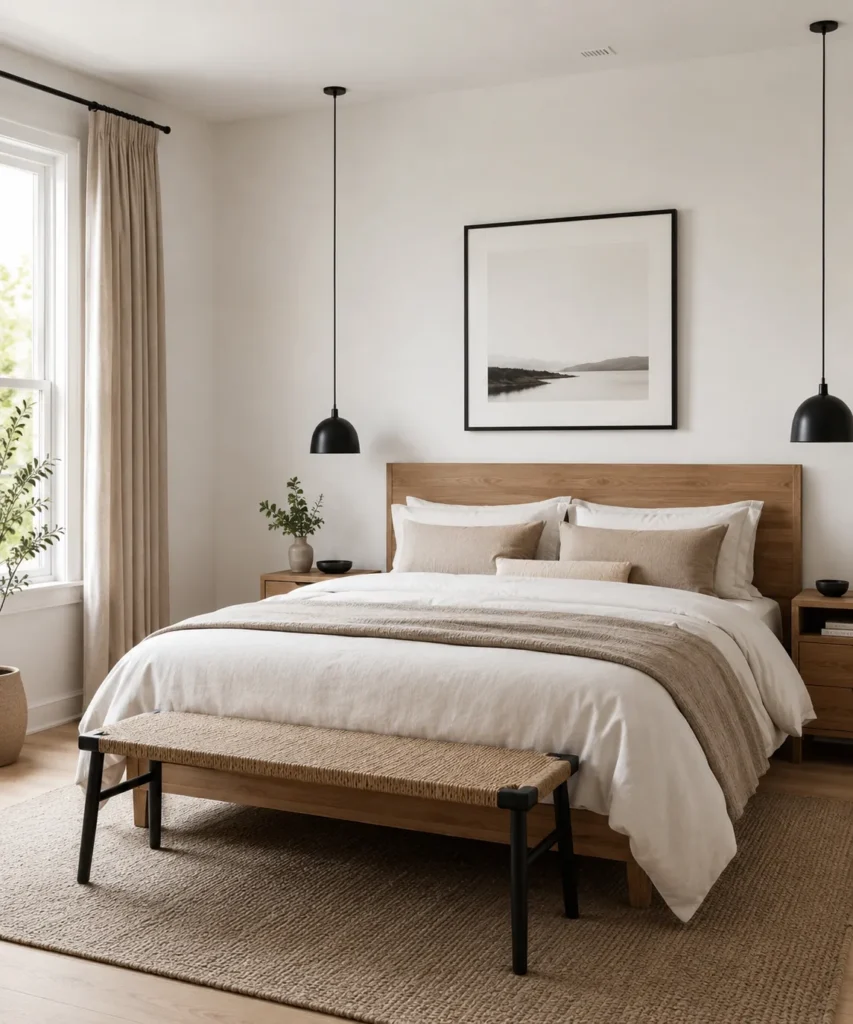
Black is useful in a Scandinavian bedroom because it creates a clear edge against pale walls, light timber, and cream bedding. The key is restraint. In this room, black appears in the pendant lights, artwork frame, and parts of the bench. Those small repetitions connect the space without turning it into a high-contrast black-and-white scheme.
This approach can be especially helpful if an existing bedroom feels washed out. You do not necessarily need a stronger wall colour. Changing a lamp, painting an old picture frame, or introducing a black metal detail can be enough to give the room more definition. I’d keep the black elements narrow and structural so the softness of the bedding remains dominant.
The bench at the foot of the bed adds another material layer through its woven seat. It also has a real job: somewhere to sit while dressing, place a folded blanket, or briefly set clothing. If you already own a sturdy bench, consider refinishing the frame or replacing a worn seat rather than buying a new one. A woven seat, neutral upholstery, or plain timber top can all work depending on the construction.
Symmetry is strong here because the pendant lights sit on both sides of the bed and the artwork is centred. You do not need exact symmetry in every bedroom, but it can make a simple room feel settled. If your bed sits off-centre because of a window or door, create balance with similar visual weight rather than forcing matching placement. One lamp may be wall-mounted and the other on a table, for example, as long as the overall composition feels deliberate.
The framed landscape keeps the colour palette quiet. If you want to reuse art you already own, change the frame before changing the artwork. A slim black frame can make a pale print feel more connected to the lighting, while a light wood frame can soften a darker image. Framing is one of the easier places to shift the mood of a room without replacing a useful object.
Keep the remaining accessories softer so the black accents stay purposeful. Dark cushions, black bedding, black furniture, black hardware, and black lighting all at once would change the character completely. Here, the dark elements act more like punctuation: enough to make the pale room readable, not enough to become the subject.
Materials and Useful Pieces
· Pale wood bed or existing wooden frame
· White, cream, or light taupe bedding
· Black pendant lights, wall lamps, or lamp bases
· Black or dark-framed artwork
· Bench with woven, timber, or neutral upholstered seat
· Natural rug and linen-like curtains
· Small ceramics and one plant or branch arrangement
A Practical Way to Recreate the Look
1. Choose two or three places for dark contrast. Look for existing structural points such as lighting, picture frames, handles, or bench legs. Repeat black in a few separated areas instead of concentrating everything on one side of the room.
2. Keep the largest surfaces soft and light. Let the bedding, walls, rug, and main wood pieces remain pale so the room still feels calm. Then add dark details around the edges of the composition rather than introducing a large black furniture piece immediately.
3. Use the bench as a practical anchor. Place a bench only if there is enough room to walk around it comfortably. If reusing an older bench, check the joints, tighten hardware, and repair the seat before relying on it for sitting or storage.
4. Connect the art and lighting. Choose or reframe artwork so its frame relates to the dark fixtures without making the wall too busy. Then step back from the doorway and check whether the contrast feels balanced on both sides of the bed.
A little black goes much further than people expect
I would add one dark element at a time and keep checking the whole room. It is easy to cross from “useful definition” into a much harder contrast than Scandinavian bedroom design really needs.
Variations and Alternatives
· Use dark bronze, charcoal, or deep brown instead of true black for a softer version.
· Paint an existing frame rather than replacing the artwork.
· Refinish an old bench and add a woven or plain upholstered seat.
· Use one black lamp and repeat the colour in a frame or handle when the room is too small for matching pendants.
Let Natural Texture Do the Decorating
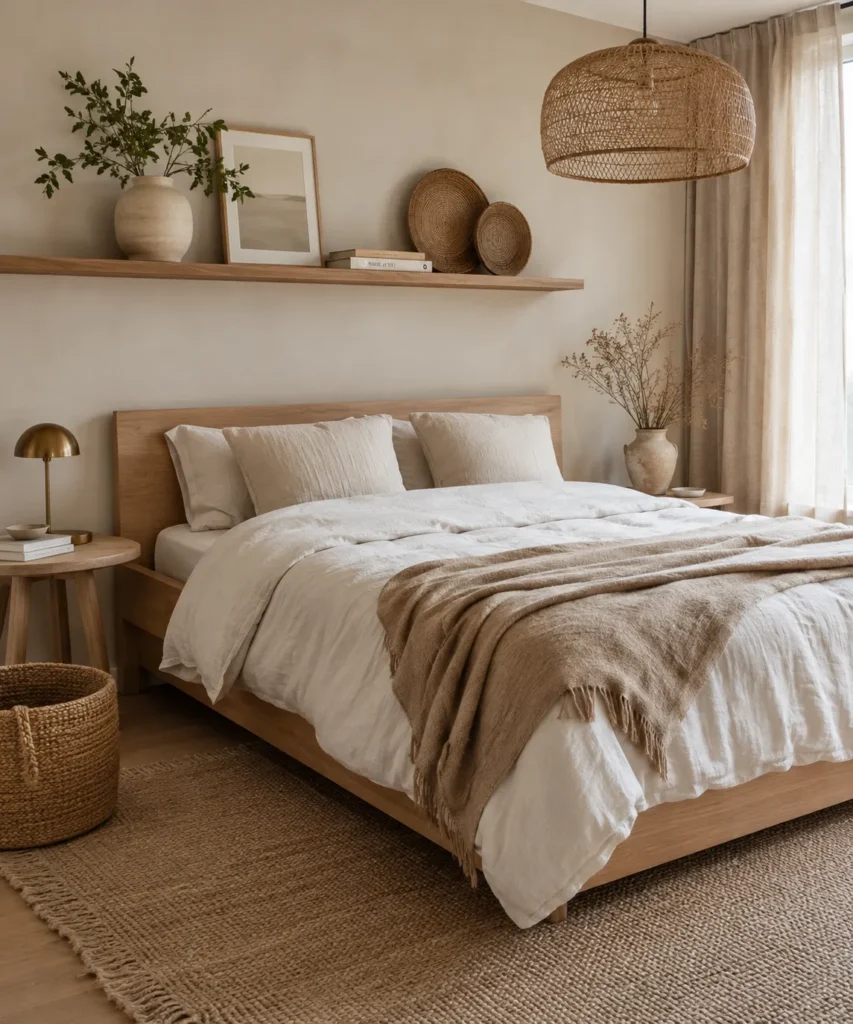
A texture-led Scandinavian bedroom is useful when you love neutral colours but do not want the room to feel plain. Here, the variety comes from linen bedding, a large woven rug, baskets, a rattan-style pendant, matte ceramics, dried stems, and visible wood grain. The colours stay close together, yet the surfaces react differently to daylight, which gives the room much more depth.
The long shelf above the bed adds storage and display space, but it needs to be treated carefully. Any shelf mounted above a sleeping area should be securely fixed with hardware appropriate to the wall and should not carry unstable or excessively heavy objects. If you are not confident about the structure, place the shelf on another wall and keep the headboard area simpler.
If you already have baskets in other rooms, try moving them before buying new ones. A sturdy basket can hold spare blankets, pillows, laundry, or bags and still contribute to the room visually. Older baskets with slight colour variation can work beautifully because Scandinavian texture does not need to look factory-identical. Clean them gently and check for sharp broken fibres before using them around bedding.
The same applies to ceramics. A plain older vase, bowl, or lamp base may suit the room once it is surrounded by quieter colours. You do not need a matching collection. Keep the forms simple, group only a few pieces, and use branches or dried stems to add height. The shelf looks considered because the objects have space between them, not because every object is part of one purchased set.
The rattan pendant gives the ceiling a warmer texture than a smooth metal shade would. If rewiring or replacing a fixture is not practical, bring woven fibre lower in the room through a basket, bench, lampshade, or rug instead. The style is flexible; repeat the material where it makes sense rather than copying the exact location.
Natural texture works best when you vary scale. A large rug provides a broad base, the throw brings medium texture, and smaller woven or ceramic pieces add detail. If every item has a heavy weave, the room can feel rough and busy. Smooth white bedding and clean wood surfaces are important because they give the eye a place to rest between the tactile pieces.
Materials and Useful Pieces
· Light wood bed or simple wooden furniture
· Linen or linen-look bedding and curtains
· Woven rug in jute, wool-look, or other natural texture
· Woven basket or storage bin
· Rattan-style pendant or woven lampshade
· Matte ceramic vase, bowl, or lamp
· Simple wall shelf secured with appropriate hardware
· Branches, dried stems, or a small amount of greenery
A Practical Way to Recreate the Look
1. Choose three texture families. For example, combine visible wood grain, soft linen-like fabric, and woven fibre. Keep most other surfaces simpler so those textures remain distinct instead of competing with one another.
2. Place the largest texture first. Use the rug, bedding, or curtains as the broad tactile layer, then add smaller woven pieces around it. If the room already has a strong textured floor, reduce the rug texture and let the bedding carry more of the softness.
3. Reuse storage and ceramics selectively. Bring in baskets, vases, or trays you already own and test them in the room before buying replacements. Keep only the pieces whose scale and colour support the space, and leave enough empty surface around them.
4. Mount shelves and hanging items safely. Use fixings appropriate to the wall and the expected load, especially near the bed. Keep heavy, fragile, or unstable objects away from overhead positions, and move decorative storage to a safer wall if there is any doubt.
5. Edit the final arrangement by touch as well as colour. Check whether the room has both smooth and tactile areas. If every visible item is rough, woven, tufted, or heavily textured, remove a few pieces and let plain fabric or timber bring the balance back.
For me, texture works best when it is not all the same texture
A room full of rattan, jute, chunky knit, wicker, and boucle can become just as busy as a room full of pattern. I’d keep some large surfaces smooth so the woven details actually stand out.
Variations and Alternatives
· Use an old ceramic jug or vase instead of buying new decorative pottery.
· Move existing baskets into the bedroom for blankets or laundry.
· Use a fabric pendant shade if woven rattan does not suit the ceiling height.
· Skip the overhead shelf and place the same decor on a dresser if wall mounting is uncertain.
Design Around Natural Light and Keep the Window Area Clear
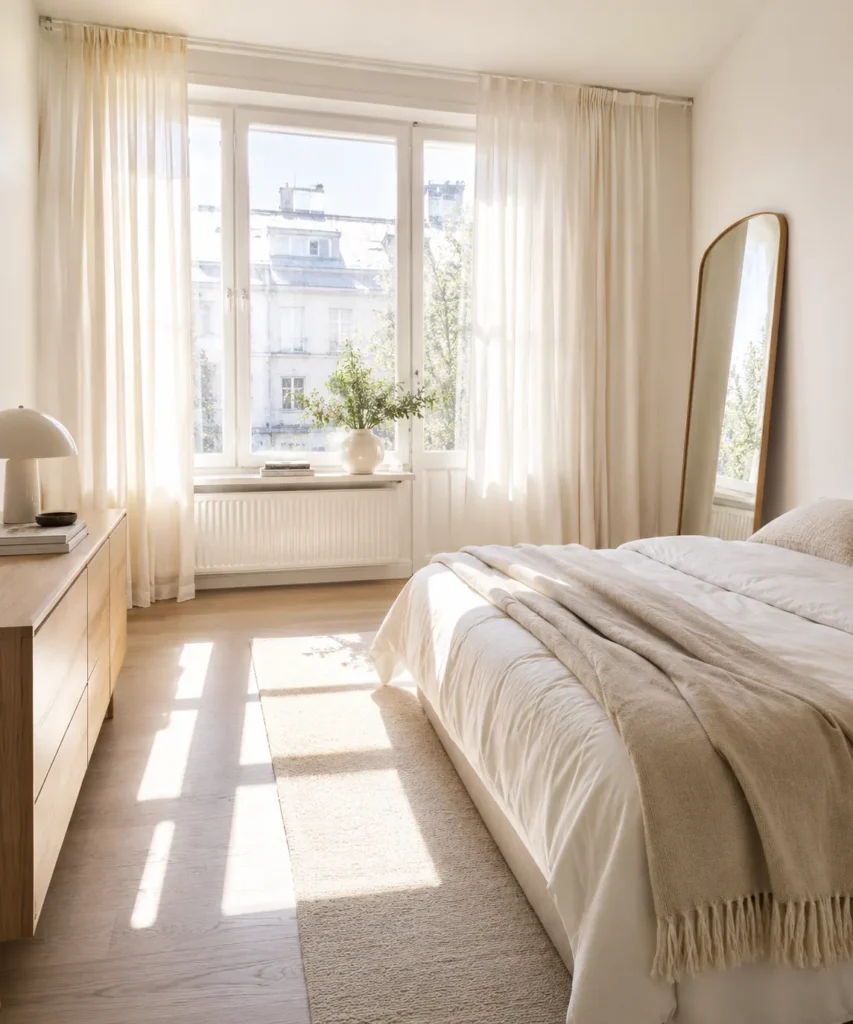
Natural light can do more for a Scandinavian bedroom than another piece of furniture. The bright room here gives the windows priority, using sheer curtains that soften glare without visually closing the wall. The bed, dresser, mirror, and rug all remain pale enough to reflect or support the daylight rather than absorbing it.
Window treatments are often the difference between a room that feels airy and one that feels permanently dim. If privacy allows, sheer or light-filtering curtains can make daytime light gentler while keeping the window bright. In bedrooms that need stronger privacy or darkness at night, pair sheers with a separate blind or lined curtain rather than choosing one heavy fabric for every purpose.
The full-length mirror helps by reflecting a portion of the window and giving the room a taller vertical element. Place a leaning mirror only where it is stable and safe, especially in homes with children or pets; secure it when appropriate. A wall-mounted mirror may be a better option in a narrow room. Reusing an older mirror with a plain wood or painted frame can fit Scandinavian design very well.
The dresser stays simple and low enough that it does not compete with the window. If you have an older chest with good drawers but a dated finish, this is a practical piece to refresh rather than replace. Clean it, repair sticking drawers, and consider whether sanding, repainting, or changing the handles would bring it closer to the bedroom palette. Sometimes simply removing excess objects from the top is enough.
Notice how the bed is not overloaded with cushions or decorative layers. The sunlight itself creates movement through changing shadows, so the room does not need much additional visual activity. The soft throw provides one texture, the rug another, and the greenery on the windowsill adds a small natural accent. That is enough.
I know bright rooms can tempt us to fill the available wall space because everything looks good in daylight. Resist that for a while. Live with the empty areas and see how the light moves through the room. Scandinavian bedrooms often feel most convincing when daylight has somewhere to land.
Materials and Useful Pieces
· Sheer or light-filtering curtains
· Optional blind or lined curtain for nighttime privacy and darkness
· Plain bed and neutral bedding
· Low dresser or refinished chest of drawers
· Full-length wall or leaning mirror
· Light rug and pale wood floor where available
· Small plant, vase, or simple windowsill object
A Practical Way to Recreate the Look
1. Clear the window zone first. Move tall furniture and unnecessary objects away from the strongest daylight path where practical. Clean the glass, sill, and surrounding surfaces so the window feels like part of the room rather than a background behind clutter.
2. Choose layered window treatments for function. Use a sheer layer for daytime softness if it suits your privacy needs, then add a blind or heavier layer for darkness at night. Keep the hardware visually simple and hang curtains so they do not cover more glass than necessary when open.
3. Place reflective surfaces deliberately. Position a mirror where it catches useful light without producing uncomfortable glare. Secure tall mirrors appropriately, and avoid placing them where they reflect the most cluttered area of the room.
4. Keep furniture low and surfaces edited. Use a low dresser or simple chest that leaves the window visually dominant. Then limit the top to one lamp, a small stack of books, or a plant rather than creating another busy display.
5. Check the room at several times of day. Morning, afternoon, and evening light can change the palette dramatically. Adjust curtains, mirror angle, and lamp placement after living with those changes rather than assuming the brightest daytime version is the only one that matters.
Daylight is part of the design, not just the lighting
If the room has a good window, I would protect that advantage before buying more decor. Clear glass, lighter curtains, and uncluttered surfaces can change the atmosphere more than another decorative object ever will.
Variations and Alternatives
· Use a wall-mounted mirror instead of a leaning mirror in a tight or high-traffic room.
· Pair sheer curtains with a blackout blind if you need better sleep darkness.
· Refinish an existing dresser rather than replacing a solid storage piece.
· Use a pale ceramic lamp and reused books on the dresser if the surface feels too empty.
Bedroom Styling Choices That Can Work Against the Scandinavian Look
The first mistake is treating Scandinavian design as a shopping list. A light wood bed, woven rug, beige throw, and black lamp may all suit the style, but buying them together will not automatically make the bedroom calm. Start with layout, function, and the pieces you already own. A room full of new “Scandinavian” objects can still feel crowded if the storage is poor or the furniture scale is wrong.
Another common problem is removing too much. If the room becomes white walls, white bedding, pale floor, and no texture, it may feel unfinished rather than restful. Add softness through rugs, curtains, bedding, wood grain, and a few tactile objects. Scandinavian simplicity depends on contrast between quiet surfaces and warm materials, not on making everything disappear.
Using too many different beige and wood tones without a plan can also make the bedroom muddy. Warm oak, cool grey wood, orange timber, yellow rattan, taupe fabric, and creamy walls may all be neutral individually, but they can fight when placed together. Repeat a smaller family of tones and keep one or two contrasting materials rather than using every natural finish at once.
Poor furniture scale is especially noticeable in a simple room. A huge bed with deep nightstands and a bench can leave no comfortable walking route, while very small furniture can look lost against a large wall. Measure before buying, and use masking tape on the floor if you need to understand how much space a piece will actually occupy. The quietest-looking bedroom still feels stressful if you bump into the bench every morning.
Lighting can flatten the whole room if it is ignored. A bright overhead fixture may make warm timber and soft textiles look much harsher at night. Add bedside or wall lighting at a lower level and make sure the light is useful for reading or dressing. Decorative lamps that do not actually illuminate the task area are only doing half a job.
Overdecorating the bed is another easy trap. A large stack of cushions may look attractive for a photograph but becomes irritating if it has to be moved twice a day. Use enough pillows for comfort and a small number of decorative ones. The same principle applies to trays, candles, books, and vases on the nightstand: leave room for the things you genuinely use.
Finally, do not ignore safety for the sake of a clean look. Heavy shelves above the bed, unsecured leaning mirrors, overloaded wall-mounted nightstands, and unstable benches need proper installation or a different location. Scandinavian design values usefulness, and a useful bedroom should also feel secure.
Frequently Asked Questions
What colours work best in a Scandinavian bedroom?
White, warm cream, soft beige, pale grey, taupe, and natural wood tones are common because they create a quiet base. You can add muted colour through textiles or artwork, but keep the palette connected. The room does not have to be white; it simply benefits from restraint and repetition.
Can I create a Scandinavian bedroom without replacing my furniture?
Yes. Begin by editing the room, simplifying visible surfaces, and reusing solid furniture where possible. Cleaning, refinishing, painting, changing hardware, or moving a piece to a more suitable position can often make more difference than buying a new matching set.
How do I make a neutral Scandinavian bedroom feel warm?
Use texture and lower-level lighting. Layer plain bedding with a woven or knitted blanket, add a substantial rug, keep some visible wood grain, and use bedside lamps or wall lights in the evening. A small amount of greenery or matte ceramic can also soften the room without adding busy colour.
Is black suitable for Scandinavian bedroom design?
Yes, especially in small amounts. Black lighting, picture frames, handles, or bench legs can give pale rooms definition. Keep the largest surfaces soft and neutral so the black acts as an accent rather than changing the room into a high-contrast scheme.
What should I do in a very small Scandinavian bedroom?
Prioritize hidden storage and clear floor area. Use under-bed space, a wall-mounted bedside shelf, closed wardrobe storage, and a mirror that reflects useful daylight. Keep decorations limited, but include enough textile texture that the room still feels comfortable rather than temporary.
Do I need expensive natural materials to get the look?
No. Use what you already have and choose the most noticeable material changes first. A reused wooden stool, old ceramic vase, second-hand bench, simple cotton bedding, or existing basket can fit the style if the colours and scale work together. The room benefits more from coherence than from expensive labels.
How can I keep a Scandinavian bedroom from becoming cluttered again?
Give daily-use items a clear home. Make sure the nightstand can hold what you actually use, provide a basket or hooks for clothes that are not ready for laundry, and keep storage easy to access. A short weekly reset works better than relying on constant perfect tidiness.
Let Calm, Useful Choices Shape the Bedroom
The strongest Scandinavian bedroom design tips are not really about copying a particular furniture set. They are about making the bedroom easier to live in: keeping a clear layout, using storage that supports your routines, choosing a small material palette, layering enough texture for warmth, and letting natural and evening light do part of the visual work.
That approach also makes reuse much easier. An existing wooden bed can stay. A solid dresser can be refreshed. A basket from another room can become blanket storage. Old frames, ceramics, benches, stools, and lamps can often fit once the surrounding palette becomes quieter. You do not need to remove the history of a home to create a Scandinavian mood; you need to edit it thoughtfully.
I would start with one change that solves a real problem. Clear and reset the nightstands, improve the lighting, simplify the bed, or make the window area brighter. Then live with the result before adding another layer. A bedroom that grows slowly around useful decisions usually feels more personal and more restful than one assembled all at once from a shopping cart.
If your bedroom already contains something sturdy, comfortable, or meaningful, look for a way to keep it in the plan. Scandinavian design has plenty of room for reused pieces when the overall room is calm enough to let them belong.