A tiny cotton onesie looks like one of the easiest things in the craft room to personalize, but the fabric makes the job more demanding than it first appears. Baby bodysuits are usually soft, stretchy, frequently washed, and small enough that a slightly fuzzy line or a little bleed-through can change the whole design. A marker that works beautifully on canvas or a tote bag can feel very different on thin jersey knit.
The best fabric markers for onesies need to do more than put bright color on cloth. They should give you enough control for small lettering and simple illustrations, suit the color and fiber of the garment, and have clear curing and washing instructions. The most important practical rule is to follow the directions for the exact marker you buy rather than assuming every permanent fabric pen sets in the same way. Some need only air curing, some benefit from or require heat setting, and some perform best only on light-colored fabric.
I also pay close attention to what a manufacturer actually means by words such as “nontoxic,” “permanent,” and “washable.” Those labels are useful, but they do not make every pen identical or automatically suitable for every baby garment. A careful test swatch, full cure time, and first wash before wear are simple steps that make a much bigger difference than most decorative tricks.
What Makes a Fabric Marker Work Well on a Onesie?
A onesie is not just a miniature T-shirt. The knit is usually thinner, softer, and more elastic than the canvas, denim, or heavy cotton surfaces shown in many marker demonstrations. That affects line quality, color saturation, drying behavior, and how the finished design moves after washing.
Stretch changes how a drawn line behaves
Cotton jersey is made from loops rather than the rigid over-under weave of canvas. When you pull the garment sideways, the surface opens slightly. A fine line that looks solid while the fabric is relaxed may appear lighter when the knit stretches, while a very heavy deposit of ink can make a small area feel stiffer than the surrounding cloth.
For that reason, it is usually better to build color gradually instead of repeatedly scrubbing the same spot with a marker. A marker should glide across a supported surface; it should not have to fight loose, moving fabric. Placing cardboard or a smooth shirt board inside the onesie keeps the front layer taut and protects the back from accidental transfer.
Fine tips are useful, but broad tips have a place
Small garments reward precision. Fine tips are easier for names, dates, stars, little flowers, faces, outlines, and short phrases. They also let you keep ink farther from seams and snap plackets where the fabric can bunch.
Broad, chisel, or brush tips are more efficient for coloring a heart, filling a rainbow band, or making a large initial. A dual-tip marker gives you both functions in one body, but it is not automatically the best choice if your design is almost entirely fine lettering. The right tip is the one that matches the marks you actually plan to make.
The color of the garment matters as much as the marker color
Many fabric markers use translucent or semi-opaque dye-based ink. These look brightest on white, cream, pale gray, and other light fabrics because the cloth itself reflects light back through the color. On navy, black, or saturated fabric, some colors can become dull or nearly invisible.
U.S. Art Supply explicitly says its 20-color Super Markers are intended for white or light-colored fabrics for bright results and will not be visible on dark garments. Lelix similarly describes its set for light-colored fabrics. STAEDTLER takes a different approach with its 3190 fabric pens, which are designed for most light and dark fabrics, though the company gives a major care limitation: designs on dark fabrics are not listed as washable.
If the onesie is dark, do not assume a large color set will solve the problem. Check whether the specific ink is designed to show on dark cloth and whether the finished design can still be laundered.
“Permanent” still has a curing period
Permanent fabric ink is not necessarily ready for the washing machine the second it looks dry. Zenacolor says its 32-color markers dry in 24 hours with no heat setting. U.S. Art Supply recommends at least 24 hours of air curing before wearing and washing.
JR.WHITE instructs users to wait more than 24 hours before washing. Tulip says its fine-tip markers can be machine washed on a gentle cycle after 24 hours. STAEDTLER also calls for 24 hours of drying to fix the ink without heat.
ARTISTRO is different: current 24-marker fabric-pen listings specify heat setting after the design is fully dry. That distinction matters on a small cotton garment because you do not want to guess at the finishing step after spending time on the artwork.
Washability is a system, not a single promise
A washable marker can still fade faster if the design is washed too soon, scrubbed aggressively, exposed to high heat, or put through harsher cycles than the manufacturer recommends. The garment itself also has a care label that matters. A cotton onesie may tolerate heat that a cotton-poly blend, printed bodysuit, or specialty-finish garment does not.
For handmade baby clothing, I prefer conservative care: let the ink cure fully, wash the garment inside out when practical, use the mild cycle recommended for the fabric, and avoid treating the design as indestructible. The marker directions and the garment care label both need to be respected; use the gentler instruction when they differ.
| Product Image | Product Name | Features | Price |
|---|---|---|---|
 |
Zenacolor 32 Fabric Markers Pens | Complete Set of 32 Colors. Non-toxic, richly pigmented ink resists fading and is safe for machine washing at cool temperatures. Perfect for personalizing t-shirts, shoes, tote bags, and apparel with long-lasting designs. Dries in 24 hours without heat, ensuring hassle-free crafting and fast results. |
Check Price |
 |
U.S. Art Supply Super Markers 20 Vibrant Dual Tip Fabric Markers | Colors dry permanently and resist fading even after washing. Works beautifully on white or light-colored fabrics; not visible on dark garments. Double-ended markers with fine bullet tips for detail work and chisel tips for broad strokes. Artist-grade markers ideal for outlining, sketching, shading, blending, and filling. |
Check Price |
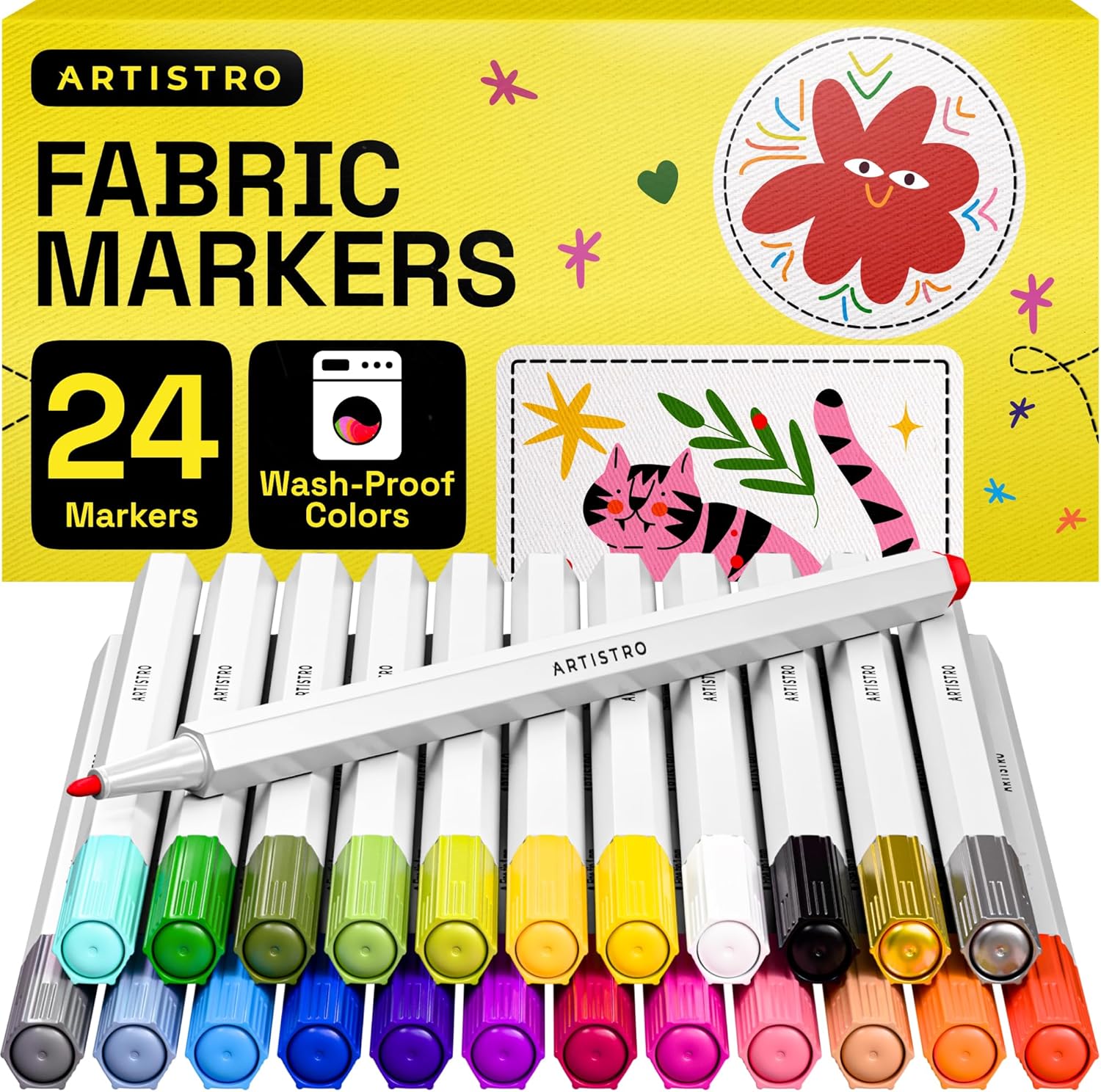 |
ARTISTRO 24 Fabric Markers | Perfect for detailed designs, outlines, lettering, and intricate patterns. Bold pigments stay fresh and resist fading, even after repeated washing. Non-bleeding formula ensures clean lines and smooth application on fabric. Designs become permanent once heat-set with an iron, ensuring durability. |
Check Price |
 |
JR.WHITE Fabric Markers Permanent | 24 Vibrant Colors. Smooth ink flow with precise coverage, ideal for detailed designs and embellishments. Eco-friendly formula ensures safe use for teens and hobbyists. Great for clothing, canvas shoes, tote bags, painted rocks, seasonal crafts, and DIY décor. |
Check Price |
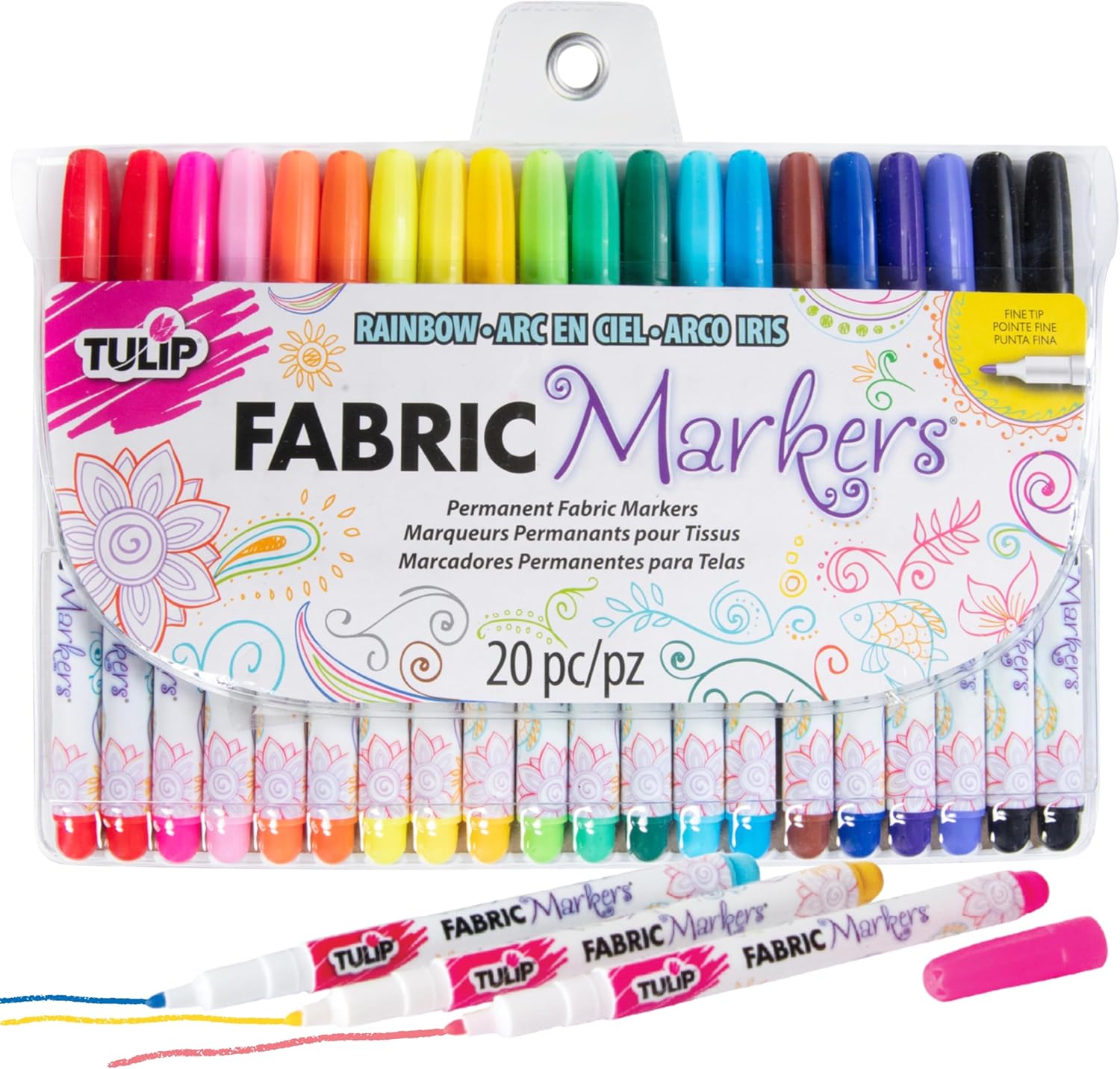 |
Tulip Permanent Nontoxic Fabric Markers Rainbow 20 Pack | Includes 20 ultra-bright colors for bold, eye-catching designs on fabric. Fade-resistant pigments withstand multiple machine washes without losing vibrancy. Designs dry fast and stay permanent without the need for heat setting. Ink flows evenly without snagging fabric, ensuring clean, professional results. |
Check Price |
 |
Sharpie Stained Fabric Markers | Versatile tip creates both thick and thin lines, ideal for hand lettering and calligraphy. Perfect for decorating shirts, backpacks, tote bags, sneakers, and other fabric items. Adheres to a variety of fabric types for flexible use across projects. |
Check Price |
 |
Lelix Fabric Markers | Each marker includes a fine point for precise lines and a chisel tip for broad strokes, shading, and blending. Smooth application with non-bleeding formula that dries fast and resists fading, even after machine washing. Long-lasting ink ensures your designs stay fresh and vivid over time. Works on light-colored fabrics such as T-shirts, canvas, socks, hats, bags, and baby gear. |
Check Price |
 |
Staedtler Double-Ended Fabric Markers | Each marker includes a fine tip for detail work and a wide tip for bold strokes. Designed for safe use, making them perfect for children and family projects. Designs dry permanently without ironing, simplifying the creative process. Perfect for decorating shirts, jeans, hats, onesies, baby bibs, pillowcases, and cushion covers. |
Check Price |
What to Check Before You Draw
Tip shape and line control
Think about the smallest feature in your design, not the largest. If you want to write a name across the chest of a newborn-size bodysuit, the letters may be only an inch or two tall. A fine point makes that job much easier than a wide chisel tip. If you want block shapes, broad fills, or large color fields, a dual-tip or brush-tip set saves time.
Brush tips deserve special attention. Sharpie Stained uses a flexible brush tip that can produce both thin and thick strokes. That is useful for hand lettering and loose floral marks, but brush tips react to pressure more dramatically than fixed fine points. A beginner who presses hard may get wider strokes than expected.
How the ink sets
There are three common patterns among the products here. Zenacolor, U.S. Art Supply, JR.WHITE, Tulip, Sharpie Stained, and STAEDTLER rely primarily on drying or air curing according to their current product information. ARTISTRO instructs users to heat-set its fabric-marker designs after drying. Lelix is sold as permanent, quick-drying, wash-resistant fabric ink, but current retail information is less detailed about a universal home curing routine, so the instructions included with the exact set should take priority.
A simple rule prevents most problems: never invent a heat-setting step just because another brand requires one. Too much heat can damage elastic, snaps, transfer graphics, or heat-sensitive fabric blends.
Light fabric versus dark fabric
If you are decorating a white cotton onesie, all eight sets are much easier to compare because color visibility is less restrictive. If you are decorating dark cotton, the field narrows. U.S. Art Supply and Lelix are not strong choices for dark garments based on their own current descriptions. STAEDTLER can mark dark fabric, but its stated washability is stronger for light fabrics.
For dark garments, always test one hidden area or a scrap of matching material. A color that looks opaque on the marker cap can still become translucent on cloth.
Bleed-through and feathering
Thin knit can pull liquid sideways along fibers, especially when you pause with the tip in one place. “No bleed” claims can help, but they do not eliminate the need to support the fabric. Insert cardboard, freezer paper, or a purpose-made shirt board between the front and back. Keep the fabric flat without stretching it aggressively.
Use lighter pressure than you would on paper. Make one controlled pass, let it settle, then decide whether the area needs another pass. Repeatedly grinding the tip into one spot deposits more liquid and increases the chance of feathered edges.
Color range versus useful color range
A 32-color or 30-color set sounds more flexible than an 8-color set, but a smaller palette can be easier to control if your project is simple. For names, outlines, and small icons, eight strong colors may be enough. For rainbow themes, florals, character-inspired palettes, or coordinated baby-shower decorating stations, a larger set makes more sense.
The practical question is not “How many colors can I get?” It is “How many colors will I actually use on this small piece of fabric?”
Safety wording should be read carefully
Several products are described by their makers or retailers as nontoxic or compliant with art-material standards. That is useful information for crafting, but I would not translate it into a claim that dried marker ink is designed for chewing, sucking, or food contact. A baby garment spends time near skin and may end up near a baby’s mouth, so sensible placement matters.
Keep heavy marker coverage away from areas likely to be repeatedly mouthed, follow the product directions completely, allow the design to cure, and wash the finished onesie before use. If the marker packaging gives age, ventilation, handling, or laundering instructions, follow those directions rather than relying on a general “nontoxic” description.
Zenacolor 32 Fabric Markers Pens — A Large Fine-Tip Palette for Detailed Designs
Zenacolor’s 32-marker set is built around a simple formula: a large color range, permanent fabric ink, and a fine point rather than a dual-tip body. The manufacturer currently describes the ink as nontoxic, fade-resistant, machine-washable on cool cycles, and able to dry in 24 hours without heat setting.
That combination makes the set easy to understand for onesie work. You can focus on outlining, lettering, doodles, names, little animals, stars, and other small shapes without switching between tip styles. The fine point also reduces the temptation to flood a small area with ink, which is useful on thin cotton jersey.
The 32-color range is more useful for small motifs than large fills
Thirty-two colors give you plenty of room to coordinate with baby-shower themes, seasonal designs, family colors, or multi-color lettering. On a onesie, that range is most valuable when the design contains several small elements rather than one large solid block.
Zenacolor says the markers work best on light textiles, and that is the setting where I would be most comfortable using them. White and pale cotton provide enough contrast for the fine lines to remain visible after drying.
A 24-hour no-heat cure simplifies finishing
The brand states that the ink dries in 24 hours and does not require heat setting. That is convenient on garments with elasticized necklines, plastic snaps, or other parts you may not want to press with an iron. It also removes one variable from the process: the main finishing task is giving the ink enough uninterrupted drying time.
The trade-off is patience. A design may feel dry well before the full cure period is complete. Treat the 24 hours as part of the project rather than an optional delay.
- Fine tip gives good control for names, outlines, and small motifs on limited onesie space.
- The 32-color palette supports multi-color designs without requiring several separate packs.
- Zenacolor specifies cool-cycle machine washability and fade-resistant permanent ink.
- No heat setting is required; the brand uses a 24-hour drying period for the design to set.
- The fine-tip-only design is slower for filling large solid shapes than a chisel or brush tip.
Who It’s Best For
This set suits crafters who want a broad palette for light-colored onesies and expect to draw mostly lettering, outlines, or small illustrations rather than large painted areas.
Not Ideal For
It is less convenient for dark garments or projects built around broad blocks of solid color.
U.S. Art Supply Super Markers 20 Vibrant Dual Tip Fabric Markers — Flexible for Outlines and Fills
U.S. Art Supply’s 20-color Super Markers use a double-ended design: a fine bullet point at one end and a chisel point at the other. The fine tip handles writing and outlines, while the chisel tip is better for broader strokes, filling, shading, and simple block shapes.
For a onesie, that two-tip format can be more useful than a very large color count. You can draw a small name with the bullet tip, then turn the same marker around to fill a heart, stripe, or large initial without making dozens of narrow passes.
Light fabric is a real requirement for bright results
The manufacturer is unusually direct about color visibility: these markers are intended to look bright and bold on white or light-colored fabric and are not visible on dark garments. That makes them a straightforward choice for classic white baby bodysuits, but a poor match for navy, black, or deep jewel tones.
The current product page also says the markers resist fading from washing and should air-cure for at least 24 hours before wearing or washing. The set is described as nontoxic and compliant with ASTM D4236 and EN71 art-product requirements, with breathable caps.
The chisel tip needs a light hand on thin knit
The broad end is efficient, but a chisel tip can deposit more ink than a fine point. On thin jersey, fill from the outside edge toward the center and avoid holding the tip in one place. A barrier inside the garment is especially important here.
- Fine bullet and chisel tips cover both detailed line work and broader fills in one set.
- Twenty colors are enough for most multi-color onesie themes without creating an oversized collection.
- The maker specifies permanent, wash-resistant ink and a 24-hour air-cure period.
- The fine tip gives better control around seams, snaps, and small lettering than a broad-only marker.
- The colors are specifically meant for white or light fabric and are not a good choice for dark onesies.
Who It’s Best For
Choose this set when you want one pack that can handle both lettering and filled shapes on white, cream, pastel, or other light-colored baby bodysuits.
Not Ideal For
Skip it if your project is centered on black, navy, forest green, burgundy, or another dark garment.
ARTISTRO 24 Fabric Markers — Controlled Lines With a Heat-Set Finish
ARTISTRO currently sells 24-count fabric-marker options, and the brand’s current listings include fine-tip as well as dual-tip versions. The common features are permanent fabric-focused color, quick-drying application, and instructions to heat-set the design after it dries. Because the tip configuration can vary by listing, check whether the exact 24-count set in your cart is the fine-tip or dual-tip version before ordering.
For onesies, the heat-setting step is the main difference from several other products here. ARTISTRO’s current directions for the 24-count fabric markers call for clean, dry fabric, then ironing the fully dried design on medium heat without steam for several minutes.
Heat setting adds durability but also adds responsibility
A heat-set marker is not difficult to use, but the garment must tolerate the process. Read the onesie’s care label before applying heat, and keep the iron away from plastic snaps, decorative transfers, rubberized graphics, and elasticized areas that should not receive prolonged direct heat.
If the bodysuit is plain cotton and the care label permits ironing, the extra setting step is manageable. If the garment contains delicate trim or a heat-sensitive print, a no-heat marker may be simpler.
A controlled tip helps keep the artwork proportional
The 24-count set is well suited to small motifs because current ARTISTRO fabric-marker versions emphasize precise tips and non-bleeding, quick-drying application. That is useful when the available drawing space may be only a few inches across.
- Twenty-four colors provide plenty of choice for multicolor lettering and illustrations.
- Current ARTISTRO fabric-marker listings emphasize quick-drying, no-bleed performance on textiles.
- Fine-tip and dual-tip versions give buyers a choice between precision-only work and more flexible stroke widths.
- Heat setting provides a clearly defined finishing step for making the design permanent according to current instructions.
- The required heat-setting step makes it less convenient for onesies with heat-sensitive trims, transfers, or care labels.
Who It’s Best For
ARTISTRO suits crafters working on plain, iron-safe cotton onesies who do not mind adding a deliberate heat-setting stage after drawing.
Not Ideal For
It is not the easiest choice if you want a completely no-heat workflow or if the garment cannot safely be ironed.
JR.WHITE Fabric Markers Permanent — Fine-Tip Simplicity With a 24-Hour Wait
JR.WHITE’s set contains 24 assorted permanent fabric markers with fine tips. Current product information describes them as quick-drying, fade-resistant, waterproof fabric pens and instructs users to wait more than 24 hours before washing. It also recommends cold water with mild detergent and hang drying to help preserve color.
The fine-tip format fits onesie-scale work well. It is easier to write a short name, draw a tiny outline, or create repeated dots and small decorative shapes when the tip does not cover too much fabric at once.
The wash directions are specific enough to plan around
The manufacturer’s care guidance is more conservative than simply saying “machine washable.” Waiting beyond 24 hours and using cold, mild washing gives you a clear routine for the first laundering. That is useful for a garment that will probably be washed often.
I would still treat the finished design gently. Permanent does not mean the underlying cotton can be scrubbed or dried at any temperature without consequences.
Fine tips favor line art over big color blocks
JR.WHITE is a stronger match for lettering and compact illustrations than for a large filled panel. You can fill larger shapes, but a broad or chisel tip will do that work faster and with fewer overlapping strokes.
- Fine tips are easy to control on small baby garments and detailed designs.
- The set provides 24 colors without requiring a dual-tip marker body.
- Current instructions give a clear wait of more than 24 hours before washing.
- Cold-water, mild-detergent care guidance makes the laundering routine easy to understand.
- Fine tips take more time to fill broad, solid areas than chisel or brush markers.
Who It’s Best For
This set is a practical fit for simple names, outlines, small illustrations, and light-to-medium coverage where precise control matters more than fast filling.
Not Ideal For
It is less efficient for designs dominated by large geometric blocks or broad painted backgrounds.
Tulip Fine-Tip Fabric Markers Rainbow 20 Pack — A Straightforward No-Heat Choice
Tulip’s current Rainbow 20 Pack is a fine-tip fabric-marker set designed for doodling, outlining, and writing. The company says the markers dry permanently on light-colored fabrics, use nontoxic ink, survive multiple machine washes, and require no heat setting.
For onesie projects, the instructions are particularly useful because they cover the whole process: prewash the fabric without fabric softener, place cardboard between layers, draw, wait 24 hours, then machine wash on a gentle cycle and tumble dry low.
The no-heat routine is easy to follow
A no-heat system reduces the chance of accidentally pressing snaps or damaging trim. The main discipline is waiting. Tulip specifies 24 hours before machine washing, so a personalized onesie made for a shower or gift should be decorated at least a day before you need to launder or wrap it.
The markers are made for light-colored fabric. That is not a serious limitation if you are working with classic white or pastel baby bodysuits, but it matters for dark garments.
Fine tips make this set especially good for words
The marker shape is intended for writing and doodling, which matches common onesie projects: names, initials, short phrases, stars, flowers, hearts, and outlined icons. For broad color fields, the same limitation as Zenacolor and JR.WHITE applies: a fine point can get the job done, but it is not the fastest tool.
- No heat setting is required, which simplifies work on garments with snaps and elasticized areas.
- The fine tips are well suited to names, small lettering, doodles, and outlines.
- Tulip provides clear preparation, 24-hour cure, washing, and drying instructions.
- The 20-color rainbow palette covers most simple baby-shower and gift themes.
- The markers are intended for light-colored fabric and are not the strongest option for dark onesies.
Who It’s Best For
Tulip is a strong fit for anyone who wants a clearly documented, no-iron workflow on a white or pastel onesie.
Not Ideal For
It is less suitable if your design needs opaque color on dark fabric or very fast coverage of large areas.
Sharpie Stained Fabric Markers — Brush Tips for Lettering and Expressive Strokes
Sharpie Stained fabric markers come in an eight-color set with flexible brush tips. Sharpie says the ink is designed for fabric, resists fading during normal wash cycles, and works across a wide range of fabric surfaces. The brush tip can create both thin and thick lines depending on angle and pressure.
That makes this set noticeably different from the fine-tip packs. If you like hand lettering, loose florals, little leaves, swashes, or a more illustrated look, the brush tip can produce movement that a rigid fine point cannot.
Eight colors can be enough when the stroke style is the main feature
The palette is smaller than the 20-, 24-, 30-, and 32-color sets, but it includes the main colors needed for basic designs. On a tiny garment, limiting the palette can actually make the finished piece feel more cohesive.
Sharpie’s current product page lists black, blue, green, yellow, orange, red, pink, and purple. The main buying question is therefore not color quantity; it is whether you like working with a pressure-sensitive brush tip.
Brush control takes a little practice
A brush point can make a hairline with light pressure and a much wider stroke with more pressure. That is excellent for calligraphy-style lettering but less predictable for someone who expects a fixed line width. Test several strokes on scrap cotton before touching the garment.
- The brush tip creates both thin and thick strokes without changing markers.
- Sharpie specifically positions the set for fabric and says the ink resists fading in normal wash cycles.
- The eight-color assortment keeps the palette simple and easy to coordinate.
- Brush tips are especially useful for hand lettering, organic lines, and expressive motifs.
- The flexible tip requires more pressure control than a fixed fine point, especially on stretchy knit.
Who It’s Best For
Choose Sharpie Stained if your onesie design is built around hand lettering, brush-style marks, or simple illustrations where varied line weight is part of the look.
Not Ideal For
A rigid fine-tip set will be easier if you need uniform tiny lettering, geometric details, or extremely consistent line widths.
Lelix Fabric Markers — A 30-Color Dual-Tip Set for Light Onesies
Lelix’s current 30-color fabric-marker set uses a fine tip and a chisel tip in each marker. The fine point is intended for writing, contouring, and sketching, while the chisel end handles broader writing, filling, shading, and blending. Retail product information describes the ink as quick-drying, permanent, fade-resistant, and intended for light-colored fabrics.
This is one of the more flexible packs for a group craft session because the 30 colors and dual tips support very different design styles. One person can work on tiny lettering while another fills a larger rainbow or block initial.
The light-fabric limitation should guide the garment choice
Lelix specifically promotes the markers for light-colored T-shirts, canvas, socks, hats, bags, and baby gear. That is useful because it sets realistic expectations. For a white or pale onesie, the color range is an advantage. For a black bodysuit, it is the wrong tool despite the large palette.
The set is described as conforming to ASTM D-4236 and EN71 and as nontoxic and acid-free. As with every art marker used on clothing, follow the instructions supplied with the exact pack and allow the design to cure fully before wear or washing.
Dual tips make one set cover more techniques
The fine point can draw a name or outline. The chisel end can fill a large letter or stripe. That makes the set more versatile than fine-tip-only packs, although the broader end also makes a protective insert especially important on thin fabric.
- Thirty colors offer one of the widest palettes among the products in this guide.
- Fine and chisel tips let the same set handle precise lines and broader fills.
- The ink is sold as quick-drying, permanent, fade-resistant, and machine-wash resistant.
- The fine point is useful for small onesie lettering while the chisel end speeds up larger shapes.
- The set is designed for light-colored fabrics, so the large palette does not translate well to dark onesies.
Who It’s Best For
Lelix is useful for white and pale onesies when you want a wide palette and expect to mix detail work with larger filled shapes.
Not Ideal For
It is not a sensible buy for predominantly dark garments or for someone who only needs a few basic colors.
STAEDTLER 3190 Double-Ended Fabric Pens — Useful on Light and Dark Fabric With a Care Caveat
STAEDTLER’s 3190 set contains 12 double-ended fabric pens. The brand says they can be used on most light and dark fabrics, need no heat setting, and should be left to dry for 24 hours. Current product information also notes that you can add another coat after the first has dried to increase color coverage.
That makes the set interesting for people who do not always start with a white onesie. However, there is a major laundering distinction: STAEDTLER says light fabrics are washable up to 60°C, while dark fabrics are not washable. For baby clothing, that difference matters far more than the fact that the marker can initially show on dark cloth.
Two tips offer useful control on small garments
The double-ended design gives you two line widths, making it easier to switch between detail and stronger strokes. This works well for a small bodysuit where the design may include a name plus a few larger decorative elements.
Because the ink sets by drying rather than ironing, you avoid direct heat on snaps and trim. The 24-hour wait still needs to be respected.
Dark-fabric visibility does not equal dark-fabric wash durability
This is the key limitation to understand. A marker can make a visible design on a dark onesie and still be a poor choice for a garment that needs routine laundering. For frequently washed baby clothes, I would treat STAEDTLER’s washable-light-fabric use as the more practical application.
- The markers are designed for most light and dark fabrics, giving more initial surface flexibility than many dye-style sets.
- Double-ended tips support both finer details and stronger strokes.
- No heat setting is required; the brand specifies a 24-hour drying period.
- Light-fabric designs are listed as washable up to 60°C, which is unusually specific care information.
- STAEDTLER states that designs on dark fabrics are not washable, limiting their usefulness for dark baby clothes.
Who It’s Best For
This set makes the most sense for light-colored onesies when you want dual-tip flexibility and clear no-heat curing directions, with occasional decorative use on dark fabric where washing is not important.
Not Ideal For
It is not the right choice for a dark onesie that will go through regular laundry cycles.
Comparing the Eight Marker Sets
For tiny names, dates, and fine outlines
Zenacolor, JR.WHITE, and Tulip are the easiest sets to understand if precision is the main goal. Their fine-tip format keeps the line narrow and predictable. ARTISTRO can also work very well here, but check whether the exact 24-count version you are buying is fine-tip or dual-tip.
If your design is mostly text in a small chest area, there is little benefit in choosing a broad-only tool. A narrow line is easier to place between seams and easier to keep proportional on infant-size clothing.
For filling larger hearts, rainbows, and block letters
U.S. Art Supply and Lelix stand out because each marker combines fine and chisel tips. You can outline with one end and fill with the other. This reduces the number of overlapping strokes needed for a solid shape.
Sharpie Stained can also cover more area than a fixed fine point because the brush widens with pressure. It feels more like drawing with a flexible paintbrush than coloring with a rigid pen.
For the simplest no-heat finishing routine
Zenacolor, Tulip, and STAEDTLER provide especially clear no-heat instructions. Zenacolor specifies 24-hour drying without heat. Tulip says no heat setting is required and gives a 24-hour wait before gentle machine washing. STAEDTLER likewise specifies 24 hours of drying with no heat setting.
U.S. Art Supply also uses air curing, recommending at least 24 hours before wear and washing. JR.WHITE similarly tells users to wait more than 24 hours before washing.
ARTISTRO is the set to choose only if you are comfortable with a heat-setting step and the garment can tolerate ironing.
For dark-colored onesies
This is where the product list narrows quickly. U.S. Art Supply explicitly says its colors will not be visible on dark garments, and Lelix is positioned for light fabrics. Tulip’s 20-pack is also intended for light-colored fabrics. Zenacolor’s current fabric-marker guidance similarly favors light textiles.
STAEDTLER can mark most dark fabrics, but its own wash guidance says dark-fabric designs are not washable. That is a serious drawback for baby clothing. If your project must be both dark-colored and routinely machine washable, test the exact marker and fabric before committing to a finished gift.
For frequent laundering
Tulip provides one of the clearest routines: wait 24 hours, machine wash on gentle, and tumble dry low. Zenacolor specifies machine washing on cool cycles after the 24-hour dry. U.S. Art Supply describes its ink as washerproof and calls for a 24-hour air cure. JR.WHITE recommends cold washing with mild detergent and hang drying after waiting more than 24 hours.
The practical lesson is that “washable” does not mean “launder however you like.” Follow the care routine that belongs to the marker you used.
For a group baby-shower craft table
A group activity benefits from easy setup, low confusion, and tips that work for different drawing styles. Lelix and U.S. Art Supply are flexible because their dual tips accommodate both outline work and fills. Tulip is especially simple because there is no heat-setting step to explain afterward.
If several people will decorate garments, label each marker set with its cure time and wash directions so the finished onesies do not get mixed up with different care requirements.
How to Decorate a Onesie Without Fuzzy Lines or Bleed-Through
1. Wash and dry the garment first
Prewashing removes sizing and finishing residues that can interfere with ink absorption. Tulip specifically instructs users to prewash and avoid fabric softener. Use the onesie’s normal care directions, then let it dry completely before drawing.
2. Insert a smooth barrier between the layers
Slide a piece of clean cardboard, a shirt board, or another smooth non-absorbent support inside the garment. Make sure it reaches under the entire design area. This prevents color from transferring to the back and gives the marker a firmer surface to move across.
3. Smooth the knit without overstretching it
Pull out wrinkles and secure the fabric gently if needed, but do not stretch the onesie to its maximum width. If you draw while the knit is heavily stretched, the finished image can compress and distort when the garment relaxes.
4. Test the marker before touching the front panel
Use a scrap of similar cotton, an inside seam allowance, or another inconspicuous area. Check color, line width, bleed, and how quickly the ink spreads. This is especially important with brush and chisel tips.
5. Draw outlines before large fills
Start with the most precise lines while the surface is clean. Then fill larger areas gradually. Working from detailed edges toward the center reduces the risk of accidentally dragging your hand through a heavy wet section.
6. Use light pressure and build color slowly
Do not press the marker into the cloth as if you are trying to force ink through it. Light, consistent pressure gives cleaner edges. If a color needs more depth, wait for the first layer to settle or dry as directed before adding another coat.
7. Follow the exact setting method
If the marker requires only air curing, leave it alone for the full stated period. If it requires heat setting, follow the temperature and timing guidance for that marker and make sure the garment itself can be ironed safely. Do not copy the finishing method from a different brand.
8. Wash before the onesie is worn
Once the ink has fully cured according to the manufacturer, launder the garment using the recommended care method. This confirms that the design has set properly and removes any loose surface residue before the garment goes into regular use.
Care That Helps Marker Designs Stay Clear
The first wash is the most important because it tests whether the design had enough time to cure. Rushing that step can cause avoidable fading or transfer. If a marker says 24 hours, give it the full 24 hours; if it says more than 24 hours, follow the longer instruction.
Turn the garment inside out when practical so the decorated surface receives less rubbing from other items in the load. Use the water temperature specified by the marker maker and the garment label. Cold or cool water is the conservative choice for several products in this guide.
Avoid strong stain treatment directly over the artwork unless the marker maker says it is acceptable. Spot removers and aggressive scrubbing are designed to break down or lift color, which is the opposite of what you want on a hand-drawn design.
Drying also matters. Tulip specifies low tumble drying for its fine-tip markers. JR.WHITE recommends hang drying in its current care guidance. If you are working with a different brand, follow that brand’s directions rather than assuming one drying method fits every marker.
A handmade onesie will usually last better when you treat the decorated area like a print, not like bare white cotton. Gentle laundering is a small compromise for preserving fine lines and color.
Where Onesie Marker Projects Commonly Go Wrong
Drawing on an unwashed garment
A brand-new bodysuit may contain sizing or finishing agents from manufacturing. That can change how ink penetrates the fibers. Prewashing gives you a more predictable surface and also lets the garment complete any initial shrinkage before you place the design.
Stretching the fabric too tightly while drawing
It feels logical to pull jersey tight so it behaves like paper, but too much tension can distort the finished artwork. Keep the surface smooth and supported, not drum-tight. The design should look correct when the garment is resting naturally.
Filling a shape until the fabric is soaked
More ink is not always more color. Heavy saturation can bleed through, feather along knit loops, stiffen the fabric, and extend drying time. Build depth in controlled passes instead of repeatedly pressing into one wet spot.
Assuming every marker needs ironing
Several products here explicitly require no heat setting, while ARTISTRO uses a heat-setting step. Applying heat to a no-heat product is unnecessary, and applying it carelessly to a baby bodysuit can affect snaps, elastic, or existing printed decoration.
Washing as soon as the ink feels dry
Touch-dry and fully cured are not the same thing. Most of the clearly documented sets here use a roughly 24-hour wait before washing. Plan the project so curing time is built in rather than treated as an inconvenience at the end.
Choosing a large palette for a dark garment
Thirty bright cap colors do not guarantee thirty bright lines on navy or black cotton. Many fabric-marker inks rely on the light surface underneath them. Check dark-fabric compatibility before buying and test visibility before drawing the full design.
Treating “nontoxic” as a universal baby-use guarantee
Art-material safety wording is helpful, but it does not replace the product instructions or thoughtful placement. Keep dense decoration away from areas likely to be chewed or sucked, allow full curing, and wash before wear.
Safety and Baby-Clothing Practicalities
Fabric markers are craft materials, and the safest approach is to use them exactly as labeled. Keep marker caps and loose supplies away from babies and toddlers while you work. If children are helping with the craft, follow the maker’s stated age guidance and supervise the activity.
Work on a washable surface with good airflow and cap pens when they are not in use. A marker labeled nontoxic is still not something you want on skin, in eyes, or in a mouth. Clean accidental marks according to the product directions and ordinary hygiene practices.
For the garment itself, choose a design area that will not interfere with snaps, fasteners, neck openings, or elastic. Avoid creating a thick, heavily saturated patch of ink where the garment must stretch significantly. Keep embellishment simple around the lower snap area because that section is handled repeatedly during changes.
Do not alter the garment in a way that adds loose pieces, hard decorations, or detachable items unless they are specifically intended and securely made for infant clothing. The marker-only projects in this guide avoid that issue because the decoration stays flat, but the garment still needs to remain comfortable and fully functional.
After curing, wash the finished onesie before wear. Inspect the design after laundering. If color transfers, feels tacky, has not set properly, or the fabric was damaged during heat setting, do not put the garment into use until the problem is resolved.
Frequently Asked Questions
Do fabric markers work well on cotton onesies?
Yes. Cotton and cotton-rich light fabrics are among the most common surfaces for permanent fabric markers. The quality of the result still depends on prewashing, supporting the fabric while drawing, using the correct cure method, and following the marker’s wash directions.
Should I put cardboard inside the onesie?
Yes. A barrier keeps ink from transferring through the front layer to the back and makes the knit easier to draw on. Use a smooth piece that covers the entire decorated area so the marker does not catch on an edge underneath the fabric.
Do I need to iron fabric-marker designs?
Not always. Zenacolor, Tulip, U.S. Art Supply, JR.WHITE, Sharpie Stained, and STAEDTLER are sold with no-heat or air-cure approaches in their current instructions, while ARTISTRO currently specifies heat setting for its fabric markers. Follow the exact marker you purchased.
How long should I wait before washing a decorated onesie?
Many of the products here specify about 24 hours, with JR.WHITE advising more than 24 hours before washing. The correct answer is the wait time on the exact product instructions. Do not shorten the cure simply because the ink looks dry on the surface.
Which marker style is easiest for writing a baby’s name?
A fixed fine tip is usually the easiest because it creates a predictable narrow line. Zenacolor, JR.WHITE, and Tulip are straightforward examples. A brush tip such as Sharpie Stained can make beautiful lettering too, but it takes more control because pressure changes the stroke width.
Which products are easiest for large colored shapes?
Dual-tip sets such as U.S. Art Supply and Lelix are efficient because the chisel end fills larger areas faster than a fine point. Sharpie Stained can also create broader strokes with its brush tip. Use a barrier inside the garment whenever you apply heavier coverage.
Can I use these markers on black or navy onesies?
Some will make visible marks, but dark-fabric performance varies sharply. U.S. Art Supply says its 20-color set will not be visible on dark garments, and Lelix is intended for light fabric. STAEDTLER works on most dark fabrics but states that dark-fabric designs are not washable, which is a major limitation for baby clothing.
Will the design survive frequent washing?
Permanent fabric markers are made to resist normal laundering, but durability depends on curing and care. Follow the specific temperature, cycle, and drying guidance for the marker, and avoid aggressive stain treatment directly over the artwork.
Is “nontoxic” enough to choose a marker for baby clothing?
It is a useful product attribute, but it should not be treated as a blanket promise for every kind of infant contact. Follow the maker’s instructions, cure and wash the garment fully, keep dense decoration away from areas likely to be mouthed, and use the garment normally rather than treating the marker ink as a food-contact material.
Choosing the Right Marker for the Onesie You Have
The best fabric markers for onesies are not simply the packs with the most colors. The garment color, your drawing style, and the finishing routine matter more. A fine-tip set such as Zenacolor, JR.WHITE, or Tulip is easy to control for names and small designs. U.S. Art Supply and Lelix make more sense if you want both fine detail and faster fills. Sharpie Stained is the most distinctive option for expressive brush lettering, while STAEDTLER offers unusual light-and-dark fabric versatility with an important washability limitation on dark cloth. ARTISTRO is the option that asks you to be comfortable with heat setting.
If I were choosing for a plain white cotton bodysuit, I would start by deciding how I want the line to look, then check the cure instructions before I look at color count. A marker that matches the fabric and your design technique is more useful than a larger set whose care requirements do not suit the garment.
Prewash the onesie, support the knit, test the ink, draw with a light hand, and give the finished design the full curing time it needs. Those simple choices do more for a clean, washable result than any complicated decorative trick.