Gouache and acrylic paint can look surprisingly similar when they are arranged in tubes or placed side by side on a palette, yet they behave very differently once the brush touches paper, canvas, or a reused household object.
Both can produce strong colour, clean shapes, and layered artwork, but the way they dry, respond to water, cover a surface, and handle later changes can completely alter the painting experience.
I’m especially interested in paint choices that help people reuse the materials and objects they already have. The right paint can turn leftover paper into a botanical study, refresh a plain plant pot, or give an old canvas another purpose. The wrong choice may still look good at first, but it can create problems when the surface bends, gets handled, or needs another layer.
The most useful way to compare gouache paint vs. acrylic paint is not to declare one better. It is to look at the job in front of you. Soft paper illustration, textured canvas, colour studies, painted crafts, and layered landscapes all ask something different from the paint. Once those differences are clear, choosing between gouache and acrylic becomes much more practical.
Understand the Main Difference Before Choosing
Traditional gouache is an opaque, water-based paint that is usually used on paper or illustration board. It can be thinned for softer washes or applied more densely for flat, velvety colour.
Even after it dries, many traditional gouache colours can be softened or reactivated with a damp brush. That makes corrections and blending possible, but it also means later wet layers may disturb earlier work.
Acrylic paint is also water-based while it is wet, but it forms a more water-resistant film after drying. The dried layer generally stays in place when another wet layer is added. Acrylic can be used thinly, but it is often chosen for stronger coverage, texture, layering, and surfaces that need more durability than a paper study.
· Choose gouache when you want a matte paper-based finish, soft corrections, and controlled illustration work.
· Choose acrylic when you want a stronger dried surface, visible brush texture, or paint that can handle more touching and layering.
· Remember that acrylic gouache is a separate product type: it has a matte appearance but dries more like acrylic and does not behave exactly like traditional gouache.
Match the Paint to the Surface and Purpose
Paint choice becomes easier when the final use comes first. A sketchbook page will not face the same wear as a plant pot. A framed paper illustration may stay protected indoors, while a small storage container may be picked up every day. I don’t think colour alone should decide the medium; the surface and the way the finished piece will be used matter just as much.
· Paper and illustration board generally suit gouache well, especially when the surface can handle some water without buckling.
· Canvas, primed wood, sturdy card, and many clean craft surfaces often suit acrylic because the dried paint film is more durable.
· Flexible surfaces require care. Thick acrylic layers may crack if the material bends repeatedly, while gouache can rub or reactivate if it is not protected.
· Objects exposed to moisture, heavy handling, or outdoor conditions need more than attractive colour. Surface preparation and a suitable protective finish may also be necessary.
Prepare Water, Brushes, and the Work Area
Both paints are easier to manage when the work area is organised before the first colour is mixed. Gouache can become muddy if dirty rinse water is carried into pale mixtures. Acrylic can dry on brushes and palettes faster than expected, especially when it is spread in a thin layer. The practical setup is slightly different, even though many of the tools overlap.
· Keep two water containers when possible: one for the first rinse and one for cleaner mixing.
· Use a flat palette for acrylic and avoid leaving paint loaded in the brush while you pause.
· Use a mixing palette with wells for gouache if you want to preserve small, moist mixtures while working.
· Choose soft round brushes for controlled gouache shapes and a mix of round and flat brushes for acrylic coverage and texture.
· Protect the table, keep paper towels nearby, and clean brushes before paint begins to dry around the ferrule.
Botanical Leaves: Soft Gouache Shapes or Textured Acrylic Layers

A simple branch of leaves reveals one of the clearest differences between these paints. Gouache encourages broad, calm shapes with softened value changes, while acrylic makes it easier to build darker areas, visible strokes, and stronger highlights without lifting the lower layer. The subject is the same, but the finished mood changes because the paint responds differently to water and repeated brushing.
What Gouache Brings to a Leaf Study
Gouache suits a botanical study when the aim is controlled shape, a matte surface, and a quieter range of greens. A small amount of water lets the paint move smoothly, while a denser mixture covers the paper with a flatter block of colour. This is useful for leaves because their silhouettes matter. Clean outer edges can make even a very simple branch feel considered.
The paint also allows gentle corrections. If one leaf feels too dark, a damp brush can soften part of it, and a lighter mixture can be placed over the top once the area settles. That flexibility helps beginners, although it requires a light hand. Scrubbing repeatedly can damage the paper surface and disturb every layer underneath.
What Acrylic Changes
Acrylic creates a more built-up leaf surface. Dark green can be placed first, then lighter green or yellow-green strokes can sit on top without fully mixing into the dried layer below. That makes veining, edge highlights, and broken brush texture easier to preserve. The result usually looks stronger and more dimensional than the flatter gouache version.
Acrylic also suits a small canvas because it grips a primed surface and keeps its layers separate after drying. I know it can feel tempting to keep blending until every transition becomes smooth, but the visible strokes are often what give an acrylic leaf study its energy. Too much blending can make several greens collapse into one dull middle tone.
Which Paint Makes More Sense Here?
· Use gouache for sketchbook botanicals, greeting-card artwork, study sheets, and framed paper pieces.
· Use acrylic for canvas panels, wooden plaques, reused boards, and artwork that benefits from stronger surface texture.
· Choose gouache when you want to adjust shapes with water; choose acrylic when you want each dried layer to stay separate.
· For either paint, mix more than one green. A single tube colour rarely gives a natural range of leaves by itself.
Flower Painting: Gentle Blending Compared With Bold Layering
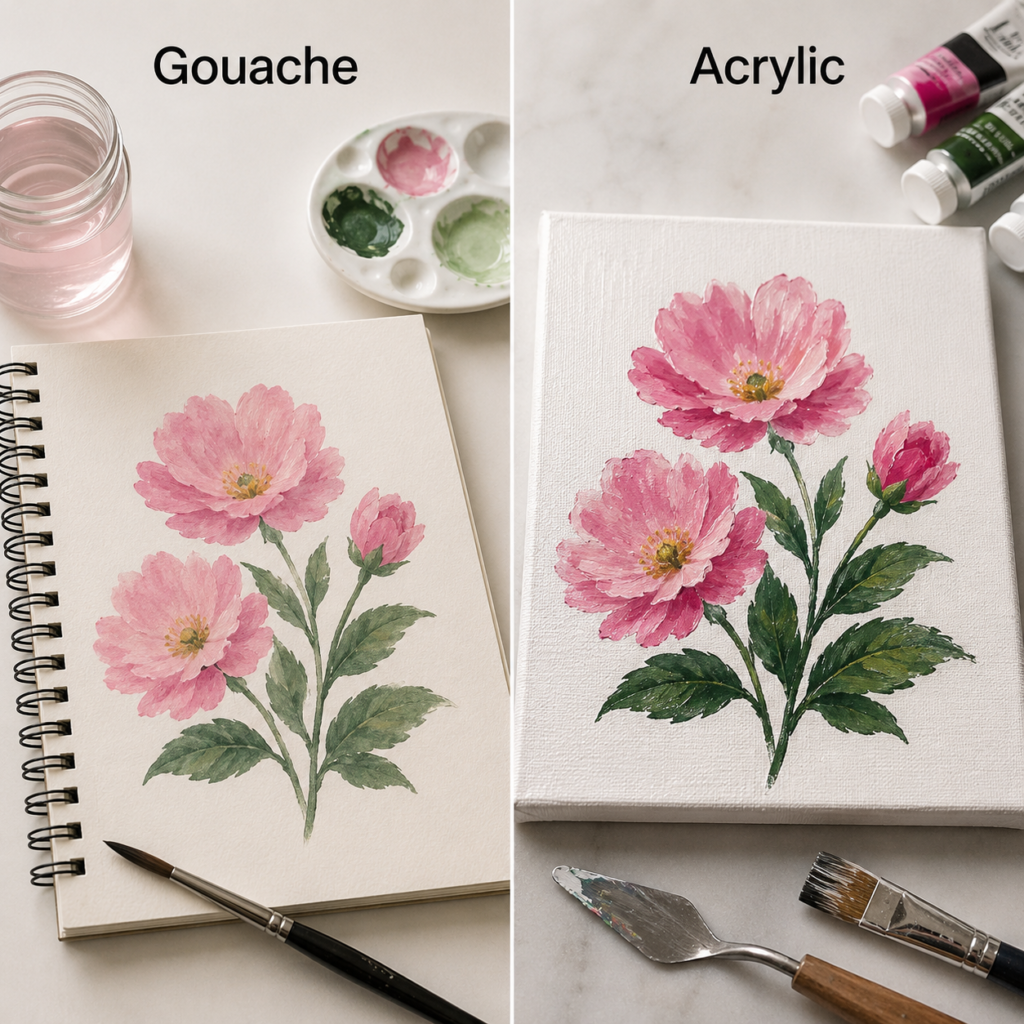
Flowers can make gouache and acrylic look almost interchangeable from a distance. Both can create pink petals, green stems, and small highlights. The difference becomes clearer up close. Gouache tends to give petals a soft, illustrated quality, while acrylic holds sharper light marks and more obvious overlaps between individual brushstrokes.
Why Gouache Works Well for Petal Studies
Gouache can produce delicate petal colour without becoming transparent in the same way as ordinary watercolour. A pale pink mixture may cover the paper softly, then a slightly darker mixture can define the base or inner fold of the petal. Because the dried colour can reactivate, neighbouring marks can be joined or softened later.
That reactivation is helpful until it is not. Adding a very wet highlight over a dry petal may lift the pink underneath and create a chalky patch. The better approach is to use less water in the later layer and place the stroke with confidence. Then leave it alone. Patience may not be the most glamorous tool on the table, but it saves many flower paintings.
Why Acrylic Produces Stronger Highlights
Acrylic allows a darker flower shape to dry before lighter pink and white strokes are added on top. Those upper marks remain visible because the lower colour is no longer easily reactivated. This makes acrylic useful for petals that need sharper ridges, bright edges, and stronger contrast around the flower centre.
The heavier body of some acrylic paint also helps individual marks keep their shape. Even a modest amount of texture catches light differently from a completely flat painted surface. For me, that physical texture is one of the reasons an acrylic flower on canvas feels more object-like, while a gouache flower often feels closer to a printed illustration.
Choose According to the Finished Look
· Gouache suits soft floral prints, stationery artwork, small framed studies, and designs that may later be scanned.
· Acrylic suits canvas flowers, painted boxes, decorative panels, and surfaces where layered highlights need to remain distinct.
· Gouache is usually easier to flatten into clean colour shapes; acrylic is easier to build into raised or broken texture.
· Both paints benefit from working from larger petal shapes toward smaller accents instead of outlining every edge first.
Colour Swatches: How Opacity, Mixing, and Drying Differ
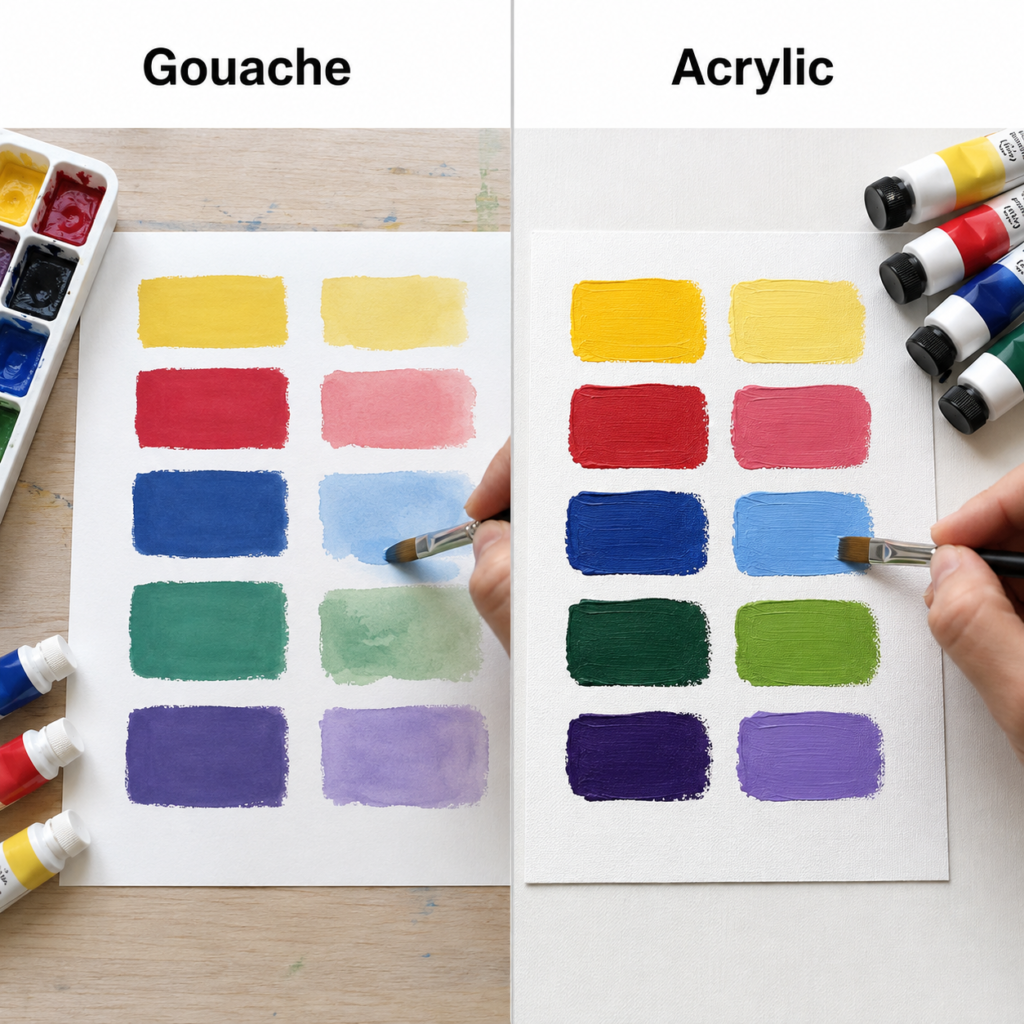
A page of colour swatches may look basic, but it tells you more about a paint than an ambitious picture often does. Swatches reveal how the colour covers, how much water it accepts, whether brush marks remain visible, and how the dry colour compares with the wet mixture. Testing first also prevents waste when you are painting on a reused surface that cannot easily be replaced.
Gouache Swatches and Water Control
Traditional gouache changes character depending on how much water is added. Too little water can make a stroke drag and leave dry gaps. Too much can weaken the opacity and create uneven pools. The most useful consistency is often smooth enough to spread but dense enough to cover the paper in one or two controlled passes.
A gouache swatch can also be tested after drying. Run a slightly damp brush across one corner and watch whether the colour moves. This shows how easily later work may disturb it. I’d rather discover that on a test card than across the centre of a finished illustration.
Acrylic Swatches and Drying Shift
Acrylic colour also deserves a dry test because the wet mixture may not look exactly the same after the water evaporates and the paint film forms. The change can be subtle or noticeable depending on the colour, surface, and thickness. Mixing a small swatch first helps when several related tones need to sit together.
Texture is easier to test here too. A thin acrylic swatch shows how the paint behaves almost like a wash, while a heavier swatch reveals brush ridges and coverage. Once dry, the surface generally resists a damp brush, which makes later layering more predictable than it is with traditional gouache.
What a Useful Test Sheet Should Include
· A full-strength swatch to test maximum opacity.
· A diluted swatch to see how the paint behaves with additional water.
· A light colour painted over a dark dry swatch to test coverage.
· A dark colour painted over a pale dry swatch to test edge control.
· A note about the surface used, because the same paint may behave differently on smooth paper, rough paper, card, or canvas.
Do not rinse thick paint sludge directly into a drain if it can be avoided. Wipe excess paint from the palette and brushes first, allow residue to dry on disposable material, and follow local disposal guidance for art materials. A more careful cleanup protects the workspace and also stops useful paint from being washed away unnecessarily.
Small Craft Surfaces: Paper Tags Versus Painted Plant Pots
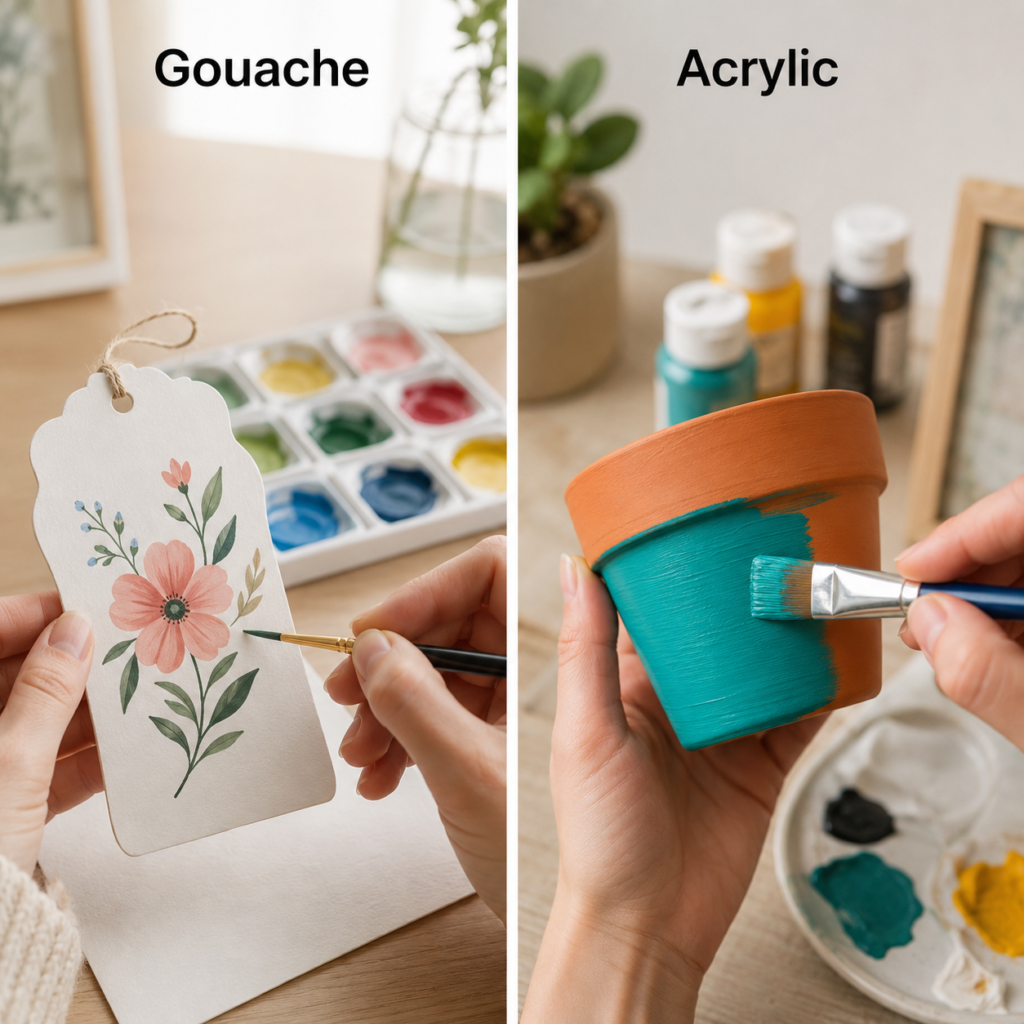
The comparison becomes especially practical when paint moves away from a sketchbook. A small paper tag and a terracotta pot may both need colour, but they ask for very different performance. The tag benefits from fine control and a soft matte finish. The pot needs paint that can grip a prepared surface and tolerate more handling.
Gouache for Paper-Based Crafts
Gouache is well suited to paper tags, gift cards, small labels, and decorative inserts that will remain dry and protected. The paint allows small floral details and clean colour blocks without requiring a thick layer. Because the surface remains matte, handwritten details and printed textures can sit comfortably beside the painted design.
However, gouache is not naturally the best choice for an object that may be rubbed, splashed, or handled repeatedly. Moist fingers can disturb the surface, and unprotected colour may transfer. A finished paper piece can be placed behind glass, stored carefully, or protected with an appropriate method, but any coating should be tested first because it may alter the colour and finish.
Acrylic for Hard Craft Objects
Acrylic is the more practical choice for a clean, properly prepared terracotta pot used as a decorative indoor cover pot. It can cover the porous surface with strong colour and accept additional painted patterns once the first layer is dry. The dried film is more resistant to ordinary handling than traditional gouache.
Surface preparation still matters. Dust, loose material, or moisture can interfere with adhesion. Paint should also stay away from areas that directly contact food, and a decorative pot should be considered separately from the inner container that holds wet soil. I don’t think a bright finish is worth ignoring how the object will actually be used.
Practical Choice for Reused Objects
· Choose gouache for flat paper crafts that remain indoors and are handled lightly.
· Choose acrylic for primed or suitable hard surfaces that need stronger coverage and more handling resistance.
· Test paint on a hidden area of any reused object before coating the full surface.
· Keep decoration away from drinking rims, food-contact areas, and surfaces exposed to constant water unless the complete material system is suitable for that use.
· Use leftover paint for small coordinated details rather than opening fresh colours for every object.
Landscape Painting: Portable Paper Work or Layered Canvas Art
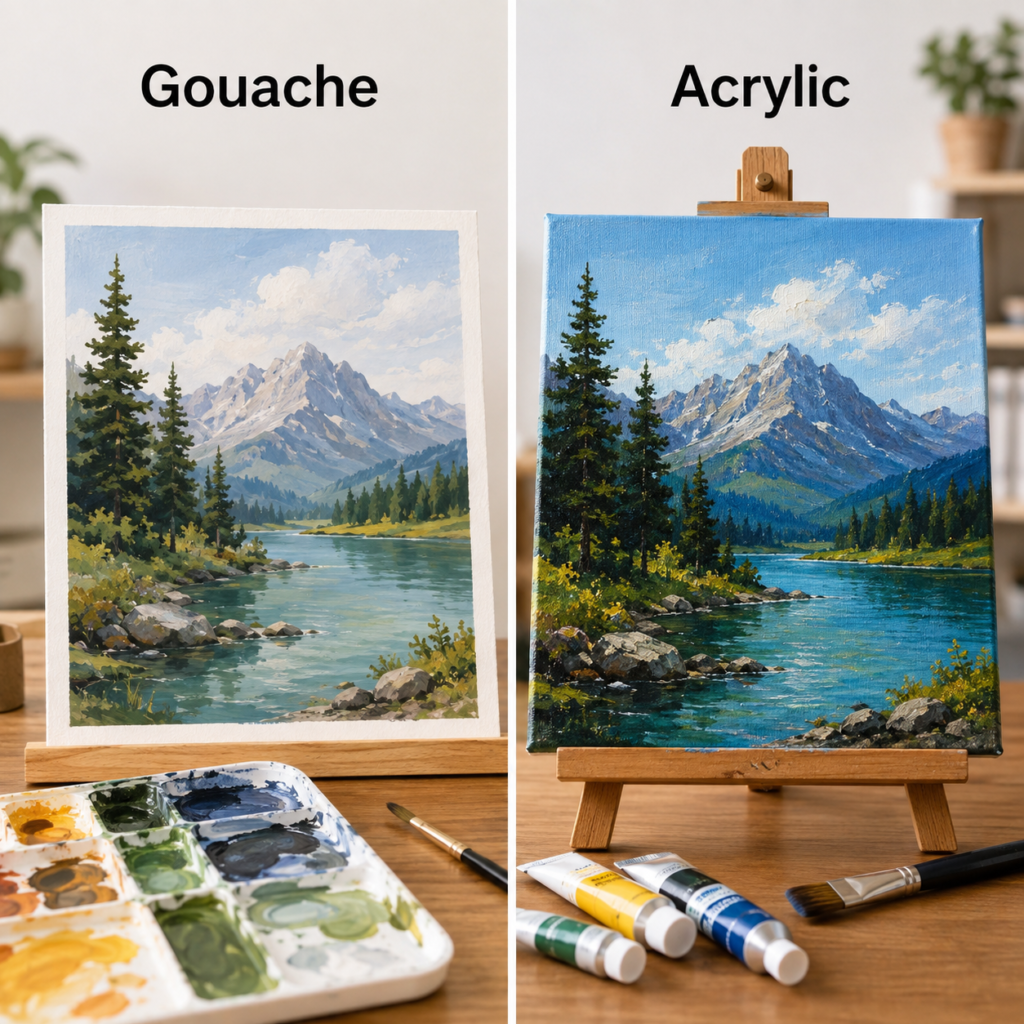
A mountain landscape brings nearly every paint difference into one picture: broad sky, distant shapes, dark trees, reflective water, stones, and small highlights. Gouache can organise these elements into clear, matte layers on paper. Acrylic can build them into a more textured surface on canvas, where earlier layers remain stable as later details are added.
Gouache for Compact Landscape Studies
Gouache is useful when the landscape is treated as a study of shape and value. The sky can be laid in broadly, distant mountains simplified into cooler tones, and foreground trees added with darker, denser paint. The matte finish helps the colour read evenly without the changing shine that may appear across thicker acrylic passages.
Because the paint can reactivate, large corrections are possible, but repeated wet brushing may also disturb the sky or mountain underneath. The most reliable approach is to let sections settle, use a drier mixture for later layers, and avoid polishing the same area until the paper begins to suffer.
Acrylic for Depth and Surface Texture
Acrylic allows the landscape to grow in separate stages. A sky can dry, then clouds can be placed above it. Dark trees can be added over distant mountains, and bright accents can sit on rocks or water without dissolving every lower layer. This is especially useful on canvas, where the weave and brush texture become part of the image.
Acrylic also makes it easier to return to the painting after a break without reactivating the entire previous session. You can mix a new colour and continue building. The challenge is matching earlier mixtures and avoiding overly thick paint in areas that should feel distant or soft.
Which Paint Fits Your Landscape Habit?
· Choose gouache for travel studies, sketchbook landscapes, compact paper paintings, and work intended for scanning or framing behind glass.
· Choose acrylic for larger canvas work, textured foregrounds, repeated layering, and paintings that will be handled without glazing.
· Use softer edges and thinner colour for distant forms regardless of the medium.
· Reserve the strongest contrast and most visible texture for the foreground so the scene keeps a sense of depth.
· Limit the palette at first. A few well-mixed colours often create a more connected landscape than many unrelated tube colours.
Gouache or Acrylic: A Quick Practical Comparison
Finish: Gouache usually dries matte and visually flat, while acrylic may range from matte to a slight sheen depending on the paint and medium.
Reactivation: Traditional gouache can often be reactivated with water. Dried acrylic generally becomes water-resistant and stays in place under later wet layers.
Best-known surfaces: Gouache is commonly used on suitable paper and illustration board. Acrylic is widely used on canvas and many prepared craft surfaces.
Layering: Gouache layers need careful water control because lower colour may lift. Acrylic layers are easier to keep separate once dry.
Texture: Gouache is often valued for smooth, opaque colour. Acrylic can be used smoothly but also supports stronger visible texture.
Corrections: Gouache may be softened and adjusted with water. Acrylic corrections usually involve painting over the dry area.
Handling: Unprotected gouache work is better kept dry and handled carefully. Acrylic is generally more suitable where the painted surface receives ordinary handling.
Paint-Choice Errors That Can Spoil the Finish
Using too much water in gouache is a common problem. The colour becomes weak, edges dry unevenly, and the paper may buckle. A small amount of water is useful, but the paint should still have enough body to cover when opacity is the goal.
Treating dried gouache like dried acrylic causes another surprise. A wet highlight or correction can lift the lower layer and mix it into the new colour. Work with a lighter touch, reduce the water in later layers, and test the brush on a spare swatch first.
Letting acrylic dry in the brush can permanently damage the bristles and build paint near the metal ferrule. Rinse brushes during pauses, wipe away excess colour, and clean them promptly when the painting session ends.
Choosing paint only by the desired colour ignores the surface. Gouache on a frequently handled object may rub or reactivate. Acrylic on unsuitable flexible or dirty material may peel or crack. The final use should guide the medium.
Skipping colour tests can create mismatched passages, especially when acrylic dries slightly differently from the wet mixture or gouache changes as the water settles. A small test sheet takes very little time and prevents much larger corrections.
Sealing without testing can alter a matte surface, deepen colours unevenly, or disturb water-sensitive paint. Always test any protective coating on a separate sample made with the same paint and surface.
Frequently Asked Questions
Is gouache easier than acrylic for beginners?
Neither paint is automatically easier. Gouache offers flexible corrections but requires careful water control because dried layers may reactivate. Acrylic keeps dried layers stable, although it can dry quickly on the palette and brush.
Can gouache be used on canvas?
Gouache may sit on some prepared canvas surfaces, but traditional gouache is usually better suited to paper or illustration board and remains sensitive to water and rubbing. For a matte canvas look with acrylic-like permanence, artists sometimes consider acrylic gouache, which behaves differently from traditional gouache.
Can acrylic paint be used like gouache?
Acrylic can be applied in flat, opaque areas and can produce a matte look when the product or medium supports it. It will still dry into an acrylic film and will not reactivate in the same way as traditional gouache.
Which paint is better for sketchbooks?
Gouache is a natural choice for sketchbooks made with paper that can handle water and opaque paint. Acrylic can also be used, but heavy layers may stiffen pages, create texture, or cause pages to stick if the surface is not fully dry.
Which paint is better for upcycled plant pots and boxes?
Acrylic is usually the more practical option for suitable, cleaned, and prepared hard craft surfaces because the dried paint handles ordinary touching better. The surface material and intended use still need to be checked before painting.
Why does my gouache look streaky?
The mixture may be too dry, too diluted, or repeatedly brushed after it begins to settle. Try a smoother paint consistency, load the brush evenly, and cover the area with fewer confident passes.
Why does my acrylic colour look different after drying?
Acrylic colour can shift slightly as the wet paint film dries. Testing mixtures on a scrap surface and allowing them to dry before using them across a large area helps keep the palette more predictable.
Choose the Paint That Fits the Surface and the Job
The useful lesson in the gouache paint vs. acrylic paint comparison is that each medium solves a different kind of problem. Gouache gives paper artwork a matte, controlled, illustration-like finish and leaves room for water-based adjustment. Acrylic creates stronger dried layers, clearer texture, and better resistance to ordinary handling on many prepared surfaces.
For a small botanical card or portable landscape, gouache may feel natural. For a reused canvas, painted container, or layered decorative panel, acrylic may be the more dependable choice. You do not need to commit to one paint for every project. A mindful craft cupboard can hold both, with each tube used where its particular behaviour is genuinely helpful.
Before beginning the next piece, look at the surface, think about how the finished object will be used, and make one small test swatch. Which would you choose first: the soft matte control of gouache or the layered durability of acrylic?