
Paint can look almost identical while it is wet and behave very differently once it reaches the project. A broad wall-style paint may roll smoothly across a cabinet door and cover a large surface without much fuss, while a small tube of artist acrylic can give you sharper control, stronger texture, and better freedom for decorative details. The confusing part is that the words latex and acrylic are not always complete opposites.
I think that distinction is worth making before choosing a brush. In everyday DIY language, latex paint usually means water-based house paint sold for walls, trim, and furniture-sized surfaces. Many of those products already contain acrylic or vinyl-acrylic binders.
In this article, acrylic paint means the more concentrated artist or craft paint commonly sold in tubes or small bottles. That practical comparison is far more useful than pretending every product in one category has exactly the same formula.
The right choice depends on scale, surface, finish, and purpose. A bedside table needs even coverage across broad panels. A small plant pot may need careful decoration. An outdoor chair needs a product made for weather exposure.
A painted art board may benefit from visible brush texture. Once the project is considered first, latex paint vs acrylic paint becomes much easier to understand.
Clarify What “Latex” and “Acrylic” Mean for DIY Projects
The label latex paint can be misleading because modern latex house paint does not depend on natural rubber latex. It is a water-based coating, and the binder may be acrylic, vinyl-acrylic, or another waterborne resin system. This means a tin marked acrylic latex is still part of the broad latex house-paint family.
Artist and craft acrylic paints also use acrylic polymer binders, but they are formulated for a different job. They usually come in smaller containers, carry more concentrated pigment for detailed work, and offer bodies ranging from fluid to thick. They are designed to be mixed, layered, glazed, or applied with visible marks rather than rolled efficiently over an entire room or large piece of furniture.
For a useful comparison, think of latex paint as a large-surface architectural coating and acrylic paint as a decorative art material. Product labels still matter because an exterior acrylic house paint and an indoor craft acrylic are not interchangeable simply because both contain acrylic resin.
Match the Paint to the Scale and Surface of the Project
Large flat surfaces usually favour paint that flows, levels, and covers efficiently with a roller or broad brush. That is where latex house paint tends to make sense. It is easier to buy in enough volume for cabinets, tables, storage furniture, wall panels, and other sizeable objects without treating every brushful like a precious art supply.
Small decorative areas often favour acrylic paint. A fine brush can carry a concentrated colour into leaves, petals, lines, borders, and stencil details. Acrylic is also easier to mix in small quantities when the project needs several shades rather than one large background colour.
The surface itself matters just as much as the scale. Bare wood, previously painted furniture, metal, terracotta, and outdoor pieces all need different preparation and may need a primer or a product specifically rated for that material. The words latex and acrylic alone do not guarantee adhesion.
Decide Whether Coverage, Detail, or Durability Matters Most
Latex paint usually earns its place through practical coverage. It suits broad coats, calm colour fields, and furniture-sized makeovers where an even finish matters more than raised brush texture. Depending on the chosen sheen, it can look flat, eggshell-like, satin, or glossy.
Acrylic paint usually earns its place through control. It is easy to mix on a palette, apply in small sections, and build with deliberate brushwork. The finish can range from matte to glossy when different acrylic products or mediums are used, so it should not be assumed that acrylic is always shinier than latex.
Durability depends on the complete system: the right product, sound preparation, suitable primer when needed, correct application, and enough curing before heavy use. I don’t think it is sensible to call one category universally tougher.
A quality exterior acrylic-latex house paint can be more suitable for an outdoor chair than an indoor artist acrylic, while a specialist acrylic craft coating may outperform ordinary wall paint on a small decorative object.
Compare the Paint in the Can Before Comparing the Finished Project
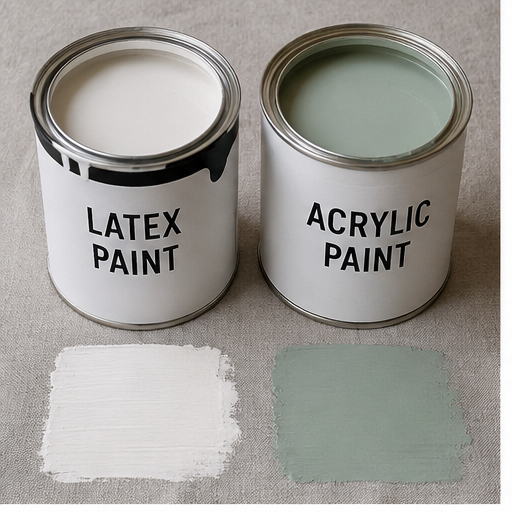
Two open paint cans beside simple square swatches make a useful starting point because they remove the distraction of a finished object. The latex side represents the broad, ready-to-apply consistency associated with house paint. The acrylic side represents a smaller-scale decorative paint with a different balance of pigment, binder, and body.
Container Size Hints at the Intended Job
Latex paint is commonly packaged for coverage. Even a modest furniture makeover can consume much more paint than a small art panel, so house paint is sold in containers suited to larger areas. The wide opening also makes it practical to load a brush or pour paint into a roller tray.
Acrylic paint is usually bought in smaller amounts because a little can cover a surprising amount of decorative work. Tubes and bottles make it easier to control individual colours and mix only what is needed. That is helpful for motifs, signs, colour blocking, and craft projects, but less efficient when the task is to coat every side of a large cabinet.
Consistency Affects How the Brush or Roller Behaves
House latex paint is formulated to spread over broad areas and leave a reasonably uniform film. It should move easily enough to roll or brush without requiring the painter to build every square centimetre like a canvas. The exact body varies by product and sheen, but the overall aim is usually coverage and levelling.
Artist acrylic may be fluid, soft-bodied, or heavy-bodied. A thicker acrylic can hold brush marks and create texture, while a fluid acrylic can move through fine details. That variety is useful for art, but it also means that a single statement about acrylic consistency is rarely accurate. The label and product type need to be checked.
Colour Strength Is Not the Same as Hiding Power
Acrylic craft or artist paint may look intensely coloured because it is intended for mixing and visual detail. Latex paint may appear calmer while still offering strong hiding across a large surface. Colour strength describes how forcefully a pigment affects a mixture, while hiding describes how well the applied coat conceals what is underneath.
That difference matters when painting over a dark object. A vivid acrylic colour may still be transparent, and a pale latex colour may still need a primer or additional coat. The swatch should be judged after it dries rather than while it is glossy and wet.
Which Container Belongs on Your Worktable
· Choose latex paint when the project needs a substantial amount of one background colour.
· Choose artist or craft acrylic when the project needs several colours, fine mixing, or controlled decorative details.
· Read the product label for surface suitability rather than relying on container size alone.
· Test the dried colour because wet paint can look darker or glossier than the final finish.
For me, the container is an early clue rather than a final answer. A large can suggests broad coverage, while a small tube suggests controlled colour, but the actual product instructions should always settle the decision.
Roll Latex Paint Across Wood and Reserve Acrylic for Controlled Colour Work
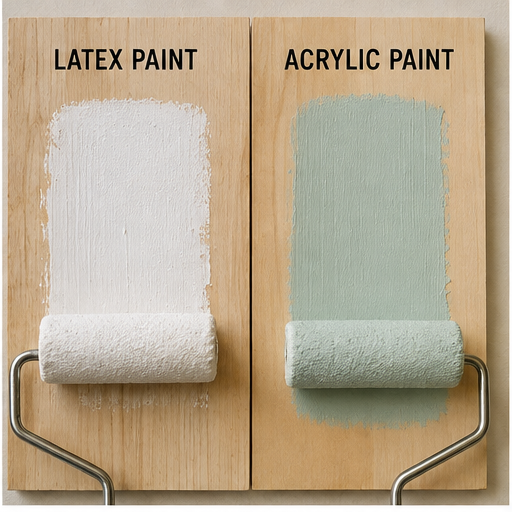
A pair of wood boards with paint rollers highlights the difference between surface coating and decorative painting. Latex paint naturally suits the broad roller application on the left because it is designed to move across furniture, panels, trim, and architectural surfaces.
Acrylic paint can also cover wood, but its strengths are usually more noticeable when the project uses brushes, small rollers, or deliberate art techniques.
Why a Roller Feels Natural with Latex Paint
A roller distributes paint quickly and helps create a consistent layer across a flat board. Latex house paint is formulated with this kind of application in mind. It gives the painter enough open working time to overlap sections and smooth the surface without treating every pass as a separate painted mark.
This makes it useful for tabletops, cabinet sides, shelves, drawer fronts, and other broad pieces. A small foam roller can also reduce obvious brush marks on furniture, although the correct roller texture should be chosen for the desired finish.
Acrylic Paint Can Cover Wood but Changes the Working Style
Acrylic paint adheres well to many properly prepared art and craft boards, but it may encourage a more painterly approach. The painter can mix several colours, build opaque and transparent areas, and deliberately keep or soften texture. That is ideal for signs, plaques, decorative panels, and illustrated furniture details.
Using artist acrylic across a large plain furniture surface is possible, but it may cost more and require more attention to consistency. I’d rather use a suitable house or furniture coating for the broad base, then use acrylic for the decorative layer when the product systems are compatible.
Preparation Matters More Than the Tool
Wood should be clean, dry, and structurally sound before either paint is applied. Glossy old coatings may need deglossing or a suitable bonding primer. Bare wood may need preparation that limits uneven absorption or tannin bleed. Skipping this stage can leave a beautiful colour sitting on a weak foundation.
The end grain and damaged edges deserve extra attention because they can absorb paint differently. Once the base is prepared, then the roller or brush has a fair chance to produce an even result.
The Practical Split Between Base Coat and Decoration
· Use latex paint for the main colour on broad wood furniture surfaces when the product is rated for that use.
· Use acrylic paint for floral motifs, borders, lettering, illustrations, and small colour-block details.
· Check compatibility before placing acrylic decoration over a latex base or adding a protective topcoat.
· Avoid thinning paint beyond the manufacturer’s direction because a weak film may cover poorly or wear unevenly.
The part I like here is the possibility of using both. A calm latex background and an acrylic decorative layer can make a practical object feel considered without turning the entire makeover into a miniature fine-art exercise.
Read One-Coat, Two-Coat, and Three-Coat Swatches Carefully
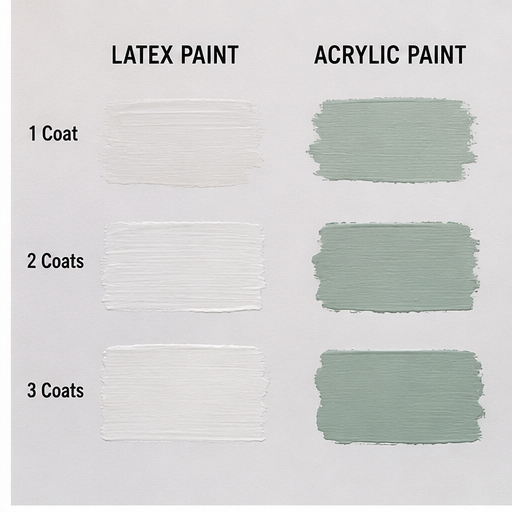
Layered swatches are useful because they reveal how coverage develops instead of presenting only the best-looking final patch. One coat may show the base beneath it. A second may even the colour. A third may deepen the finish without necessarily improving it enough to justify more paint. The result depends on pigment, colour, product quality, applicator, and the surface underneath.
One Coat Reveals Transparency and Surface Absorption
The first coat is not only about colour. It shows whether the surface pulls paint in unevenly, whether the applicator leaves ridges, and whether the existing colour remains visible. A primer can sometimes make a bigger difference than asking the topcoat to do all the hiding by itself.
Latex house paint is often evaluated for broad hiding and uniformity. Artist acrylic may be intentionally transparent or semi-transparent because painters use that quality for glazing and depth. That is why a thin acrylic swatch should not automatically be judged as poor paint.
Two Coats Often Show the Intended Finish More Honestly
A second coat usually brings the colour closer to the intended appearance and reduces small differences between passes. It also reveals the final sheen more clearly. On furniture and architectural projects, even coverage matters because light travelling across a broad panel will expose patches and lap marks quickly.
For decorative acrylic work, the second layer may serve a different purpose. It can sharpen edges, correct a shape, deepen selected shadows, or cover only the areas that need more opacity. The whole painting does not always need the same number of layers.
A Third Coat Is Not Automatically Better
Adding paint simply because more seems safer can create unnecessary buildup. Thick layers may hide fine details, soften moulding edges, or produce a surface that takes longer to settle. The better approach is to stop when the finish is even and the product has achieved the required coverage.
I know it is satisfying to see a swatch become perfectly solid, but the test should answer a practical question. If the second coat already looks uniform, a third may not add meaningful value.
How to Use a Coat Test Before the Main Project
· Make the test on the same material and over the same base colour as the real project.
· Use the same brush or roller planned for the final work.
· Let each layer dry according to the product instructions before judging coverage.
· Examine the swatches from straight on and from a low angle where uneven sheen becomes easier to see.
A coat test is one of the least glamorous parts of painting, but it prevents the far less glamorous experience of discovering patchy coverage across a finished cabinet door.
Choose Latex for a Full Cabinet Door and Acrylic for Decorative Cabinet Art
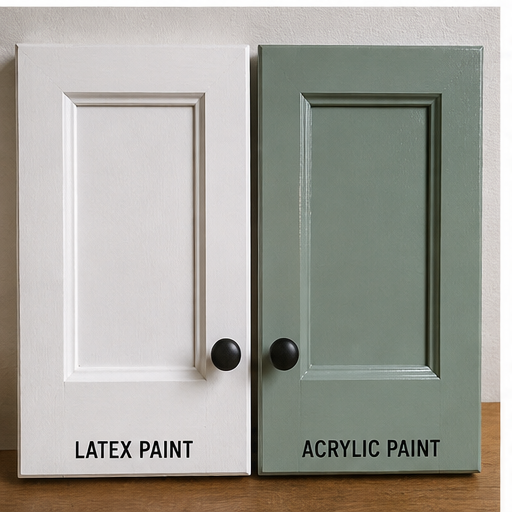
Painted cabinet doors show why the size and role of the surface matter. A full door needs a consistent finish across rails, stiles, recessed panels, and edges. Latex or acrylic-latex trim paint is often the practical route for that broad coating job. Artist acrylic becomes more useful when the door is treated as a decorative panel with motifs, borders, or illustrated accents.
Broad Cabinet Surfaces Expose Every Inconsistency
Cabinet doors sit at eye level and catch light across several planes. Uneven sheen, heavy brush marks, drips near the profile, and missed inner corners are easy to notice. A coating designed for trim or cabinetry gives the painter a better chance of producing a unified result than a small-bottle craft paint chosen only because the colour looked right.
The existing cabinet finish also matters. Grease, polish, and glossy factory coatings can interfere with adhesion, so cleaning and surface preparation should be treated as part of the paint system rather than an optional extra.
Latex Paint Is Efficient for the Background Colour
A suitable latex or acrylic-latex product can cover the entire door with a controlled, repeatable finish. It is practical when several doors need to match, because the same paint can be brushed or rolled consistently across a larger set.
Sheen choice affects both appearance and maintenance. A flatter finish disguises minor surface flaws but may show handling differently, while a higher sheen can be easier to wipe but more revealing of preparation defects. The product instructions and cabinet use should guide that decision.
Acrylic Paint Is Better Suited to the Smaller Visual Story
Acrylic paint becomes valuable when the door needs a botanical border, geometric motif, hand-painted number, or a more elaborate focal panel. Small brushes and a palette allow better control over line quality and colour transitions than working directly from a large can of house paint.
The decorative layer should be tested over the base coat first. A smooth, fully cured background can behave differently from raw craft board, and a protective finish may alter the colour or sheen. Compatibility matters more than assuming all water-based products will cooperate perfectly.
The Better Cabinet Strategy May Use Both
· Use a suitable latex or acrylic-latex coating for the broad cabinet colour.
· Use acrylic artist or craft paint for controlled decorative motifs after the base is ready.
· Remove or protect hardware rather than painting around knobs carelessly.
· Test any clear protective finish over both paint layers before applying it to the entire door.
For me, the smartest cabinet comparison is not always either-or. The large-surface paint handles the practical coat, and the small-format acrylic handles the personality.
Decorate Plant Pots Without Confusing Indoor Craft Paint with Exterior Coating
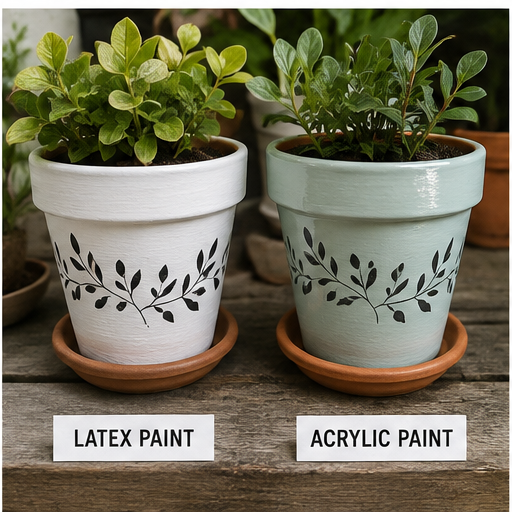
Painted plant pots are small enough for acrylic detail yet exposed enough to punish the wrong product. Moisture, porous terracotta, soil, sunlight, and repeated handling all affect the finish.
A latex house paint may work as a broad base on a properly prepared pot, while acrylic paint may make decorative leaves and patterns easier. Neither category is automatically suitable outdoors unless the specific product says so.
Terracotta Changes How Paint Dries and Bonds
Unglazed terracotta is porous. It absorbs moisture and can draw water through the pot wall, which may affect a decorative coating on the outside. The pot should be clean and fully dry before painting, and the chosen system should suit porous masonry or terracotta if long-term performance matters.
Painting the interior or sealing every surface can change how the pot manages moisture, so the intended use should be considered. A decorative cachepot that holds a separate nursery pot has different demands from a pot filled directly with soil.
Latex Paint Makes Sense for a Calm Base Colour
A small amount of leftover suitable house paint can create a broad, even colour around a pot. This can be a thoughtful reuse of material from another project, provided the paint is still in good condition and appropriate for the location.
The broad base also gives decorative details a cleaner background. Pale neutrals and soft greens can turn mismatched pots into a more coordinated group without requiring each pot to become a complicated artwork.
Acrylic Paint Gives Better Control for Motifs
Leaves, dots, borders, and geometric lines are easier to place with artist or craft acrylic because small brushes can carry concentrated colour precisely. Acrylic also makes it simple to mix several related shades from a limited palette, which helps a group of pots look connected without being identical.
The finish may still need protection if the product is not designed for water exposure or outdoor use. A decorative sealer is not a magic solution for an unsuitable base product, so every layer should be checked for its intended environment.
Use the Pot’s Location to Make the Final Decision
· For an indoor cachepot, a suitable latex base with acrylic decoration may work well after testing.
· For an outdoor pot, use coatings and sealers specifically rated for exterior exposure and the pot material.
· Avoid painting surfaces that directly contact food or drinking water unless the product is explicitly approved for that use.
· Keep drainage holes clear and let the pot dry completely before returning it to use.
The mistake I would avoid is treating every painted pot as a harmless shelf ornament. Once water and weather enter the picture, product suitability becomes much more important than the prettiest colour combination.
Paint Small Chairs for Real Use Rather Than for the Photograph Alone
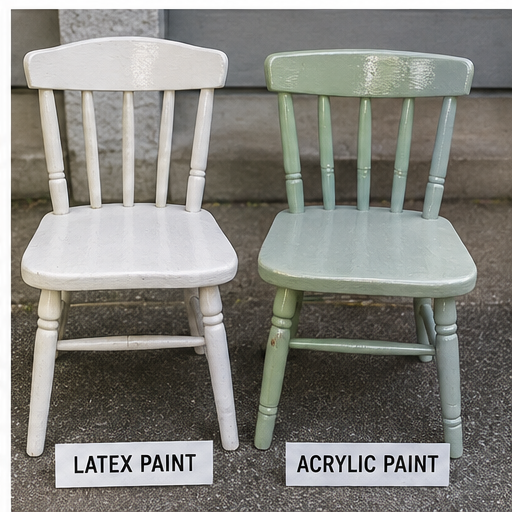
A pair of painted chairs turns the comparison toward real wear. Seats, front rails, and backrests are touched constantly. Legs may be knocked by shoes or cleaning tools. If the chairs live outdoors, sunlight and moisture add another layer of demand. This is not the place to choose paint only because it was easy to open.
Furniture Use Changes the Meaning of Durability
A chair finish must resist handling and mild abrasion while remaining well bonded to a surface that may flex slightly at joints. The strongest result begins with a sound chair. Loose joints, flaking old coatings, and damaged wood should be repaired before painting rather than hidden under colour.
A house-paint product suitable for trim, furniture, or exterior use may offer the broad coverage needed for a full chair. A general wall paint is not automatically the best choice simply because it belongs to the latex family.
Acrylic House Paint and Artist Acrylic Are Not the Same Product
This chair comparison is where terminology matters most. A high-quality exterior 100% acrylic latex paint is still commonly called latex paint, even though acrylic is central to its binder. That product is very different from a small tube of artist acrylic used for canvas.
An artist acrylic can add a flower, stripe, or small motif to a chair, but it should not be assumed to replace a furniture coating across the entire piece. The intended use, substrate, and exposure rating remain more important than the shared word acrylic.
Indoor and Outdoor Chairs Need Different Decisions
An indoor accent chair may prioritise a smooth finish, easy wiping, and colour harmony with the room. An outdoor chair needs a complete exterior-rated system that can cope with weather and seasonal movement. The primer, paint, and any protective finish should be chosen as a compatible set.
Even an exterior coating cannot rescue a chair left with trapped moisture or failing joints. Paint protects a prepared surface; it does not replace basic maintenance.
A Sensible Painting Plan for Chairs
· Use a furniture- or trim-suitable latex/acrylic-latex coating for the main chair colour.
· Use artist acrylic only for tested decorative accents, not as an automatic substitute for the full coating system.
· Choose an exterior-rated system for chairs that will remain outdoors.
· Allow the finish to cure adequately before sitting on, stacking, or heavily cleaning the chair.
To be honest, chairs are where I would be least willing to gamble. A finish can look flawless and still fail quickly if it was never meant for repeated contact.
A Practical Latex Paint vs Acrylic Paint Comparison
The simplest comparison is not that latex is weak and acrylic is strong, or that one is matte and the other glossy. Those statements ignore the enormous variety within both categories. The more useful distinction is the product’s intended application.
· Latex house paint: generally intended for walls, trim, broad furniture surfaces, and other large-area coating work.
· Acrylic-latex house paint: still a latex/water-based house paint, but formulated with acrylic binder technology.
· Artist acrylic paint: intended for art, craft, detail, layering, mixing, and controlled decorative work.
· Exterior acrylic coating: a specialised product that may be appropriate for outdoor surfaces when the label confirms it.
If the project involves one large background colour, begin by looking at a suitable house, trim, or furniture coating. If it involves several small colours and hand-painted details, begin by looking at artist or craft acrylics. If it involves both, a compatible combination may be the most practical answer.
Paint-Choice Mistakes That Make a Good Project Harder
The first mistake is treating latex and acrylic as two completely separate chemical worlds. Many latex house paints are acrylic or vinyl-acrylic products. Failing to read beyond the front label can lead to an oversimplified comparison and the wrong assumptions about performance.
Another mistake is using artist acrylic across a large furniture piece simply because it seems more durable. Artist acrylic is versatile, but a paint created for canvas does not automatically level, cover, or withstand furniture use like a suitable trim or furniture coating.
The opposite mistake is using leftover wall paint for tiny decorative detail. The colour may work, but the consistency and pigment behaviour may make fine lines harder to control. A small amount of artist acrylic often makes the detailed part easier and cleaner.
Skipping surface preparation causes problems in both categories. Dust, grease, polish, loose old paint, and glossy finishes can interrupt adhesion. No attractive colour can compensate for a coating that never bonded properly.
Judging a finish while it is still wet is another easy error. Wet paint often looks darker and glossier. The dried and cured film is the result that matters, so test patches deserve enough time to reveal the real colour and sheen.
Finally, people sometimes assume that a clear sealer will make any paint suitable for any surface. A protective topcoat can help in the right system, but it cannot always correct poor adhesion, an unsuitable indoor product, or a weakly prepared base.
Frequently Asked Questions
Is latex paint actually different from acrylic paint?
Sometimes, but the terminology overlaps. Latex usually means water-based house paint, and many latex products use acrylic or vinyl-acrylic binders. Artist acrylic is a separate application category designed mainly for art and detailed craft work.
Does modern latex paint contain natural latex rubber?
Usually, the word latex refers to the water-based emulsion system rather than natural rubber latex. The exact binder should be checked on the manufacturer’s product information.
Which paint is better for furniture?
For the main furniture colour, a suitable trim, cabinet, or furniture coating is usually more practical than artist acrylic. Acrylic artist paint can be very useful for decorative motifs once compatibility with the base coat has been tested.
Which paint is better for an art canvas?
Artist acrylic is normally the more natural choice for canvas because it is formulated for colour mixing, brushwork, layering, and art surfaces. Ordinary wall latex paint is made for a different purpose.
Can I mix latex paint and artist acrylic paint together?
Some makers tint small amounts of water-based paint with acrylic colour, but compatibility and final performance can vary. For an important project, it is safer to use manufacturer-approved tinting systems or make a small test rather than mixing large quantities blindly.
Can acrylic paint be applied over latex paint?
It may work for decorative details after the latex base has dried and cured, but a test is important. The base should be clean, well bonded, and compatible with any final protective coating.
Is acrylic paint always glossier than latex paint?
No. Both categories are available in different finishes. Latex house paint may range from flat to gloss, and artist acrylic can be matte, satin, or glossy depending on the product and medium.
Which paint is better outdoors?
Use a product specifically rated for exterior use and for the intended surface. A high-quality exterior acrylic-latex house paint may be suitable for some outdoor projects, while an indoor craft acrylic should not be assumed weather-resistant.
Do both paints clean up with water?
Many latex house paints and acrylic artist paints clean up with water while wet. Once dry, they form films that are much harder to remove, so tools should be cleaned promptly according to the product directions.
Do I need a primer?
It depends on the surface, previous coating, colour change, and product system. Bare, stained, glossy, or difficult surfaces often benefit from the correct primer, while some repaint projects may not require one. The product instructions should guide the decision.
Choose the Product Category Before Choosing the Colour
The most useful lesson in latex paint vs acrylic paint is that the names overlap, but the jobs can still be very different. Latex paint usually points toward a water-based house coating made for broad coverage. Artist acrylic points toward concentrated colour, controlled detail, and creative layering. Many high-quality latex house paints are already acrylic-latex formulas, so the product description matters more than a simple either-or label.
For a cabinet door, chair, or large wood surface, begin with a coating made for that type of use. For flowers, stencil details, borders, and art panels, artist acrylic may give you much better control. For a project that needs both a practical base and a decorative finish, there is no shame in letting each paint do the part it handles best.
I’d start with one small test board and let the dried result answer the questions about colour, coverage, texture, and sheen. That quiet experiment is far more reliable than judging two open containers on the table. Which project are you deciding between latex paint and acrylic paint for?